
Thought Leadership on Social Media Regulation
Are We Losing Freedom of Speech?
Why Florida government focused on content moderation from a different angle and how others react to this perspective

Introduction
Florida is the first state attempting to regulate how social media organizations moderate online content.
Can we really regulate the Internet, or more precisely social media like Facebook, Twitter, and YouTube?
Many attempts to regulate the Internet failed in the past. Probably people of my age would remember this historical speech by John Perry Barlow in 1996.
It is called “A Declaration of the Independence of Cyberspace”.
“Governments of the Industrial World, you weary giants of flesh and steel, I come from Cyberspace, the new home of Mind. On behalf of the future, I ask you of the past to leave us alone. You are not welcome among us. You have no sovereignty where we gather.
We have no elected government, nor are we likely to have one, so I address you with no greater authority than that with which liberty itself always speaks. I declare the global social space we are building to be naturally independent of the tyrannies you seek to impose on us. You have no moral right to rule us nor do you possess any methods of enforcement we have true reason to fear.
Governments derive their just powers from the consent of the governed. You have neither solicited nor received ours. We did not invite you. You do not know us, nor do you know our world. Cyberspace does not lie within your borders. Do not think that you can build it, as though it were a public construction project. You cannot. It is an act of nature and it grows itself through our collective actions.”
Content Moderation
Content moderation has a substantial impact on the economy, business, politics, freedom of speech, quality of life, international collaboration, and society’s overall well-being.
While we all have differing views on social media moderation for various reasons, especially its implementation affecting the free speech of citizens, many experts believe moderation is essential for social media platforms.
Otherwise, the internet will be full of harmful materials and thus will be unusable. Finding the middle ground in this discussion is challenging and certainly is not a trivial task.
Content moderation on the Internet became a big issue since the emergence of gigantic networks like Facebook, Twitter, LinkedIn, YouTube, Quora, Reddit, and many more.
If moderation does not happen, possibly all we see is disturbing and harmful content for society. Content related to porn and drugs prevails on the web.
Many public content platforms invest millions of dollars to keep their sites safe and secure for the public.
Artificial Intelligence (AI) plays an important role in detecting, monitoring, alerting, and censoring content to some extent.
However, AI is still not sufficient to understand the subtleties of human language. Some complex posts certainly require human intervention.
This intervention comes with a high cost. Some companies have a dedicated department for content moderation. And some outsource them.
Some platforms are so large that it requires dedicated and specialized teams to handle content moderation.
For example, Facebook has over three billion users. Thinking conservatively, just one post per user can generate three billion records a day.
The cost of content moderation was $4.9 billion in 2020. It is expected to grow rapidly.
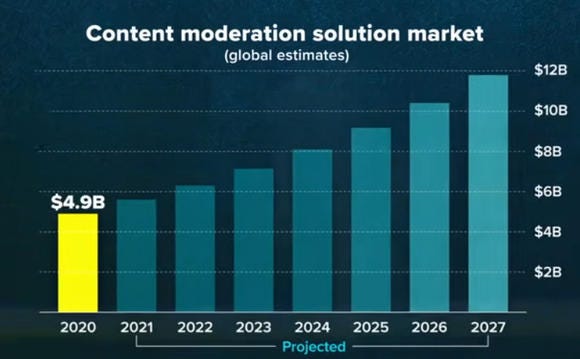
This report from Fact. MR provides insights on “Content Moderation Solutions Market, Forecast, Trend, Analysis & Competition Tracking — Global Market Insights 2020 to 2030.”
In this post, I aim to introduce a recent development in Florida that hit the press and social media.
It is a hot topic as it relates not only to citizens of Florida but to citizens from all other states in America.
Florida is the first state attempting to regulate how social media organizations moderate online content.
Background on Florida Senate Bill 7072
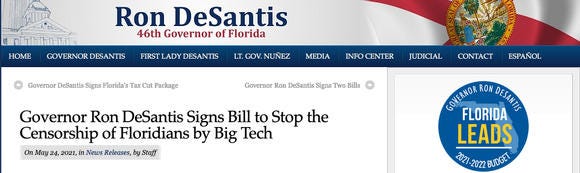
On May 24, 2021, Governor Ron DeSantis Signs Bill to Stop the Censorship of Floridians by Big Tech.
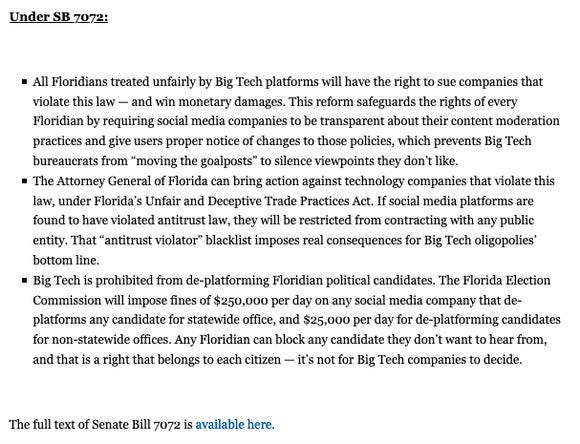
Let me share critical information shared by prominent leaders by quoting their words related to this law.
Why did Florida make this attempt?
Let’s take a look at the thoughts and sentiments of six state leaders in Florida.
1 — Governor Ron DeSantis, in this Florida Government webpage, is quoted to say:
“This session, we took action to ensure that ‘We the People’ — real Floridians across the Sunshine State — are guaranteed protection against the Silicon Valley elites. Many in our state have experienced censorship and other tyrannical behavior firsthand in Cuba and Venezuela. If Big Tech censors enforce rules inconsistently, to discriminate in favor of the dominant Silicon Valley ideology, they will now be held accountable.”
2 — In the same report Lieutenant Governor Jeanette Nuñez said:
“What we’ve been seeing across the U.S. is an effort to silence, intimidate, and wipe out dissenting voices by the leftist media and big corporations. Today, by signing SB 7072 into law, Florida is taking back the virtual public square as a place where information and ideas can flow freely. Many of our constituents know the dangers of being silenced or have been silenced themselves under communist rule. Thankfully in Florida we have a Governor that fights against big tech oligarchs that contrive, manipulate, and censor if you voice views that run contrary to their radical leftist narrative”
3 — Another notable quote in this report was by Senate President Wilton Simpson who said:
“I’m pleased to see Florida setting the example by doing everything in our power to stop the abuses that are possible when big tech goes unchecked. People have a right to express opposing views. This good bill protects candidates for elected office, media outlets and others from unfair and arbitrary discrimination on social media platforms. Thank you, Governor DeSantis and Speaker Sprowls, for your leadership on this important issue”.
4 — Speaker Chris Sprowls said:
“Social media platforms have morphed into the town square. If our democracy is going to survive, we must stand up to these technological oligarchs and hold them accountable. This legislation protects the free speech of Floridians and demands transparency. No more secret algorithms, inconsistent standards, shadow banning, and de-platforming. In Florida, sunshine is the best disinfectant — and it’s time we bring these big tech monopolies out of the dark. I applaud Governor Ron DeSantis, President Simpson, and the Senate for taking action while our federal government idly sits by and congratulate Commerce Chairman Blaise Ingoglia for carrying this in the House.”
5 — Senator Ray Rodrigues said:
“Big Tech has a responsibility to be fair and transparent to all of its users, regardless of our political ideology. Requiring Big Tech to define the behaviors that will lead to someone being de-platformed is a significant victory for free speech and I am grateful for our Governor’s leadership on this issue.”
6 — According to Representative Blaise Ingoglia:
“Day in and day out, our freedom of speech as conservatives is under attack by the “big tech” oligarchs in Silicon Valley. But in Florida, we said this egregious example of biased silencing will not be tolerated. It was an honor carrying this historic piece of legislation for Governor DeSantis to ensure our voices are heard as we safeguard free speech.”
What do these thoughts mean to the public?
These statements by Florida leaders make sense.
We certainly need freedom of speech as protected by the first amendment to the United States Constitution. It is a fundamental human right.
However, the coin has a flip side, too, showing concerns from various stakeholders.
The implications of this report were discussed in an article in the Washington Post on May 25, 2021, informing the Florida governor to sign a bill barring social media companies from blocking political candidates.
The report mentioned that
“The legislation would bar Internet companies from suspending political candidates in the run-up to elections. It also would also make it easier for the Florida state attorney general and individuals to bring lawsuits when they think the tech companies have acted unfairly”.
I checked the SB 7072 at this link before, but the link failed and produced this error message when clicked from multiple browsers: “The requested URL was rejected. Please consult with your administrator”.
Before introducing the development in Florida, this interesting debate between Texas senator Ted Cruz and Twitter CEO Jack Dorsey is worth watching to understand the implications of censorship in social media. Senator Cruz challenges Dorsey about censoring a New York post.
I discussed the implications of Donald Trump’s Twitter account suspension in this article.
You can watch other videos on this hearing, including Facebook CEO Mark Zuckerberg and Google CEO Sundar Pichai, in this link hosted on the C-Span site.
Recent Development in Florida
Yesterday an article titled Federal Judge Halts Florida Law Taking On Big Social Media: Our prediction when the law was signed still holds true:
“This is a dramatic act, but it’s unlikely to survive. You’re still on your own” was published by Legal Insurrection.
According to this Legal Insurrection article, The Court concluded:
“The legislation now at issue was an effort to rein in social-media providers deemed too large and too liberal. Balancing the exchange of ideas among private speakers is not a legitimate governmental interest. And even aside from the actual motivation for this legislation, it is plainly content-based and subject to strict scrutiny. It is also subject to strict scrutiny because it discriminates on its face among otherwise-identical speakers: between social-media providers that do or do not meet the legislation’s size requirements and are or are not under common ownership with a theme park. The legislation does not survive strict scrutiny. Parts also are expressly preempted by federal law.”
Today, Reuters published an article titled Federal judge rules Florida social media law likely violates free speech. This article informs that “A federal judge on Wednesday blocked a recently-enacted Florida law that was meant to authorize the state to penalize social media companies when they ban political candidates, with the judge saying the law likely violated free speech rights.”
According to an article on DataFloq, Tech trade groups sue Florida over social media law. This lawsuit creates some concerns. In this article, a quote from NetChoice’s Vice President Carl Szabo says:
“We cannot stand idly by as Florida’s lawmakers push unconstitutional bills into law that bring us closer to state-run media and a state-run internet. The First Amendment protects social media platforms’ right to host and moderate content as they see fit for their business models and users.”
You can read the preliminary injunction signed by Robert L. Hinkle, United States District Judge, on June 30, 2021. Here is the synopsis:
“The State of Florida has adopted legislation that imposes sweeping requirements on some but not all social-media providers. The legislation applies only to large providers, not otherwise-identical but smaller providers, and explicitly exempts providers under common ownership with any large Florida theme park. The legislation compels providers to host speech that violates their standards — speech they otherwise would not host — and forbids providers from speaking as they otherwise would. The Governor’s signing statement and numerous remarks of legislators show rather clearly that the legislation is viewpoint-based. And parts contravene a federal statute. This order preliminarily enjoins enforcement of the parts of the legislation that are preempted or violate the First Amendment.”
What is the real problem?
My understanding from the skeptics of law on social media is that if people from Florida post harmful materials on Facebook, Twitter, or YouTube and if these social media organizations ban the harmful material, those people can sue these organizations.
They believe that this state law in Florida clashes with Code 230.
The important law for the United States is Code 230 (Protection for private blocking and screening of offensive material). Here is the screen capture of the policy stated in Code 230 obtained from the Cornell Law School.
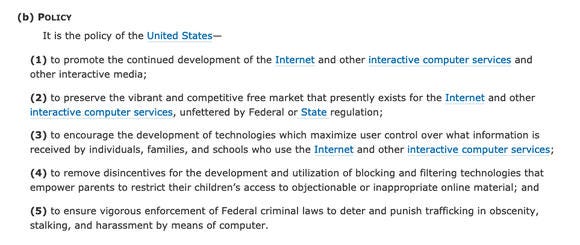
The topic of social media moderation is comprehensive and complex. While the Florida government has a good intention to protect freedom of speech, some social media evangelists think that the legislation may cause a problem in the long run. Here is a comprehensive Twitter Thread discussing this issue.
It is time for collaboration to identify risks of moderation and find the optimal solution for the state and overall nation.
I recommend watching this CNBC video on YouTube, “Why Content Moderation Costs Social Media Companies Billions”, it provides valuable information about content moderation, and the qualified presenters make eye-opening remarks worth watching.
What do you think about Florida’s attempt to regulate social media?
Do you think other states and the federal government would attempt to regulate social media?
What do we lose and gain by regulating social media?
Please share your thoughts reflecting your experiences and localities.
Thank you for reading my perspectives. I wish you a healthy and happy life.
The original version of this story was published on another platform.
Besides leadership, technology, metabolic and mental health, as nutrients are critical, I also document promising molecules such as lithium orotate, alpha-lipoic acid, n-acetyl-cysteine, acetyl-l-carnitine, CoQ10, NADH, TMG, creatine, choline, digestive enzymes, magnesium, hydrolyzed collagen, nootropics, pure nicotine, activated charcoal, Vitamin B12, Vitamin B1, Vitamin D, Vitamin K2, and other nutrients that might help to improve health and fitness.

About the Author
Thank you for subscribing to my content. I share my health and well-being stories in my publication, Euphoria. If you are new to Medium, you may join by following this link. You may also join my seven publications on Medium as a writer requesting access via this weblink. I write about health as it matters. I believe health is all about homeostasis. I share important life lessons from people in my professional and social circles.


