
Archbishop Desmond Tutu, the Man, Activist, and Leader
How one man became a great humanitarian and legend around the world.
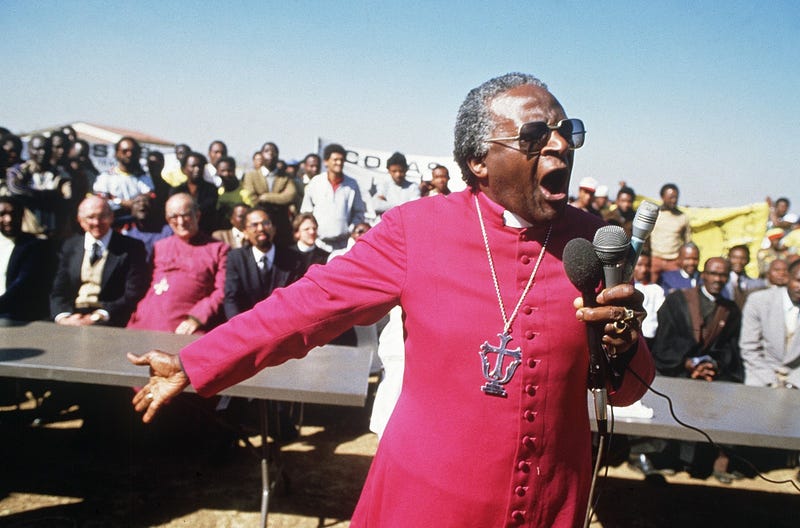
Archbishop Tutu, Nobel Laureate, First Black South African Archbishop and a moral compass for humanity has died leaving a legacy for many to continue. The world has lost a moral beacon, peacemaker, and renowned humanitarian who stood up in the face of Apartied and called it out in the face of the apartheid White government, proclaiming they were suppressive to the culture and Black South Africans.
Desmond Tutu, the former archbishop of Cape Town was the recipient of the 1984 Nobel Peace Prize for his courageous championing against apartheid in South Africa during the time that Nelson Mandela was incarcerated.
For years in the face of Apartheid suppressing Black South Africans, Bishop Tutu’s voice never ceased as it was loud, fervent in the face of Apartheid, as he became an inspiring symbol of courage, dignity, and hope in a country that seemed doomed to be suppressed forever. He pleaded nonstop for peace and racial justice while interjecting his irrepressible sense of humor.
South Africa was on the edge and Bishop Tutu pushed and pushed to bring about a much-demanded change. He even risked his life to stop violence by Black protesters. Also, stared death in the face of white people as he lead an international campaign to impose economic and cultural sanctions against the white minority regime.
After the anti-apartheid movement was successful he stood at the helm of the governing African National Congress to root out corruption and its failure to address South African widespread poverty.
Bishop Tutu’s legacy included him being one of the leading influencers in South Africa other than Nelson Mandela. His joy of the new South Africa was seen when South Africans lined up peacefully to vote in 1994 in the first all-race elections in April 1994.
Another notable moment among many moments was when he raised the hand of Mandela, the long-imprisoned leader of the African National Congress while introducing him as the new South African president.
As the moral guardian to what he proudly called the “rainbow people of God,” he remained vocally and visibly slamming the new government or Mandela when injustice appeared from the corners. One poignant moment was when he spoke out against Mandela for having stopped the gravy train long enough to get on. This calling out forced Mandela to reduce his salary, his Cabinet, and Parliament.
Wherever there was a cause, Bishop Tutu was there. One of his greatest contributions was leading the Truth and Reconciliation Commission, a statutory panel charged with investigating murders, torture, bombings, and other crimes by Black and white people committed during apartheid.
These atrocities broke Tutu’s heart as he was seen on occasion openly weeping as the perpetrators confessed to their crimes against humanity in the midst of their victims’ forgiveness. Tutu used his stature to call out crimes, corruption, and the African National Congress failures on AIDS and poverty because Black South Africans were too intimated to raise their voices.
He kept his arm on the pulse of the South African National Congress, often calling them out directly by saying, “You are not God,” and denounced his displeasure with the incoming president, Jacob Zuma, who later resigned in 2009 in the midst of repeated corruption scandals. In 2010, Tutu decided to take a back seat as he announced his retirement from public life in 2010 due to health issues as he desired to spend more time with his family.
Even in the midst of retirement, Tutu continued to advocate for social and political issues, offered his support for same-sex marriage, assisted dying, and human rights. Also, he condemned former President Trump’s decision to formally recognize the divided city of Jerusalem as Israel’s capital, saying, “God is weeping.”
Desmond Mpilo Tutu was born Oct. 7, 1931 in a poor Black township about 100 miles southwest of Johannesburg. His father was the headmaster of the segregated high school for Black students while his mother was a maid, his greatest influencer. He said his mother was compassionate, gentle, and caring while his father drank and was hostile in the home.
As a child he was sickly with polio that cause the right side of his body to be left semi-paralyzed, contracted tuberculosis that landed him in thehospitall for 20 months, and he was nearsighted which cost him a job. His desire was to be a doctor but his family could not afford the fees so he became an English teacher at his father’s school.
His teaching career ended in the face of the government imposing Bantu education, designed to train Black students as laborers for white people. He chose not to be a part of the suppression instilled in South African culture.
He attended St. Peter’s Theological College in Rosettenville and was ordained as a priest in 1961. His oratorical skills and powerful intellect were undeniable. In 1962, he won a scholarship to King’s College in London and years later was named chaplain at South Africa’s University of Fort Hare.
Upon returning to South Africa in 1975, he became the first Black Anglican dean of Johannesburg. His public activism began during this time as he addressed a letter to the white prime minister, John Vorster. He warned of bloodshed and violence due to the repression of the Black South Africans.
Tutu was ignored and the white-run media vilified him in every way. Just as he had warned, a month later, riots explored in Soweto, Johannesburg’s largest Black township. This began almost 18 years and tens of thousands of deaths, which mark the beginning of the end of the apartheid era.
Tutu found himself thrust into the midst of fighting apartheid becoming the voice against racism and oppression of minority white rule while Mandela, most other Black leaders were in prison, the African National Congress and, other liberation groups were banned.
As his influence grew, he was elected the first Black general secretary of the South African Council of Churches in 1978. This position allowed him to launch a campaign appealing to the international community to assist by adding pressure on the apartheid regime by imposing punitive sanctions.
He and his family were jailed, harassed, his passport was confiscated, and the police constantly followed him even when jogging each morning. On the other side, calling out Blacks pertaining to their violent actions, he was labeled a sellout.
This visibility led to him being awarded the Nobel Peace Prize, he was named the Anglican bishop of Johannesburg and became the archbishop of Cape Town, the head of the church nationwide, in 1986.
Very notable was the historical moment when Nelson Mandela was released from prison after 27 years, he spent his first night of freedom at Bishop Tutu’s residence in Cape Town.
During his active retirement, he joined forces with a group of world leaders including Mandela and Jimmy Carter who use their influence behind the scenes for peace worldwide. He campaigned against AIDS and cancer.
When he was diagnosed with prostate cancer in 1997, he slowed his activism to spend more time with his family but kept his voice in the midst championing peace and justice for all.
His personal life was quiet as he was married to Nomalizo Leah Shenxane in 1955 and they had four children and were inseparable over the years. He is survived by all including his grandchildren.
In conclusion, at the age of 90, he succumbed to cancer and died at a care center in Cape Town. Prior to his death, he had been hospitalized several times in recent years.
In the words of Desmond Tutu about his activism, “I’m not defying the government. “I’m obeying God.” He always proclaimed that he never lost hope or faith that change would come from the darkest days. R.I.P. Archbishop Tutu who changed the world for the better.
For additional reads:


