
An Open Letter To Our Minister Of Education
A letter to anyone who will actually read it, since MLA Wayne Ewasko doesn’t respond to my letters

MLA Wayne Ewasko, Minister of Education Room 168, Legislative Building 450 Broadway Winnipeg MB R3C 0V8
March 28, 2022
Dear Mr. Ewasko,
I have written to you previously, but have yet to receive a response. As Minister of Education, I do hope you have reviewed my letters expressing concerns on behalf of students and families in Manitoba, myself included.
I write to you again to express serious concerns about budget cuts to Manitoba’s community schools.
As a former educator, I am sure you understand the importance of adequate staffing and staff training in our children’s schools, especially as regard to supporting vulnerable students with exceptional needs.
In 2020, I wrote letters to your predecessor expressing grave concerns over the lack of knowledge and training of school staff supporting neurodiverse and disabled students.
In 2021, I wrote to both your predecessor and then to yourself, expressing further concerns about budget cuts to education in our province in general.
I write to you again, this time with very specific concerns.
Recently our school division presented their budget to parents and community members. One of the items in the budget indicated funding for 2022–2023 is short $357,000 for Educational Assistant (EA) support to current students.
This is not yet considering the additional students expected to enrol next year.
My son is fortunate to no longer require EA support in the classroom. However, he did need that level of support in grades one and two (2017–2019) — in part due to his neurodevelopmental disability, but also due to lack of staff understanding, knowledge, compassion, and training.
Three years ago the situation was so dire that I removed my son from public school and paid for him to attend a private school for one year. I have since supported other families, both in our division and in others, who have experienced similar distressing and traumatic situations.
Families have expressed to me their school staff don’t understand their child’s disabilities, their child’s unique needs, nor are the schools equipped to properly support their children.
Now, instead of increasing professional development and training opportunities, our division has been forced to cut P.D. funding by $40,000.
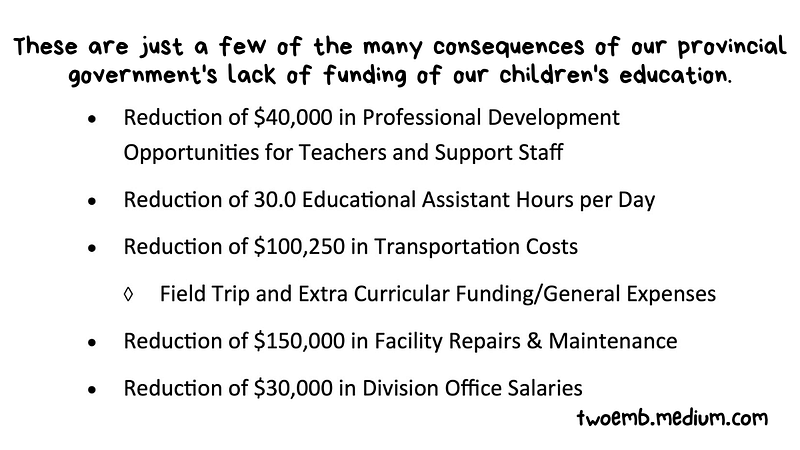
School divisions cannot improve conditions for these students and their families without the resources to recruit, hire, train, and retain qualified and compassionate staff.
After my son began school in this division in 2017, things only got worse. I cannot imagine how things could possibly improve when schools barely have enough funding to retain adequate numbers of bus drivers, teachers, and custodians — let alone qualified, well-trained EAs and support staff.
As we have seen throughout the Covid-19 pandemic, when there is an emergency in our communities, we always manage to come up with the funding.
This is an emergency for our children, students, and schools — one which must be addressed immediately.
These shortages will continue to have the most significant impact on vulnerable children in our schools, and on neurodiverse and disabled students.
It would be negligent to allow the 2022–2023 school year to proceed with the current funding models in place. Our children’s education has already been suffering for years due to previous budget cuts, and schools cannot continue to scrape by.
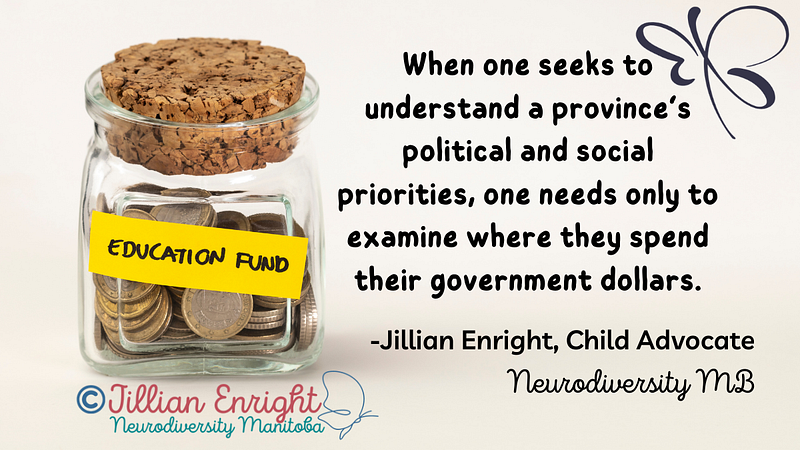
When one seeks to understand a province’s political and social priorities, one needs only to examine where they spend their government dollars.
Will Manitobans accept our government placing our children’s education, and the needs of special needs students, at such a low priority?
I sincerely hope not.
I look forward to your timely response.
Respectfully,
Me.
Jillian Enright, CYW, BA Psych. Child Advocate, Neurodiversity MB
Speak up!
You can email Minister Ewasko’s office at [email protected], and email your regional MLA to ask for their for support.
I originally posted this article in August of 2020, almost two years ago. We’re nearing the end of March 2022, and rather than seeing improvements, things are getting worse.
Much worse.
As I mentioned above, the government of Manitoba is causing school divisions to make drastic cuts, including Educational Assistant (EA) positions, which primarily hurts vulnerable, disabled, and neurodiverse students.
Children with disabilities have a legal right to appropriate support and accommodations, and an ethical and legal right to equal education.
Reducing supports for vulnerable students contravenes Article 24 of the Convention for the Rights of People with Disabilities (CRPD), which states the following:
- Persons with disabilities are not excluded from the general education system on the basis of disability, and that children with disabilities are not excluded from free and compulsory primary education, or from secondary education, on the basis of disability;
- Persons with disabilities can access an inclusive, quality and free primary education and secondary education on an equal basis with others in the communities in which they live;
- Reasonable accommodation of the individual’s requirements is provided;
- Persons with disabilities receive the support required, within the general education system, to facilitate their effective education;
- Effective individualized support measures are provided in environments that maximize academic and social development, consistent with the goal of full inclusion.
Neurodiverse and disabled children deserve equal access to education and have a legal right to appropriate accommodations and support. Neurodiverse and disabled children are not an afterthought:

When you join medium, as a member you’ll have access to unlimited reads for only $5 per month. If you use my referral link, I’ll earn a small commission, and you’ll earn my undying gratitude.


