
EMPATHY | Shadow Self
What Annoys You In Others?
Is it them or is it you?

When we try to understand why someone irritates us that much, sometimes it feels like trying to find our reflection in a distorted mirror that shows many other reflections that we don’t see the value of.
If you take a closer look at the image above, you can see that some people are reflected more than once. The reflections though are not the same. It’s similar to being in a mirror maze.
It’s easy to get lost in a labyrinth made of mirrors, and even easier to keep going around in circles the more people are in the maze with you. There is a trick to always find your way out fast, but that’s beyond the scope of this article.
The reason why I am bringing up the mirrors and the maze is because I thought it would be a great analogy for the ways in which empathy can make us feel angry or snap at others for no apparent reason.
“Everything that irritates us about others can lead us to an understanding of ourselves.” — C. G. Jung
Natalie recently shared a story that I think is a great way to demonstrate how people who are not in touch with their Self mistreat others. Another story from Natalie that is also a very good example of what my article is about is her most recent one.
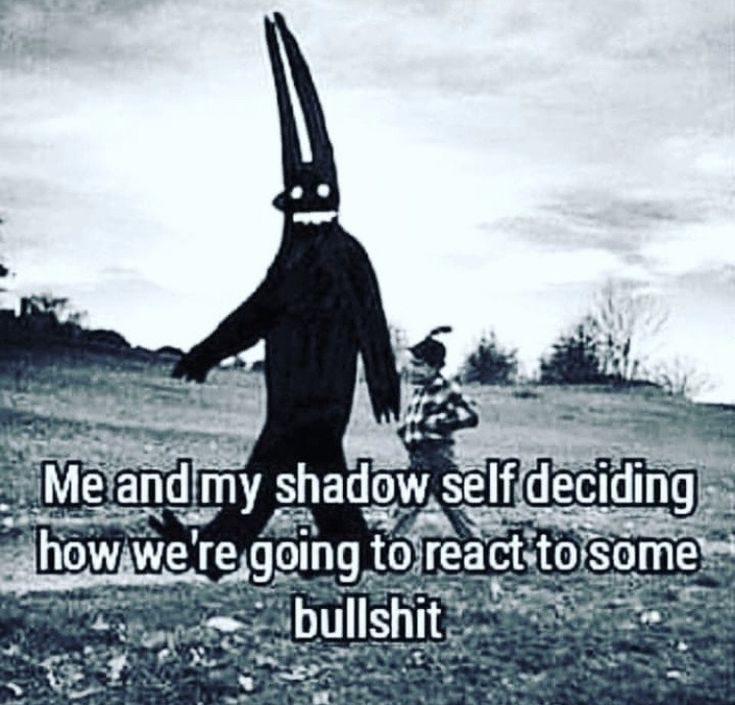
Jung’s quote above talks about what happens when others make our Shadow react. The Shadow is the hidden part of our psyche, and it contains all those traits which we think are unacceptable. The Shadow is primarily created through shame and the reactions of others (e.g. anger, disgust, irritability) towards our personality traits.
The formation of the Shadow begins at a very early age. Due to that, we can’t remember what led us to forcing some of our parts of ourselves to hide. However, when we encounter another person who openly exhibits a trait that we were told is unacceptable, we feel irritable.
That could happen for two reasons. One, we feel betrayed and jealous. Why is that person being themselves, while I was told/shown that I can’t do that? And, two, we feel scared of the consequences (e.g. “if the person keeps doing that, I might also get in trouble”) so we try to make the other person to stop.
What is the fastest way to make someone stop? By scaring them. That is why the horn of the car makes a loud noise, instead of playing some soft music.
Those reactions that were just mentioned, are intrapsychic, thus unconscious. We can become conscious of them through inner work. Until we do though, it’s like a party for our Shadow.
Anything that triggers us makes our Shadow really excited to show itself. And, since it wants to keep showing off, it will make sure to keep finding triggers in the environment. Even if something isn’t triggering, the Shadow will twist it around.
When our empathy tells us that we need to connect with the struggles of someone (through our mirror neurons), sometimes we get the opposite result. We might feel angry or irritable or disgusted. Does that sound familiar? Yes, empathy and the Shadow are at a constant interplay.
Studies have shown that children who exhibit interpersonal aggression do in fact have lots of empathy (source). That was surprising, because it was believed that the people who start out being aggressive from a young age probably lacked empathy. It turns out that this is not the case though.
In practical terms, this means that sometimes empathy can make us angry. When we can understand and connect with the hardship of another (empathy) but that hardship threatens to bring up a part of the Self we have hidden away (Shadow), we snap at the other person to make them stop.
In a previous article about empathy, I mentioned the term “pseudo-empathy”. In people whose Shadow is overactive, it’s usual to see them exhibiting pseudo-empathy rather than “empathy proper”.
If you read Natalie’s stories with that in mind, you will probably be able to identify the Shadow part. I have also shared another example of how the Shadow can cause anger, when I shared a fragment of my dream and its interpretation.
Therefore, similarly to how I got angry in the dream at a part of myself, other people get angry in their waking life at others when they exhibit a trait they feel is threatening or shameful.
So, what can you do with that information?
The next time something annoys you, take a moment to consider what is happening. What is it that annoys you, exactly?
If, for example, it’s because of the way something was said then think… “Was I ever told something in a similar way from a person important to me?”. Or, “When I read it/hear it, does it remind me of a situation where I was being scolded/yelled at/put down?”
If you feel annoyed by something a person is doing, then you can ask yourself… “Is it possible that I would also like to do things that I was forced to believe are shameful/inappropriate?”. Or, “Have I ever tried to do something similar and was rejected?”
These are just examples. You know your life best, so you need to come up with the questions that match your experiences. The overall goal is to ask questions in such a way that will allow you to see deeper in you.
It’s not easy, and it’s not pleasant. The reason why the Shadow was created was to protect ourselves. Therefore it’s likely that through such questions we might arrive to some painful realizations.
At the same time though, we can understand ourselves better and maybe start doing the things we have been afraid to do for so long.
“Knowing your own darkness is the best method for dealing with the darknesses of other people.” — C. G. Jung
For instance, I know that I would like to learn how to dance. I will pursue it eventually, instead of being angry at my Shadow in dreams.
Moreover, being in contact with the contents of our Shadow helps us see the Shadow in others and understand their reactions. And that’s another way we can pair it with empathy for better results.
Of course sometimes it’s easier to just ignore someone whose Shadow is partying and wrecking havoc. But, if we feel like it, we can use our empathy in such a way that will make the other person feel heard and safe enough to see that maybe their reaction is from something within themselves.
I hope that was useful enough. In the next article on empathy I will discuss how empathy and the Shadow cause us psychosomatic pain.
Until then, be aware of the partying Shadows out there and thank you for reading!
You can see more about how the Shadow interacts with the other components of the Self in the article I had posted about symbolism in dreams. There you can also find the explanations for other Jungian terms.