The Language of Symbols in Our Dreams
What is our mind trying to tell us?
In the previous article on the faces we see when we dream (you can read it here), I explained the function of dreams and the way our brain constructs images.
Those images though don’t always make sense if we look at them rationally. That’s because the mind conveys messages using symbols. These symbols can be decoded into meaningful units of information. Before I start explaining though how that’s done, let’s take a brief look at the foundations of psychoanalytic dream interpretation.
If you don’t feel like reading lots of theory, feel free to go straight to the section “Identifying symbols in dreams” to get the answer on what is the symbolism of the people we see in our dreams.
Table of Contents − What is the unconscious? − Commonly misused terms − Scientific evidence of symbolism − The meaning of the archetypes − Identifying symbols in dreams − Decoding symbols in dreams − An example of dreamwork − What else is there? − Conclusion
What is the unconscious?
In general, the term “unconscious mind” refers to the material that is stored in our brain without a direct access to it. Contrary to popular belief, Freud was not the first to use this term. However, due to his extensive work in psychoanalysis, most people associate the unconscious with Freud’s views.
In our unconscious, we usually store information that our brain collects automatically. For example, the faces of random people as discussed in part 1. The unconscious also holds memories that are repressed, which frequently give rise to phobias, nightmares, obsessions and compulsions, anxiety, depression, and so on. Another thing that is believed to be residing within our unconscious, is repressed desires.
We can access the contents of our unconscious mind through psychoanalysis, but also through practicing free association (here’s a book chapter on how it’s done), and of course through the contents of our dreams.
Our unconscious mind is cryptic and uses symbolism as its “language”, but with the right tools we can learn to understand it and communicate with it.
The benefits of doing so include a deeper understanding of our Self, and the resolution of manifestations that concern us (such as a mental health issue).
Before going any further, it’s important to look briefly at some commonly misused terms.
Commonly misused terms
(1) Many people think that the terms “unconscious” and “subconscious” are interchangeable. As stated earlier, unconscious refers to something we don’t have direct access to; something that’s hidden. On the contrary, subconscious refers to something we’re not readily aware of but we can retrieve it as a whole at any point (no need for symbolism for retrieval).
An example of a subconscious memory is writing with a pen or pencil. After learning how to write, our brain does not need to consciously tell us exactly what steps to follow to make our muscles move in they way they’re supposed to so we can write. Another example would be driving a car, or riding a bicycle.
(2) Repressed memories are different than suppressed memories. The former term refers to memories which were unconsciously stored and hidden; in other words, we didn’t tell ourselves to hide the memories. The latter refers to memories that we knowingly tried to hide or alter.
(3) Dream interpretation is the process of narrating and then interpreting your dreams in analysis with a trained analyst or a therapist who’s trained in psychodynamic or psychoanalytic therapy. Dreamwork is the process of interpreting your dreams on your own. Dreamwork can also occur in therapy, if the therapist remains silent and lets the patient/analysand interpret the dream on their own.
Now, let’s move on!
Scientific evidence of symbolism
For many years, it was not possible for psychoanalytic theories to be empirically tested because we didn’t have the right tools to monitor and decode the brain functions during sleep.
As the technology progresses, we are becoming better able to research dreams deeper. For instance, research that has shown how the brain stores memories and how those memories resurface during the dreaming cycles, has opened the way for a better understanding of those images as a symbolic language (source).
Another exciting thing is that we’re close to actually see our dreams on a screen! There are at least two devices right now that can translate thoughts to images (they’re still at an experimental level though). Scientists hope that soon they’ll come up with something even more precise. Brain implants are already being used to translate thoughts to words on a screen, giving paralyzed people a way to “speak” (source). So now the goal is to combine this technology with the thoughts-to-images technology to be able to read and record dreams.
When this is achieved it will be groundbreaking for dream analysis and interpretation. Until this happens though, we can use the tools that are listed in the following sections.
The meaning of the archetypes
Carl Jung was the psychiatrist and psychoanalyst who popularized the word “archetypes” and talked the most about understanding the world through dream symbolism.
Archetypes are universal symbols of the collective unconscious (i.e. unconscious material that is common in all humans). Examples of archetypes are: the great mother, father, child, devil, god, wise old man, wise old woman, the trickster, the hero. Other figures can also serve as archetypes.
Do these archetypes sound familiar to you?
If you answered “yes”, that’s probably because you see them everywhere. In fairy tales, in stories, in real-life situations… Each archetype has distinct qualities, and despite its universal nature, it can obtain different attributes depending on our personal experiences.
Jung’s work on Archetypes was also connected to his explorations on personality traits. Have you ever come across the terms “Introversion” and “Extroversion”? If yes, thank Jung for that!
Through the exploration of his works by other scholars, the well-known MBTI Personality Test arose. A word of caution though: not all tests you find online are accurate, and the combination of letters (or, traits) shouldn’t be taken as an in-depth description of your personality or that of others.
If you’re still curious about what your MBTI type is, this test is so far the most accurate one you can find online.
You can read more about the descriptions of the basic archetypes here. If you’re feeling more adventurous, here you can find an extended list of over 300 archetypes.
Identifying symbols in dreams
If you’re still reading, congratulations! You’re about to find out how all this connects to the people we see in our dreams.
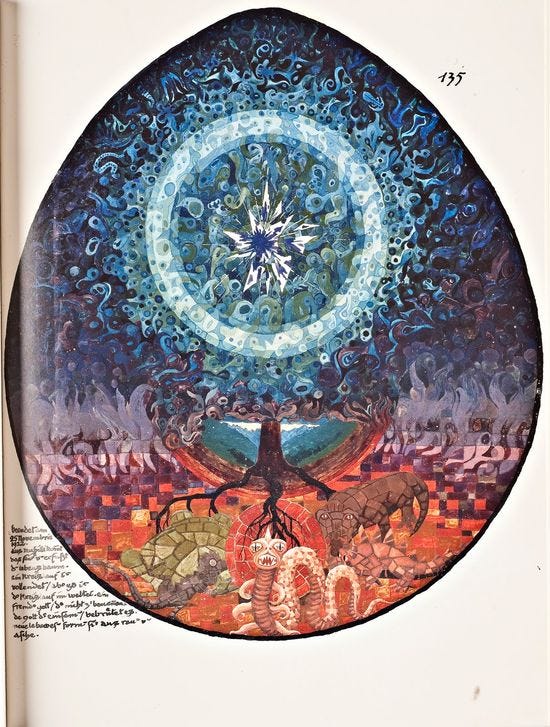
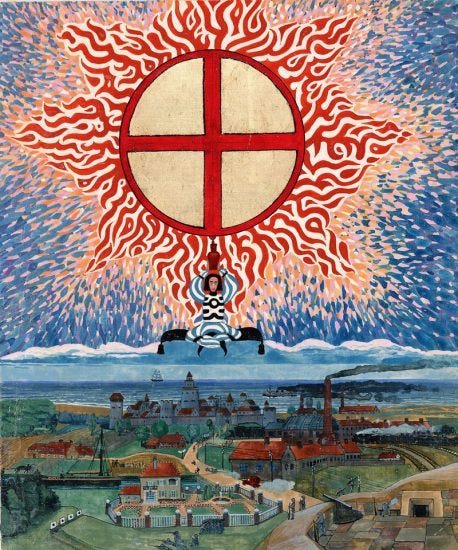
Jung’s works relied heavily on the information from his dreams. The illustrations in the Red Book are all sourced from his own dreamwork.
As discussed in part 1, the brain uses stored memories to make sense of new input. Therefore, anything we have ever seen can become a symbol. This means that there are cultural variations in dreams, so any attempt on dreamwork or dream interpretation should take cultural aspects into consideration.
The way to identify the symbols in a dream is to understand that nothing you see is literal.
Even when you’re dreaming of a memory, it’s your brain using that memory to draw your attention to something, to give you comfort, or to give you an answer. Keeping that in mind, let’s see how we can decode the symbols!
Decoding symbols in dreams
There are some psychoanalytic theories that state that all the people we see in our dreams are aspects of the Self. In other words, everyone you interact with in your dreams is you, taking on a form to convey a message from the unconscious to the conscious mind in a way that would make you understand it better.
All other elements of the dream are portrayals of your desires, your fears, and your memories. They highly depend on what each element means to you. For instance, we can both dream of a red snake that climbs a brick wall wearing a yellow raincoat.
The elements in that dream are: the snake, the color red, the ascending motion, the bricks, the wall, the color yellow, and the raincoat. Another crucial element is the emotion associated with the dream image. Meaning, how you felt when you saw the snake climbing up the wall. Each element means something different for me than it does for you. Therefore, this dream as a whole doesn’t mean the same for both of us. That is why the “dream dictionaries” are pretty much useless.
If you want to understand your dreams in depth, you need to understand what each symbol means to you and how it connects to your life.
An example of dreamwork
In order to bring all this together, I will present a dream I had a while ago and its interpretation. Notice that I will be using present tense to narrate the dream. It’s important to use present tense when you write down your dreams or when you narrate them, because it helps you get back into the dreaming world.
I have changed some aspects of the dream to avoid giving away too much personal information.
The dream “I am in a bar. In the crowd I notice E. I tell her that she needs to leave and that this is not the right place for her. She laughs in my face and tells me that she can do whatever she wants. I get angry and start yelling at her, telling her to go home. She pretends to not hear me, and starts dancing sensually. I am enraged. She tells me that I’ll never be as feminine and good-looking as her.”
The interpretation In order to interpret this dream, we’ll start from the premise that nothing is literal and that E. is an aspect of myself. Clearly, I am using E.’s image to portray an aspect of myself I want to hide. This is possibly because, in the waking life (in real life), I see some qualities in E. that I would like to have on an unconscious level but I’m too scared to do so.
In the waking life, E. is an extroverted person, who is very skilled in dancing, she’s tall and is very pretty. She does things without overthinking them, and seems to be very secure. On the contrary, I am an introvert, I can’t dance to save my life, I am relatively short, and I believe that appearance-wise I am below average. I overthink everything to the point of exhaustion, and I am rather insecure.
In the dream, my Self is trying to communicate to me that I really desire to express these qualities (e.g. being carefree, being more confident) but another part of me sees this as too threatening. Perhaps, at the moment, it’s a threat to the image I have of myself. Or, I might be worried that if I express those qualities then there might be no way back.
In the dream, E. doesn’t listen and laughs at me. I am angry because of that. On a symbolic level, I am angry at this side of my unconscious mind that dared to show me something I desire but I have partially suppressed and partially repressed.
What else is there?
Dream interpretation can go very deep. There are many more aspects of the Self than those covered in this article. Below is an illustration of what the Self is possibly composed of. The illustration is derived based on the work of E. F. Edinger “Ego and Archetype” and Jung’s works.
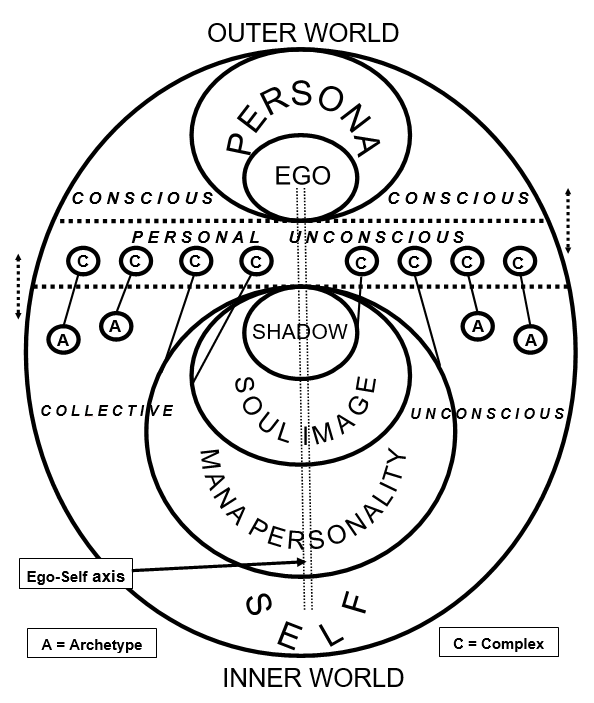
- Mana Personality is “a personified archetypal image of a supernatural force”. More about it here.
- The Shadow is an archetype that consists of our basic instincts. In my dream, E. is partly my Shadow.
- The Persona is our “social face”, how we present ourselves to the world. In my dream, perhaps my Persona felt threatened by the desires of my Shadow.
- The Ego-Self Axis is the line of communication between the Ego (the part of us that runs the day-to-day stuff we need to function) and the Self (our wider potentials as sentient beings). When there is an impairment in the axis (e.g. due to trauma), problems such as feelings of unreality and depersonalization may arise.
- The psychological integration of all the aspects in the illustration, will lead to individuation: self-actualization through the harmonic integration of the conscious and the unconscious.
“Who looks outside dreams; who looks inside awakes.” — C. G. Jung
Conclusion
- Dreams should be interpreted on a symbolic level.
- Everything we see in a dream is a potential symbol.
- Each symbol has a unique meaning to us.
- Through writing down and decoding our dreams, we can learn how to communicate with our unconscious.
- The people we see in dreams are aspects of our Self.
Thank you for reading!
As a reward, here’s a Jungian meme: