avatarJeremy Roberts

Free AI web copilot to create summaries, insights and extended knowledge, download it at here

9967

Abstract

h for Andy. Never believe anything you read in books or newspapers [laughs]. She was great to us for some reason. She loved the Dillards because we hadn’t gotten into the Hollywood thing. We were still what you might call “real.” There’s a chemical change that occurs the longer you stay there [laughs].</p><p id="fb42">After the first show we did, I had become very lonely for my dogs and horses left back home. So I wanted an animal, and I decided to buy an Alaskan Malamute. They are sled dogs and are really territorial animals. He weighed 115 pounds.</p><p id="8d5f">Anyway, I took the dog down to a veterinary clinic in Hollywood. Here I was, this hillbilly with this big dog named Wenatchee, named after the mountains where I loved to camp back in Oregon. Most of the folks there had poodles — all kinds of things shaved up and dyed lavender.</p><p id="2232">As I’m standing there with my dog, in comes Frances Bavier with her dog, a little Dachshund. She came right up to me and said hello and started a conversation. Being a kid at that time, I felt really embarrassed because I didn’t know what to say to a star.</p><p id="18c9">All of a sudden, she looked me dead in the eye, and she went, “Oh, ohh, ohh…” I didn’t know what was happening. Maybe she was having a stroke. Again, she uttered those sounds. I finally followed her gaze down, and Wenatchee was marking his territory on Aunt Bee’s leg. It’s absolutely a true story, I’m not smart enough to make that up [laughs].</p><p id="d21c">Later when we had filmed our second episode and knew her a bit more, she baked us a lot of brownies, gave us a basket of fruit, and gave me some great words of wisdom. She said, “I have some advice for you. This is a terrible business, and you should just go home.” And that was my relationship with Frances.</p><figure id="1419"><img src="https://cdn-images-1.readmedium.com/v2/resize:fit:800/1*mcNYtp8O4b8FEhfi9rXTyA.jpeg"><figcaption><b><i>Speaking only through the music, mandolin picker Dean Webb, lightning fast banjoist Doug Dillard, stand-up bassist-emcee Mitch Jayne, and lead singer-guitarist Rodney Dillard [Doug’s younger brother] come alive while filming “The Darlings Are Coming” on February 4, 1963, the Dillards’ debut episode of beloved sitcom “The Andy Griffith Show.” Image Credit: The Bart Boatwright / Gary Wedemeyer Collection / RetroWeb Archives</i></b></figcaption></figure><p id="de9e"><b>Why did the Dillards rarely speak on <i>The Andy Griffith Show</i>?</b></p><p id="fe6d">Because they would have had to pay us. That’s really true [laughs]. Whatever they told me to do, I would do. I always kept my mouth open because the producers wanted us to look like we didn’t know anything. They wanted us to be stoic and non-communicative. You could call that a form of improvisation.</p><p id="7e14">When we first started the show, Andy told us we would not get paid as actors. First of all, there were no residuals then. But he said he would try to get every one of our songs on the show that we wrote. And he did that.</p><p id="138c">We averaged five songs per show, six shows in total between 1963 and 1966 — ”The Darlings Are Coming,” “Mountain Wedding,” “Briscoe Declares for Aunt Bee,” “Divorce, Mountain Style,” “The Darling Baby,” and “The Darling Fortune.” And the show’s never been off the air since 1960.</p><p id="91d6">Andy could have taken real advantage of us. We could have been told to only perform public domain songs and never gotten a penny. Collectively, I think we made $375 for each show. That’s the kind of man Andy Griffith was.</p><figure id="dea2"><img src="https://cdn-images-1.readmedium.com/v2/resize:fit:800/1*6n0mTT-zU3o1QuCe1siMDw.jpeg"><figcaption><b><i>Lord help the fine citizens of Mayberry as “The Darlings Are Coming!” Rodney Dillard, Dean Webb, Doug Dillard, and Mitch Jayne of the Dillards progressive bluegrass band are seen aboard the mountain clan’s </i>1928 Ford Model AA flatbed truck. Love-lorn, breath-taking sister Charlene Darling [Maggie Peterson Mancuso] has her eyes firmly set on an uncomfortable Sheriff Andy Taylor [Andy Griffith] in this vintage still from the Darling Family’s debut episode of “The Andy Griffith Show,” filmed <i>February 4, 1963, on the Desilu “40 Acres” backlot. </i>Image Credit: CBS Photo Archive</b></figcaption></figure><p id="9e8d"><b>Did any of your suggestions make it into the show?</b></p><p id="0ad8">The one time, believe it or not, was when Charlene [Maggie Peterson Mancuso]’s husband, Dud Walsh [Hoke Howell], was twisting his face in a scene where he was saying how he would use guerilla warfare to take care of Ernest T. Bass [“Mountain Wedding,” 1963].</p><p id="7782">I remarked to someone on the set, “My mama had a saying that she would say to me all the time if I was whining or crying — ‘Do you want your face to freeze that way?’” So Denver Pyle [“Briscoe Darling”] used my suggestion, and it’s featured in the episode.</p><p id="2fa6">The only improvisation scene we ever did was the snoring scene in that same episode. That was total improv. Beverly, my wife, hears that every night [laughs].</p><figure id="6b98"><img src="https://cdn-images-1.readmedium.com/v2/resize:fit:800/1*roX34kaJutOwoQWW_6WY3A.jpeg"><figcaption><b>Acoustic guitar maestro Rodney Dillard and banjo-wielding wife Beverly Cotten-Dillard promote their Christian-themed Mayberry Values ministry circa 2006. The lead singer of the mountain-living Darling Family on “The Andy Griffith Show,” Rodney gives his inspiring “Andy Griffith Show” testimony in churches across the United States. Image Credit: Courtesy of Rodney Dillard</b></figcaption></figure><p id="633b"><b>What exactly is a <i>Mayberry Minute</i>?</b></p><p id="3a15"><i>Mayberry Minute</i> was a radio show that I narrated which ran nationally for three years beginning around the year 2001. The show consisted of 60-second stories written by Rene Ray and myself about different episodes.</p><p id="26e2">We would present a short summary of a particular episode and then present a positive thought from that show to live by. “There’s always something to be learned from Mayberry” was the tagline, and that is certainly true all these years later. My albums <i>I Wish Life Was Like Mayberry</i> [2010] and <i>Don’t Wait for the Hearse to Take You to Church</i> [2011] featured a handful of show samples as bonus material.</p><p id="7629"><b>Beginning with “There Is a Time”, what is the story behind the following classic bluegrass tunes in the Dillards’ repertoire?</b></p><p id="e55d">The late Mitch Jayne wrote “There Is a Time” in 1963, and I helped. Even though I wasn’t a Christian at the time, we based it on the book of Ecclesiastes, since I was raised in a church. Andy Griffith liked it a lot. He ultimately sang it on the show, Charlene sang it, and then the Dillards performed it, too.</p><p id="26e3"><b>“The Old Home Place”</b></p><p id="ae42">Written by Mitch and Dean Webb, this song describes what happens when you leave home and then return after a long spell, and the home isn’t there anymore.</p><p id="e54d"><b>“Dooley”</b></p><p id="1714">It’s about an old boy from Salem who made moonshine whiskey for 25 consecutive years. He would come into town in his pickup truck every Saturday and load five 100-pound sacks of sugar in the back of his truck.</p><p id="2cb4">He never got caught, never went to jail, but everybody in town knew he was making whiskey. They knew he wasn’t making fudge up there on that ridge [laughs]. Written by Mitch and myself in 1963, “Dooley” has been very, very good to us over the years.</p><p id="e34f"><b>“Doug’s Tune”</b></p><p id="3624">We filmed <i>The Andy Griffith Show</i> like a movie, using a single camera. Since it would take hours to set up one shot, we would go to Andy’s dressing room and pick. He absolutely loved bluegrass music.</p><p id="5a42">Anyway, one day Doug was noodlin’ around with a tune. Andy became curious and asked, “Doug, what is that?” Doug looked him dead in the eye and sheepishly admitted, “I don’t know.” You would have to know my late brother’s disposition to understand the full weight of his statement. Andy replied, “Well, why don’t we call it ‘Doug’s Tune?’” Shortly thereafter, Andy graciously included a segment of us performing it on the show.</p><figure id="6cd1"><img src="https://cdn-images-1.readmedium.com/v2/resize:fit:800/1*mLyJymEzBo6z665bZmPUHA.jpeg"><figcaption><b>He died with his boots off and mouth open: Doghouse bassist Mitch Jayne, mandolinist Dean Webb, and banjoist Doug Dillard fondly bade farewell to lead singer-guitarist Rodney Dillard with a small bouquet of dark pink carnations on the cover of “Live!!!!Almost!!!,” the Dillards’ second, unfortunately non-charting album distributed in August 1964. Photography by William S. Harvey / Elektra Records</b></figcaption></figure><p id="ae39"><b>“Walkin’ Down the Line”</b></p><p id="c130">I still remember the first significant place they sent us after we made our first appearance on <i>Andy Griffith</i>. It was the 1963 Newport Folk Festival. I heard Bob Dylan perform for the first time there. We were the first bluegrass group to cover Dylan. He’s a great songwriter, but he’s got a voice very much like a dog caught with his leg in a car door [laughs].</p><p id="78f3"><b>“The Whole World Round”</b></p><p id="40eb">What happens when you can hear your neighbor’s car start up or the low end wolfer on somebody’s jeep who’s two miles away? A lonesome song, written by Mitch and Joe Stuart in 1964, that you could classify as sort of an early precursor to “There Goes the Neighborhood,” the title cut of my 2001 album on Varese Sarabande Records.</p><p id="41c9"><b>“Ebo Walker”</b></p><p id="3491">I liken this song to the lyrical counterpoint of “Dooley.” It is the other, tragic end of the tale. Written by Mitch and myself in 1964, it’s about a man who died from drinking tractor radiator alcohol. He was our town drunk in Salem. By the w

Options

ay, there is a real Ebo Walker, but he’s not the town drunk — he was a stand-up bass player for New Grass Revival.</p><div id="e2f8" class="link-block"> <a href="https://readmedium.com/when-the-dillards-bumped-into-steve-mcqueen-on-a-hollywood-street-c645967168d3"> <div> <div> <h2>When the Dillards bumped into Steve McQueen on a Hollywood street [PART TWO OF THE RODNEY DILLARD INTERVIEW]</h2> <div><h3>The Dillards are to bluegrass what Steve McQueen was to film cinema — supreme innovators during a decade when…</h3></div> <div><p>medium.com</p></div> </div> <div> <div style="background-image: url(https://miro.readmedium.com/v2/resize:fit:320/1*1SYG6X31-SDD98TB5QPIgA.jpeg)"></div> </div> </div> </a> </div><div id="9476" class="link-block"> <a href="https://readmedium.com/further-into-rock-territory-rediscovering-the-dillards-blazing-roots-and-branches-1972-album-e9acf86f8039"> <div> <div> <h2>Further into rock territory: Rediscovering the Dillards’ blazing ‘Roots and Branches’ 1972 album [PART THREE OF THE RODNEY DILLARD INTERVIEW]</h2> <div><h3>Surviving Dillards Rodney Dillard and Dean Webb recall the bluegrass band’s ballsy bid for mainstream rock success with…</h3></div> <div><p>medium.com</p></div> </div> <div> <div style="background-image: url(https://miro.readmedium.com/v2/resize:fit:320/1*972zEwSbYiDehlejdXDwfw.jpeg)"></div> </div> </div> </a> </div><div id="8c62" class="link-block"> <a href="https://readmedium.com/rodney-dillards-miraculous-christian-transformation-64d74108a1a4"> <div> <div> <h2>Rodney Dillard’s miraculous Christian transformation [PART FOUR OF THE INTERVIEW]</h2> <div><h3>Part of Elektra Records’ eclectic 1960s roster that also claimed Jim Morrison and the Doors, Dillard details his…</h3></div> <div><p>medium.com</p></div> </div> <div> <div style="background-image: url(https://miro.readmedium.com/v2/resize:fit:320/1*ZUo8sLvRCHovGMUeq65eJg.jpeg)"></div> </div> </div> </a> </div><div id="4039" class="link-block"> <a href="https://readmedium.com/full-circle-with-the-founding-frontman-of-trendsetting-country-rockers-the-dillards-e8cd95e8b14e"> <div> <div> <h2>Full circle with the founding frontman of trendsetting country rockers the Dillards [PART FIVE, THE CONCLUSION OF THE RODNEY DILLARD INTERVIEW]</h2> <div><h3>Rodney Dillard explores mid-’60s Los Angeles music, Bob Dylan, Beatles, the Nitty Gritty Dirt Band and his former band…</h3></div> <div><p>medium.com</p></div> </div> <div> <div style="background-image: url(https://miro.readmedium.com/v2/resize:fit:320/1*yxvJpux5BZTeIhmzVT1mdg.jpeg)"></div> </div> </div> </a> </div><blockquote id="5bd6"><p><b><i>DON’T GO ANYWHERE YET*</i></b></p></blockquote><blockquote id="328f"><p><b>Exclusive Interview: </b><i>Eagles frontman Don Henley admitted during promotion for his chart-topping </i>Cass County <i>country-leaning record that “</i>Wheatstraw Suite<i>, which came out in 1968 — was a very influential album in my life…I was a big fan of the Dillards. In fact, I drove through a snowstorm to hear them play in Fort Worth back in 1968. I just thought ‘She Sang Hymns Out of Tune’ was the most interesting song and they were an interesting band.” Dean Webb, a founding member of the pioneering country rockers, graciously agreed to examine his nearly 60-year professional music career in a sweeping interview called “<a href="https://readmedium.com/the-dillards-secret-weapon-in-step-with-mandolin-maestro-dean-webb-7a476a27bf7a">The Dillards’ Secret Weapon: In Step with Mandolin Maestro Dean Webb.</a>”</i></p></blockquote><blockquote id="243b"><p><b>Further Reading: </b><i>Griffith and Knotts sing about friendship, ill-advisedly demonstrate firearm and judo safety procedures, and tug at heartstrings in a <a href="https://readmedium.com/long-lost-video-of-andy-griffith-and-don-knotts-performing-classic-skit-surfaces-dc233fbf8c64">1965 color variety special skit</a> not seen in 50 years. It proves that the actors were masters of comedic timing and relished performing together in front of a live audience. The Southerners later collaborated in a funny yet touching 1967 episode, “<a href="https://readmedium.com/revisiting-the-emmy-winning-barney-comes-to-mayberry-1967-episode-of-the-andy-griffith-show-c9c01a5e4415">Barney Comes to Mayberry</a>,” that landed Knotts his fifth and final Emmy. And if you’ve ever been curious about Knotts’ musical variety appearances, an additional article of mine distills <a href="https://readmedium.com/don-knotts-tied-up-with-laughter-dvd-unearths-vintage-hollywood-palace-skits-bda270abd5e9">Don Knotts: Tied Up with Laughter</a>, a DVD collecting the rubber-faced comedian’s 1970 episode hosting </i>The Hollywood Palace<i> as well as bonus material including the hysterical nervous master of ceremonies routine].</i></p></blockquote> <figure id="ed8d"> <div> <div> <img class="ratio" src="http://placehold.it/16x9"> <iframe class="" src="https://cdn.embedly.com/widgets/media.html?src=https%3A%2F%2Fwww.youtube.com%2Fembed%2FecUudG64c-w%3Ffeature%3Doembed&amp;url=http%3A%2F%2Fwww.youtube.com%2Fwatch%3Fv%3DecUudG64c-w&amp;image=https%3A%2F%2Fi.ytimg.com%2Fvi%2FecUudG64c-w%2Fhqdefault.jpg&amp;key=a19fcc184b9711e1b4764040d3dc5c07&amp;type=text%2Fhtml&amp;schema=youtube" allowfullscreen="" frameborder="0" height="480" width="854"> </div> </div> </figure></iframe></div></div></figure> <figure id="02a1"> <div> <div> <img class="ratio" src="http://placehold.it/16x9"> <iframe class="" src="https://cdn.embedly.com/widgets/media.html?src=https%3A%2F%2Fwww.youtube.com%2Fembed%2F31oanOgCjsc%3Ffeature%3Doembed&amp;url=http%3A%2F%2Fwww.youtube.com%2Fwatch%3Fv%3D31oanOgCjsc&amp;image=https%3A%2F%2Fi.ytimg.com%2Fvi%2F31oanOgCjsc%2Fhqdefault.jpg&amp;key=a19fcc184b9711e1b4764040d3dc5c07&amp;type=text%2Fhtml&amp;schema=youtube" allowfullscreen="" frameborder="0" height="480" width="854"> </div> </div> </figure></iframe></div></div></figure> <figure id="e2f9"> <div> <div> <img class="ratio" src="http://placehold.it/16x9"> <iframe class="" src="https://cdn.embedly.com/widgets/media.html?src=https%3A%2F%2Fwww.youtube.com%2Fembed%2FxRsjszrf8xA%3Ffeature%3Doembed&amp;url=http%3A%2F%2Fwww.youtube.com%2Fwatch%3Fv%3DxRsjszrf8xA&amp;image=https%3A%2F%2Fi.ytimg.com%2Fvi%2FxRsjszrf8xA%2Fhqdefault.jpg&amp;key=a19fcc184b9711e1b4764040d3dc5c07&amp;type=text%2Fhtml&amp;schema=youtube" allowfullscreen="" frameborder="0" height="480" width="640"> </div> </div> </figure></iframe></div></div></figure><div id="33d4" class="link-block"> <a href="https://readmedium.com/the-50th-anniversary-of-andy-griffiths-angel-in-my-pocket-and-still-no-official-remaster-in-6520a21c2fa7"> <div> <div> <h2>The 50th anniversary of Andy Griffith’s ‘Angel in My Pocket’ and still no official remaster in…</h2> <div><h3>The 1969 comedy-drama for Universal was the first project Andy Griffith tackled after willingly abdicating his number…</h3></div> <div><p>medium.com</p></div> </div> <div> <div style="background-image: url(https://miro.readmedium.com/v2/resize:fit:320/1*OtkP7hEBqtBo9mF09hVVIw.jpeg)"></div> </div> </div> </a> </div><div id="d381" class="link-block"> <a href="https://readmedium.com/aunt-bees-astounding-wedding-rsvp-676c68473544"> <div> <div> <h2>Aunt Bee’s astounding wedding RSVP</h2> <div><h3>Three Stooges expert Scott Reboul brazenly mailed reclusive “Andy Griffith Show” alum Frances Bavier a 1988 wedding…</h3></div> <div><p>medium.com</p></div> </div> <div> <div style="background-image: url(https://miro.readmedium.com/v2/resize:fit:320/1*jGa0YgeKUhNMlyUThVDNEg.jpeg)"></div> </div> </div> </a> </div><div id="c4cd" class="link-block"> <a href="https://readmedium.com/airport-escapades-with-gomer-pyle-and-frankensteins-monster-ed6bb1f729ec"> <div> <div> <h2>Airport escapades with Gomer Pyle and Frankenstein’s monster</h2> <div><h3>Simple-minded “Andy Griffith Show” mechanic Jim Nabors and irascible “Everybody Loves Raymond” father Peter Boyle were…</h3></div> <div><p>medium.com</p></div> </div> <div> <div style="background-image: url(https://miro.readmedium.com/v2/resize:fit:320/1*an9lEck_zP5fwK31_FGqiA.jpeg)"></div> </div> </div> </a> </div><p id="6845"><i>© Jeremy Roberts, 2012, 2017. All rights reserved. To touch base, email <a href="mailto:[email protected]"></a></i><a href="mailto:[email protected]">[email protected]<i></i></a><i> and mention which story led you my way. I appreciate it sincerely.</i></p></article></body>

A Mayberry minute with ‘Andy Griffith Show’ alum Rodney Dillard
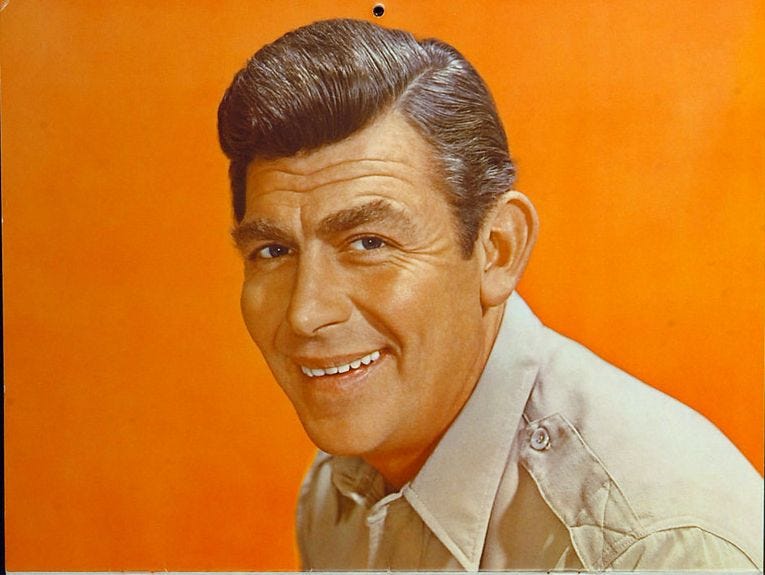
Bluegrass-country rocker Rodney Dillard, best known as the non-speaking, open-mouthed lead singer of the Darling Family hillbillies on six hilarious episodes of “The Andy Griffith Show,” relives those halcyon Mayberry years in a heart-warming feature story. In the accompanying vintage still 39-year-old Andy Griffith is seen on a December 1965 calendar advertising the witty “Romeo and Juliet” monologist’s Harrah’s Las Vegas Hotel and Casino stand-up appearances. Image Credit: The Bart Boatwright Collection

“Relax, slow down, take it easy…what’s your hurry?” Guest preacher Dr. Harrison Everett Breen of New York City delivered those soothing words to the All Souls Church non-denominational congregation in “The Sermon for Today,” a superior 1963 episode of The Andy Griffith Show encapsulating exactly the tone which made the series such a resounding pop culture juggernaut. Although not an actual town in North Carolina — Griffith’s hometown of Mt. Airy comes pretty close — Mayberry is very much alive in the hearts of millions of fans five decades after it voluntarily vacated CBS’s Monday evening lineup as television’s No. 1 program.

The Dillards were perhaps the most visibly progressive bluegrass group of the 1960s, notching watershed moments in covering Bob Dylan, transitioning to electric instrumentation, and adopting orchestral arrangements for Wheatstraw Suite and Copperfields. They graced the Griffith Show as the tight-lipped and backwoods-endorsing Darling Family in six fan favorite episodes taped between 1963–1966, mostly penned by the absurdly hilarious team of Jim Fritzell and Everett Greenbaum, who later wrote Don Knotts’ The Ghost and Mr. Chicken as well as 24 episodes of M*A*S*H.

The undisputed leader of the Dillards was songwriter-guitarist-producer-singer Rodney Dillard. Besides a still active 60-year music career, Dillard also mounts a show at churches throughout the United States with his wife, singer-banjoist Beverly Cotten, called Mayberry Values. Featuring music, behind the scenes trivia, audience participation, and Dillard’s testimony hinging on how the Griffith Show reflected a simpler time through Christian values, visit Dillard’s official website to see if they’re performing in your neck of the woods.

Stay tuned as the quick-witted raconteur exclusively addresses how the quartet was spotted at the Ash Grove club in Hollywood by Elektra Records founder and future Doors signer Jac Holzman, getting noticed by Griffith’s manager Dick Linke in a Variety magazine advertisement, stepping upon Lucille Ball’s Desilu Studios for the first time, Griffith’s guitar playing prowess, Mayberry town drunk Otis Campbell, the Aunt Bee and Alaskan Malamute anecdote, why he never spoke in Mayberry, the rolling on the floor snoring scene from the “Mountain Wedding” episode, and a play by play explanation of seven essential tunes in the Dillards’ early repertoire.
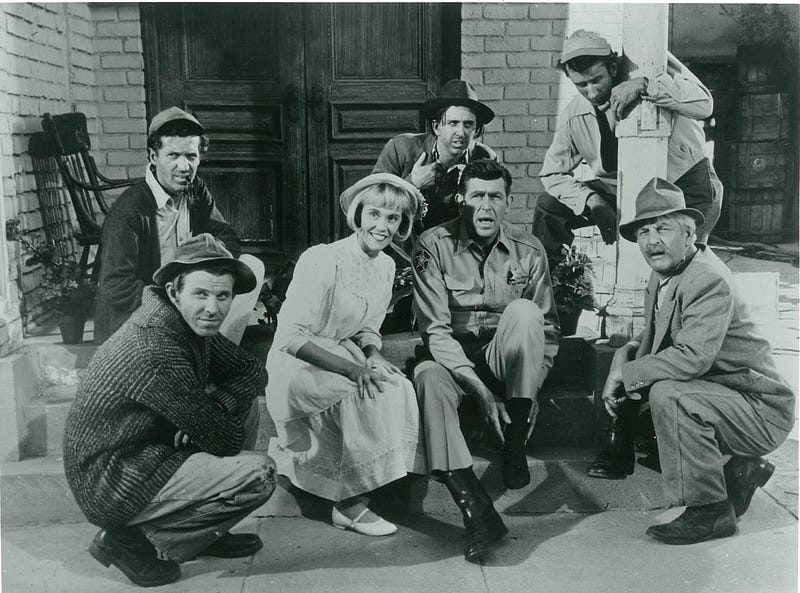
Charlene Darling [Maggie Peterson Mancuso] is bound and determined to divorce her husband Dud Wash [portrayed by Bob Denver of future “Gilligan’s Island” fame] and wed an uninterested, excuse-ready Sheriff Andy Taylor [Andy Griffith] until an omen in the black-clad figure of Barney Fife appears riding a white horse from east to west. Front row, left to right are Doug Dillard [Doug Darling], Charlene, Andy, and Denver Pyle [Briscoe Darling]. Back row, left to right are Mitch Jayne [Mitch Darling], an unruly-haired Rodney Dillard [Rodney Darling], and Dean Webb [Dean Darling] in a vintage still from the “Divorce, Mountain Style” episode of “The Andy Griffith Show,” aired on March 30, 1964. Image Credit: CBS Photo Archive

The Rodney Dillard Interview, Part One

How did the Dillards become attached to The Andy Griffith Show?

I was finishing up high school when Andy Griffith first came on the air in September 1960. We lived out in the country in Salem, so the TV reception was always very snowy. That’s how I first saw the show.

We went to California in the summer of 1962 in a ’55 Cadillac. I was just 19 then. We had $9.50 in our pockets. We weren’t used to large sums of money like that, so we ran through it in about two months [laughs]. We were performing shows on our way out there.

Anyway, once we arrived, we checked into this real cheap hotel and decided to go down to a club called the Ash Grove. It later became the Comedy Store. That was where everybody went to hang out and play. We got out our instruments and started playing in the lobby. The owner approached us and said, “You can’t play here. Do it up there.” He pointed to the stage. So we went up there and did what we did.

It so happened that Andy Griffith’s talent agency was there. William Morris is still the largest agency in the world. Elektra Records founder Jac Holzman and the Dillards’ first producer Jim Dickson were present. When we came offstage, they all drifted our way and asked us if we wanted a record deal with Elektra.

Being kids, we were like, “Yeah, sure, what’s it gonna cost us?” We signed with Elektra. About a week later they placed an ad in Variety proclaiming, “Elektra Records signs these weird looking guys from the Ozarks who play this really funny kind of music.” Hollywood didn’t know anything about bluegrass music.

Andy had a script in front of him called “The Darlings Are Coming.” It called for weird-looking guys from the mountains who played bluegrass music. He saw the Variety ad and got in touch with us.

So we went to Desilu Studios, a huge studio complex now known as CBS Television Studios. I Love Lucy, The Dick Van Dyke Show, The Untouchables, Star Trek — all these classic shows were filmed there.

As we walked into the soundstage, we saw all these people gathering around to meet us. They had heard the hillbillies were coming. Andy was shooting “Barney and the Choir,” the episode where they can’t figure out that Barney is singing horribly off-key.

I’ll never forget this — they stopped the episode in mid-shoot. Andy and director Bob Sweeney pulled up chairs and said, “Show us what you’ve got.” So we started playing, and then Andy slapped his knees and got up, exclaiming, “That’s it!” I turned to Doug and whispered, “They’re throwing us out.”

We started to pack up our instruments but Andy quickly stopped us, saying “Where are you going? You’ve got the job.” When we appeared on our first Andy Griffith Show in 1963, Salem let out the National Guard that night to watch it. True story.

We were supposed to only do one episode, but because it happened to catch on, we did a total of six. We couldn’t do more, because we were constantly on the road touring all over the world.

One time our son came running into the room and exclaimed, “Daddy’s on another one of those gray shows!” The Andy Griffith Show will always be timeless. It was an honor to be part of something that’s been on the air for over 60 years.
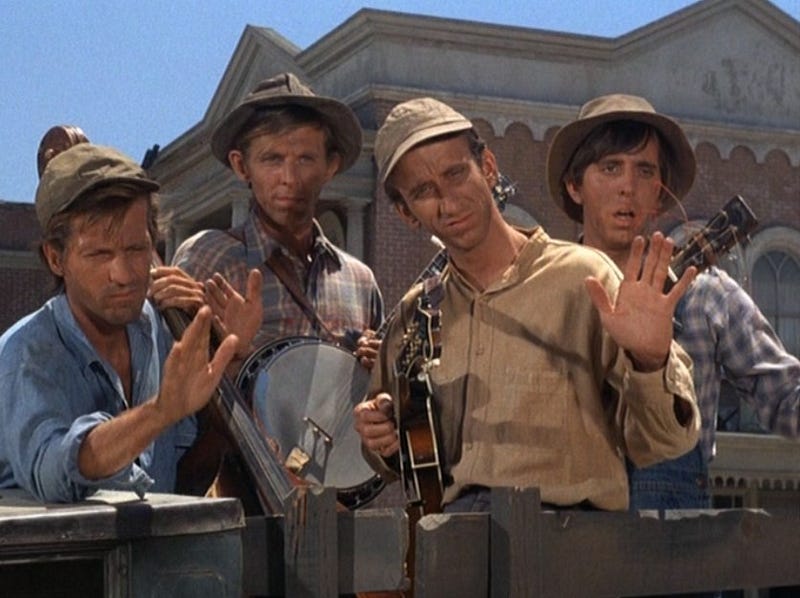
Dillards Mitch Jayne, Doug Dillard, Dean Webb, and Rodney Dillard wave hello, or is it goodbye, in “The Darling Fortune,” the Darling Family’s sixth and final appearance on “The Andy Griffith Show” aired on October 17, 1966. Image Credit: CBS Television Studios / screengrab

How do you assess Andy’s skills as a singer-guitarist?

He had this funny, kinda strange hand-style when he would play. We used to sit around and jam. I did some of the guitar playing for Andy on our episodes. He loved music, especially bluegrass music. Andy also collected instruments.

Andy was a good singer, too. He surprised me with his bass vocal on “Leaning on the Everlasting Arms.” That was also unusual to do a real gospel song on a TV show back then. It would often be something innocuous like “Oh, Happy Day.”

Which actor on The Andy Griffith Show was diametrically opposite in real life?

Hal Smith, who portrayed “Otis Campbell, the town drunk,” was truly the most different. He never had a drop of booze in his life. He was the sweetest, kindest man on the planet. Just a wonderful person. Did you know he was an accomplished voice-over artist who performed in hundreds of cartoons and commercials? Off the top of my head, Hal originally voiced “Owl” and then later “Winnie the Pooh.”
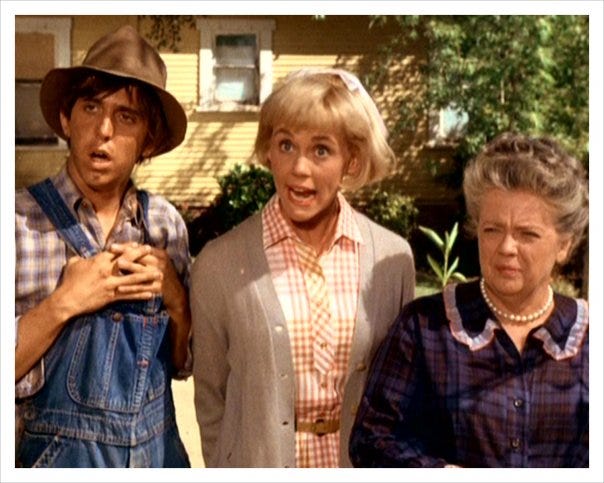
Rodney Dillard [the non-speaking, perpetually open-mouthed Rodney Darling] Maggie Peterson Mancuso [the assertive, gorgeous, vocally talented Charlene Darling], and Frances Bavier [the voice of reason-possessing Aunt Bee Taylor] are seen in “The Darling Fortune,” the Darling Family’s final appearance on “The Andy Griffith Show” broadcast on October 17, 1966. Image Credit: CBS Television Studios / screengrab

Were you on friendly terms with Frances Bavier, everybody’s favorite “Aunt Bee?”

A lot of people talk about Aunt Bee not caring very much for Andy. Never believe anything you read in books or newspapers [laughs]. She was great to us for some reason. She loved the Dillards because we hadn’t gotten into the Hollywood thing. We were still what you might call “real.” There’s a chemical change that occurs the longer you stay there [laughs].

After the first show we did, I had become very lonely for my dogs and horses left back home. So I wanted an animal, and I decided to buy an Alaskan Malamute. They are sled dogs and are really territorial animals. He weighed 115 pounds.

Anyway, I took the dog down to a veterinary clinic in Hollywood. Here I was, this hillbilly with this big dog named Wenatchee, named after the mountains where I loved to camp back in Oregon. Most of the folks there had poodles — all kinds of things shaved up and dyed lavender.

As I’m standing there with my dog, in comes Frances Bavier with her dog, a little Dachshund. She came right up to me and said hello and started a conversation. Being a kid at that time, I felt really embarrassed because I didn’t know what to say to a star.

All of a sudden, she looked me dead in the eye, and she went, “Oh, ohh, ohh…” I didn’t know what was happening. Maybe she was having a stroke. Again, she uttered those sounds. I finally followed her gaze down, and Wenatchee was marking his territory on Aunt Bee’s leg. It’s absolutely a true story, I’m not smart enough to make that up [laughs].

Later when we had filmed our second episode and knew her a bit more, she baked us a lot of brownies, gave us a basket of fruit, and gave me some great words of wisdom. She said, “I have some advice for you. This is a terrible business, and you should just go home.” And that was my relationship with Frances.
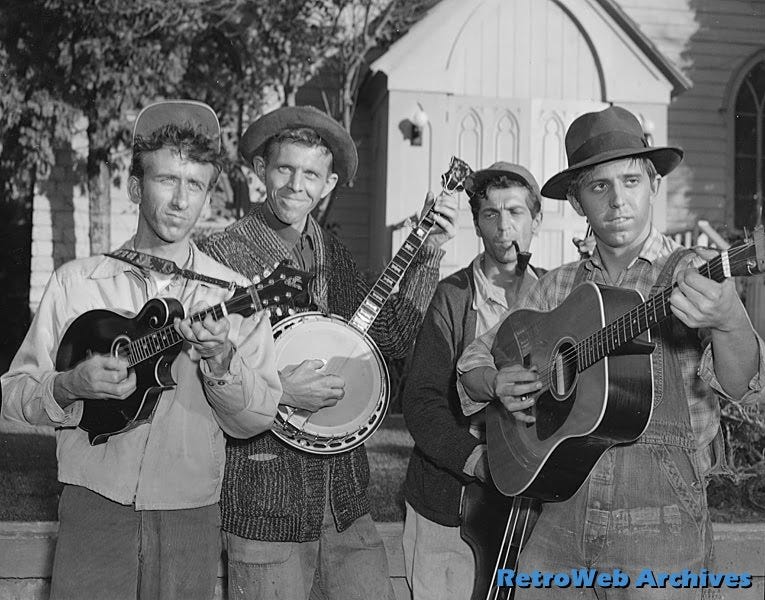
Speaking only through the music, mandolin picker Dean Webb, lightning fast banjoist Doug Dillard, stand-up bassist-emcee Mitch Jayne, and lead singer-guitarist Rodney Dillard [Doug’s younger brother] come alive while filming “The Darlings Are Coming” on February 4, 1963, the Dillards’ debut episode of beloved sitcom “The Andy Griffith Show.” Image Credit: The Bart Boatwright / Gary Wedemeyer Collection / RetroWeb Archives

Why did the Dillards rarely speak on The Andy Griffith Show?

Because they would have had to pay us. That’s really true [laughs]. Whatever they told me to do, I would do. I always kept my mouth open because the producers wanted us to look like we didn’t know anything. They wanted us to be stoic and non-communicative. You could call that a form of improvisation.

When we first started the show, Andy told us we would not get paid as actors. First of all, there were no residuals then. But he said he would try to get every one of our songs on the show that we wrote. And he did that.

We averaged five songs per show, six shows in total between 1963 and 1966 — ”The Darlings Are Coming,” “Mountain Wedding,” “Briscoe Declares for Aunt Bee,” “Divorce, Mountain Style,” “The Darling Baby,” and “The Darling Fortune.” And the show’s never been off the air since 1960.

Andy could have taken real advantage of us. We could have been told to only perform public domain songs and never gotten a penny. Collectively, I think we made $375 for each show. That’s the kind of man Andy Griffith was.
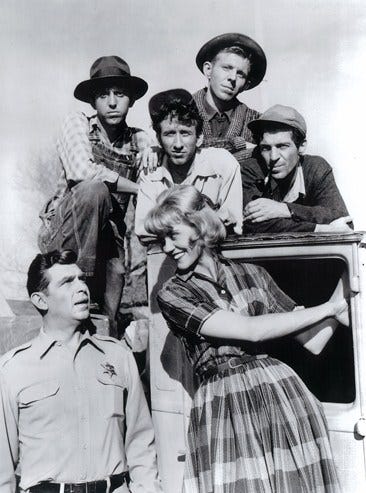
Lord help the fine citizens of Mayberry as “The Darlings Are Coming!” Rodney Dillard, Dean Webb, Doug Dillard, and Mitch Jayne of the Dillards progressive bluegrass band are seen aboard the mountain clan’s 1928 Ford Model AA flatbed truck. Love-lorn, breath-taking sister Charlene Darling [Maggie Peterson Mancuso] has her eyes firmly set on an uncomfortable Sheriff Andy Taylor [Andy Griffith] in this vintage still from the Darling Family’s debut episode of “The Andy Griffith Show,” filmed February 4, 1963, on the Desilu “40 Acres” backlot. Image Credit: CBS Photo Archive

Did any of your suggestions make it into the show?

The one time, believe it or not, was when Charlene [Maggie Peterson Mancuso]’s husband, Dud Walsh [Hoke Howell], was twisting his face in a scene where he was saying how he would use guerilla warfare to take care of Ernest T. Bass [“Mountain Wedding,” 1963].

I remarked to someone on the set, “My mama had a saying that she would say to me all the time if I was whining or crying — ‘Do you want your face to freeze that way?’” So Denver Pyle [“Briscoe Darling”] used my suggestion, and it’s featured in the episode.

The only improvisation scene we ever did was the snoring scene in that same episode. That was total improv. Beverly, my wife, hears that every night [laughs].
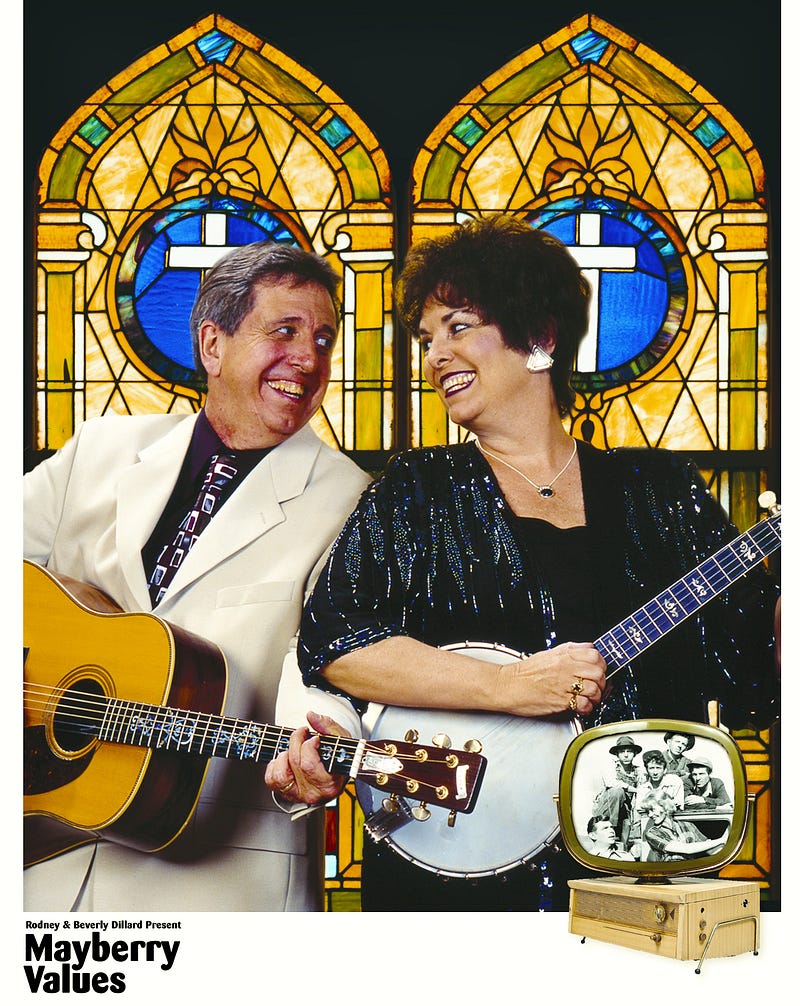
Acoustic guitar maestro Rodney Dillard and banjo-wielding wife Beverly Cotten-Dillard promote their Christian-themed Mayberry Values ministry circa 2006. The lead singer of the mountain-living Darling Family on “The Andy Griffith Show,” Rodney gives his inspiring “Andy Griffith Show” testimony in churches across the United States. Image Credit: Courtesy of Rodney Dillard

What exactly is a Mayberry Minute?

Mayberry Minute was a radio show that I narrated which ran nationally for three years beginning around the year 2001. The show consisted of 60-second stories written by Rene Ray and myself about different episodes.

We would present a short summary of a particular episode and then present a positive thought from that show to live by. “There’s always something to be learned from Mayberry” was the tagline, and that is certainly true all these years later. My albums I Wish Life Was Like Mayberry [2010] and Don’t Wait for the Hearse to Take You to Church [2011] featured a handful of show samples as bonus material.

Beginning with “There Is a Time”, what is the story behind the following classic bluegrass tunes in the Dillards’ repertoire?

The late Mitch Jayne wrote “There Is a Time” in 1963, and I helped. Even though I wasn’t a Christian at the time, we based it on the book of Ecclesiastes, since I was raised in a church. Andy Griffith liked it a lot. He ultimately sang it on the show, Charlene sang it, and then the Dillards performed it, too.

“The Old Home Place”

Written by Mitch and Dean Webb, this song describes what happens when you leave home and then return after a long spell, and the home isn’t there anymore.

“Dooley”

It’s about an old boy from Salem who made moonshine whiskey for 25 consecutive years. He would come into town in his pickup truck every Saturday and load five 100-pound sacks of sugar in the back of his truck.

He never got caught, never went to jail, but everybody in town knew he was making whiskey. They knew he wasn’t making fudge up there on that ridge [laughs]. Written by Mitch and myself in 1963, “Dooley” has been very, very good to us over the years.

“Doug’s Tune”

We filmed The Andy Griffith Show like a movie, using a single camera. Since it would take hours to set up one shot, we would go to Andy’s dressing room and pick. He absolutely loved bluegrass music.

Anyway, one day Doug was noodlin’ around with a tune. Andy became curious and asked, “Doug, what is that?” Doug looked him dead in the eye and sheepishly admitted, “I don’t know.” You would have to know my late brother’s disposition to understand the full weight of his statement. Andy replied, “Well, why don’t we call it ‘Doug’s Tune?’” Shortly thereafter, Andy graciously included a segment of us performing it on the show.
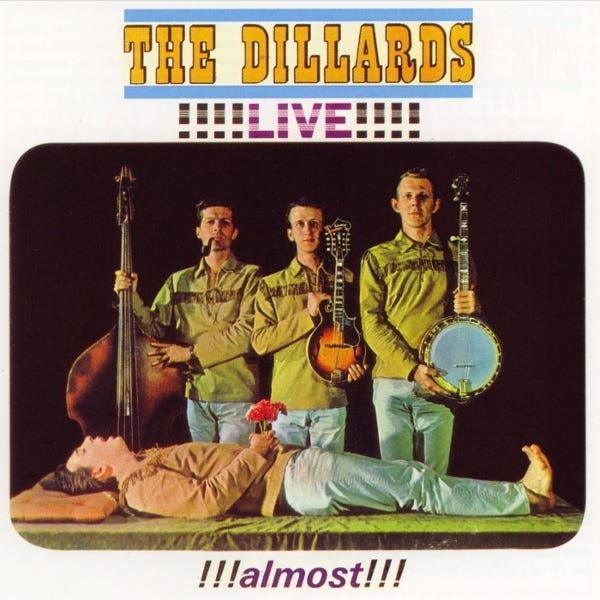
He died with his boots off and mouth open: Doghouse bassist Mitch Jayne, mandolinist Dean Webb, and banjoist Doug Dillard fondly bade farewell to lead singer-guitarist Rodney Dillard with a small bouquet of dark pink carnations on the cover of “Live!!!!Almost!!!,” the Dillards’ second, unfortunately non-charting album distributed in August 1964. Photography by William S. Harvey / Elektra Records

“Walkin’ Down the Line”

I still remember the first significant place they sent us after we made our first appearance on Andy Griffith. It was the 1963 Newport Folk Festival. I heard Bob Dylan perform for the first time there. We were the first bluegrass group to cover Dylan. He’s a great songwriter, but he’s got a voice very much like a dog caught with his leg in a car door [laughs].

“The Whole World Round”

What happens when you can hear your neighbor’s car start up or the low end wolfer on somebody’s jeep who’s two miles away? A lonesome song, written by Mitch and Joe Stuart in 1964, that you could classify as sort of an early precursor to “There Goes the Neighborhood,” the title cut of my 2001 album on Varese Sarabande Records.

“Ebo Walker”

I liken this song to the lyrical counterpoint of “Dooley.” It is the other, tragic end of the tale. Written by Mitch and myself in 1964, it’s about a man who died from drinking tractor radiator alcohol. He was our town drunk in Salem. By the way, there is a real Ebo Walker, but he’s not the town drunk — he was a stand-up bass player for New Grass Revival.

******************DON’T GO ANYWHERE YET*******************

Exclusive Interview: Eagles frontman Don Henley admitted during promotion for his chart-topping Cass County country-leaning record that “Wheatstraw Suite, which came out in 1968 — was a very influential album in my life…I was a big fan of the Dillards. In fact, I drove through a snowstorm to hear them play in Fort Worth back in 1968. I just thought ‘She Sang Hymns Out of Tune’ was the most interesting song and they were an interesting band.” Dean Webb, a founding member of the pioneering country rockers, graciously agreed to examine his nearly 60-year professional music career in a sweeping interview called “The Dillards’ Secret Weapon: In Step with Mandolin Maestro Dean Webb.”

Further Reading: Griffith and Knotts sing about friendship, ill-advisedly demonstrate firearm and judo safety procedures, and tug at heartstrings in a 1965 color variety special skit not seen in 50 years. It proves that the actors were masters of comedic timing and relished performing together in front of a live audience. The Southerners later collaborated in a funny yet touching 1967 episode, “Barney Comes to Mayberry,” that landed Knotts his fifth and final Emmy. And if you’ve ever been curious about Knotts’ musical variety appearances, an additional article of mine distills Don Knotts: Tied Up with Laughter, a DVD collecting the rubber-faced comedian’s 1970 episode hosting The Hollywood Palace as well as bonus material including the hysterical nervous master of ceremonies routine].

© Jeremy Roberts, 2012, 2017. All rights reserved. To touch base, email [email protected] and mention which story led you my way. I appreciate it sincerely.

Andy Griffith
The Dillards
Interview
Television
Bluegrass
Recommended from ReadMedium