avatarJeremy Roberts

Free AI web copilot to create summaries, insights and extended knowledge, download it at here

14891

Abstract

ake sure I knew which direction and concept to take the band in. It took me that long to put the album together in my head.</p><p id="addf">The title “Wheatstraw Suite” was sort of a rural name that I liked. We added various strings and an orchestra to tracks, and nobody in bluegrass was doing that back then. It might be difficult to believe today, but bluegrass guys just hated me for doing that in 1968. But in the long run it was okay. Always do what your heart tells you.</p><figure id="eab3"><img src="https://cdn-images-1.readmedium.com/v2/resize:fit:800/1*drWviOPTHKzd7xQj5tk8zw.jpeg"><figcaption><b>Mandolinist-backing vocalist Dean Webb, emcee-acoustic bassist Mitch Jayne, banjoist-rhythm guitarist-singer Herb Pedersen, and lead singer-guitarist-producer Rodney Dillard are captured in concert on February 18, 1970, at the University of California, Riverside, plugging the release of the Dillards’ fourth studio album “Copperfields,” unleashed in January 1970 on Elektra Records. The critically acclaimed country rock follow-up to 1968’s “Wheatstraw Suite” criminally did not chart but contained fine covers of Harry Nilsson’s “Rainmaker,” the Beatles’ “Yesterday,” Eric Andersen’s “Close the Door Lightly,” along with 10 group originals featuring “Old Man at the Mill.” Photography by Bob Clevenger</b></figcaption></figure><p id="a700"><b>Herb Pedersen’s angelic tenor vocals are all over <i>Wheatstraw Suite</i> and <i>Copperfields</i>. Why did he leave the Dillards?</b></p><p id="2eb6">Herb left in 1971 because he wanted to try his solo effort. There were absolutely no ill feelings. He later did quite well when he joined Chris Hillman and formed the Desert Rose Band in 1985 [they had a string of Top Ten country hits in the late ’80s. “He’s Back and I’m Blue” and “I Still Believe In You” both skyrocketed to number one].</p><p id="1f3e">Herb reunited with us for a trio of records — <i>Decade Waltz </i>[1978],<i> Mountain Rock</i> [1979],<i> Homecoming and Family Reunion </i>[1980] — and last played with us in 1990 on the <i>Let It Fly</i> record. We got a Grammy nomination for one of the songs on the album, “Darlin’ Boys.” I still get together with him just to pick. We did a concert together several years ago. He mainly stays busy playing with Chris Hillman and the Desert Rose Band.</p><p id="801b">I’ve thought about doing another project with Herb, but life kinda goes on. You just never get around to doing it until it’s too late. But I’ve entertained the notion — if somebody ever wanted us to do something, I’d be all up for it.</p><figure id="4f6f"><img src="https://cdn-images-1.readmedium.com/v2/resize:fit:800/1*73Ak6pFYLVqk7uvdcJGqmQ.jpeg"><figcaption><b>Starting clockwise from the left, singer-guitarist Rodney Dillard, banjoist-singer Herb Pedersen, drummer Paul York, mandolinist Dean Webb, guitarist-bassist Doug Bounsall, and stand-up bassist Jeff Gilkinson converge around a cafe table for the Dillards’ 10th album. Distributed by the since-defunct Crystal Clear Records, “Mountain Rock” is remembered for being the first digital recording and was tracked without overdubs between January 27 and 28, 1979, in Berkeley, California. Image Credit: Discogs</b></figcaption></figure><p id="187b"><b>Do you have any idea how many albums the Dillards have sold?</b></p><p id="6dc9">Not really — I do know that the direct-to-disc album we did called <i>Mountain Rock </i>[1979] on Crystal Clear Records sold 80,000 records. It was the first digital recording before digital tape. You went in and cut directly to acetate, like the old days. You had to start the machine. It would begin carving the grooves in the record.</p><p id="5114">You didn’t stop recording until the album was done. They would hit you with a red light. You had to start again when you got the green light. You better be ready and in tune for the next song. And that was a lot of pressure.</p><p id="f2ff">Our publicist finally hired a lawyer and went after Elektra, Warner Bros., and Asylum after many years because we hadn’t received any royalties. They said, “Oh, we thought the group was dead.” We ultimately started getting our royalties, over 20 years after we recorded most of the music. Welcome to the record business.</p><p id="3ba0">The record industry is crooked. It destroyed itself, because they would never report all the sales to the artist. Since 1991, Nielsen SoundScan has been available. Every time you sell records, even if they’re sold at our shows, we report it on SoundScan. That’s how you get on the charts.</p><p id="fca3">It’s real now. Used to, if you got on the Billboard Hot 100, somebody bought it onto the charts so it would get started. We landed on the Southern Gospel charts legitimately with <i>Don’t Let the Hearse Take You to Church</i> [2011].</p><figure id="52c3"><img src="https://cdn-images-1.readmedium.com/v2/resize:fit:800/1*9QVSkL5cUolFiDGqL8NX3w.jpeg"><figcaption><b>In June 1971, an unabashed hippie bum eggs on mandolin maestro Dean Webb, banjoist Billy Ray Latham, emcee-doghouse bassist Mitch Jayne, and lead singer-guitarist Rodney Dillard of the Dillards during a hysterical portion of their bluegrass-country rock set at the sixth annual Culpeper-Warrenton Bluegrass Festival in Virginia. Drummer Paul York is completely obscured. Photography by Fred Robbins / FRobbi.org</b></figcaption></figure><p id="fd73"><b>How has the Internet affected the record industry?</b></p><p id="f1dc">Everything is changing — everything. There was a time when you had freeform radio, and everything had a chance to be heard. Then the ’80s rolled around, and that’s when I started to lose interest in music. You had formula music, where people came along and said, “Okay, you’ve got a lick here, now do this, dah dah dah…” After awhile, all the pop music started sounding the same.</p><p id="41c0">Now if you were born in the Internet era, that’s a good thing. Madison Avenue and the big marketing people who controlled the taste of America and the world lost that ability when the Internet arrived.</p><p id="1fa0">You can throw stuff up on YouTube and see a lot of different things. I’m glad, because you can have a broader view of what people are doing music wise. Before, it was all how they hyped it and sold it to you, like soap.</p><p id="452f">The Internet has caused the record companies to go down the tubes. Albums won’t survive. Of course, there’s retro-minded people who will keep that format alive. Jac Holzman, the founder of Elektra, came to see me in June 2011 while we were playing a festival in California. He said, “Rodney, we’re re-releasing all the Dillards’ Elektra records on vinyl.” I remarked, “Okay, alright” [laughs].</p><p id="3839">See, what those albums are is distortion. If you get too clear, it gets so clear it hurts the ears. They tire easily listening to digital music. The resident frequency of the human ear is between 3 and 4 k. People used to try to get better mics to take away that distortion that tape created. When digital came in, they all went back to find the old mics, so they could get that sound again.</p><p id="e917">Downloading is the thing everybody’s doing now. In fact, that’s how we released our last two singles. Everybody’s searching to find the best way to market their wares. But it will always come down to content. Like a good book — if it’s a good book, people will buy it. If it’s not, they won’t.</p><p id="0d08">Music all started when the first caveman hit the other one in the head with a bone and got a sound. Then he lined up eight other cavemen…thwoop, thwoop, thwoop! [laughs]. Anyway, I don’t know where music’s gonna go from here. There’ll come a time I guess when you’ll be able to think your music and the other person will be able to receive it.</p><figure id="fe01"><img src="https://cdn-images-1.readmedium.com/v2/resize:fit:800/1*VEJuqDCnfe-h_l30f2H7jQ.jpeg"><figcaption><b>The CD cover of the 29-track “Let the Music Flow: The Best of 1963–1979,” just the second ever anthology documenting the Dillards’ stellar discography dropped on May 31, 2005. Left to right are banjoist-guitarist-singer-songwriter Herb Pedersen [founding member Doug Dillard’s replacement], lead singer-guitarist Rodney Dillard, emcee-acoustic bassist Mitch Jayne, and mandolinist-harmony singer Dean Webb during their country rock “Wheatstraw Suite” era in 1968. Image Credit: 45Worlds user Lee Wrecker / Elektra Records / Raven Records</b></figcaption></figure><p id="a2e1"><b>Do you have much say-so in reissues of the Dillards’ catalogue?</b></p><p id="44dc">Companies re-release our albums or put out compilations, and we’re rarely interviewed or put in the loop [Critic Richie Unterberger and Collectors Choice Music did a fantastic job on the 2002 Elektra reissues].</p><p id="055c">They usually think, ‘Oh wait, we’re make some money off of this.’<i> </i>They’re trying to do something to boost their sales by thinking going back might help because they can’t find anything new. Somebody reported to me recently about maybe reissuing <i>Roots and Branches</i> in Surround Sound. I don’t know.</p><p id="286e">Raven Records in Australia put out one in 2005 called <i>Let the Music Flow: The Best of 1963–1979. </i>Bob Dylan’s “One Too Many Mornings,” which we recorded as a single for White Whale Records in 1969, is on there.</p><p id="04f2">[Dillard sings the lyric “Down the street the dogs are barkin,’ and the day is a-gettin’ dark, as the night comes in a-fallin,’ the dogs’ll lose their bark…for I’m one too many mornings and a thousand miles behind”]. Chip Douglas, a friend of mine, produced that single for us in 1969 on White Whale Records.</p><figure id="35d7"><img src="https://cdn-images-1.readmedium.com/v2/resize:fit:800/1*p7VjTzVmyuw6peC_NlIO3g.jpeg"><figcaption><b>Hot dog, we’re finally in! Mandolinist Dean Webb, bassist-emcee Mitch Jayne, singer-guitarist Rodney Dillard, and extremely jubilant banjoist Doug Dillard of the Dillards receive their induction into the International Bluegrass Hall of Fame in Nashville on October 1, 2009. Banjoist-guitarist John McEuen of the Nitty Gritty Dirt Band, partially obscured behind Doug, inducted the innovative bluegrass outfit. Mitch and Doug are since deceased. <i>Image Credit: The Andy Griffith Show Rerun Watchers Club</i></b></figcaption></figure><p id="e323"><b>What is the current status of the Dillards?</b></p><p id="2d60">It’s what it’s always been. When you think about it, the original Dillards weren’t together that long — five years from 1962 to 1967. That’s when Doug left. I later received a Grammy nomination for my production work on Doug’s <i>Heartbreak Hotel</i> album in 1988. I hadn’t played with him in a few years. But we played together for a long time.</p><p id="27de">Doug had a different approach to what he wanted to do. I’m not sure he knew what his approach was [laughs]. He became semi-retired and got to really enjoy life until health problems, exacerbated by a collapsed lung, ultimately took their toll on May 16, 2012. I miss him terribly.</p><p id="b248">Dean has always been an outstanding mandolin player. On our records, he would sing the parts that Herb Pedersen and I didn’t sing. Having Dean’s voice kept the band’s identity intact.</p><p id="8c0e">Dean has his own <a href="http://www.missouriboatride.com/">bluegrass group called Missouri Boatride</a>. I saw him last summer at a festival where both our groups were playing. He just wants to do his own thing — we both do. We spent so much time together, and we needed a break [in spite of various personnel changes over the years, Webb and Dillard were the only consistent members].</p><p id="888a">Mitch was having trouble hearing, and he began to plot his exit from the band during the <i>Roots and Branches </i>sessions. However, for the follow-up album, <i>Tribute to the American Duck, </i>he returned with a vengeance, co-writing over half of that record.</p><p id="1dfc">He moved back to our hometown in Salem, Missouri, after his mother died. She was a Dole of Dole Pineapple and left him a whole bunch of money. So Mitch built a log cabin and retired in the woods for the most part. The band continued for many years after his departure.</p><p id="0553">Billy Ray Latham [replaced Pedersen on banjo in 1971] was in a terrible car accident [November 2004]. The cops were chasing an illegal Mexican in Nashville, and his car hit Billy head-on at 90 mph. Billy almost died, as both his legs, right knee and femur, arms, and left hip were badly broken. He also received a significant head injury.</p><p id="1f23">It really messed him up, but after being in a coma for a week and remaining in the hospital for six months, Billy Ray is on the mend. He had to learn how to play all over again. It’s still tough going for him, but he hasn’t given up.</p><p id="b894">Once in awhile the original Dillards would get together for reunion tours. Unfortunately, Mitch and Doug are permanently out of the picture now.</p><p id="9f61">Even if someone offered us an incentive, I doubt it would happen. It’s over, that’s past, that’s done. It wouldn’t be the same, it wouldn’t possess the right quality or energy it should have. It simply wouldn’t be productive.</p><p id="b1a2">I was the youngest one in the Dillards and the one who was doing all the singing and arranging of the tunes. I decided to keep on going as long as people would let me [laughs], because that’s what I do.</p><figure id="60c8"><img src="https://cdn-images-1.readmedium.com/v2/resize:fit:800/1*jjIMzDVay9zC42b8e8orFw.jpeg"><figcaption><b>The DVD cover of “The Dillards: A Night in the Ozarks — An Audiolithograph,” distributed on November 14, 2006, and produced and directed by former Nitty Gritty Dirt Band multi-instrumentalist John McEuen. The progressive bluegrass outfit, consisting of lead singer-guitarist Rodney Dillard, mandolinist-harmony singer Dean Webb, emcee-doghouse bassist Mitch Jayne, and lightning quick banjoist Doug Dillard, are seen backstage at their sold out performance at New York’s Carnegie Hall on November 30, 2002, although the independent documentary was actually filmed live in a Salem, Missouri, farmhouse years earlier in 1989. Photography by Diana Jayne / Varèse Sarabande</b></figcaption></figure><p id="fc17"><b>What is the Dillards’ legacy?</b></p><p id="2d76">John McEuen of the Nitty Gritty Dirt Band, who was really influenced by our music, did a wonderful job on <i>A Night in the Ozarks</i> [a 1989 independent documentary featuring interviews and live performances]. He’s got such insight, and he’s really talented at being able to pull things like that together. That video really illustrates our legacy.</p><p id="a271"><i>Rolling Stone</i> always gave me credit for being the father of country rock, and that kinda stuck. It’s great, I never had a hit-hit, but I would rather do what I’ve done over the year

Options

s than be a one-hit wonder. You get one song that’s the pick flower of the day, and then it’s over.</p><p id="0156">Our publisher tells me every day an artist is requesting a song from one of my albums to record. I’m very thankful for that. I’m just thankful to be alive [laughs].</p><p id="f150"><b>Do you have time to just hang out and jam?</b></p><p id="d427">Not so much anymore, because we’re always out on the road. When we’re out at the farm, we’ll sit and pick. I’ll get up out of bed and start pickin’ away if I get a song idea or melody going. Beverly has been woken up on more than one occasion by my plunking [laughs]. I mainly like to just sit down with my guitar and see if I can come up with new stuff as opposed to jamming with friends.</p><p id="c86e">We don’t do very much rehearsal before we play a show. But it’s always fun to get together with the guys. They’re capable of playing anything. It’s like a football player going out and throwing the ball around a bunch of times. It gets your blood going.</p><figure id="7f7f"><img src="https://cdn-images-1.readmedium.com/v2/resize:fit:800/1*k4Yzzb2OjiAEKVITFVfOOQ.jpeg"><figcaption><b>Former Nitty Gritty Dirt Band banjoist and multi-instrumentalist John McEuen, sound engineer Tim Cooney, Dillards lead singer Rodney Dillard, country hitmaker Ricky Skaggs, Nitty Gritty Dirt Band lead guitarist Jeff Hanna, and producer-songwriter-guitarist Randy Scruggs are pictured during the star-studded sessions for the Dirt Band’s “Will the Circle be Unbroken, Vol. 3,” ultimately released on October 1, 2002. Dillard and Skaggs duetted on the Dillards’ esteemed “There Is a Time,” written by Dillard and Mitch Jayne in 1964 and originally part of the “Live!!!! Almost!!!” album. Image Credit: The Tim Cooney Collection / Wikimedia Commons</b></figcaption></figure><p id="12ed"><b>How many instruments can you play?</b></p><p id="05b1">I dabble at everything, I’m not a master of none. There are no rules in recording when you make rules. Anything you try, if it succeeds, then you’ve set a precedence. That was absolutely the philosophy of the Beatles. Their producer, George Martin, was a genius. He managed to merge all that orchestration with what they were doing at the time. That’s real innovation.</p><p id="7b47">I did get an opportunity to meet the Beatles’ press officer, Derek Taylor. Doug was friends with John Lennon and Ringo while they were in L.A. during the early ’70s. My brother was a bachelor at the time, while I was married to my first wife [Linda Carey] with a new toddler [Brian].</p><p id="5120"><b>Do you still play any electric guitar?</b></p><p id="a578">I gave my last electric guitar, a really pretty purple Blade, away to a friend who’s a really good jazz player. I don’t have an electric guitar anymore; all mine are acoustic. My daughter, Rachel, has one.</p><p id="69a9">I haven’t played an electric onstage since Beverly, Dean Webb, and I had our show at the Silver Dollar City Amphitheatre in Branson [1982–1988]. Beverly would perform on banjo and sing her own songs during the show.</p><p id="32eb">I’m coming full circle today — I’m back to acoustic again. Electric finally got to me after awhile, too many frequencies clashing. A bluegrass ensemble is very much like a string quartet, almost the perfect vibe of frequencies. That’s what a string quartet is — a perfect frequency convergence. I just got into the real finessing of real, non-disguisable finessing.</p><figure id="00af"><img src="https://cdn-images-1.readmedium.com/v2/resize:fit:800/1*wyUG6qflFD20TYKgLUtG_g.jpeg"><figcaption><b>Sixty-nine-year-old original Dillards frontman Rodney Dillard and personable banjo-pickin’ wife Beverly Cotten are seen moments after an inspiring Mayberry Values story-song presentation at Frederica Baptist Church in St. Simons Island, Georgia, on September 25, 2011. Dillard portrayed introverted mountaineer Rodney Darling on six gut-busting episodes of “The Andy Griffith Show” between 1963 and 1966. Photography by Jeremy Roberts</b></figcaption></figure><p id="2eee"><b>Is it true that your lovely wife Beverly Cotten appeared on <i>Hee Haw</i>?</b></p><p id="5334">Yes; she was opening for the Dillards in Nashville in 1982 when <i>Hee Haw</i> representatives came up to her and said, “We like what you do. Would you like to do <i>Hee Haw</i>?” After she stood there incredulously for a few seconds and finally agreed, they said, “Well, come on and meet the producer, Sam Lovello.”</p><p id="3e9f">She clogged, played banjo, and did her whole act for the official audition. She must have passed it. Anyway, she was featured in a couple of guest spots.</p><p id="2b44">She got to salute her hometown of Morrisville, North Carolina. Morrisville encompasses all these yuppie, big million dollar houses and golf courses today. Then there were only about 250 people in the city, and most of them were her cousins.</p><p id="6de8">Her uncle was the mayor, and he wanted to sound big on <i>Hee Haw</i>. So he annexed the trailer park down the road and made it 480. When Beverly got to salute, she was dancing while she said, “Salute my hometown of Morrisville, NC, population 480. Except when I’m home, then it’s 481! And everyone in the corn field jumped up and yelled, “Salute!”</p><p id="dc45">Her whole family watched it at home. Beverly’s mom even made a star with aluminum foil on it and placed it on their front door. I know she had a lot of fun doing it. By the way, she got her picture made sitting on comedian Junior Samples’ lap. That was an abundant lap [laughs].</p><p id="4b8e">Beverly has also performed with Buck Trent, and she performed with the Grand Ladies of the Grand Ole Opry and also served as their emcee for two years in Branson.</p><p id="a6b7">The Grand Ladies included Helen Cornelius, Jean Shepard, Mary Lou Turner — “Sometimes” and “That’s What Made Me Love You” were hit duets with Whisperin’ Bill Anderson in the late ’70s — Merle Haggard’s third wife and “Bull and the Beaver” duet partner Leona Williams, and “pretty little” Miss Norma Jean. They would rotate, but she was there all the time. An old timey style banjo picker, Beverly can play some mean claw-hammer banjo.</p><p id="b1dd"><b>How important is it to nurture a relationship with an audience?</b></p><p id="b2da">Live performances are becoming a rarity where you have actual entertaining at the same time you’re playing music. Entertainment is very important and how you relate to an audience.</p><p id="6271">Back in the mid-‘70s rock and roll became rock theater with lighting, smoke, guys wrapping snakes around themselves, doing all these tricks…because they could not actually communicate with an audience. So rock became a circus, and then Cirque du Soleil became rock [laughs].</p><p id="eba3">Now we’re trying to make a show out of our concerts, not just get up there and say, “Thank you very much. A great big howdy and a couple doody’s to you. Kick her off there, Wichita!” [laughs].</p><p id="7609">Our setlists are never written down in stone. I love to see and hear what a crowd wants to hear. Spontaneity is essential to my live shows. Beverly has to be on her toes because I’ll always bring her out at different times [laughs].</p><p id="df4b">Plus, I love to be right in the middle of the crowd. That’s why I like indoor theatres, because every nuance, every movement, and every subtlety — if you’re doing comedy — they get. It’s hard when you have a show set up like a rock concert — the audience is far away from the stage.</p><p id="179e">We’re gonna tour around the country as much as we can. Last summer we were gone for three months. This past summer we were only home for maybe two weeks. As long as guys like you keep writing about us, we’re keep doing it. You’re keeping us alive.</p><div id="2043" class="link-block"> <a href="https://readmedium.com/a-mayberry-minute-with-andy-griffith-show-alum-rodney-dillard-9f649add31f8"> <div> <div> <h2>A Mayberry minute with ‘Andy Griffith Show’ alum Rodney Dillard [PART ONE OF THE INTERVIEW]</h2> <div><h3>“Relax, slow down, take it easy…what’s your hurry?” Guest preacher Dr. Harrison Everett Breen of New York City…</h3></div> <div><p>medium.com</p></div> </div> <div> <div style="background-image: url(https://miro.readmedium.com/v2/resize:fit:320/1*cSRtL4ZgSt3hb_0qeI8pRw.jpeg)"></div> </div> </div> </a> </div><div id="e2f8" class="link-block"> <a href="https://readmedium.com/when-the-dillards-bumped-into-steve-mcqueen-on-a-hollywood-street-c645967168d3"> <div> <div> <h2>When the Dillards bumped into Steve McQueen on a Hollywood street [PART TWO OF THE RODNEY DILLARD INTERVIEW]</h2> <div><h3>The Dillards are to bluegrass what Steve McQueen was to film cinema — supreme innovators during a decade when…</h3></div> <div><p>medium.com</p></div> </div> <div> <div style="background-image: url(https://miro.readmedium.com/v2/resize:fit:320/1*1SYG6X31-SDD98TB5QPIgA.jpeg)"></div> </div> </div> </a> </div><div id="9476" class="link-block"> <a href="https://readmedium.com/further-into-rock-territory-rediscovering-the-dillards-blazing-roots-and-branches-1972-album-e9acf86f8039"> <div> <div> <h2>Further into rock territory: Rediscovering the Dillards’ blazing ‘Roots and Branches’ 1972 album [PART THREE OF THE RODNEY DILLARD INTERVIEW]</h2> <div><h3>Surviving Dillards Rodney Dillard and Dean Webb recall the bluegrass band’s ballsy bid for mainstream rock success with…</h3></div> <div><p>medium.com</p></div> </div> <div> <div style="background-image: url(https://miro.readmedium.com/v2/resize:fit:320/1*972zEwSbYiDehlejdXDwfw.jpeg)"></div> </div> </div> </a> </div><div id="8c62" class="link-block"> <a href="https://readmedium.com/rodney-dillards-miraculous-christian-transformation-64d74108a1a4"> <div> <div> <h2>Rodney Dillard’s miraculous Christian transformation [PART FOUR OF THE INTERVIEW]</h2> <div><h3>Part of Elektra Records’ eclectic 1960s roster that also claimed Jim Morrison and the Doors, Dillard details his…</h3></div> <div><p>medium.com</p></div> </div> <div> <div style="background-image: url(https://miro.readmedium.com/v2/resize:fit:320/1*ZUo8sLvRCHovGMUeq65eJg.jpeg)"></div> </div> </div> </a> </div><div id="d4a5" class="link-block"> <a href="https://readmedium.com/the-dillards-secret-weapon-in-step-with-mandolin-maestro-dean-webb-7a476a27bf7a"> <div> <div> <h2>The Dillards’ secret weapon: In step with mandolin maestro Dean Webb</h2> <div><h3>“Wheatstraw Suite was a very influential album in my life,” admitted Eagles co-frontman Don Henley during promotion for…</h3></div> <div><p>medium.com</p></div> </div> <div> <div style="background-image: url(https://miro.readmedium.com/v2/resize:fit:320/1*P8rt17UCo8BhSW3FgYIP9g.jpeg)"></div> </div> </div> </a> </div><figure id="1caf"><img src="https://cdn-images-1.readmedium.com/v2/resize:fit:800/1*5yGnOSYfzPSo7eNvxTRsvw.jpeg"><figcaption><b>“Gentle on My Mind” songwriter John Hartford is interviewed in the KPFT Radio studio in Houston, Texas, along with founding Dillards Dean Webb [mandolin, harmony vocals] and lead singer-guitarist Rodney Dillard on August 21, 1977, five days after Elvis Presley’s passing. Photography by Rick Gardner / Classic Bluegrass Pictures [Facebook]</b></figcaption></figure><figure id="0829"><img src="https://cdn-images-1.readmedium.com/v2/resize:fit:800/1*yu1uPPtXGYhFpLvmQ0PayQ.jpeg"><figcaption><b>Fiddle hotshot George Giddens, acoustic bassist Shane Lail, and acoustic guitarist Rodney Dillard perform at the annual Gram Parsons Guitar Pull and Tribute Festival on September 23, 2011, in Waycross, Georgia. Photography by Jeremy Roberts</b></figcaption></figure> <figure id="e5d6"> <div> <div> <img class="ratio" src="http://placehold.it/16x9"> <iframe class="" src="https://cdn.embedly.com/widgets/media.html?src=https%3A%2F%2Fwww.youtube.com%2Fembed%2FGsCuxhJqWm8%3Ffeature%3Doembed&amp;url=http%3A%2F%2Fwww.youtube.com%2Fwatch%3Fv%3DGsCuxhJqWm8&amp;image=https%3A%2F%2Fi.ytimg.com%2Fvi%2FGsCuxhJqWm8%2Fhqdefault.jpg&amp;key=a19fcc184b9711e1b4764040d3dc5c07&amp;type=text%2Fhtml&amp;schema=youtube" allowfullscreen="" frameborder="0" height="480" width="854"> </div> </div> </figure></iframe></div></div></figure> <figure id="0a2c"> <div> <div> <img class="ratio" src="http://placehold.it/16x9"> <iframe class="" src="https://cdn.embedly.com/widgets/media.html?src=https%3A%2F%2Fwww.youtube.com%2Fembed%2FNKTTHMUhzCU%3Ffeature%3Doembed&amp;url=http%3A%2F%2Fwww.youtube.com%2Fwatch%3Fv%3DNKTTHMUhzCU&amp;image=https%3A%2F%2Fi.ytimg.com%2Fvi%2FNKTTHMUhzCU%2Fhqdefault.jpg&amp;key=a19fcc184b9711e1b4764040d3dc5c07&amp;type=text%2Fhtml&amp;schema=youtube" allowfullscreen="" frameborder="0" height="480" width="854"> </div> </div> </figure></iframe></div></div></figure><div id="a534" class="link-block"> <a href="https://readmedium.com/when-merle-haggard-sang-the-stellar-i-am-what-i-am-on-the-tonight-show-with-jay-leno-afc5f9b65bda"> <div> <div> <h2>When Merle Haggard sang the stellar ‘I Am What I Am’ on ‘The Tonight Show with Jay Leno’</h2> <div><h3>The country music icon made a rare appearance on late night TV when he visited The Tonight Show with Jay Leno and sang…</h3></div> <div><p>medium.com</p></div> </div> <div> <div style="background-image: url(https://miro.readmedium.com/v2/resize:fit:320/1*5OQ4CrKtmS867w0hYCLAxQ.jpeg)"></div> </div> </div> </a> </div><p id="b8ab"><i>© Jeremy Roberts, 2012, 2018. All rights reserved. To touch base, email <a href="mailto:[email protected]"></a></i><a href="mailto:[email protected]">[email protected]<i></i></a><i> and mention which story led you my way. I appreciate it sincerely.</i></p></article></body>

Full circle with the founding frontman of trendsetting country rockers the Dillards
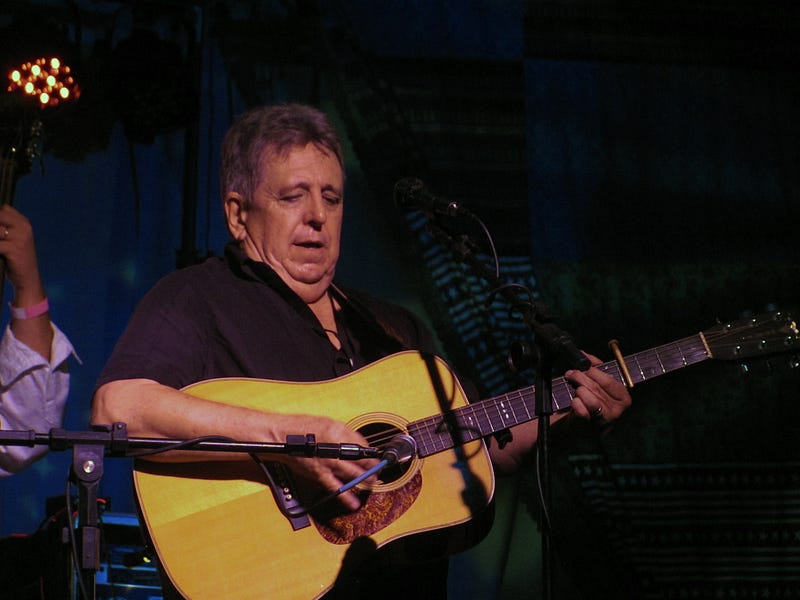
Former Elektra Records artist Rodney Dillard leaves no stone unturned as he dissects the mid-’60s Los Angeles music scene, covering Bob Dylan, the Beatles’ innovative spirit, Nitty Gritty Dirt Band multi-instrumentalist John McEuen’s documentary, the day the Dillards suddenly walked out of a Capitol Records meeting after refusing to cut a horrible tune, the impact of the Internet and how listeners may someday receive music, and whatever happened to his former comrades in arms. In the accompanying still Dillard is really concentrating on an acoustic guitar lick at the annual Gram Parsons Guitar Pull and Tribute Festival in Waycross, Georgia, on September 23, 2011. Photography by Jeremy Roberts

The Dillards was arguably the best bluegrass band of the ’60s. Featuring mandolin extraordinaire Dean Webb, emcee-doghouse bassist Mitch Jayne, banjoist Doug Dillard, and baby brother Rodney Dillard supplying lead vocals, guitar, and production expertise, the band confounded listeners when they stepped on Golden State soil in November 1962.

Proudly wearing Ozark Mountain influences on their sleeve, audiences assumed they were encountering outlandish hillbillies without an ounce of high society culture. But after witnessing one of their legendary shows at the Troubadour in West Hollywood or listening to debut album Back Porch Bluegrass, it became pretty clear these guys were seriously devoted to their craft.

Jayne was also a talented songwriter and novelist who rescued a number of the Dillards’ earliest shows in front of indifferent audiences utilizing sharp comic timing. Jayne co-wrote the majority of the band’s essential songs — “Dooley”, “Old Home Place,” “There Is a Time,” “The Whole World Round,” “Nobody Knows,” “The Biggest Whatever, “Listen to the Sound,” “Ebo Walker” — and remained a staunch outdoorsman until his death in 2010.

Webb’s harmony vocals and unheralded arranging skills were the envy of fellow up and coming L.A. bands. He walked into World Pacific Studios one day and helped David Crosby and the Byrds sort out the complicated triad harmonies on “Mr. Tambourine Man,” unknowingly bridging folk rock and bluegrass. And he could unleash some killer mandolin.

Mentored by Earl Scruggs, Doug was an innovative banjo ambassador. Originally a traditional player, Doug gradually incorporated folk, country, rock, and pop elements. “Hickory Hollow” from Back Porch Bluegrass finds Doug at his most ferocious and inspired level. He lost his battle with a collapsed lung and ensuing infection two years after Jayne’s passing.

After the Dillard brothers argued during a band rehearsal, Herb Pedersen was drafted as Doug’s replacement circa May 1968, appearing on the ground-breaking country rock albums Wheatstraw Suite and Copperfields. His angelic tenor, in burgeoning display on “She Sang Hymns Out of Tune”, songwriting, banjo, and guitar skills helped the Dillards reach new creative heights until he too left in 1971 after not wanting to stay up all night doing sessions at the behest of producer Richard Podolor for the mainstream-surging Roots and Branches [Pedersen returned for four Dillards albums in the late ’70s and early ’90s].

Onstage, Rodney was the buffoon of the group, but in the recording studio it was a different story. As an unabashed music connoisseur, his production sensibilities melded bluegrass and jazz, pop, country, and rock with orchestration to develop the seeds of the country rock movement later popularized by the Eagles. “Hotel California” topliner Don Henley confirmed the Dillards’ influence in multiple interviews plugging fifth studio album Cass County.

In 1995 an official biography of the Dillards was distributed. Succinct at 168 pages, the out of print Everybody on the Truck! The Story of the Dillards gave relatively little information on the group’s trailblazing country rock, enforcing the general public’s assumption that the band was a one-trick pony who succumbed to obscurity after their six rib-tickling episodes as the Darling Family mountain clan on The Andy Griffith Show ground to a sudden halt.

In the twenty-tens Rodney intermittently toiled away at his debut memoir. Cheekily titled Nuggets from The Horse I Rode In On: Reflections of a Road Scholar, the book “is not really about my career, just life observations about events and people I’ve encountered,” admits Rodney. “I’m hoping the short stories will offer a little advice or lesson to the reader.”

To combat the agonizing waiting game, Rodney exclusively goes on the record for the fifth and final installment of his most in-depth interview [check out “A Mayberry Minute with ‘Andy Griffith Show’ alum…” to get back to Part One].

Anecdotes abound regarding the mid-’60s L.A. music scene, the ensuing 10 years when music contained real dimension, covering Bob Dylan, being part of Jac Holzman’s eclectic Elektra label that counted Jim Morrison and the Doors among its roster, and the day the Dillards suddenly walked out of a Capitol Records meeting after refusing to cut a horrible tune.

Rodney then takes time to examine connecting with audiences, the ever-evolving concert experience, the impact of the Internet and how listeners may someday receive music, musical spontaneity, if he still plays any electric guitar, the Beatles’ innovative spirit, Nitty Gritty Dirt Band multi-instrumentalist John McEuen’s 1989 documentary, and whatever happened to his comrades in arms. The music flows starting now.
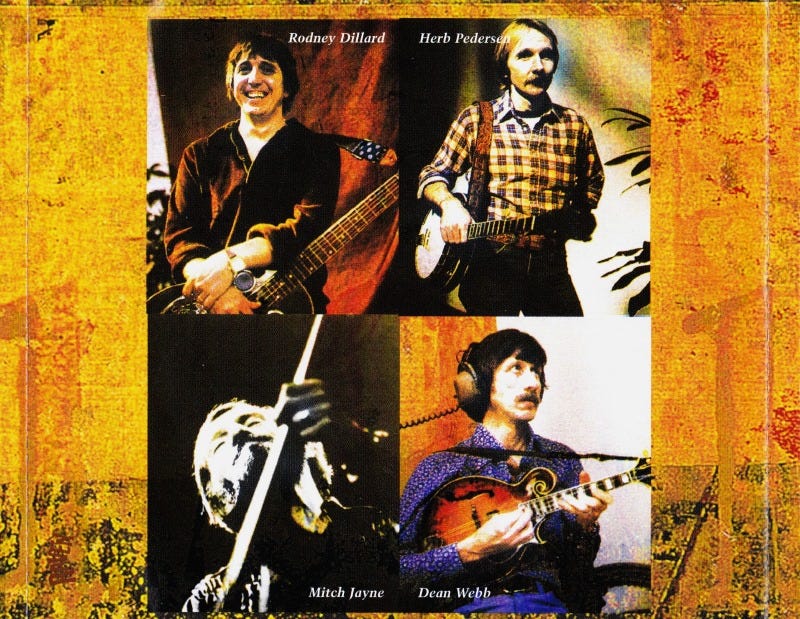
Part of the CD inlay artwork for the 29-track “Let the Music Flow: The Best of 1963–1979,” dropped on May 31, 2005, and only the second ever anthology documenting the Dillards’ stellar discography. The stills of lead singer-guitarist-producer Rodney Dillard, banjoist-singer-songwriter Herb Pedersen, and mandolinist-harmony vocalist Dean Webb were all taken during the album sessions for “Mountain Rock” between January 27 and 28, 1979. The black and white shot of acoustic bassist-emcee Mitch Jayne originates from the mainstream-pushing “Roots and Branches” 1972 era. Photography by Dennis Hearn except Mitch Jayne captured by Barbara Harris / 45Worlds user Lee Wrecker / Raven Records

The Rodney Dillard Interview, Part Five [Conclusion]

So much of the music waxed on vinyl between 1965 and 1974 holds merit for me.

That’s when music really had dimension or teeth to it. Everybody was searching for good stuff. I can remember in the early ’60s when we all used to hang out at the Troubadour. Instead of a bar, the front of the club was a guitar/folk den.

Everybody would sit around and play and pick together. People like Gram Parsons — when he was young and innocent — the Byrds and Roger McGuinn — who was Jim McGuinn until he temporarily joined a religion called Subud and decided to change his name — Linda Ronstadt, and members of the Eagles — Glenn Frey was trying to make it with a group called Longbranch Pennywhistle with songwriter J.D. Souther. Then we would go to where they were staying and party all night.

Out of that started coming some really interesting things. I think I was the first one to start adding orchestra, steel guitar, drums, and electric bass to what we were doing with the bluegrass triad harmonies [first evidenced on Wheatstraw Suite].

Not just plugging in grass instruments, turning them up, and playing, but actually finding out production so everything worked together. Most of the song arrangements were also my idea.
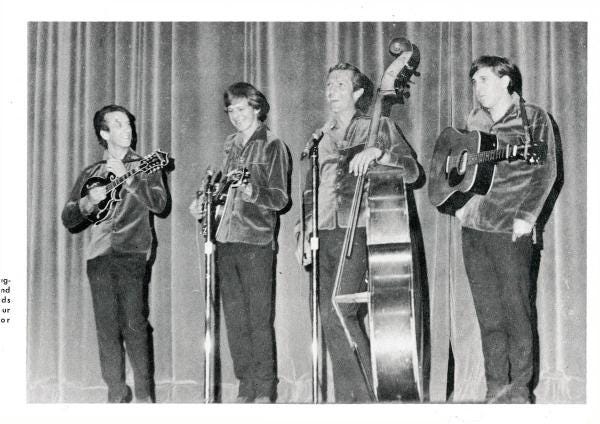
In matching corduroy sweaters, mandolin maestro Dean Webb, banjoist Doug Dillard, doghouse bassist-emcee Mitch Jayne, and lead singer-guitarist Rodney Dillard are the founding Dillards onstage at Fullerton College, the oldest community college in continuous operation in California established in 1913. According to the college’s online library resource, the Dillards were the debut college hour entertainers for the 1965 fall semester and performed to a packed house on September 28, 1965. Image Credit: Fullerton College Library

The critically acclaimed 1963–1970 Elektra albums — Back Porch Bluegrass, Live!!!! Almost!!!, Wheatstraw Suite, Copperfields — are obviously beloved by fans. But what about the predominantly forgotten demos that the Dillards cut with producer Jim Dickson?

We were trying to find a producer when we landed in Los Angeles, and Jim Dickson fit that bill [Dickson also organized the Byrds and had a hand in getting the Eagles together]. He began producing us in 1963 with Back Porch Bluegrass. Jim and his partner, Eddie Tickner, were also our managers for awhile.

Since Elektra wasn’t initially receptive to our efforts to expand our musical palette, we did some demo sessions in 1964 at Columbia Studios in L.A. Chris Hillman of the Byrds played bass and Jim brought in Tom Ray from the Leaves — a ’60s garage rock band who released the first popular version of “Hey Joe” before Jimi Hendrix — to be the drummer.

The demos were later sold. There’s a rare compilation album called Early L.A. that was released in 1969 on Together Records. [Featuring sessions produced by Dickson, the album was expanded with an additional unreleased track in 2007 and released as Sixties Transition: Rare 1960s L.A. Sessions Recordings on Sierra Records].

It’s got us performing the Osborne Brothers’ “Each Season Changes You” as rock, “Don’t You Cry” — re-recorded for Wheatstraw Suite — and “Someday You’ll Find.” Other artists including the Byrds, Dino Valenti of Quicksilver Messenger Service, Glen Campbell, and Leon Russell contributed songs on there.

Because we had gotten a lot of criticism from folkies and different people about authenticity, we wanted our next album to be something straight down the line — academic if you will. It was as traditional as we wanted to go without being old-timey. Byron Berline’s fiddle playing was especially traditional and beautiful. Pickin’ & Fiddlin’ [1965] became our last obligated record on our first Elektra contract.
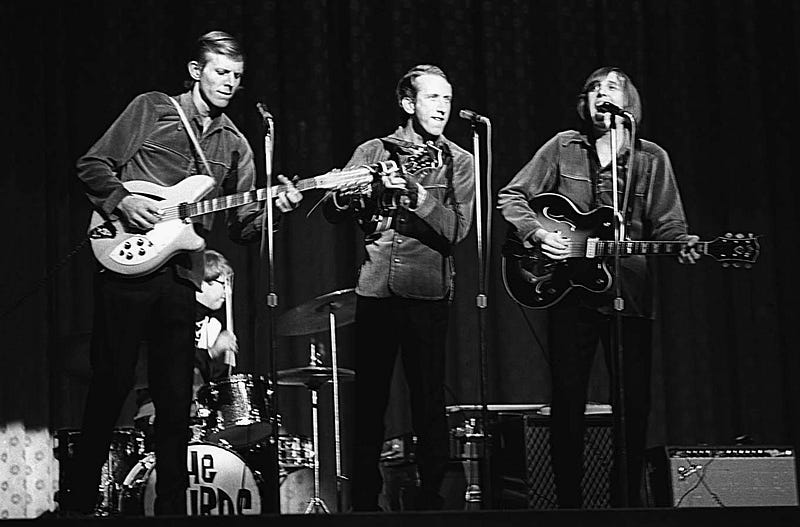
A Rickenbacker-sporting Doug Dillard, mandolinist Dean Webb, and a hollow-body, Gibson-brandishing Rodney Dillard of Salem, Missouri bluegrass band the Dillards probably shocked fans by going electric at the Santa Barbara High School Auditorium in Santa Barbara, California, opening for the Byrds on February 19, 1966. Drummer Dewey Martin, soon to join Buffalo Springfield, is partially obscured. Photography by Lisa Law

When the Dillards initially exited Elektra in 1965 and landed on Capitol, did they have a clue how to promote the band?

After the fiddle record, we signed with Capitol and did an album later in 1965, but it was never released. Two singles did appear — “Nobody Knows” b/w “Ebo Walker” and “Last Thing on My Mind” b/w “Lemon Chimes.” All of those, except “Last Thing,” were re-recorded on Wheatstraw Suite and Copperfields [1970], respectively.

Dewey Martin of later Buffalo Springfield fame was our drummer then. By the way, some other great drummers who worked with us during the ’60s included fantastic jazz player Earl Palmer, who played on Wheatstraw Suite, and Derek and the Dominos member Jim Gordon, who played on Copperfields. Jim really was such a great guy. I don’t know why he later killed his mother [Most discographies, including the Collectors’ Choice Music 2002 reissue, list Jim Gordon and Toxey French as handling drumming duties on Wheatstraw Suite, not Earl Palmer].

Capitol didn’t know what to do with us — they didn’t have any idea what we were about. They assigned several producers to us, but nothing seemed to click. One had produced Wayne Newton, so he was a big deal. He brought out a song that his brother-in-law had written.
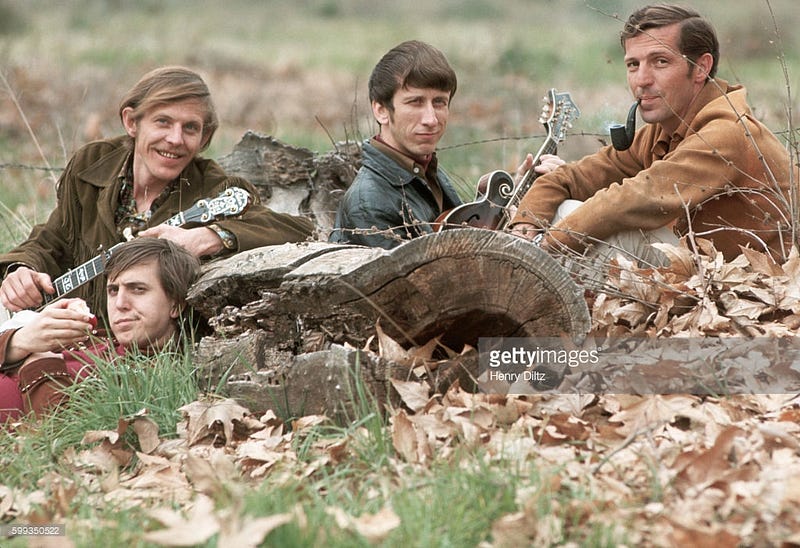
Cantankerously holding a chewed up apple while resting against a rotting tree trunk, singer-guitarist Rodney Dillard is flanked by fellow founding Dillards Doug Dillard on banjo, mandolin extraordinaire-harmony singer Dean Webb, and doghouse bassist-emcee-songwriter Mitch Jayne on the Melody Ranch property of original singing cowboy Gene Autry in 1967. Rodney’s older brother Doug departed the group later that year and wisely teamed up with chief Byrds songwriter Gene Clark for a winning country rock collaboration over two albums. Photography by Henry Diltz / Corbis via Getty Images

It was the worst song ever. I wouldn’t have sung the song if somebody had held a gun to my head. It was called “The Gunslinger’s Union.” It was a stupid, dumb song. We all just looked at each other at the table. The guy said, “You have gotta do this song.”

We simply got up and walked out. We asked for a release from Capitol, and they agreed. There are unreleased, albeit largely unfinished songs from our short stay on the label.

One was “Lay Down Your Weary Tune” by Bob Dylan [Dillard sings the verse “Lay down your weary tune, lay down…Lay down the song you strum and rest yourself ’neath the strength of strings”]. I don’t know, I didn’t think the performance captured what we were looking for.

We eventually resigned with Elektra and recorded Wheatstraw Suite and Copperfields. We waited nearly three years after recording the Capitol singles before we tackled Wheatstraw Suite. I just wanted to make sure I knew which direction and concept to take the band in. It took me that long to put the album together in my head.

The title “Wheatstraw Suite” was sort of a rural name that I liked. We added various strings and an orchestra to tracks, and nobody in bluegrass was doing that back then. It might be difficult to believe today, but bluegrass guys just hated me for doing that in 1968. But in the long run it was okay. Always do what your heart tells you.
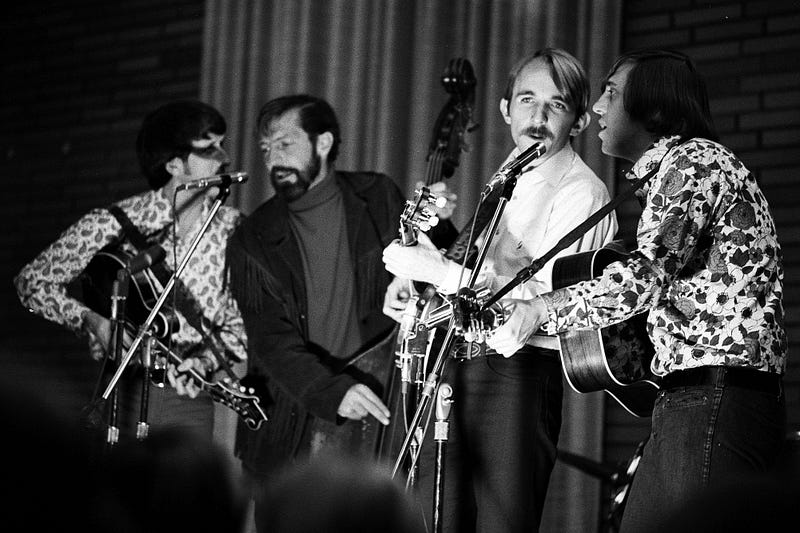
Mandolinist-backing vocalist Dean Webb, emcee-acoustic bassist Mitch Jayne, banjoist-rhythm guitarist-singer Herb Pedersen, and lead singer-guitarist-producer Rodney Dillard are captured in concert on February 18, 1970, at the University of California, Riverside, plugging the release of the Dillards’ fourth studio album “Copperfields,” unleashed in January 1970 on Elektra Records. The critically acclaimed country rock follow-up to 1968’s “Wheatstraw Suite” criminally did not chart but contained fine covers of Harry Nilsson’s “Rainmaker,” the Beatles’ “Yesterday,” Eric Andersen’s “Close the Door Lightly,” along with 10 group originals featuring “Old Man at the Mill.” Photography by Bob Clevenger

Herb Pedersen’s angelic tenor vocals are all over Wheatstraw Suite and Copperfields. Why did he leave the Dillards?

Herb left in 1971 because he wanted to try his solo effort. There were absolutely no ill feelings. He later did quite well when he joined Chris Hillman and formed the Desert Rose Band in 1985 [they had a string of Top Ten country hits in the late ’80s. “He’s Back and I’m Blue” and “I Still Believe In You” both skyrocketed to number one].

Herb reunited with us for a trio of records — Decade Waltz [1978], Mountain Rock [1979], Homecoming and Family Reunion [1980] — and last played with us in 1990 on the Let It Fly record. We got a Grammy nomination for one of the songs on the album, “Darlin’ Boys.” I still get together with him just to pick. We did a concert together several years ago. He mainly stays busy playing with Chris Hillman and the Desert Rose Band.

I’ve thought about doing another project with Herb, but life kinda goes on. You just never get around to doing it until it’s too late. But I’ve entertained the notion — if somebody ever wanted us to do something, I’d be all up for it.
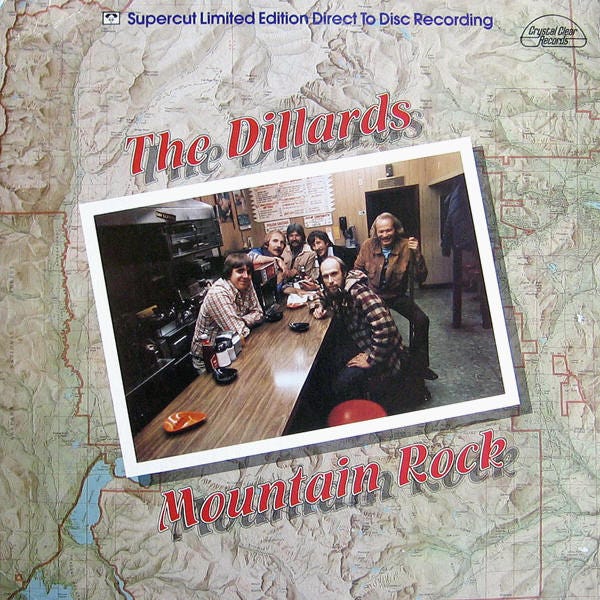
Starting clockwise from the left, singer-guitarist Rodney Dillard, banjoist-singer Herb Pedersen, drummer Paul York, mandolinist Dean Webb, guitarist-bassist Doug Bounsall, and stand-up bassist Jeff Gilkinson converge around a cafe table for the Dillards’ 10th album. Distributed by the since-defunct Crystal Clear Records, “Mountain Rock” is remembered for being the first digital recording and was tracked without overdubs between January 27 and 28, 1979, in Berkeley, California. Image Credit: Discogs

Do you have any idea how many albums the Dillards have sold?

Not really — I do know that the direct-to-disc album we did called Mountain Rock [1979] on Crystal Clear Records sold 80,000 records. It was the first digital recording before digital tape. You went in and cut directly to acetate, like the old days. You had to start the machine. It would begin carving the grooves in the record.

You didn’t stop recording until the album was done. They would hit you with a red light. You had to start again when you got the green light. You better be ready and in tune for the next song. And that was a lot of pressure.

Our publicist finally hired a lawyer and went after Elektra, Warner Bros., and Asylum after many years because we hadn’t received any royalties. They said, “Oh, we thought the group was dead.” We ultimately started getting our royalties, over 20 years after we recorded most of the music. Welcome to the record business.

The record industry is crooked. It destroyed itself, because they would never report all the sales to the artist. Since 1991, Nielsen SoundScan has been available. Every time you sell records, even if they’re sold at our shows, we report it on SoundScan. That’s how you get on the charts.

It’s real now. Used to, if you got on the Billboard Hot 100, somebody bought it onto the charts so it would get started. We landed on the Southern Gospel charts legitimately with Don’t Let the Hearse Take You to Church [2011].
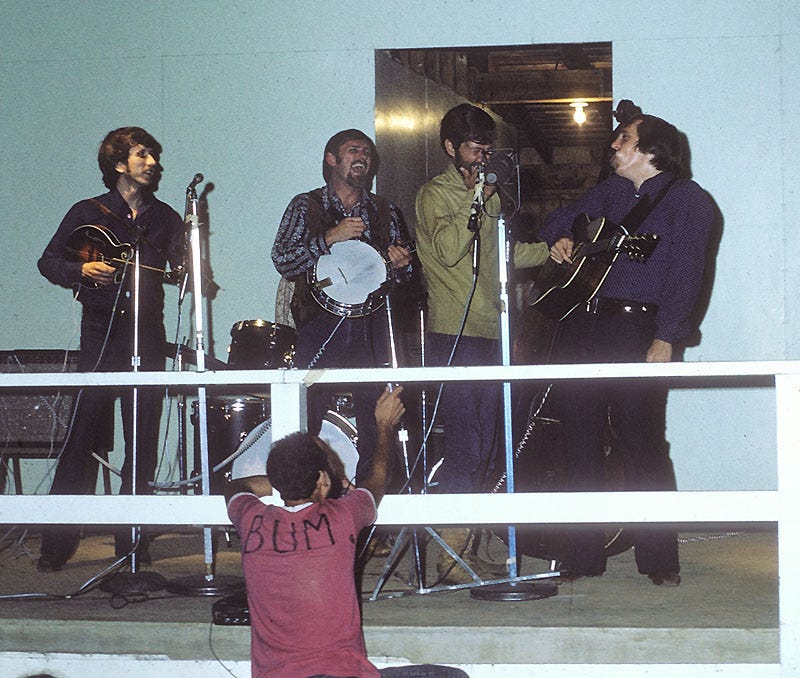
In June 1971, an unabashed hippie bum eggs on mandolin maestro Dean Webb, banjoist Billy Ray Latham, emcee-doghouse bassist Mitch Jayne, and lead singer-guitarist Rodney Dillard of the Dillards during a hysterical portion of their bluegrass-country rock set at the sixth annual Culpeper-Warrenton Bluegrass Festival in Virginia. Drummer Paul York is completely obscured. Photography by Fred Robbins / FRobbi.org

How has the Internet affected the record industry?

Everything is changing — everything. There was a time when you had freeform radio, and everything had a chance to be heard. Then the ’80s rolled around, and that’s when I started to lose interest in music. You had formula music, where people came along and said, “Okay, you’ve got a lick here, now do this, dah dah dah…” After awhile, all the pop music started sounding the same.

Now if you were born in the Internet era, that’s a good thing. Madison Avenue and the big marketing people who controlled the taste of America and the world lost that ability when the Internet arrived.

You can throw stuff up on YouTube and see a lot of different things. I’m glad, because you can have a broader view of what people are doing music wise. Before, it was all how they hyped it and sold it to you, like soap.

The Internet has caused the record companies to go down the tubes. Albums won’t survive. Of course, there’s retro-minded people who will keep that format alive. Jac Holzman, the founder of Elektra, came to see me in June 2011 while we were playing a festival in California. He said, “Rodney, we’re re-releasing all the Dillards’ Elektra records on vinyl.” I remarked, “Okay, alright” [laughs].

See, what those albums are is distortion. If you get too clear, it gets so clear it hurts the ears. They tire easily listening to digital music. The resident frequency of the human ear is between 3 and 4 k. People used to try to get better mics to take away that distortion that tape created. When digital came in, they all went back to find the old mics, so they could get that sound again.

Downloading is the thing everybody’s doing now. In fact, that’s how we released our last two singles. Everybody’s searching to find the best way to market their wares. But it will always come down to content. Like a good book — if it’s a good book, people will buy it. If it’s not, they won’t.

Music all started when the first caveman hit the other one in the head with a bone and got a sound. Then he lined up eight other cavemen…thwoop, thwoop, thwoop! [laughs]. Anyway, I don’t know where music’s gonna go from here. There’ll come a time I guess when you’ll be able to think your music and the other person will be able to receive it.
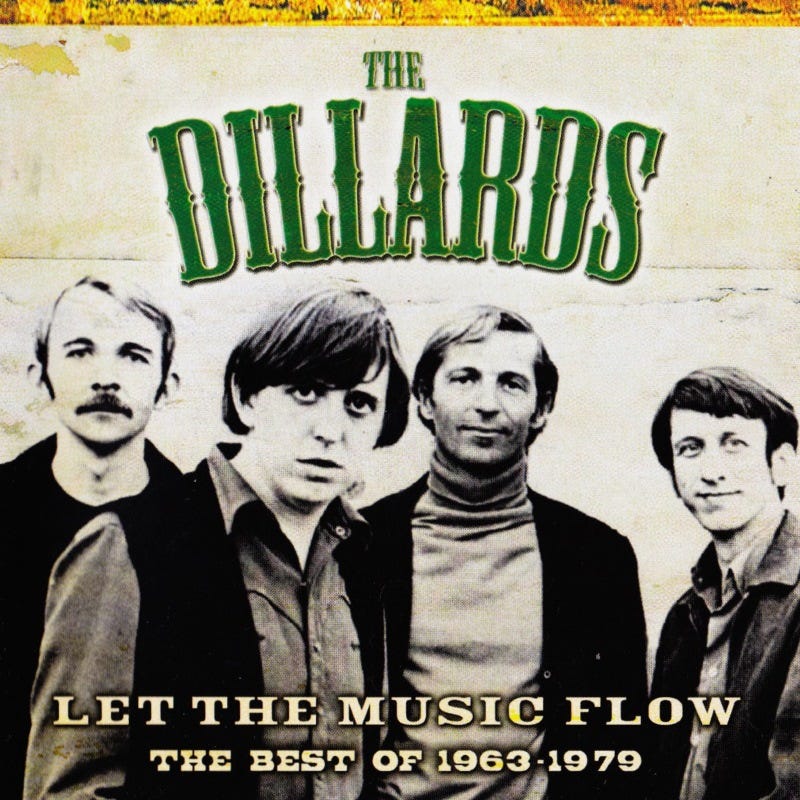
The CD cover of the 29-track “Let the Music Flow: The Best of 1963–1979,” just the second ever anthology documenting the Dillards’ stellar discography dropped on May 31, 2005. Left to right are banjoist-guitarist-singer-songwriter Herb Pedersen [founding member Doug Dillard’s replacement], lead singer-guitarist Rodney Dillard, emcee-acoustic bassist Mitch Jayne, and mandolinist-harmony singer Dean Webb during their country rock “Wheatstraw Suite” era in 1968. Image Credit: 45Worlds user Lee Wrecker / Elektra Records / Raven Records

Do you have much say-so in reissues of the Dillards’ catalogue?

Companies re-release our albums or put out compilations, and we’re rarely interviewed or put in the loop [Critic Richie Unterberger and Collectors Choice Music did a fantastic job on the 2002 Elektra reissues].

They usually think, ‘Oh wait, we’re make some money off of this.’ They’re trying to do something to boost their sales by thinking going back might help because they can’t find anything new. Somebody reported to me recently about maybe reissuing Roots and Branches in Surround Sound. I don’t know.

Raven Records in Australia put out one in 2005 called Let the Music Flow: The Best of 1963–1979. Bob Dylan’s “One Too Many Mornings,” which we recorded as a single for White Whale Records in 1969, is on there.

[Dillard sings the lyric “Down the street the dogs are barkin,’ and the day is a-gettin’ dark, as the night comes in a-fallin,’ the dogs’ll lose their bark…for I’m one too many mornings and a thousand miles behind”]. Chip Douglas, a friend of mine, produced that single for us in 1969 on White Whale Records.
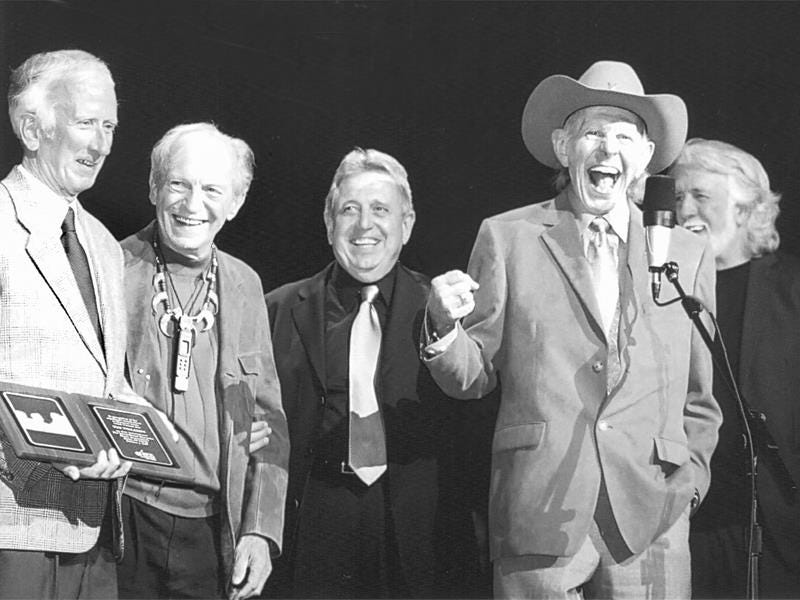
Hot dog, we’re finally in! Mandolinist Dean Webb, bassist-emcee Mitch Jayne, singer-guitarist Rodney Dillard, and extremely jubilant banjoist Doug Dillard of the Dillards receive their induction into the International Bluegrass Hall of Fame in Nashville on October 1, 2009. Banjoist-guitarist John McEuen of the Nitty Gritty Dirt Band, partially obscured behind Doug, inducted the innovative bluegrass outfit. Mitch and Doug are since deceased. Image Credit: The Andy Griffith Show Rerun Watchers Club

What is the current status of the Dillards?

It’s what it’s always been. When you think about it, the original Dillards weren’t together that long — five years from 1962 to 1967. That’s when Doug left. I later received a Grammy nomination for my production work on Doug’s Heartbreak Hotel album in 1988. I hadn’t played with him in a few years. But we played together for a long time.

Doug had a different approach to what he wanted to do. I’m not sure he knew what his approach was [laughs]. He became semi-retired and got to really enjoy life until health problems, exacerbated by a collapsed lung, ultimately took their toll on May 16, 2012. I miss him terribly.

Dean has always been an outstanding mandolin player. On our records, he would sing the parts that Herb Pedersen and I didn’t sing. Having Dean’s voice kept the band’s identity intact.

Dean has his own bluegrass group called Missouri Boatride. I saw him last summer at a festival where both our groups were playing. He just wants to do his own thing — we both do. We spent so much time together, and we needed a break [in spite of various personnel changes over the years, Webb and Dillard were the only consistent members].

Mitch was having trouble hearing, and he began to plot his exit from the band during the Roots and Branches sessions. However, for the follow-up album, Tribute to the American Duck, he returned with a vengeance, co-writing over half of that record.

He moved back to our hometown in Salem, Missouri, after his mother died. She was a Dole of Dole Pineapple and left him a whole bunch of money. So Mitch built a log cabin and retired in the woods for the most part. The band continued for many years after his departure.

Billy Ray Latham [replaced Pedersen on banjo in 1971] was in a terrible car accident [November 2004]. The cops were chasing an illegal Mexican in Nashville, and his car hit Billy head-on at 90 mph. Billy almost died, as both his legs, right knee and femur, arms, and left hip were badly broken. He also received a significant head injury.

It really messed him up, but after being in a coma for a week and remaining in the hospital for six months, Billy Ray is on the mend. He had to learn how to play all over again. It’s still tough going for him, but he hasn’t given up.

Once in awhile the original Dillards would get together for reunion tours. Unfortunately, Mitch and Doug are permanently out of the picture now.

Even if someone offered us an incentive, I doubt it would happen. It’s over, that’s past, that’s done. It wouldn’t be the same, it wouldn’t possess the right quality or energy it should have. It simply wouldn’t be productive.

I was the youngest one in the Dillards and the one who was doing all the singing and arranging of the tunes. I decided to keep on going as long as people would let me [laughs], because that’s what I do.
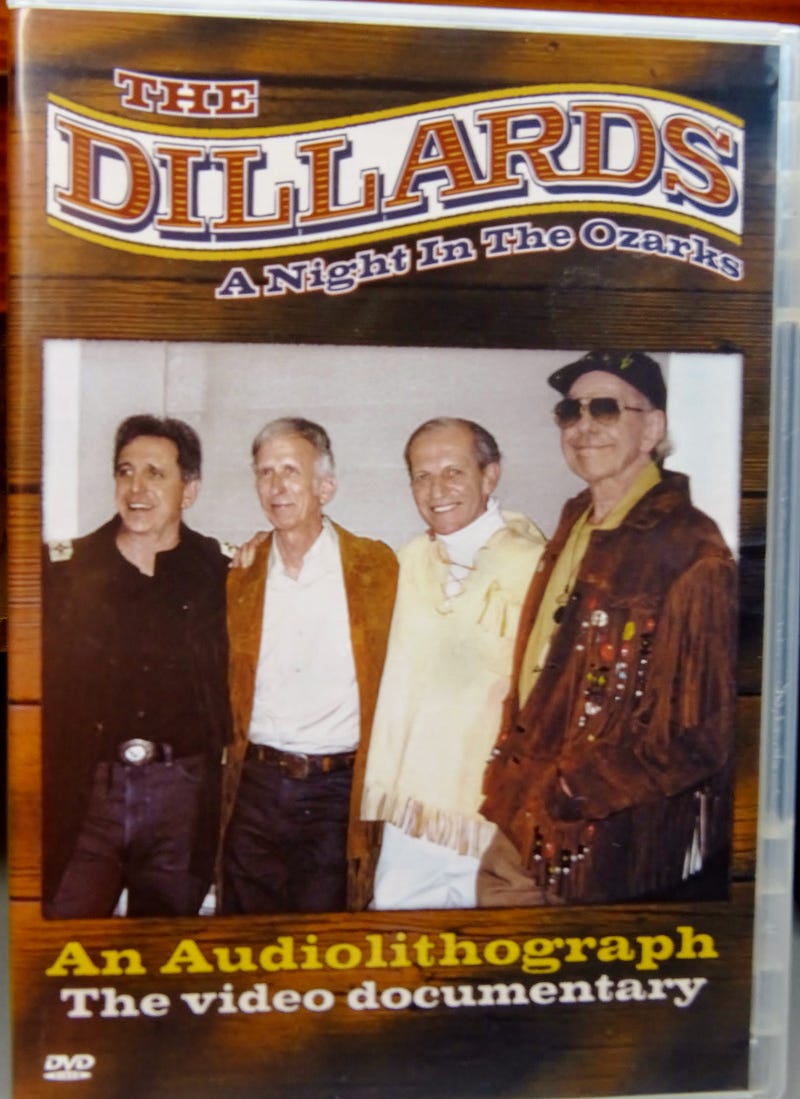
The DVD cover of “The Dillards: A Night in the Ozarks — An Audiolithograph,” distributed on November 14, 2006, and produced and directed by former Nitty Gritty Dirt Band multi-instrumentalist John McEuen. The progressive bluegrass outfit, consisting of lead singer-guitarist Rodney Dillard, mandolinist-harmony singer Dean Webb, emcee-doghouse bassist Mitch Jayne, and lightning quick banjoist Doug Dillard, are seen backstage at their sold out performance at New York’s Carnegie Hall on November 30, 2002, although the independent documentary was actually filmed live in a Salem, Missouri, farmhouse years earlier in 1989. Photography by Diana Jayne / Varèse Sarabande

What is the Dillards’ legacy?

John McEuen of the Nitty Gritty Dirt Band, who was really influenced by our music, did a wonderful job on A Night in the Ozarks [a 1989 independent documentary featuring interviews and live performances]. He’s got such insight, and he’s really talented at being able to pull things like that together. That video really illustrates our legacy.

Rolling Stone always gave me credit for being the father of country rock, and that kinda stuck. It’s great, I never had a hit-hit, but I would rather do what I’ve done over the years than be a one-hit wonder. You get one song that’s the pick flower of the day, and then it’s over.

Our publisher tells me every day an artist is requesting a song from one of my albums to record. I’m very thankful for that. I’m just thankful to be alive [laughs].

Do you have time to just hang out and jam?

Not so much anymore, because we’re always out on the road. When we’re out at the farm, we’ll sit and pick. I’ll get up out of bed and start pickin’ away if I get a song idea or melody going. Beverly has been woken up on more than one occasion by my plunking [laughs]. I mainly like to just sit down with my guitar and see if I can come up with new stuff as opposed to jamming with friends.

We don’t do very much rehearsal before we play a show. But it’s always fun to get together with the guys. They’re capable of playing anything. It’s like a football player going out and throwing the ball around a bunch of times. It gets your blood going.
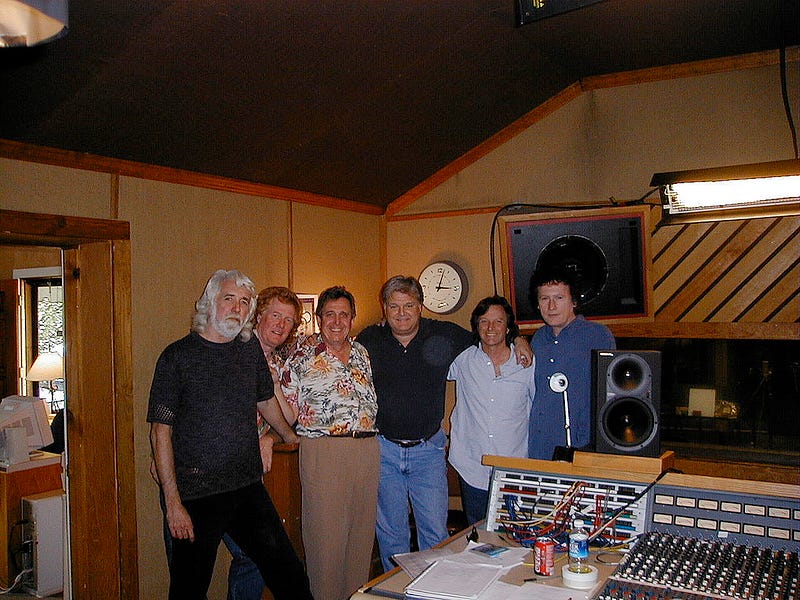
Former Nitty Gritty Dirt Band banjoist and multi-instrumentalist John McEuen, sound engineer Tim Cooney, Dillards lead singer Rodney Dillard, country hitmaker Ricky Skaggs, Nitty Gritty Dirt Band lead guitarist Jeff Hanna, and producer-songwriter-guitarist Randy Scruggs are pictured during the star-studded sessions for the Dirt Band’s “Will the Circle be Unbroken, Vol. 3,” ultimately released on October 1, 2002. Dillard and Skaggs duetted on the Dillards’ esteemed “There Is a Time,” written by Dillard and Mitch Jayne in 1964 and originally part of the “Live!!!! Almost!!!” album. Image Credit: The Tim Cooney Collection / Wikimedia Commons

How many instruments can you play?

I dabble at everything, I’m not a master of none. There are no rules in recording when you make rules. Anything you try, if it succeeds, then you’ve set a precedence. That was absolutely the philosophy of the Beatles. Their producer, George Martin, was a genius. He managed to merge all that orchestration with what they were doing at the time. That’s real innovation.

I did get an opportunity to meet the Beatles’ press officer, Derek Taylor. Doug was friends with John Lennon and Ringo while they were in L.A. during the early ’70s. My brother was a bachelor at the time, while I was married to my first wife [Linda Carey] with a new toddler [Brian].

Do you still play any electric guitar?

I gave my last electric guitar, a really pretty purple Blade, away to a friend who’s a really good jazz player. I don’t have an electric guitar anymore; all mine are acoustic. My daughter, Rachel, has one.

I haven’t played an electric onstage since Beverly, Dean Webb, and I had our show at the Silver Dollar City Amphitheatre in Branson [1982–1988]. Beverly would perform on banjo and sing her own songs during the show.

I’m coming full circle today — I’m back to acoustic again. Electric finally got to me after awhile, too many frequencies clashing. A bluegrass ensemble is very much like a string quartet, almost the perfect vibe of frequencies. That’s what a string quartet is — a perfect frequency convergence. I just got into the real finessing of real, non-disguisable finessing.
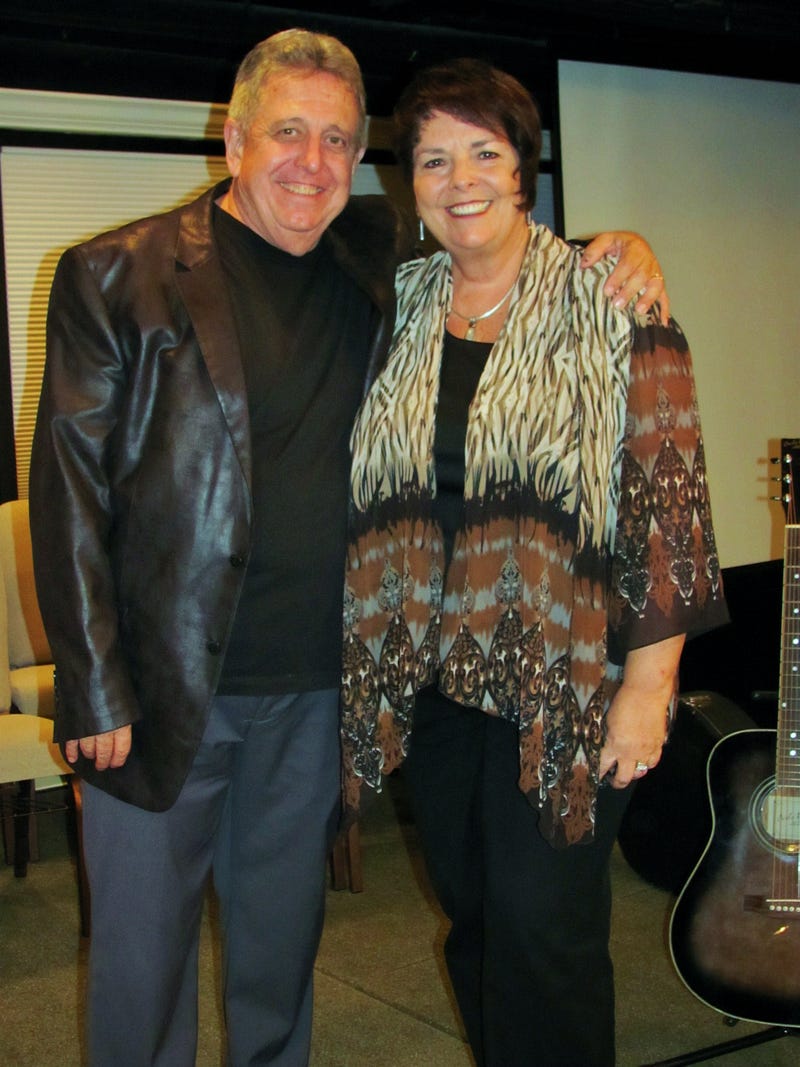
Sixty-nine-year-old original Dillards frontman Rodney Dillard and personable banjo-pickin’ wife Beverly Cotten are seen moments after an inspiring Mayberry Values story-song presentation at Frederica Baptist Church in St. Simons Island, Georgia, on September 25, 2011. Dillard portrayed introverted mountaineer Rodney Darling on six gut-busting episodes of “The Andy Griffith Show” between 1963 and 1966. Photography by Jeremy Roberts

Is it true that your lovely wife Beverly Cotten appeared on Hee Haw?

Yes; she was opening for the Dillards in Nashville in 1982 when Hee Haw representatives came up to her and said, “We like what you do. Would you like to do Hee Haw?” After she stood there incredulously for a few seconds and finally agreed, they said, “Well, come on and meet the producer, Sam Lovello.”

She clogged, played banjo, and did her whole act for the official audition. She must have passed it. Anyway, she was featured in a couple of guest spots.

She got to salute her hometown of Morrisville, North Carolina. Morrisville encompasses all these yuppie, big million dollar houses and golf courses today. Then there were only about 250 people in the city, and most of them were her cousins.

Her uncle was the mayor, and he wanted to sound big on Hee Haw. So he annexed the trailer park down the road and made it 480. When Beverly got to salute, she was dancing while she said, “Salute my hometown of Morrisville, NC, population 480. Except when I’m home, then it’s 481! And everyone in the corn field jumped up and yelled, “Salute!”

Her whole family watched it at home. Beverly’s mom even made a star with aluminum foil on it and placed it on their front door. I know she had a lot of fun doing it. By the way, she got her picture made sitting on comedian Junior Samples’ lap. That was an abundant lap [laughs].

Beverly has also performed with Buck Trent, and she performed with the Grand Ladies of the Grand Ole Opry and also served as their emcee for two years in Branson.

The Grand Ladies included Helen Cornelius, Jean Shepard, Mary Lou Turner — “Sometimes” and “That’s What Made Me Love You” were hit duets with Whisperin’ Bill Anderson in the late ’70s — Merle Haggard’s third wife and “Bull and the Beaver” duet partner Leona Williams, and “pretty little” Miss Norma Jean. They would rotate, but she was there all the time. An old timey style banjo picker, Beverly can play some mean claw-hammer banjo.

How important is it to nurture a relationship with an audience?

Live performances are becoming a rarity where you have actual entertaining at the same time you’re playing music. Entertainment is very important and how you relate to an audience.

Back in the mid-‘70s rock and roll became rock theater with lighting, smoke, guys wrapping snakes around themselves, doing all these tricks…because they could not actually communicate with an audience. So rock became a circus, and then Cirque du Soleil became rock [laughs].

Now we’re trying to make a show out of our concerts, not just get up there and say, “Thank you very much. A great big howdy and a couple doody’s to you. Kick her off there, Wichita!” [laughs].

Our setlists are never written down in stone. I love to see and hear what a crowd wants to hear. Spontaneity is essential to my live shows. Beverly has to be on her toes because I’ll always bring her out at different times [laughs].

Plus, I love to be right in the middle of the crowd. That’s why I like indoor theatres, because every nuance, every movement, and every subtlety — if you’re doing comedy — they get. It’s hard when you have a show set up like a rock concert — the audience is far away from the stage.

We’re gonna tour around the country as much as we can. Last summer we were gone for three months. This past summer we were only home for maybe two weeks. As long as guys like you keep writing about us, we’re keep doing it. You’re keeping us alive.
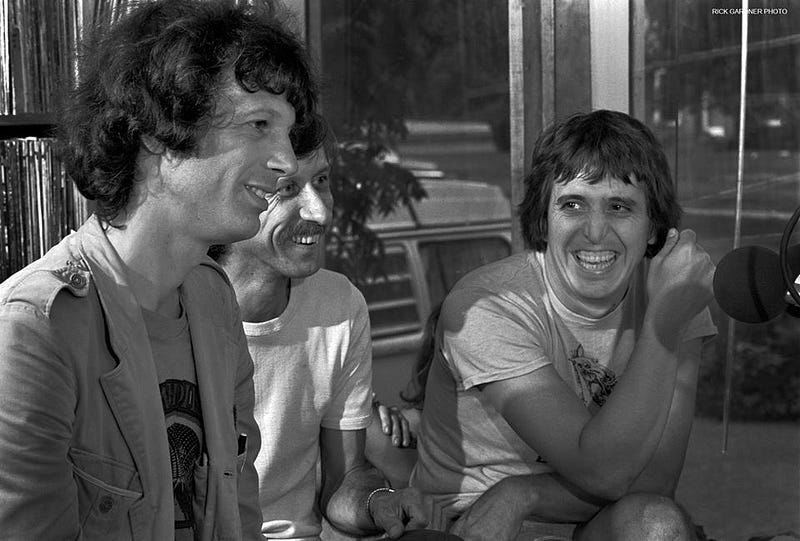
“Gentle on My Mind” songwriter John Hartford is interviewed in the KPFT Radio studio in Houston, Texas, along with founding Dillards Dean Webb [mandolin, harmony vocals] and lead singer-guitarist Rodney Dillard on August 21, 1977, five days after Elvis Presley’s passing. Photography by Rick Gardner / Classic Bluegrass Pictures [Facebook]
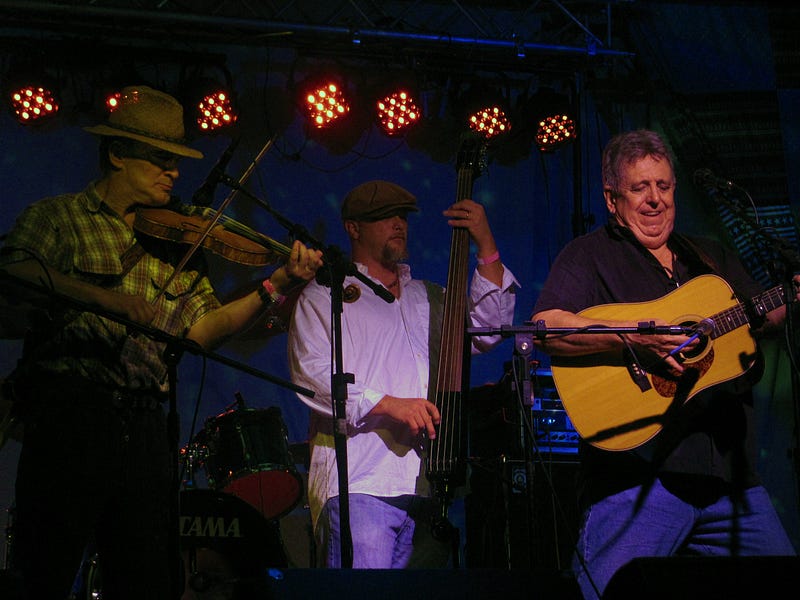
Fiddle hotshot George Giddens, acoustic bassist Shane Lail, and acoustic guitarist Rodney Dillard perform at the annual Gram Parsons Guitar Pull and Tribute Festival on September 23, 2011, in Waycross, Georgia. Photography by Jeremy Roberts

© Jeremy Roberts, 2012, 2018. All rights reserved. To touch base, email [email protected] and mention which story led you my way. I appreciate it sincerely.

Music
Bluegrass
Life Lessons
Country Music
Entertainment
Recommended from ReadMedium