
A FILM TO REMEMBER: “THEY LIVE BY NIGHT” (1948)
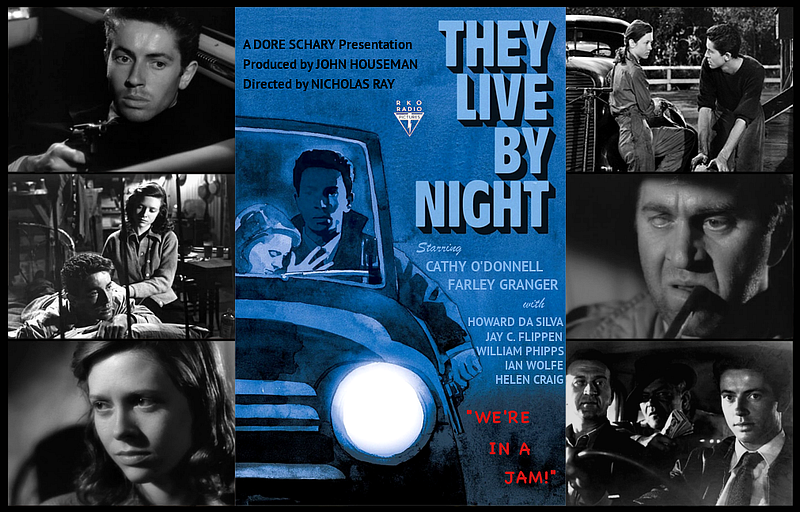
Before I get into this, I want to make mention “A FILM TO REMEMBER” will be a series about films that have reached a milestone anniversary since their origin in being culturally, historically, or aesthetically significant. The articles will contain the film’s plot outline, director, cast, a compilation of trivialities, various photos, movie trailer, critical reception and more. So, let’s start:
We are here to mark the celebration of the 70th Anniversary of Nicholas Ray’s “They Live by Night”. Let’s take an inside look at the film:
PLOT OUTLINE:
An escaped convict, injured during a robbery, falls in love with the woman who nurses him back to health, but their relationship seems doomed from the beginning.
STUDIO:
RKO Radio Pictures
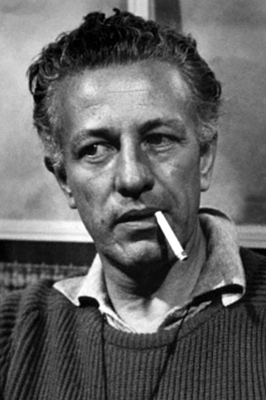
DIRECTOR:
Nicholas Ray
CAST:
- Cathy O’Donnell … Catherine “Keechie” Mobley
- Farley Granger … Arthur “Bowie” Bowers
- Howard Da Silva … Chicamaw “One-Eye” Mobley
- Jay C. Flippen … Henry “T-Dub” Mansfield
- Helen Craig … Mattie
- Will Wright … Mobley
- William Phipps … Young Farmer
- Ian Wolfe … Hawkins
- Harry Harvey … Hagenheimer
- Marie Bryant … Singer
- Will Lee … Jeweler
- James Nolan … Schreiber
- Charles Meredith … Comm. Hubbell
- Teddy Infuhr … Alvin
- Byron Foulger … Lambert
- Guy Beach … Plumber
GENRE(S):
Crime | Film-Noir | Romance
TAGLINE:
“WE’RE IN A JAM! You’re crazy to stick to me…but I’d rather die than let you go!”
The film is known for being a truly groundbreaking entry in a distinctly American genre that announced in no uncertain terms of its arrival. Director Nicholas Ray established himself as a major talent to watch with his feature directorial debut, bringing a plaintive artistry that redefined the lexicon of action imagery and foreshadowed the development of Ray’s intrepid and idiosyncratic visual style that lends this weepy film noir, a melancholic beauty with splendid performances from Cathy O’Donnell and Farley Granger in this crime-and-compassion melodrama. The film is based from Edward Anderson’s Depression era novel “Thieves Like Us,” it was critically praised and is considered by many to be the prototype for the “couple on the run” genre, and is generally seen a forerunner to the film “Bonnie and Clyde” (1967), though the first telling of the story was actually in the “Persons in Hiding” (1939), based on the J. Edgar Hoover memoir of the same title.
Here’s what some of the critical receptions have been for the film over the years:
Geoff Andrew from Time Out says: “Passionate, lyrical, and imaginative, it’s a remarkably assured debut, from the astonishing opening helicopter shot that follows the escaped convicts’ car to freedom, to the final, inexorably tragic climax.”
Variety Staff from Variety says: “There’s no attempt at sugarcoating a happy ending, and yarn moves towards its inevitable, tragic climax without compromise.”
Bosley Crowther from New York Times says: “‘They Live by Night’ has the failing of waxing sentimental over crime, but it manages to generate interest with its crisp dramatic movement and clear-cut types.”
Leonard Maltin from TCM.com says: “Director Nicholas Ray’s first film is sensitive, well-made story of young lovers who are fugitives from the law. Set in 1930s, it avoids cliches and builds considerable impact instead.”
Dave Kehr from Chicago Reader says: “A key film noir of the 40s, this was Nicholas Ray’s first film as a director (1949), and the freshness of his expressionist-documentary style is still apparent and gripping.”
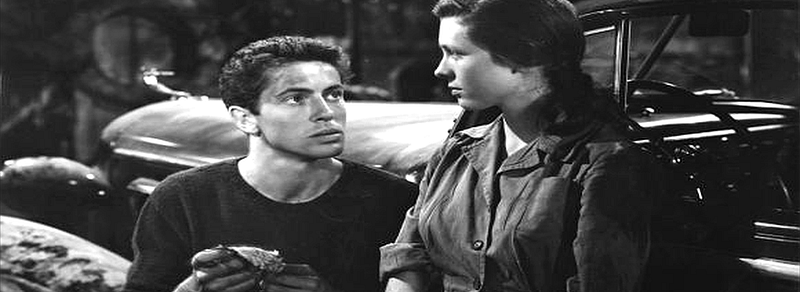
As you can tell by the critical reactions, the film was universally praised and in the process, became the precedent for the “couple on the run” genre. Ray helms with an easy assurance, propelling the plot forward to its unbearably foreordination, inevitable conclusion. All at the same time, reinventing the medium on the fly, with reckless and thrilling disregard for its established conventions in using a close-up strategy, allowing the actors all to have a more naturalistic bent than most of the films of its day, opting for a low-key simmering approach which results in a more intimate portrait in giving heavy stylized performances from O’Donnell and Granger that don’t resemble what any other actor was doing in the 1940s in this luminously lyrical and poignantly melodramatic, film noir benchmark. But I’ll let you decide…
Unfortunately, there is no link to a movie trailer of Nicholas Ray’s “They Live by Night” but to help give a better look at the feature film, here’s a link to a preview clip of Nicholas Ray’s “They Live by Night”:
Here I have provided 12 interesting and intriguing trivia facts (I wanted to keep it limited) about “They Live by Night”:
- The novel “Thieves Like Us” by Edward Anderson had been bought by RKO in 1941 for $10,000. After numerous writers tried to make a screenplay out of it, nothing became of it. According to producer John Houseman, “I found the book and gave it to Nick to read, and he fell madly in love with it–as indeed I did, but Nick particularly was very familiar with that territory. He’d been there when he worked with the Lomaxes, he’d been there when he worked for the Department of Agriculture, and so on. And that whole Depression stuff was terribly his stuff. So he sat down and wrote the treatment. I’d come home at night and we’d go over it; I’d edit it a little, that’s all, and it was very, very good.”Houseman would repeatedly send in treatments, fronting for the novice Nicholas Ray. Houseman, who had considerable authority as a producer, was aware of Ray’s passion for the project and there was never any doubt that Ray would direct the film.
- Much to the dismay of Nicholas Ray and John Houseman, RKO saw no commercial value in the story, especially because Ray had had no film directing experience. In early 1947, producer Dore Schary became Production Chief over RKO with hopes of turning it into Hollywood’s most adventurous studio. Schary became known for his liberal values and for giving novice directors the chance to make their debuts. Schary read Ray’s treatment and on February 10, Ray signed a contract to RKO with a note by Schary specifying that: “It is the intention to have him direct his first project ‘Thieves Like Us.’”
- Making “They Live by Night” under John Houseman and Dore Schary’s guidance remained probably the only time in Nicholas Ray’s career when he had complete creative control and not unlike Orson Welles’s debut “Citizen Kane” (1941), also made at RKO for Houseman, Ray experimented with sound and cinematography. Ray’s biographer notes that “Only Welles similarly tried to define acoustic and even verbal textures as much as the visual.”Renowned film editor Sherman Todd also urged Ray to experiment and break rules. Exteriors were filmed both on location and at RKO’s movie ranch in Encino, California but Todd blended sequences so well together that audiences didn’t notice the difference.
- Farley Granger recounted that he was at Saul and Ethel Chaplin’s house for a party. Nicholas Ray had also been invited and just sat and drank and stared at Granger. Granger asked Ethel Chaplin about Ray’s behavior, and she replied that Ray was in the middle of casting his first movie and had taken a professional interest in Granger. Houseman arranged to have Granger test for RKO, which went very well; Ray was determined that he had found his Bowie and then asked Granger if there was an actress whom he felt comfortable with. Granger replied with Cathy O’Donnell, who was also brought in to make a test.
- Both Farley Granger and Cathy O’Donnell were under contract to Samuel Goldwyn and had limited acting experience behind them, Granger had been in two films before being drafted for World War II while O’Donnell had just made the classic “The Best Years of Our Lives” (1946) but Nicholas Ray was fiercely loyal and fought for both of them. Granger later said that “[Ray] and John Houseman were among the few people who fought for me in my career. They said no, we will not make the film without him. When Nick believed in you, he was very loyal.” In his autobiography, Granger lists “They Live by Night” as one of his two or three favorite films.
- It is rumored that Nicholas Ray made Cathy O’Donnell work at a gas station for two weeks so that she would look convincing in her role.
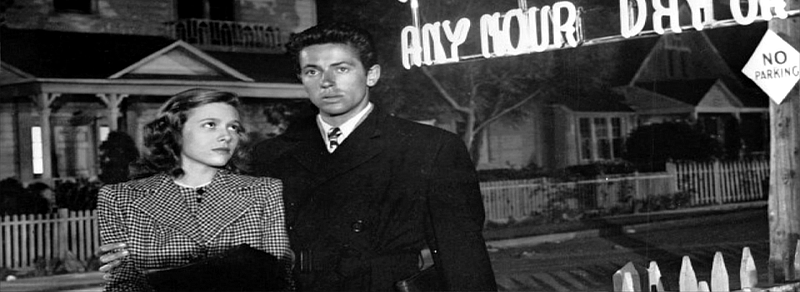
- Many of the supporting cast and minor characters were played by friends of John Houseman and Nicholas Ray, although RKO contract player Robert Mitchum expressed interest in playing Chicamaw, saying that like Ray he knew all about the Depression-era South and had once been in a chain gang. Mitchum went so far as to shave his head and dye it black for the role (in the original novel Chicamaw is an Indian), but because Mitchum was a rising star and had recently received an Oscar nomination, the role of a bank robber was deemed unfit for him. The role of Chicamaw eventually went to Howard Da Silva, who had made an impression in Marc Blitzstein’s musical “The Cradle Will Rock” (1937), produced by Houseman.
- The movie has a very unusual prologue before the opening credits showing a very romantic Farley Granger and Cathy O’Donnell with subtitles.
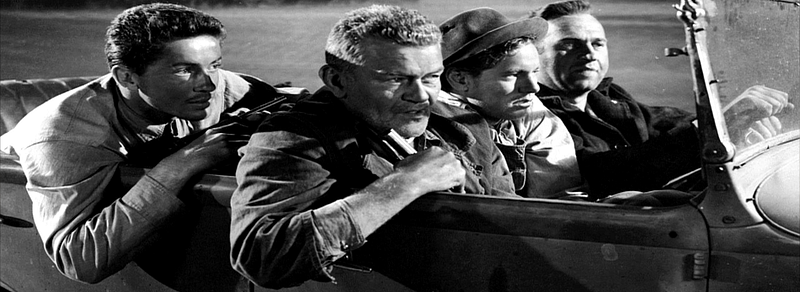
- The first scene shot was the opening scene, a tracking shot of Bowie, T-Dub and Chickamaw escaping from prison in a stolen car. Ray decided to use a helicopter, which had previously been used for establishing shots of landscapes but never before had it been used to shoot action. This film is sometimes considered the first to use a helicopter for this purpose and predates James Wong Howe’s celebrated final shot for “Picnic” (1955) by eight years. Four takes were required, with the second one being in the final cut.
- The opening helicopter shot was the first scene that Nicholas Ray ever directed.
- Filmed in 1947. The film’s release was delayed by two years because Howard Hughes was in the process of buying RKO.
- According to Eddie Muller on TCM’s Noir Alley (2017–10–15), Farley Granger and Cathy O’Donnell first appeared together in “They Live by Night” (1948), filmed at RKO Pictures in 1947 but put on the shelf by new studio boss Howard Hughes. Former RKO Production Chief Dore Schary feared the picture would never be released, so he paired the actors again in “Side Street” (1950) at his new studio, M-G-M. Hughes learned of this and, wanting to beat Schary to the punch, finally released “They Live by Night” in the USA in November 1949, just a few weeks before “Side Street” opened nationwide.
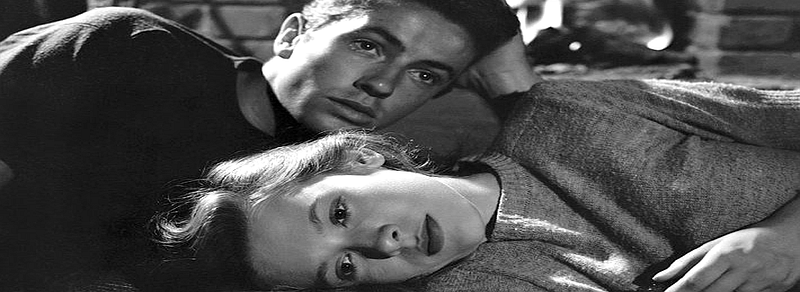
To conclude, Nicholas Ray’s “They Live by Night” is cinema of anxiety and sensuality, with a streak of instability and a peculiar combination of the folksy and the Cocteau-abstract that is not quite a film noir. It’s not quite a teenage romance. It’s not quite a crime drama. It’s not quite like anything to come before its time. Nicholas Ray brings a lyricism (lovers in close-up, twined) promptly invaded by kinetic despair (the camera descends from above as it rushes along with a trio of fugitives), a continuous whirl of a wealth of volatile filmmaking coups that emphasize the characters’ emotional fragility as it reigns in idiosyncratic performances from Cathy O’Donnell and Farley Granger in this simultaneously tough-minded, risky, delicate matrimonial union of an on-the-run trendsetting film noir classic.
NOTE: The article contains sources from IMDb and Wikipedia.
Follow me and check out other articles of mine: