
A FILM TO REMEMBER: “PAPILLON” (1973)
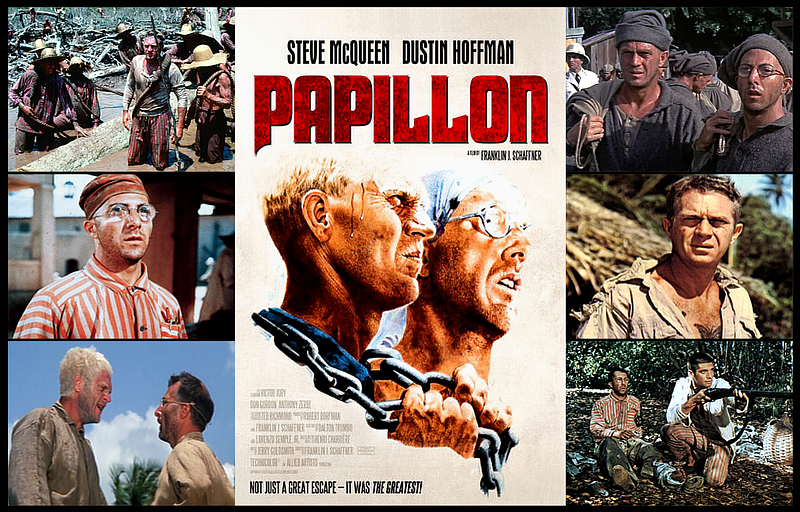
Before I get into this, I want to make mention “A FILM TO REMEMBER” will be a series about films that have reached a milestone anniversary since their origin in being culturally, historically, or aesthetically significant. The articles will contain the film’s plot outline, director, cast, a compilation of trivialities, various photos, movie trailer, critical reception and more. So, let’s start:
We are here to mark the celebration of the 45th Anniversary of Franklin J. Schaffner’s “Papillon”. Let’s take an inside look at the film:
PLOT OUTLINE:
A man befriends a fellow criminal as the two of them begin serving their sentence on a dreadful prison island, which inspires the man to plot his escape.
STUDIO:
Allied Artists Pictures
DIRECTOR:
Franklin J. Schaffner
CAST:
- Steve McQueen … Henri “Papillon” Charrière
- Dustin Hoffman … Louis Dega
- Victor Jory … Indian Chief
- Don Gordon … Julot
- Anthony Zerbe … Toussaint
- Robert Deman … André Maturette
- Woodrow Parfrey … Clusiot
- Bill Mumy … Lariot
- Richard Angarola … Commandant
- George Coulouris … Dr. Chatal
- Ratna Assan … Zoraima
- William Smithers … Warden Barrot
- Val Avery … Pascal
- Gregory Sierra … Antonio
- Vic Tayback … Sergeant
- John Quade … Masked Breton
- Mills Watson … Guard
- Ron Soble … Santini
- Fred Sadoff … Deputy Warden
- Barbara Morrison … Mother Superior
- Don Hanmer … Butterfly Trader
- E.J. André … Old Con
- Jack Denbo … Classification Officer
- Len Lesser … Guard
- Allen Jaffe … Turnkey
- Liam Dunn … Old Trustee
GENRE(S):
Biography | Crime | Drama
TAGLINE:
Two men with nothing in common but a will to live and a place to die
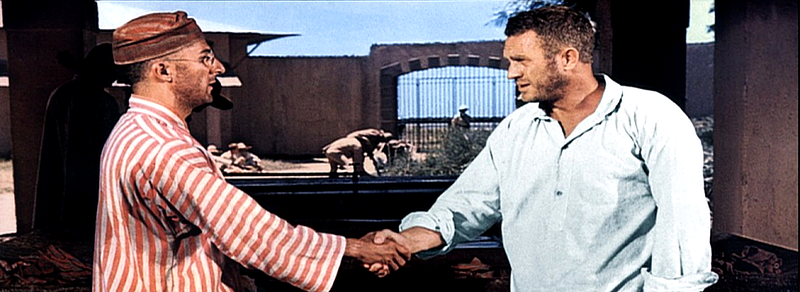
The film is known for being the consummate prison-break epic of a narrative that unfolds slowly of a man who’s not a complicated man but his experiences changed him almost beyond recognition in this stirring drama of durability, opportunism and friendship under fire. Director Franklin J. Schaffner, who expertly captures the gritty prison story, does not flinch from showing every conceivable horror of the French penal system all with the help from its two lead performers of Steve McQueen with a transformational esteemed performance and Dustin Hoffman with an eccentric submerged performance in this grin and bear black hole chronicle. The film is based from the autobiography by the French convict Henri Charrière, it was critically mixed during its initial release garnering some criticism against it but critical reassessment over the years has made it one of the greatest behind-bars cinematic touchstones of its genre.
Here’s what some of the critical receptions have been for the film over the years:
Ian Nathan from Empire Magazine says: “One of the greatest behind-bars movies ever, the result finds director Franklin J. Schaffner making the most of both his sun-drenched locations and his leading man, who squintingly acts even co-star Dustin Hoffman well off the screen.”
Vincent Canby from New York Times says: “A big, brave, stouthearted, sometimes romantic, sometimes silly melodrama with the kind of visual sweep you don’t often find in movies anymore.”
Variety Staff from Variety says: “The script is very good within its limitations, but there is insufficient identification with the main characters.”
Richard Schickel from TIME Magazine says: “McQueen works hard and al most manages to triumph over his star presence, while Hoffman submerges himself eccentrically and amusingly in his coward’s role.”
Michael Booth from Denver Post says: “The squinting, ever-watchful gaze of Steve McQueen, coupled with one of Dustin Hoffman’s early showcase performances as a shambling accomplice, turned ‘Papillon’ into a hit and an enduring classic. The maybe-true story of transported French murderer Henri Charriere is a rousing drama of endurance, opportunism and friendship under fire.”
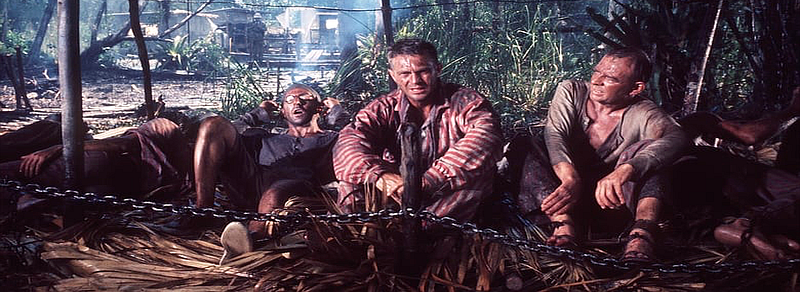
As you can tell by the critical reactions, the film generally got a mixed reception at it’s initial release with a fair share of criticism against it for being overlong, becoming unevenly episodic and having an insufficient identification with the main characters. Despite the negative critical judgment by various pundits, this breakout of prison epic has seen positive reappraisal over the years for bringing a narrative that is courageous, stunning and life-spanning…and the surreal touches…add to the sense of a highly original art-film spectacle. Schaffner makes the most of both his sun-drenched locations and his leading men adding a perfect balance with McQueen’s charismatic personage and Hoffman’s depiction of cunning corruption well off the screen in this grisly, brutal, peril lockup of a scot-free plat du jour. But I’ll let you decide…
So, to get a better look at the film, here’s a link to the movie trailer of Franklin J. Schaffner’s “Papillon”:
Here I have provided 12 interesting and intriguing trivia facts (I wanted to keep it limited) about “Papillon”:
- The real-life Henri “Papillon” Charrière was twenty-five when he was sent to French Guiana.
- Although billed as a true story, the French in French Guiana claim that much of the story of Henri “Papillon” Charrière is fabricated. Papillon was documented to have been incarcerated in Saint Laurent and may have escaped from there, but he never served any time on the Devil’s Islands (now known as Iles du Salut or Salvation Islands). The novel and film both present Devil’s Island as having rocky cliffs, when in fact, though the entire island is rocky, it gently slopes into the surrounding sea.
- Reportedly, the producers began taking raw footage to backers in Paris and getting just enough cash to keep things rolling. For a period of three weeks, money ran out and nobody got paid, and it looked as though the production would be shut down altogether. When Steve McQueen found out, he told the producers, “Unless everyone gets paid, I don’t work.” The situation improved after that.
- Steve McQueen insisted on performing the stunt where he jumps off a cliff. McQueen once said that it was “one of the most exhilarating experiences of my life”.
- Dustin Hoffman had to wear contact lenses so that he could see correctly through the thick glasses he had to wear.
- While shooting in Jamaica, Dustin Hoffman met Sir Paul McCartney who was vacationing in Montego Bay. One evening, Hoffman invited McCartney to dinner and challenged him to write a song “about anything”. Since painter Pablo Picasso had just died, Hoffman requested that McCartney compose a song around Picasso’s dying words (“Drink to me, drink to my health. You know I can’t drink anymore”). McCartney created a demo on the spot and the song, “Picasso’s Last Words (Drink to Me)”, appeared on Wings’ 1973 album “Band On the Run”.
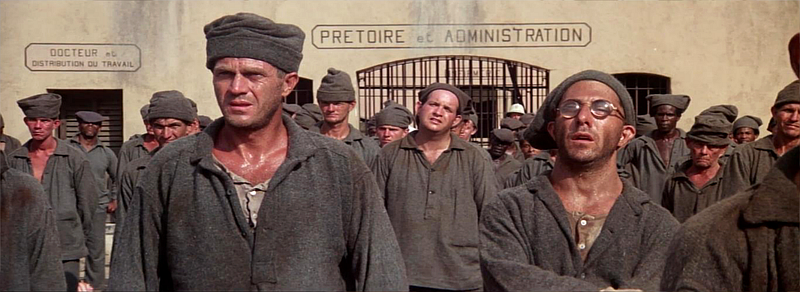
- The crew took advantage of the abundant marijuana that was readily available in Jamaica. Not content to merely smoke it, they boiled it down to mix in drinks at a party. Several people got sick from that, particularly Director Franklin J. Schaffner, causing a day’s delay in shooting.
- Dustin Hoffman became angry and uncooperative for some time after he discovered that although he and Steve McQueen would receive equal billing, he was actually making $750,000 dollars less than his co-star. Although they didn’t really speak to each other between takes or after principal photography was completed, they behaved professionally on the set for the most part.
- Steve McQueen and Dustin Hoffman did have some difficulties, despite their determination to behave professionally toward each other. When Hoffman began one speech at breakneck speed, McQueen stopped him and said, “Less, man, less. Toss that shit out, you don’t need it. Keep it simple.” Another time, Hoffman invited a few close friends to watch a day’s filming. McQueen had them thrown off the set. Nevertheless, Hoffman called their relationship “friendly rivalry” and later said his co-star “was a wonderful guy. Off screen, he was the nicest, classiest man. On the set itself he became very intense.” Another time, however, he referred to McQueen as “that son of a bitch”.
- Theft and pillage by the locals were a constant problem. When the production ended, before properties could be packed and shipped, locals raided and stripped the set, making off with costumes (six hundred pairs of shoes alone), machinery, and lumber. In all, $30,000 was lost.
- Although many considered this Steve McQueen’s best performance to date, he was overlooked by the Academy. Some say that was because McQueen had “stolen” Ali MacGraw (who became his second wife) from her husband Robert Evans, who was a powerful studio executive at the time. McQueen was also rumored to have slept with many other Hollywood wives. Others say McQueen’s Academy Award snub was because the actor, in rather coarse language, once told the Golden Globes committee he would accept an award if he won, but would never consider going to the ceremony. He did, however, receive a Golden Globe Best Actor nomination.
- The meaning of the film and source novel’s title “Papillon” is “Butterfly” from French. It is pronounced, “PAP-PEE-YONH”. Papillon also refers to the butterfly tattoo that Henri Charrière (played by Steve McQueen) has. Papillon was also the nickname given to Charrière. The title of Butterfly (1982) also refers to a butterfly tattoo.
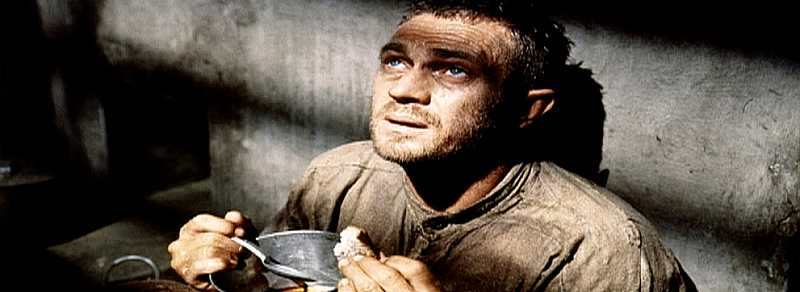
To conclude, Franklin J. Schaffner’s “Papillon” is prominently guillotine-equipped penal saga that shows the horrors of prison life that are graphically on display including a decapitation that results in blood spurting onto the lens of the camera (‘70s era filmmaking at its most provocative), cockroaches eaten to supplement the prison diet, storms at sea, a hand-to-hand encounter with a crocodile and much more in this hairbreadth escapes and survivals against all odds prison-break tale. Franklin J. Schaffner brings a gritty realism and a glossy romanticism all together with a remarkable feat of stylistic control that’s aided with two shipshape immersed performances from Steve McQueen and Dustin Hoffman in this nightmarishly glum, chillingly graphic, freedom fighting, full-throated epic of a human enduring, prison escaping pièce de résistance classic.
NOTE: The article contains sources from IMDb and Wikipedia.
Follow me and check out other articles of mine: