
A FILM TO REMEMBER: “THE EXORCIST” (1973)
Before I get into this, I want to make mention “A FILM TO REMEMBER” will be a series about films that have reached a milestone anniversary since their origin in being culturally, historically, or aesthetically significant. The articles will contain the film’s plot outline, director, cast, a compilation of trivialities, various photos, movie trailer, critical reception and more. So, let’s start:
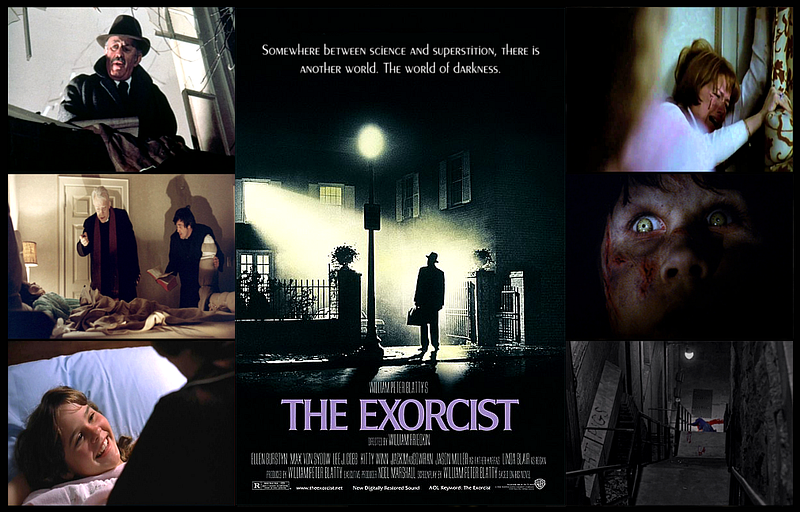
We are here to mark the celebration of the 45th Anniversary of William Friedkin’s “The Exorcist”. Let’s take an inside look at the film:
PLOT OUTLINE:
When a teenage girl is possessed by a mysterious entity, her mother seeks the help of two priests to save her daughter.
STUDIO:
Warner Bros. Pictures
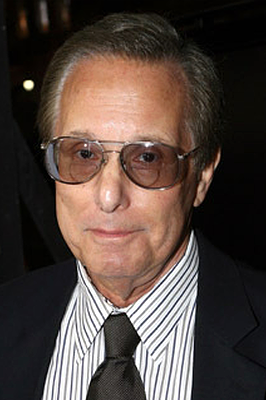
DIRECTOR:
William Friedkin
CAST:
- Ellen Burstyn … Chris MacNeil
- Max von Sydow … Father Lankester Merrin
- Jason Miller … Father/Dr. Damien Karras, S.J.
- Linda Blair … Regan MacNeil
- Lee J. Cobb … Lieutenant William F. Kinderman
- Kitty Winn … Sharon Spencer
- Jack MacGowran … Burke Dennings
- Father William O’Malley … Father Joseph Dyer
- Peter Masterson … Dr. Barringer
- Robert Symonds … Dr. Taney
- Barton Heyman … Dr. Samuel Klein
- Arthur Storch … Psychiatrist
- Mercedes McCambridge … Voice of the Demon
- Eileen Dietz … Face of the Demon
GENRE(S):
Horror
TAGLINE:
Something beyond comprehension is happening to a girl on this street, in this house…a man has been sent for as a last resort. That man is The Exorcist.
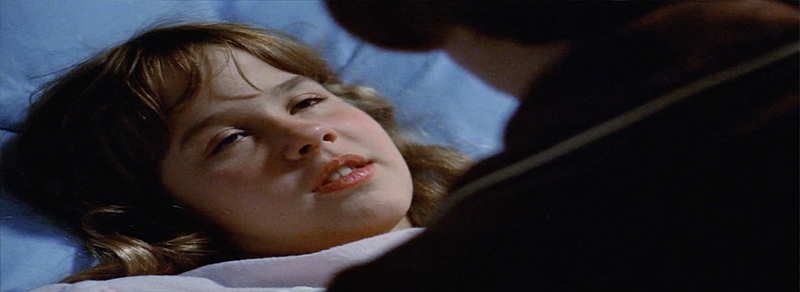
The film is known for not only topping its genre but transcends it, it launched a new era in horror cinema, resulting in a profound experience where horror filmmaking, thrillingly dramatic storytelling and deeply felt spirituality of the Catholic kind make for pivotal viewing. Director William Friedkin pushes all the right buttons with a mounting intensity, and ingeniously constructed surprises along with its superb cast and performances especially by Linda Blair, Ellen Burstyn, Max Von Sydow and Jason Miller in this ritual meditation exemplar on the struggle between good and evil. The film is based from William Peter Blatty’s novel of the same name, which was inspired by the 1949 exorcism of Roland Doe, it was critically well received though had its share of negative receptions about being a crude religious exploitation piece but over the years, the film’s critical reputation has grown considerably in becoming a significant influence on popular culture and being a cinematic horror masterpiece.
Here’s what some of the critical receptions have been for the film over the years:
Stanley Kauffmann from The New Republic says: “This is the scariest film I’ve seen in years — the only scary film I’ve seen in years…If you want to be shaken — and I found out, while the picture was going, that that’s what I wanted — then ‘The Exorcist’ will scare the…(shit) out of you.”
Owen Gleiberman from Entertainment Weekly says: “Some movies aren’t just movies. They are closer to voodoo — they channel currents larger and more powerful than themselves.”
Jon Landau from Rolling Stone says: “The film is nothing more than a religious porn film, the gaudiest piece of shlock this side of Cecil B. DeMille (minus that gentleman’s wit and ability to tell a story)”
Desmond Ryan from Philadelphia Inquirer says: “‘The Exorcist,’ with its excellent cast, mounting intensity, and ingeniously constructed surprises, is still a commanding achievement.”
Roger Ebert from Chicago Sun-Times says: “What we get here aren’t the delicious chills of a Vincent Price thriller, but a raw and painful experience. Are people so numb they need movies of this intensity in order to feel anything at all? If movies are, among other things, opportunities for escapism, then ‘The Exorcist’ is one of the most powerful ever made.”
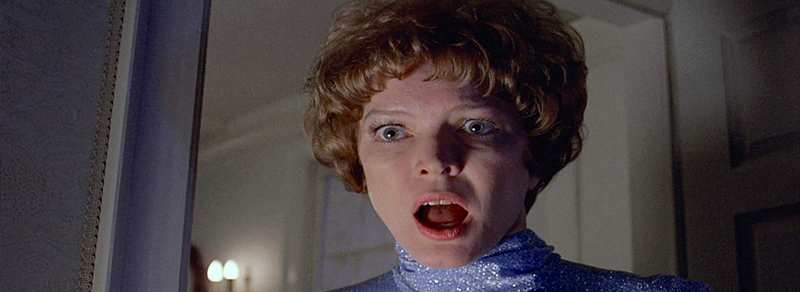
As you can tell by the critical reactions, the film was overall a success critically but it garnered a bit of various criticisms for having a disjointed narrative structure, barbarism, religious exploitation and its use of characters as mere props with not enough visual information. However, this trendsetting shocker about a possessed child has become a touchstone of its genre, Friedkin with a top-notch ensemble cast led by Blair, Burstyn, Sydow and Miller has established a hellish chiller in a cunning and intensely terrifying rollercoaster ride, that’s highly instructive as well as unnerving in audience manipulation in this chillingly atmospheric tale of demonic possession, medical torture and religious salvation of a finely crafted, all-time frightening classic thriller. But I’ll let you decide…
So, to get a better look at the film, here’s a link to the movie trailer of William Friedkin’s “The Exorcist”:
Here I have provided 12 interesting and intriguing trivia facts (I wanted to keep it limited) about “The Exorcist”:
- Aspects of William Peter Blatty’s fictional novel were inspired by the 1949 exorcism performed on an anonymous young boy known as “Roland Doe” or “Robbie Mannheim” (pseudonyms) by the Jesuit priest Fr. William S. Bowdern, who formerly taught at both St. Louis University and St. Louis University High School. Doe’s family became convinced the boy’s aggressive behavior was attributable to demonic possession, and called upon the services of several Catholic priests, including Bowdern, to perform the rite of exorcism. It was one of three exorcisms to have been sanctioned by the Catholic Church in the United States at that time. Later analysis by paranormal skeptics has concluded that Doe was likely a mentally ill teenager acting out, as the actual events likely to have occurred (such as words being carved on skin) were such that they could have been faked by Doe himself. The novel changed several details of the case, such as changing the gender of the allegedly possessed victim from a boy into a girl and changing the alleged victim’s age.
- Director William Friedkin has admitted he is very reluctant to speak about the factual aspects of the film, he made the film with the intention of immortalizing the events involving Doe that took place in St. Louis in 1949, and despite the relatively minor changes that were made, the film depicts everything that could be verified by those involved. In order to make the film, Friedkin was allowed access to the diaries of the priests involved, as well as the doctors and nurses; he also discussed the events with Doe’s aunt in great detail. Friedkin has said that he does not believe that the “head-spinning” actually occurred, but this has been disputed. Friedkin is secular, despite coming from a Jewish family.
- Audrey Hepburn was William Friedkin’s first choice to play the role of Chris MacNeil, and Warner Bros. supported him because of her good critical/commercial reputation with the studio, but she only agreed to do it if it was filmed in Rome, so that she could stay close to her two young sons. Friedkin and the producers considered the offer but decided against moving the production to Italy. Anne Bancroft was the second choice but she was in her first month of pregnancy and was dropped from contention. William Peter Blatty suggested his friend, Shirley MacLaine, for the part, but Friedkin was hesitant to cast her, given her lead role in another possession film, “The Possession of Joel Delaney” (1971) two years before. Ellen Burstyn received the part after she phoned Friedkin and emphatically stated that she was going to play the role of Chris MacNeil.
- Warners Bros. had approached Arthur Penn, Stanley Kubrick and Mike Nichols, to direct, all of whom turned the project down. Originally, Mark Rydell was hired to direct, but William Peter Blatty insisted on William Friedkin instead, because he wanted his film to have the same energy as Friedkin’s previous film, “The French Connection” (1971). After a standoff with the studio, which initially refused to budge over Rydell, Blatty eventually got his way as Friedkin would get to helm the film.
- Principal photography for filming was scheduled to shoot for an estimated 105 days, but ultimately ran well over 200 days.
- Although the film is set in Washington, D.C., many interior scenes were shot in various parts of New York City. The MacNeil residence interiors were filmed at CECO Studios in Manhattan. The bedroom set had to be refrigerated to capture the authentic icy breath of the actors in the exorcism scenes. The temperature was brought so low that a thin layer of snow fell onto the set one morning. Linda Blair, who was only in a thin nightgown, says to this day she cannot stand being cold. Exteriors of the MacNeil household were filmed at 36th and Prospect in Washington, using a family home and a false wall to convey the home’s thrust toward the steps.
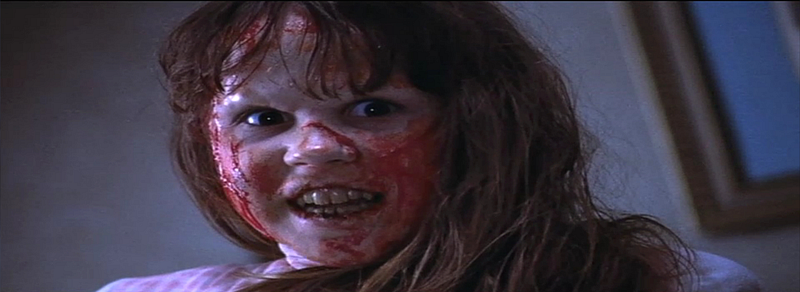
- In an interview, Jason Miller (who played the role of Father/Dr. Damien Karras, S.J.) stated that he had a major verbal confrontation with William Friedkin after the director fired a gun near his ear to get an authentic reaction from him. Miller told Friedkin that he is an actor, and that he didn’t need a gun to act surprised or startled.
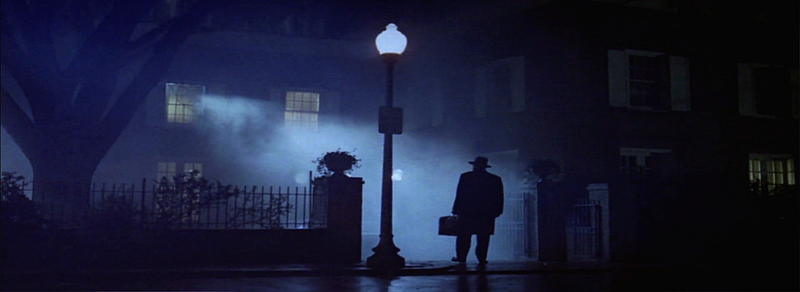
- Father Merrin’s arrival scene was filmed on Max von Sydow’s first day of work. The scene where the elderly priest steps out of a cab and stands in front of the MacNeil residence, silhouetted in a misty streetlamp’s glow and staring up at a beam of light from a bedroom window, is one of the most famous scenes in the film. The shot was used for film posters and home entertainment covers. The scene and photo was inspired by the 1954 painting “Empire of Light” (“L’Empire des lumières”) by René Magritte.
- Although the agency representing Linda Blair did not send her for the role, Blair’s mother took her to meet with Warner Bros.’s casting department and then with William Friedkin. Pamelyn Ferdin, a veteran of science fiction and supernatural drama, was a candidate for the role of Regan MacNeil, but was ultimately turned down because her career thus far had made her too familiar to the public. April Winchell was considered, until she developed pyelonephritis, which caused her to be hospitalized and ultimately taken out of consideration. Denise Nickerson, who played Violet Beauregarde in “Willy Wonka & the Chocolate Factory” (1971), was considered, but the material troubled her parents too much, and they pulled her out of consideration. Anissa Jones, known for her role as Buffy in “Family Affair” (1966–1971), auditioned for the role, but she too was rejected, for much the same reason as Ferdin. The part went instead to Blair, a relative unknown until the film’s success.
- Linda Blair received death threats from religious zealots who believed the film “glorified Satan”, Warner Bros. had bodyguards protecting her for six months after the film’s release.
- There was question of whether or not such a young actress, even a talented one, could carry the film on her shoulders was an issue from the beginning. Film directors considered for the project, which included Arthur Penn, Stanley Kubrick and Mike Nichols, were skeptical. Warner Bros. wanted Marlon Brando for the role of Lankester Merrin. William Friedkin immediately vetoed this by stating it would become a “Brando film”. Jack Nicholson was up for the part of Karras before Stacy Keach was hired by William Peter Blatty. According to Friedkin, Paul Newman also wanted to portray Karras. Friedkin then spotted Jason Miller following a performance of Miller’s play “That Championship Season” in New York. Even though Miller had never acted in a film, Keach’s contract was bought out by Warner Bros. and Miller was signed.
- Mercedes McCambridge had to sue Warner Bros. for credit as the voice of the demon. William Friedkin, on the Diane Riehm Show (NPR, 29 April 2012) said that originally she didn’t want a credit, saying that she wanted the audience to believe the voice was Regan’s. However, after it was released she changed her mind, and was given the credit.
To conclude, William Friedkin’s “The Exorcist” gains its power from the way it mixes opposites: new-style realism and sexual radicalism, old-style horror and religion with a story whose archetypal pull and sheer visceral power can’t be negated in this effective demonic and spiritual excursion. William Friedkin rides its supernatural theme(s) to a wicked effect, developing an eerie sense of atmosphere and a talented cast and performances, particularly from Linda Blair, Ellen Burstyn, Max Von Sydow and Jason Miller into the disturbing exploration of the caliginous elements of religion and the spiritual world of painful trauma, hysterical screams, devilish diabolism and Godship goodness in this quintessence, prime moving, genre monument of a cinematic horror.
NOTE: The article contains sources from IMDb and Wikipedia.
Follow me and check out other articles of mine: