
A FILM TO REMEMBER: “DON’T LOOK NOW” (1973)
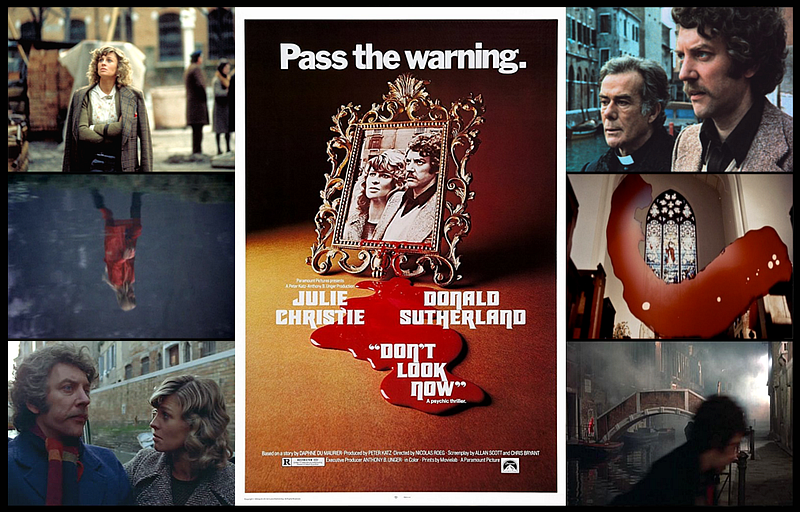
Before I get into this, I want to make mention “A FILM TO REMEMBER” will be a series about films that have reached a milestone anniversary since their origin in being culturally, historically, or aesthetically significant. The articles will contain the film’s plot outline, director, cast, a compilation of trivialities, various photos, movie trailer, critical reception and more. So, let’s start:
We are here to mark the celebration of the 45th Anniversary of Nicolas Roeg’s “Don’t Look Now”. Let’s take an inside look at the film.
PLOT OUTLINE:
A married couple grieving the recent death of their young daughter are in Venice when they encounter two elderly sisters, one of whom is psychic and brings a warning from beyond.
STUDIO:
Paramount Pictures
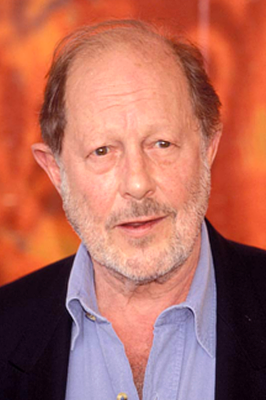
DIRECTOR:
Nicolas Roeg
CAST:
- Julie Christie … Laura Baxter
- Donald Sutherland … John Baxter
- Hilary Mason … Heather
- Clelia Matania … Wendy
- Massimo Serato … Bishop Barbarrigo
- Renato Scarpa … Inspector Longhi’
- Giorgio Trestini … Workman
- Leopoldo Trieste … Hotel Manager
- David Tree … Anthony Babbage
- Ann Rye … Mandy Babbage
- Nicholas Salter … Johnny Baxter
- Sharon Williams … Christine Baxter
- Bruno Cattaneo … Detective Sabbione
- Adelina Poerio … Dwarf
GENRE(S):
Drama | Horror | Thriller
TAGLINE:
It’s utter MADNESS!
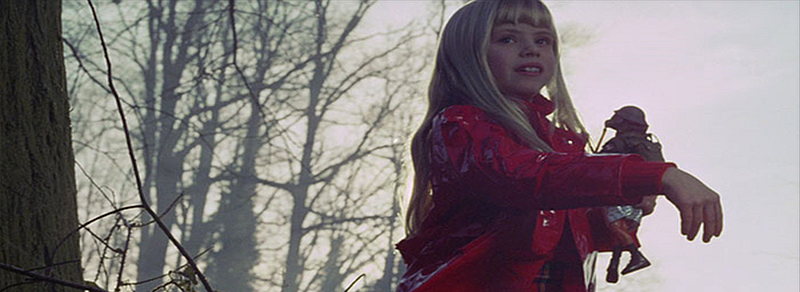
The film is known for its innovative and disjunctive editorial style, its use of recurring motifs and themes and for a controversial sex scene that was highly explicit for its time. Director Nicolas Roeg often employs with flashbacks and flash-forwards in keeping with the depiction of precognition, with intercutting or merging various sequences to alter the viewer’s perception of what is really happening. It’s adopting of an impressionist approach to its imagery, often presaging events with familiar objects, patterns and colors using associative editing techniques in creating both a chilling horror film and a fascinating portrait of grief. The film is based from a from the short story of the same name by Daphne du Maurier, it was generally well received by critics, although some criticized it for being too artsy and mechanical in its approach but the film has grown some critical re-evaluation since its initial release and has now become regarded as an influential masterwork in the genre of cinematic horror.
Here’s what some of the critical receptions have been for the film over the years:
Jay Cocks from TIME Magazine says: “‘Don’t Look Now’ uses the occult and the inexplicable as Henry James did: to penetrate the subconscious, to materialize phantoms from the psyche.”
Vincent Canby from New York Times says: “It stops being suspenseful and becomes an elegant travelogue that treats us to second-sightseeing in Venice which was not convincing on screen, since it appeared simply like flash-forward which is a standard storytelling device in films.”
James Berardinelli from ReelViews says: “[Don’t Look Now] takes the viewer on a winding, unpredictable trip that starts as a meditation on grief and ends as a supernatural thriller.”
Roger Ebert from Chicago Sun-Times says: “Nicolas Roeg’s 1973 film remains one of the great horror masterpieces, working not with fright, which is easy, but with dread, grief and apprehension.”
Justin Chang from Los Angeles Times says: “A devastating portrait of grief, a master class in disjunctive editing and a haunting disquisition on the use of the color red.”
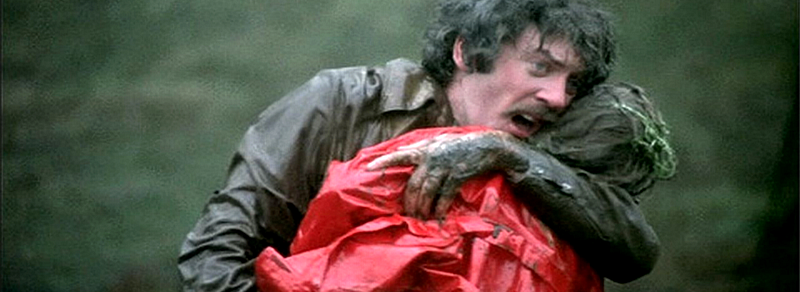
As you can tell by the critical reactions, it was critically well praised although it did have a few criticisms from some, mainly for its narrative structuring devices but also, it had caused considerable controversy with censorships for its infamous sex scene with Sutherland and Christie which was unusually graphic for its period, including a rare depiction of cunnilingus in mainstream cinema. The film is purposely detached, almost cursory as Roeg and his collaborators have constructed an intricate, intense speculation about levels of perception and reality through fine performances from Christie and Sutherland, as it maps Sutherland’s character’s disintegrating psyche onto the city of Venice, with its labyrinthian alleys, murky canals and crumbling facades that manages to establish a haunting meditation on fear, death and the beyond in this psychodramatic occult and rhythmic pungency of a exemplar horror feature film. But I’ll let you decide…
So, to get a better look at the film, here’s a link to the movie trailer of Nicolas Roeg’s “Don’t Look Now”:
Here I have provided 12 interesting and intriguing trivia facts (I wanted to keep it limited) about “Don’t Look Now”:
- The film is particularly indebted to filmmaker Alfred Hitchcock, exhibiting several characteristics of the director’s work. The aural match cut following Christine’s death (played by Sharon Williams) from Laura’s scream (played by Julie Christie) to the screech of a drill references a cut in “The 39 Steps” (1935), when a woman’s scream cuts to the whistle of a steam train. When John (played by Donald Sutherland) reports Laura’s disappearance to the Italian police he inadvertently becomes a suspect in the murder case they are investigating — an innocent man being wrongly accused and pursued by the authorities is a common Hitchcock trait. The film also takes a Hitchcockian approach to its mise en scène, by manifesting its protagonist’s psychology in plot developments: in taking their trip to Venice the Baxters have run away from personal tragedy, and are often physically depicted as running to and from things during their stay in Venice; the labyrinthine geography of Venice causes John to lose his bearings, and he often becomes separated from Laura and is repeatedly shown to be looking for her — both physical realisations of what is going on in his head.
- Renato Scarpa who played Inspector Longhi didn’t speak any English. He just read the lines he’d been given without knowing what they meant, which added to the sinister quality of his character.
- Adelina Poerio was cast as the fleeting red-coated figure after Nicolas Roeg saw her photo at a casting session in Rome. Standing at only 4'2" tall, she had a career as a singer.
- Real-life couple Natalie Wood and Robert Wagner were suggested for the parts of Laura and John Baxter, director Nicolas Roeg was eager to cast Julie Christie and Donald Sutherland from the very start. Initially engaged by other projects, both actors unexpectedly became available. Christie liked the script and was keen to work with Roeg, who had served as cinematographer on “Fahrenheit 451” (1966), “Far from the Madding Crowd” (1967) and “Petulia” (1968) in which she had starred. Sutherland also wanted to make the film but had some reservations about the depiction of clairvoyance in the script. He felt it was handled too negatively and believed that the film should be a more “educative film”, and that the “characters should in some way benefit from ESP and not be destroyed by it”. Roeg was resistant to any changes and issued Sutherland an ultimatum to which of course, Sutherland took the part.
- Donald Sutherland and Julie Christie met for the first time on the set of this film. The first scene they had to shoot was the infamous sex scene, as Nicolas Roeg wanted to “get it out of the way” and then move on to the “bone” of the matter. Christie was reportedly “terrified.”
- When he appeared on “Inside the Actors Studio” (1994), Donald Sutherland recounted the story of how the (in)famous sex scene was actually shot and that it was anything but a sexy or erotic experience for those involved. He and Julie Christie were on the set at 7 a.m. in dressing gowns, waiting downstairs while the room was prepared and both had a glass of champagne to calm their nerves. Inside the room was Nicolas Roeg and cinematographer Anthony B. Richmond, each operating their own Mitchell 35mm camera. Sutherland and Chiststie disrobed and got onto the bed and Roeg and Richmond began filming. The huge Mitchell cameras were unblimped (unsilenced) and as the room was oak panelled the noise from the two cameras was amplified hugely. At the same time, Roeg began shouting directions (over the noise of the cameras) to the actors such as “Lick her nipples,” “Put your hand between her legs,” “Get on top” and etc. The filming lasted until well into the afternoon before Roeg was satisfied and wrapped.
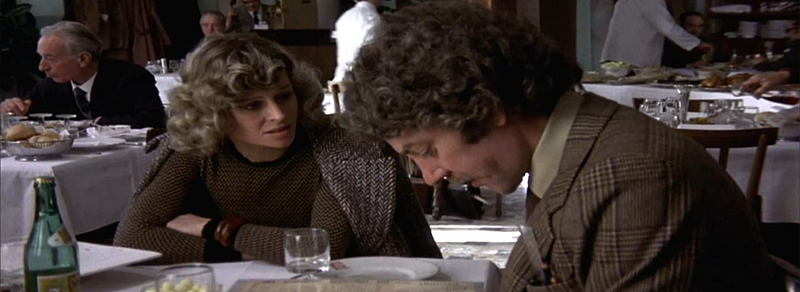
- Nicolas Roeg wanted Julie Christie to attend a séance prior to filming. Leslie Flint, a direct voice medium based in Notting Hill, invited them to attend a session which he was holding for some American parapsychologists, who were coming over to observe him. Roeg and Christie went along and sat in a circle in the pitch dark and joined hands. Flint instructed his guests to “uncross” their legs, which Roeg subsequently incorporated into the film.
- Shooting the sequence was particularly problematic: Sharon Williams, who played Christine, became hysterical when submersed in the pond, despite the rehearsals at the swimming pool going well. A farmer on the neighboring land volunteered his daughter who was an accomplished swimmer, but who refused to be submersed when it came to filming. In the end, the scene was filmed in a water tank using three girls. Nicolas Roeg and editor Graeme Clifford showed the opening sequence to some friends before filming resumed on the Venice segment, and Clifford recalls it making a considerable impression.
- Nicolas Roeg decided not to use traditional tourist locations to purposefully avoid a “travel documentary” look. Venice turned out to be a difficult place to film in, mainly due to the tides which caused problems with the continuity and transporting equipment.
- Filming the scene in which John almost falls to his death while restoring the mosaic in San Nicolò church was also beset by problems, and resulted in Donald Sutherland’s life being put in danger. The scene entailed some of the scaffolding collapsing leaving John dangling by a rope, but the stuntman refused to perform the stunt because the insurance was not in order. Sutherland ended up doing it instead, and was attached to a kirby wire as a precaution in case he should fall. Some time after the film had come out, renowned stunt coordinator Vic Armstrong commented to Sutherland that the wire was not designed for that purpose, and the twirling around caused by holding on to the rope would have damaged the wire to the extent that it would have snapped if Sutherland had let go.
- The famous sex scene between Donald Sutherland and Julie Christie was a last minute on-set idea from director Nicolas Roeg who felt that otherwise the film would have too many scenes of the couple arguing. Most of the scenes around it are improvised. However, in order to avoid an X-certificate rating for the film’s United States release, 9 frames (less than half a second) had to be cut from the intimate love sequence between Sutherland and Christie. Interestingly enough in 2011, both co-star Sutherland and producer Peter Katz issued denials to the longstanding rumor that Sutherland and Christie had engaged in unstimulated intercourse during their characters’ sex scene.
- Daphne Du Maurier wrote a letter to Nicolas Roeg after seeing the film, congratulating him on making such a strong film from her short story.
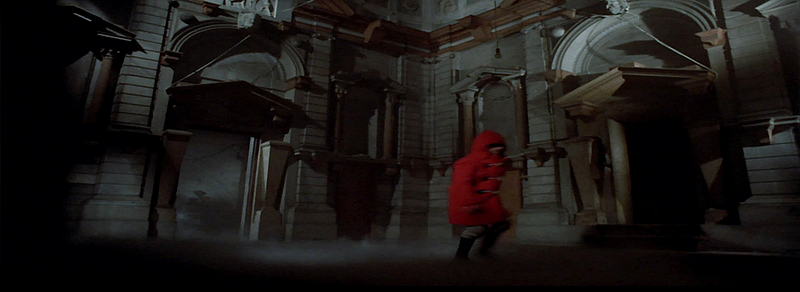
To conclude, Nicolas Roeg’s “Don’t Look Now” is a ghost story detailed with what seems to ripple, rhyme and resonate, bleeding uncannily into what ought to be entirely unrelated episodes — and everything bearing the ghostly traces of a different story trying to break through in this patiently build-up of suspense of haunting imagery, chilling musical score and sublimely subtle performances from Donald Sutherland and Julie Christie. Nicolas Roeg guides with a compulsory besetting, rendering the notion of foresight explicitly but still be mysterious while severing the natural arteries between cause and effect to expose a more irrational kind of narrative continuum. The film portrays the loves and losses we all experience, our here and now dictated by the fallibility of human nature and the cruelties of time penetrating the subconscious, to materialize phantoms from the psyche in this psychological dread, fathomless grief and fear-drenched apprehension of a supernatural classic thriller chiller.
NOTE: The article contains sources from IMDb and Wikipedia.
Follow me and check out other articles of mine: