
A FILM TO REMEMBER: “THE BIRDS” (1963)
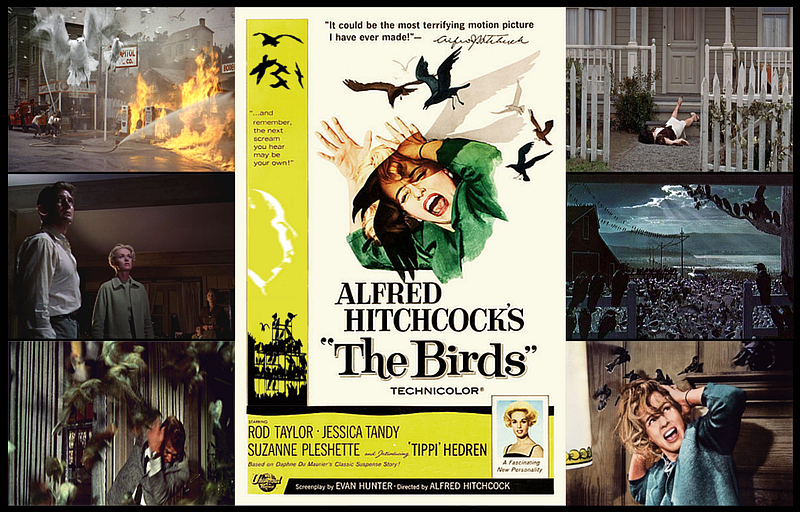
Before I get into this, I want to make mention “A FILM TO REMEMBER” will be a series about films that have reached a milestone anniversary since their origin in being culturally, historically, or aesthetically significant. The articles will contain the film’s plot outline, director, cast, a compilation of trivialities, various photos, movie trailer, critical reception and more. So, let’s start:
We are here to mark the celebration of the 55th Anniversary of Alfred Hitchcock’s “The Birds”. Let’s take an inside look at the film.
PLOT OUTLINE:
A wealthy San Francisco socialite pursues a potential boyfriend to a small Northern California town that slowly takes a turn for the bizarre when birds of all kinds suddenly begin to attack people.
STUDIO:
Universal Pictures
DIRECTOR:
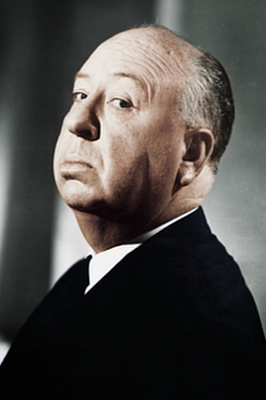
Alfred Hitchcock
CAST:
- Tippi Hedren … Melanie Daniels
- Rod Taylor … Mitchell “Mitch” Brenner
- Jessica Tandy … Lydia Brenner
- Suzanne Pleshette … Annie Hayworth
- Veronica Cartwright … Cathy Brenner
- Ethel Griffies … Mrs. Bundy
- Charles McGraw … Sebastian Sholes
- Ruth McDevitt … Mrs. MacGruder
- Lonny Chapman … Deke Carter
- Doreen Lang … Hysterical Mother in Diner
- Karl Swenson … Drunken Doomsayer in Diner
- Joe Mantell … Traveling Salesman at Diner’s Bar
- Malcolm Atterbury … Deputy Al Malone
- John McGovern … Postal Clerk
- Richard Deacon … Mitch’s City Neighbor
- Elizabeth Wilson … Helen Carter
- Doodles Weaver … Fisherman Helping with Rental Boat
- William Quinn … Sam
- Morgan Brittany … Brunette Girl at Birthday Party (uncredited)
- Darlene Conley … Waitress (uncredited)
- Dal McKennon … Sam the Cook (uncredited)
GENRE(S):
Drama | Horror | Mystery | Romance
TAGLINE:
The Birds is coming!
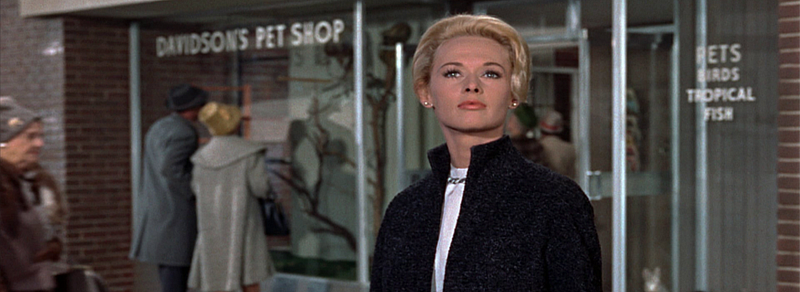
The film is known for being most notable for turning something completely harmless into an incredible menace — all with absolutely no explanation. Director Alfred Hitchcock while in the thick of this avian horror narrative, that pays deep attention to all those involved, as Hitchcock makes the malevolent birds seem like manifestations of his characters’ mental uneasiness. All the while, managing to reach far inside the psychological chasm and finding a rich inspiration in this chillingly nihilistic, terrorizing esthetic exploit. The film is loosely based from Daphne du Maurier’s novel of the same name, it received a mixed critical reception upon its initial release but with the passage of time of the critical revaluation, the film’s standing has since improved in becoming a masterful suspense of an elaborate feather bedlam classic.
Here’s what some of the critical receptions have been for the film over the years:
Tom Milne from Time Out says: “It’s fierce and Freudian as well as great cinematic fun, with ample fodder for the amateur psychologist following up on Hitch’s tortuous involvement with his leading ladies.”
Philip K. Scheuer from Los Angeles Times says: “Hitchcock was once widely quoted as saying he hated actors. After his 1960 ‘Psycho’ and now ‘The Birds,’ it must be fairly obvious that he has extended his abhorrence to the whole human race. For reasons hardly justified either dramatically or esthetically, the old master has become a master of the perverse. He has gone all out for shock for shock’s sake, and it is too bad.”
Andrew Sarris from Village Voice says: “Drawing from the relatively invisible literary talents of Daphne du Maurier and Evan Hunter, Alfred Hitchcock has fashioned a major work of cinematic art, and ‘cinematic’ is the operative term here, not ‘literary’ or ‘sociological.’”
Bosley Crowther from New York Times says: “Mr. Hitchcock and his associates have constructed a horror film that should raise the hackles of the most courageous and put goose-pimples on the toughest hide.”
James Powers from Hollywood Reporter says: “Hitchcock prolongs his prelude to horror for more than half the film, playing with audience suspense with comedy and romance while he sets his stage. The horror when it comes is a hair-raiser…”
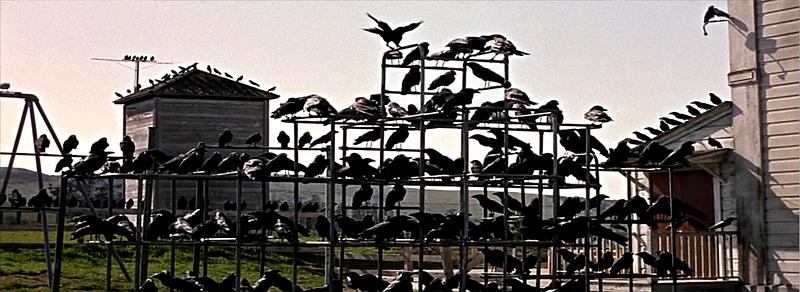
As you can tell by the critical reactions, the film was met with a mixed critical response upon its initial release as some criticisms of various claims pointed to it being perverse, too nakedly sadistic or just purely shock value exploitation. Nevertheless, time though has played key in the film’s favorable critical reassessment, having proven to be a much depreciated and undervalued feature during its initial assessment. The film has concocted an elaborate tease as if to prove that suspense and thrills can be induced as much by the expectation of horror as by horror itself. Hitchcock depicts so eerily, yet, so meticulously the philosophical esoteric and attested sense of a world out of joint in this apocalyptic construct of a beautifully realized, fright-filled, nightmarishly fowl, cinematic thriller. But I’ll let you decide…
So, to get a better look at the film, here’s a link to the movie trailer of Alfred Hitchcock’s “The Birds”:
Here I have provided 12 interesting and intriguing trivia facts (I wanted to keep it limited) about “The Birds”:
- Residents in the town of Capitola, California awoke on August 18, 1961, to find sooty shearwaters slamming into their rooftops and their streets covered with dead birds. News reports suggested domoic acid poisoning (amnesic shellfish poisoning) as the cause. According to the local Santa Cruz Sentinel, director Alfred Hitchcock requested a news copy in 1961 to use as “research material for his latest thriller”. At the end of the same month, he hired screenwriter and novelist Evan Hunter to adapt Daphne du Maurier’s novella, “The Birds”, first published in her 1952 collection “The Apple Tree”. Hunter had previously written “Vicious Circle” for Alfred Hitchcock’s Mystery Magazine, which he adapted for the television anthology series “Alfred Hitchcock Presents” (1955–1961)He also adapted Robert Turner’s story “Appointment at Eleven” for the same television series. Hunter later suspected that he was hired because he had demonstrated he could write suspense (with the 87th Precinct novels, as Ed McBain) and because his novel “The Blackboard Jungle” had received critical acclaim. The relationship between Hunter and Hitchcock during the creation of “The Birds” was documented by the writer in his 1997 autobiography “Me and Hitch,” which contains a variety of correspondence between the writer, director and Hitchcock’s assistant, Peggy Robertson.
- Evan Hunter and Alfred Hitchcock developed the story, suggesting foundations such as the townspeople having a guilty secret to hide and the birds an instrument of punishment. He suggested that the film begin using some elements borrowed from the screwball comedy genre then have it evolve into stark terror. This appealed to Hitchcock, according to the writer, because it conformed to his love of suspense: the title and the publicity would have already informed the audience that birds attack, but they do not know when. The initial humor followed by horror would turn the suspense into shock.
- Alfred Hitchcock solicited comments from several people regarding the first draft of Hunter’s screenplay. Consolidating their criticisms, Hitchcock wrote to Hunter, suggesting that the script (particularly the first part) was too long, contained insufficient characterization in the two leads, and that some scenes lacked drama and audience interest. Hitchcock at later stages consulted with his friends Hume Cronyn (whose wife Jessica Tandy was playing Lydia) and V.S. Pritchett, who both offered lengthy reflections on the work.
- Alfred Hitchcock decided to do without any conventional incidental score. Instead, he made use of sound effects and sparse source music in counterpoint to calculated silences. He wanted to use the electroacoustic Mixtur-Trautonium to create the birdcalls and noises. He had first encountered this predecessor to the synthesizer on Berlin radio in the late 1920s. It was invented by Friedrich Trautwein and further developed by Oskar Sala into the Trautonium, which would create some of the bird sounds for this film.
- The special effects shots of the attacking birds were done at Walt Disney Studios by animator/technician Ub Iwerks, who used the sodium vapor process (“yellow screen”) which he had helped to develop. The SV process films the subject against a screen lit with narrow-spectrum sodium vapor lights. Unlike most compositing processes, SVP actually shoots two separate elements of the footage simultaneously using a beam-splitter. One reel is regular film stock and the other a film stock with emulsion sensitive only to the sodium vapor wavelength. This results in very precise matte shots compared to blue screen special effects, necessary due to “fringing” of the image from the birds’ rapid wing flapping.
- The schoolhouse, in Bodega, California, has also been known to be haunted, even back during the filming. According to Tippi Hedren, the entire cast was spooked to be there. She also mentioned how she had the feeling, while there, that the building was immensely populated…but there was nobody there. When Alfred Hitchcock was told about the schoolhouse being haunted, according to Hedren, he was even more encouraged to film there.
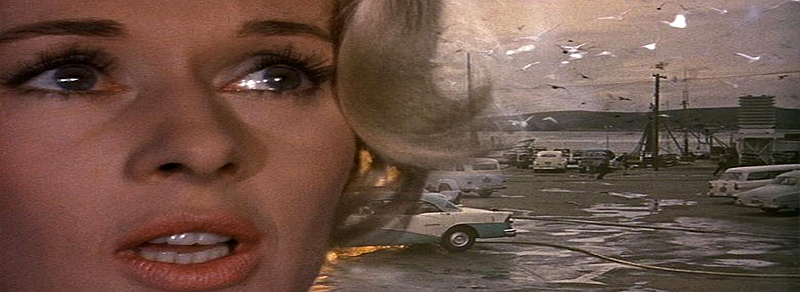
- The classic scene in which Tippi Hedren watches birds attacking the townsfolk was filmed in the studio from a phone booth. When Melanie (played by Tippi Hedren) opens the phone-booth door, a bird trainer had trained gulls that were taught to fly at it. Surviving photos of the shooting of the scene were published in the book “Hitchcock at Work” by Bill Krohn.
- A scene in the film shows a service station where a bird knocks over an attendant filling a car with gas. The gas flows across the street where a man lighting his cigar proceeds to drop the match igniting the gas. The fire follows the gas stream back to the pump and explodes. The service station was located across from “The Tides” restaurant and pier. In reality this service station did not exist at the time of the filming. However, several years later a service station was built and is still located at the spot shown in the film.
- Mitch Zanich, owner of the Tides Restaurant at the time of shooting, told Alfred Hitchcock he could shoot there if the lead male in the film was named after him, and Hitchcock gave him a speaking part in the film. Hitchcock agreed: Rod Taylor’s character was named Mitch Brenner, and Zanich was given a speaking part. After Melanie is attacked by a seagull, Zanich can be heard saying to Mitch Brenner, “What happened, Mitch?”
- Rod Taylor claims that the seagulls were fed a mixture of wheat and whiskey. It was the only way to get them to stand around so much.
- Alfred Hitchcock briefly considered Cary Grant for the role of Mitch Brenner, but decided against using the hugely expensive actor because he felt the birds and the Hitchcock name were the big attractions. Rod Taylor of course was eventually cast for the role of Mitch Brenner.
- Alfred Hitchcock revealed on “The Dick Cavett Show” (1968–1974) that 3,200 birds were trained for the movie. He said the ravens were the cleverest, and the seagulls were the most vicious.
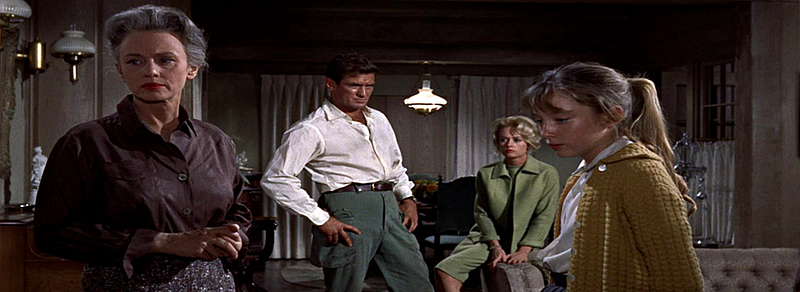
To conclude, Alfred Hitchcock’s “The Birds” proves once again that build-up is the key to formulating effective and tense-filled suspense, while the film successfully and nihilistically turns nature’s habitude normality to a susceptible abnormality in a birds’ revolt into some of the most terrifying villains in the annals of cinematic horror history. This ornithological mystery thriller represents better than any other Hitchcock film the extreme polarities of his universe: vicious unpredictability with moral and emotional disorder on the one hand, and rigorous stylistic control and formal organization, on the other. While it isn’t in Hitchcock’s style to inject allegorical meanings or social significance in his films, the birds could be meant to be an allegory to represent the Furies of Greek mythology who pursued the wicked upon the Earth in this textbook exercise of a menacing chiller, arial assault, feathered fright masterwork.
NOTE: The article contains sources from IMDb and Wikipedia.
Follow me and check out other articles of mine: