
A FILM TO REMEMBER: “THE THIN RED LINE” (1998)
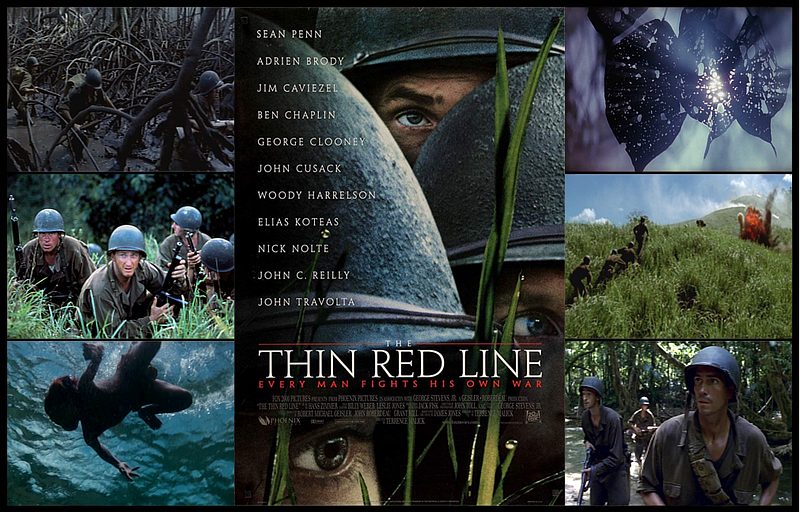
Before I get into this, I want to make mention “A FILM TO REMEMBER” will be a series about films that have reached a milestone anniversary since their origin in being culturally, historically, or aesthetically significant. The articles will contain the film’s plot outline, director, cast, a compilation of trivialities, various photos, movie trailer, critical reception and more. So, let’s start:
We are here to mark the celebration of the 20th Anniversary of Terrence Malick’s “The Thin Red Line”. Let’s take an inside look at the film:
PLOT OUTLINE:
The premise focuses on the conflict at Guadalcanal during World War II which becomes about a story of redemption and the meaningless of war, regardless the outcome.

STUDIO:
20th Century Fox Pictures
DIRECTOR:
Terrence Malick
CAST:
- Jim Caviezel … Pvt. Robert Witt
- Sean Penn … 1st Sgt. Edward Welsh
- Elias Koteas … Capt. James “Bugger” Staros
- Ben Chaplin … Pvt. Jack Bell
- Nick Nolte … Col. Gordon Tall
- Dash Mihok … Ptv. 1cl. Don Doll
- John Cusack .. Capt. John Gaff
- Adrien Brody … Cpl. Geoffrey Fife
- John C. Reilly … Sgt. Maynard Storm
- Woody Harrelson … Sgt. William Keck
- Miranda Otto … Marty Bell
- Jared Leto … 2nd Lt. William Whyte
- John Travolta … Brig. Gen. David Quintard
- George Clooney … Capt. Charles Bosche
- Nick Stahl … Ptv. 1cl. Edward Bead
- Thomas Jane … Pvt. Jason Ash
- John Savage … Sgt. Jack McCron
- John Dee Smith … Pvt. Edward P. Train
- Kirk Acevedo … Pvt. Alfredo Tella
- Penelope Allen … Witt’s Mother
- Mark Boone Junior … Pvt. Christopher Peale
- Arie Verveen … Pvt.Charlie Dale
- Matt Doran … Pvt. Howard Coombs
- Paul Gleeson … 1st Lt. George “Brass” Band
- Don Harvey … Sgt. Paul Becker
- Danny Hoch … Pvt. Leonardo Carni
- Tim Blake Nelson … Pvt. Brian Tills
- Larry Romano … Pvt. Frank Mazzi
GENRE(S):
Drama | War
TAGLINE:
Every man fights his own war.
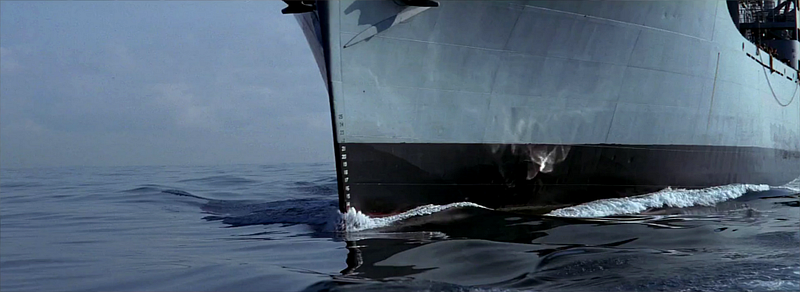
The film is known for being a fictionalized version of the Battle of Mount Austen, that essentially sidesteps history, politics and conventional ethics to deal with war as an absolute, inevitable and eternal facet of existence in a kind of an imaginative narrative poem about the way men are transformed for good by the experience of war, carefully balancing romanticism and dispassion, action and introspection. Director Terrence Malick has created an impressive visceral look, albeit with a much more impressionistic touch through a painterly, probing and poetic picture of war that’s filled with an ensemble of an all-star cast and performances by Jim Caviezel, Sean Penn, Elias Koteas, Ben Chaplin, Nick Nolte, John Cusack, Adrien Brody, John C. Reilly, Woody Harrelson, Miranda Otto, Jared Leto, John Travolta and George Clooney in this two-fisted prose of visual poetry, sublime power and a philosophical tapestry of a cinematic showpiece. The film is based from James Jones’ novel of the same, it got generally favorable reviews though mixed with some rather negative receptions but it has become a reputable avant-garde exemplar of cinematic artistry.
Here’s what some of the critical receptions have been for the film over the years:
Norman Green from Film.com says: “It wrestles with complexity, speaks to us in poetry, weaves multiple narrative strands into a tapestry, opens the festering wounds of war and gazes inside without blinking.”
Owen Gleiberman from Entertainment Weekly says: “‘The Thin Red Line’ is an epic aestheticization of World War II and could, I think, turn out to be similar to ‘Beloved,’ a movie too paralyzingly high-minded to connect with audiences.”
Richard Corliss from TIME Magazine says: “Some films deal in plot truth; this one expresses emotional truth, the heart’s search for saving wisdom, in some of the most luscious imagery since Malick’s last film, the 1978 ‘Days of Heaven.’”
Charles Taylor from Salon.com says: “Dispenses with plot, characterization, dramatic structure and emotional payoffs in favor of the sort of painstakingly composed pictorial diddling that invariably gets critics frothing about the director’s ‘indelible’ images.”
Michael O’Sullivan from Washington Post says: “‘The Thin Red Line’ is a movie about creation growing out of destruction, about love where you’d least expect to find it and about angels — especially the fallen kind — who just happen to be men.”
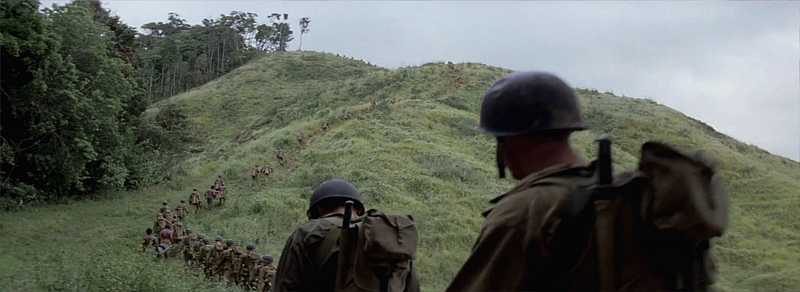
As you can tell by the critical reactions, the film had mostly a positive reception but an assortment of critics felt it was narratively confusing in not firmly knowing what it wants to be about with too much mental malaise and philosophical pretenses throughout. But it remains as one of the most harrowing anti-war statements in cinema, as Malick has a unique way of distilling the poetry from the commonplace, asking more questions than it answers and violates more rules than it obeys, ultimately prodding for one to engage in a far greater level of intellectual participation as that only adds to the film’s brave, strange and eroded nobility. It becomes a cinematic discourse of philosophy given through a company of infantrymen in Guadalcanal from its array five-star studded cast that includes Caviezel, Penn, Koteas, Chaplin, Nolte, Cusack, Brody, Reilly, Harrelson, Otto, Leto, Travolta and Clooney in this hallucinatory blend of bold and baffling, immediate and abstract WWII classic. But I’ll let you decide…
So, to get a better look at the film, here’s a link to the movie trailer of Terrence Malick’s “The Thin Red Line”:
Here I have provided 12 interesting and intriguing trivia facts (I wanted to keep it limited) about “The Thin Red Line”:
- The film marked director Terrence Malick’s return to filmmaking after a 20-year absence (at the time).
- New York-based producer Bobby Geisler first approached Terrence Malick in 1978 and asked him to direct a film adaptation of David Rabe’s play “In the Boom Boom Room”. Malick declined the offer, but instead discussed the idea of a film about the life of Joseph Merrick. Once word got out about David Lynch’s film of “The Elephant Man” (1980), Malick shelved the idea. In 1988, Geisler and John Roberdeau met with Malick in Paris about writing and directing a movie based on D. M. Thomas’ 1981 novel The White Hotel. Malick declined, but told them that he would be willing instead to write either an adaptation of “Molière’s Tartuffe”, or of James Jones’ “The Thin Red Line”. The producers chose the latter and paid Malick $250,000 to write a screenplay.
- Terrence Malick began adapting the material on January 1, 1989. Five months later, the producers received his first draft, which was 300 pages long. According to an article in Entertainment Weekly, they gained the director’s confidence by “catering to his every whim,” providing him with obscure research material, including a book titled “Reptiles and Amphibians of Australia,” an audiotape of Kodo: Heartbeat Drummers of Japan, information on the Navajo code talkers recruited by the United States Marine Corps to communicate in their native Navajo language to evade understanding by Japanese troops intercepting radio transmissions, making his travel plans, and helping the Malick and his wife Michele get a mortgage for their Paris, France apartment.
- Terrence Malick spent years working on other projects, including a stage production of “Sansho the Bailiff” (1954) and a script known as “The English-Speaker,” spending $2 million of the producers’ money, half of which for writing. In 1990, Malick met with James Jones’ widow Gloria and his daughter Kaylie about adapting “The Thin Red Line” into a film. By January 1995, Geisler and Roberdeau were broke and pressured Malick to decide which one he would complete. They approached Malick’s former agent, Mike Medavoy, who was setting up his own production company, Phoenix Pictures, and Medavoy agreed to give them $100,000 to start work on “The Thin Red Line”. Medavoy had a deal with Sony Pictures and Malick began scouting locations in Panama and Costa Rica before settling on the rain forests of northern Australia. In April 1997, just 3 months before filming, Sony pulled the plug while crews were building the sets in Queensland, because new studio chairman John Calley did not think Malick could make his film with the proposed $52 million budget. Malick traveled to Los Angeles with Medavoy to pitch the project to various studios. The studio of 20th Century Fox agreed to put up $39 million of the budget with the stipulation that Malick cast 5 movie stars from a list of 10 who were interested. Pioneer Films, a Japanese company, contributed $8 million to the budget, and Phoenix added $3 million.
- Casting for the film became a hot topic. When Sean Penn met Terrence Malick, he told him, “Give me a dollar and tell me where to show up”. In 1995, once word went out that Malick was making another film after many years, numerous actors approached him, flooding the casting directors until they had to announce they wouldn’t be accepting more requests. Some A-list actors including Brad Pitt, Al Pacino, Gary Oldman, and George Clooney offered to work for a fraction and some even offered to work for free. Bruce Willis even went as far as offering to pay for first-class tickets for the casting crew, to get a few lines for the film. At Medavoy’s home in 1995, Malick staged a reading with Martin Sheen delivering the screen directions, and Kevin Costner, Will Patton, Peter Berg, Lukas Haas and Dermot Mulroney playing the main roles. In June of that year, a 5-day workshop was scheduled at Medavoy’s with Pitt dropping by, and culminating with Malick putting on the soundtrack of “Where Eagles Dare” (1968) and playing Japanese taiko drums. Malick met with an interested Johnny Depp about the project at the Book Soup Bistro on the Sunset Strip. Edward Norton flew out to Austin, Texas and met Malick, who had been impressed by the actor’s screen test for “Primal Fear” (1996). Matthew McConaughey reportedly took a day off filming “A Time to Kill” (1996) to see Malick. Others followed, including William Baldwin, Edward Burns, Josh Hartnett, Philip Seymour Hoffman, Stephen Dorf, and Leonardo DiCaprio; the latter flew up from the Mexico set of “Romeo + Juliet” (1996) to meet Malick at the American Airlines lounge in the Austin airport.
- Before the casting was finalized, Nicolas Cage had lunch with Terrence Malick in Hollywood in February 1996. Malick went off to scout locations and tried calling Cage that summer only to find out that his phone number had been disconnected.
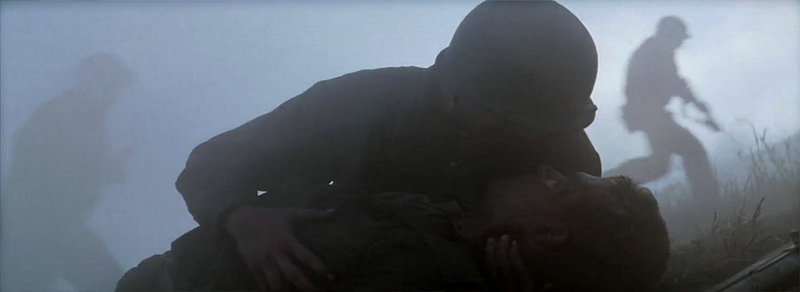
- Tom Sizemore, however, was offered a more substantial role in “Saving Private Ryan” (1998) and, when he could not contact Terrence Malick for several days, he decided to do Steven Spielberg’s film instead.
- Pre-production went slowly. Weeks before filming began, Terrence Malick told Bobby Geisler and John Roberdeau not to show up in Australia where the film was being made, ostensibly because George Stevens Jr. would be the on-location producer supporting line producer Grant Hill. Malick told them that they had upset the studio for refusing to give up above-the-title production credit to Stevens. Malick did not tell them, however, that in 1996 he had a clause inserted in his contract barring the producers from the set. Geisler and Roberdeau were mystified about this behavior; Geisler told Entertainment Weekly, “I didn’t think he was capable of betrayal of this magnitude”
- Terrence Malick’s unconventional filming techniques included shooting part of a scene during a bright, sunny morning only to finish it weeks later at sunset. He made a habit of pointing the camera away during an action sequence and focus on a parrot, a tree branch or other fauna. Malick’s reputation and working methods commanded great respect among the actors, with both Woody Harrelson and John Savage staying on for an extra month after they finished all of their scenes just to watch him at work.
- Editor Leslie Jones was on location for 5 months and rarely saw Terrence Malick, who left her to her own devices. After principal photography wrapped, she came back with a 5-hour first cut and spent 7 months editing, with Billy Bob Thornton contributing 3 hours of narrative voice-over material that was eventually scrapped. It was at this point that editor Billy Weber joined and they spent 13 months in post-production and the last 4 months mixing the film, using four Avid machines with a fifth added at one point. Malick edited the footage one reel at a time with the sound off while listening to a Green Day CD. There were no preview screenings but several in-house ones, the largest of which was attended by 15 people for marketing executives. The editors faced the challenge of blending footage of veteran actors with less-experienced ones, integrating the many cameos, and the voice-overs. According to Jones, “Malick removed scenes with dialogue whenever possible, with the final film varying greatly from the original concept”. Four months after principal photography, Malick invited the film’s cinematographer John Toll to a rough-cut screening. In December 1998, Toll did the first color correction at the lab prior to the film’s release in North America.
- The editing resulted in many of the well-known cast members being on screen for only a brief period. John Travolta and George Clooney’s appearances are little more than cameos, yet Clooney’s name appears prominently in the marketing of the movie. The unfinished film was screened for the New York press in December 1998 and Adrien Brody attended a screening to find that his originally significant role, “to carry the movie”, as he put it, had been reduced to two lines and approximately five minutes of screen time. On April 15, 2001, an interview with Brody revealed that he was still upset over the removal of his work. He expressed his opinions in an interview with the London newspaper The Independent, “I was so focused and professional, I gave everything to it, and then to not receive everything…in terms of witnessing my own work. It was extremely unpleasant because I’d already begun the press for a film that I wasn’t really in. Terry obviously changed the entire concept of the film. I had never experienced anything like that…You know the expression ‘Don’t believe the hype’? Well, you shouldn’t.”
- Terrence Malick was upset that the studio screened his unfinished version for critics and Sean Penn ended up helping him in the editing room, shaping the final version. Malick spent three more months and cut 45 additional minutes from the film. Malick refused to subject his film to test screenings before delivering his final cut.

To conclude, Terrence Malick’s “The Thin Red Line” is a visually enchanting, philosophically murky meditation on war in showing us freedom at its most visceral and unintellectual — and cinematic. Terrence Malick hasn’t lost his touch for eye-catching vistas and the poetics of conflict in this haunting, scattered reminiscence piece, where the mind is allowed to drift through its memories, and retrieve impressions of the beautiful and the hideous, the serene and the hysterical, the banal and the profound. The film is a challenging and emotionally riveting, that plumbs the depths of the soldier’s experience of war through a high-ranking ensemble of performances from Jim Caviezel, Sean Penn, Elias Koteas, Ben Chaplin, Nick Nolte, John Cusack, Adrien Brody, John C. Reilly, Woody Harrelson, Miranda Otto, Jared Leto, John Travolta and George Clooney in this intensely internalized portrait of external pandemonium of a lyrical, meditative, slippery and insidiously haunting work of a WWII epic ciné-poem.
NOTE: The article contains sources from IMDb and Wikipedia.
Follow me and check out other articles of mine:


