
A FILM TO REMEMBER: “THE GREAT ESCAPE” (1963)
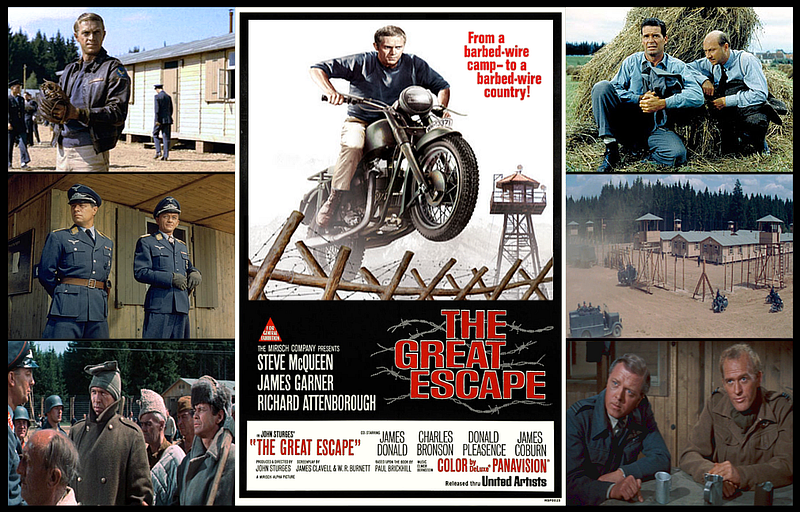
Before I get into this, I want to make mention “A FILM TO REMEMBER” will be a series about films that have reached a milestone anniversary since their origin in being culturally, historically, or aesthetically significant. The articles will contain the film’s plot outline, director, cast, a compilation of trivialities, various photos, movie trailer, critical reception and more. So, let’s start:
We are here to mark the celebration of the 55th Anniversary of John Sturges’ “The Great Escape”. Let’s take an inside look at the film:
PLOT OUTLINE:
Allied prisoners of war plan for several hundred of their number to escape from a German camp during World War II.
STUDIO:
United Artists
DIRECTOR:
John Sturges
CAST:
- Steve McQueen … Hilts “The Cooler King”
- James Garner … Hendley “The Scrounger”
- Richard Attenborough … Bartlett “Big X”
- James Donald … Ramsey “The SBO”
- Charles Bronson … Danny “Tunnel King”
- Donald Pleasence … Blythe “The Forger”
- James Coburn … Sedgwick “Manufacturer”
- Hannes Messemer … Von Luger “The Kommandant”
- David McCallum … Ashley-Pitt “Dispersal”
- Gordon Jackson … MacDonald “Intelligence”
- John Leyton … Willie “Tunnel King”
- Angus Lennie … Ives “The Mole”
- Nigel Stock … Cavendish “The Surveyor”
- Robert Graf … Werner “The Ferret”
- Jud Taylor … 2nd Lt. Goff
- Hans Reiser … Herr Kuhn
- Harry Riebauer … Stabsfeldwebel Strachwitz
- William Russell … Sorren
- Robert Freitag … Capt. Hauptmann Posen
- Ulrich Beiger … Preissen
- George Mikell … Lt. Obersturmführer Dietrich
- Lawrence Montaigne … Haynes “Diversions”
- Robert Desmond … Griffith “Tailor”
- Til Kiwe … Frick
- Heinz Weiss … Kramer
- Tom Adams … Dai Nimmo “Diversions”
- Karl-Otto Alberty … S.S. Officer Untersturmführer Steinach
GENRE(S):
Adventure | Drama | History | Thriller | War
TAGLINE:
The great adventure! The great entertainment!
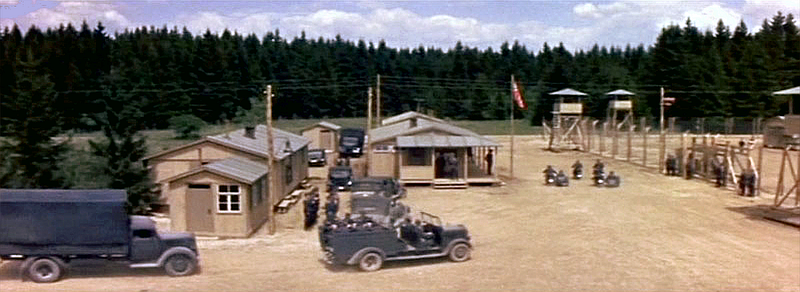
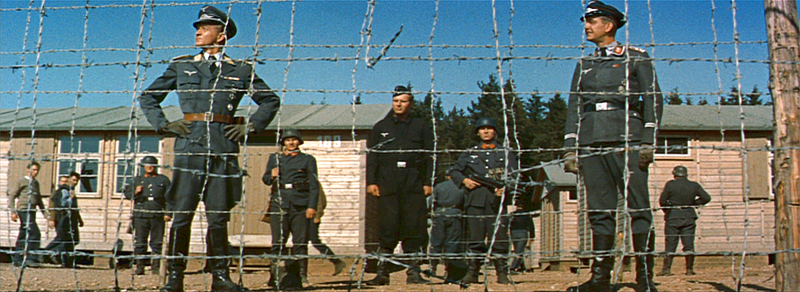
The film is known for being one that doesn’t hide the discrepancies between it’s thrilling story of wartime derring-do and the more sobering truths of historical record. It’s especially telling to discover that the most rousing passages in this adventuress saga strikes closest to the facts, while the embellishments often whiff of pseudo triumph. Director John Sturges largely evades the action and horror of war, and instead focuses on an immense creative process with an infectious undercurrent of wry humor while it deliberately details all the ins and outs, the successes and pitfalls of the escape plan that gradually allows the wildly different characters to work together and form a troupe in spite of their differences — anchored by an all-star cast and performances from Steve McQueen, James Garner, Richard Attenborough, James Donald, Charles Bronson, Donald Pleasence, James Coburn, David McCallum, Gordon Jackson, John Leyton and Hannes Messemer in this heart-pounding, action-packed and escapism tour de force. The film is based from Paul Brickhill’s novel of the same name, a non-fiction first-hand account of the mass escape from Stalag Luft III, it was critically received most enthusiastically though it did have its criticisms but this POW escapade adventurer is a defining, cinematic action classic.
Here’s what some of the critical receptions have been for the film over the years:
TIME Magazine Staff from TIME Magazine says: “With accurate casting, a swift screenplay, and authentic German settings, Producer-Director John Sturges has created classic cinema of action. There is no sermonizing, no soul probing, no sex. The Great Escape is simply great escapism.”
Ian Nathan from Empire Magazine says: “It’s all based on the true escape plan from Stalag Luft North, and cinema, bank holidays and life in general would be vastly inferior without it.”
Bosley Crowther from New York Times says: “But for much longer than is artful or essential, ‘The Great Escape’ grinds out it’s tormenting story without a peek beneath the surface of any man, without a real sense of human involvement. It’s a strictly mechanical adventure with make-believe men.”
Variety Staff from Variety says: “Producer-director John Sturges has fashioned a motion picture that entertains, captivates, thrills and stirs.”
Derek Adams from Time Out says: “Worth seeing the last half hour, if nothing else, for one of the best stunt sequences in years: McQueen’s motor-cycle bid for freedom.”
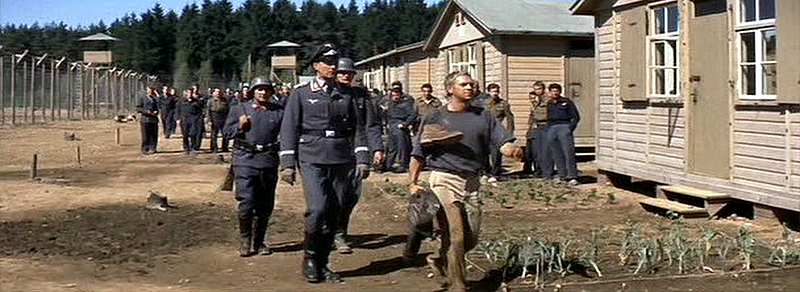
As you can tell by the critical reactions, the film was consensually positively praised in its reception despite a some critics feeling it was overly long and lacked an in-depth sense of characteristic development but this highly enjoyable WWII action-adventure, Sturges directs this boys’ own tale with great panache in celebrating the indomitable spirit of the Allied forces even when their backs were against the wall. The film is a mix of suspense, humor and old-fashioned derring-do pitched by a dream-team cast of bravado performances by McQueen, Garner, Attenborough, Donald, Bronson, Pleasence, Coburn, McCallum, Jackson, Leyton and Messemer in this well crafted, highly entertaining, propagating macho and gung-ho heroism of a high-ranking action exemplar. But I’ll let you decide…
So, to get a better look at the film, here’s a link to the movie trailer of John Sturges’ “The Great Escape”:
Here I have provided 12 interesting and intriguing trivia facts (I wanted to keep it limited) about “The Great Escape”:
- Paul Brickhill who wrote the novel of “The Great Escape” had been a prisoner at Stalag Luft III during World War II. In the book, Brickhill noted he had been a very minor member of the X Organization, one of the “stooges” who monitored German movements in the POW compound.
- The film was to a significant extent fictional, based on real events but with numerous changes made to increase its drama and appeal, and as a vehicle for its box-office stars. While some of its characters were fictitious, most were amalgams of several real characters and others based on real people.
- In reality, there were no escapes by aircraft or motorcycle: the motorcycle sequence was asked for by Steve McQueen, a keen motorcyclist, who did the stunt riding himself (except for the final jump, done by Bud Ekins). Nor were the recaptured prisoners executed in one place at the same time.
- The screenwriters of James Clavell, W. R. Burnett, and Walter Newman significantly increased the involvement of American POWs; the real escape was by largely British and other Allied personnel. A few American officers in the camp initially helped dig the tunnels, and worked on the early plans; however, they were moved away seven months before the escape, ending their involvement. In addition, the film suggests the three prisoners who escaped to freedom were British, Polish, and Australian; in reality, they were Norwegian (Jens Müller and Per Bergsland) and Dutch (Bram van der Stok).
- The film omits to mention the crucial role Canadians played in building the tunnels and in the escape itself. Of the 1,800 or so POWs, 600 were involved in preparations out of which 150 were Canadian. Wally Floody, an RCAF pilot and mining engineer who was the real-life “tunnel king,” was engaged as a technical advisor for the film.
- Ex-POWs asked the filmmakers to exclude details about the help they received from their home countries, such as maps, papers, and tools hidden in gift packages, lest it jeopardize future POW escapes. The filmmakers complied. Furthermore, the film omits to mention that many Germans willingly helped in the escape itself. The film suggests that the forgers were able to make near-exact replicas of just about any pass that was used in Nazi Germany. In reality, the forgers received a great deal of assistance from Germans who lived many hundreds of miles away on the other side of the country. Several German guards, who were openly anti-Nazi, also willingly gave the prisoners items, and assistance in any way to aid their escape.
- After viewing the rushes, Steve McQueen decided his part was minor and undeveloped. McQueen was particularly upset that his character virtually disappears from the film for about 30 minutes in the middle of it, so he walked out demanding re-writes. John Sturges admitted the half-hour gap was likely a problem, but with the production already behind schedule due to the heavy rain, Sturges felt he couldn’t take time out to do re-writes and rescheduling. James Garner claimed that he and James Coburn got together with McQueen to determine what his specific gripes were. Garner later stated that it was apparent McQueen wanted to be the hero, but didn’t want to be seen doing anything overtly heroic that contradicted his character’s cool detachment and sardonic demeanor. At the same time, McQueen never really liked his character’s calm acquiescence to his time in the cooler, or the famous bit with the catcher’s mitt and ball. Sturges considered writing the character out of the story altogether, but United Artists informed him they considered McQueen indispensable to the film’s success, and would spring for the extra money to hire another writer, Ivan J. Moffitt, to deal with the star’s demands. McQueen returned to work.
- During the climactic motorcycle chase, director John Sturges allowed Steve McQueen to ride (in disguise), so that in the final sequence, through the magic of editing, McQueen is actually chasing himself. McQueen played the German motorcyclist who hits the wire.
- Several cast members were actual POW’s during World War II. Hannes Messemer in a Russian camp, Til Kiwe and Hans Reiser were prisoners of the Americans. Donald Pleasence was another one, as he had been a Royal Air Force pilot in World War II, who was shot down, became a prisoner of war, and was tortured by the Germans while being held in the German camp Stalag Luft I. When Pleasence kindly offered advice to John Sturges, he was politely asked to keep his “opinions” to himself. Later, when another actor from the film informed Sturges that Pleasence had been a Royal Air Force Officer in a World War II German POW camp, Sturges requested his technical advice and input on historical accuracy from that point forward. Pleasence claimed the set was a very accurate representation of a POW camp.
- Charles Bronson, who portrays the chief tunneler, brought his own expertise and experiences to the set. Bronson had been a gunner in the USAAF and was wounded, but had not been shot down. He had been a coal miner before turning to acting, and gave John Sturges advice on how to move the dirt. As a result of his work in the coal mines, Bronson suffered from claustrophobia, just as his character had.
- The individual incidents in the film are mostly true, but were rearranged as to both the timing and the people involved. (A note at the start of the film acknowledges this.) For instance, of the 76 who escaped, there were indeed 3 who got away and 50 who were murdered in reprisal, but the murders occurred in small groups, not all at once. (14 Germans were executed after the war for their parts in them).
- John Sturges shopped the film for 8 years, but couldn’t get a major studio to bite until United Artists stepped in. Sturges credited the success of “The Magnificent Seven” (1960) for the eventual funding of this film. Interestingly enough, Steve McQueen, James Coburn and Charles Bronson all appeared in “The Magnificent Seven” (1960) as well.
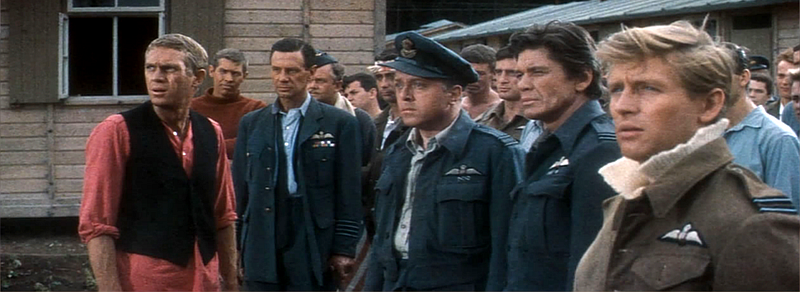
To conclude, John Sturges’ “The Great Escape” is a tribute to old-fashioned heroism and bravery, that’s an inspirational spirit-lifter based on the real events and real men but with numerous compromises, however, John Sturges manages to helm in his customary unpretentious way with an intense, urgent style, blending effectively elements of suspense, action, humor and derring-do in offering many pleasures, both thematic and visual that is involving throughout this WWII POW escape yarn. The film gives each group of its variant characters getting their own riveting scheme sequences, all skillfully told with each meeting differing fates — but equally providing stirring excitement accompanied through its preeminent performances from a first-rate ensemble that’s boasted by Steve McQueen, James Garner, Richard Attenborough, James Donald, Charles Bronson, Donald Pleasence, James Coburn, David McCallum, Gordon Jackson, John Leyton and Hannes Messemer in this tension-filled, entertainingly exhilarating, memorably thrilling and jailbreaking adventure in a daredevilry motorcycle bid of an epic action touchstone.
NOTE: The article contains sources from IMDb and Wikipedia.
Follow me and check out other articles of mine:


