
A FILM TO REMEMBER: “MASTER AND COMMANDER: THE FAR SIDE OF THE WORLD” (2003)
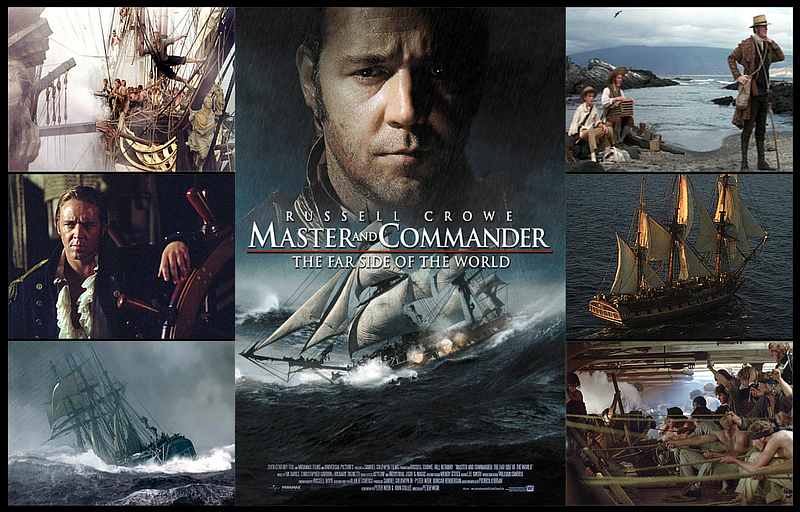
Before I get into this, I want to make mention “A FILM TO REMEMBER” will be a series about films that have reached a milestone anniversary since their origin in being culturally, historically, or aesthetically significant. The articles will contain the film’s plot outline, director, cast, a compilation of trivialities, various photos, movie trailer, critical reception and more. So, let’s start:
We are here to mark the celebration of the 15th Anniversary of Peter Weir’s “Master and Commander: The Far Side of the World”. Let’s take an inside look at the film:
PLOT OUTLINE:
During the Napoleonic Wars, a brash British captain pushes his ship and crew to their limits in pursuit of a formidable French war vessel around South America.

STUDIO:
20th Century Fox Pictures
DIRECTOR:
Peter Weir
CAST:
- Russell Crowe … Captain Jack Aubrey
- James D’Arcy … First Lieutenant Thomas Pullings
- Edward Woodall … Second Lieutenant William Mowett
- Chris Larkin … Captain Howard
- Paul Bettany … Dr Stephen Maturin, Surgeon
- Robert Pugh … John Allen, Master
- Max Benitz … Peter Myles Calamy, Midshipman
- Max Pirkis … Lord William Blakeney, Midshipman
- Jack Randall … Boyle, Midshipman
- Lee Ingleby … Hollom, Midshipman
- Richard Pates … Williamson, Midshipman
- Richard McCabe … Mr. Higgins, Surgeon’s Mate
- Ian Mercer … Mr. Hollar, Boatswain
- Tony Dolan … Mr. Lamb, Carpenter
- David Threlfall … Preserved Killick, Captain’s Steward
- Billy Boyd … Barrett Bonden, Coxswain
- Bryan Dick … Joseph Nagle, Carpenter’s Mate
- Joseph Morgan … William Warley, Captain of Mizzentop
- George Innes … Joe Plaice, Able Seaman
- William Mannering … Michael “Faster” Doudle, Able Seaman
- Patrick Gallagher … Awkward Davies, Able Seaman
- Alex Palmer … Nehemiah Slade, Able Seaman
- John DeSantis … Padeen Colman, Loblolly Boy
- Ousmane Thiam … Black Bill, Killick’s Mate
- Mark Lewis Jones … Mr. Hogg, Master of the Whaler Albatross
- Thierry Segall … French Captain of the Acheron
GENRE(S):
Action | Adventure | Drama | History | War
TAGLINE:
The Courage To Do The Impossible Lies In The Hearts of Men.
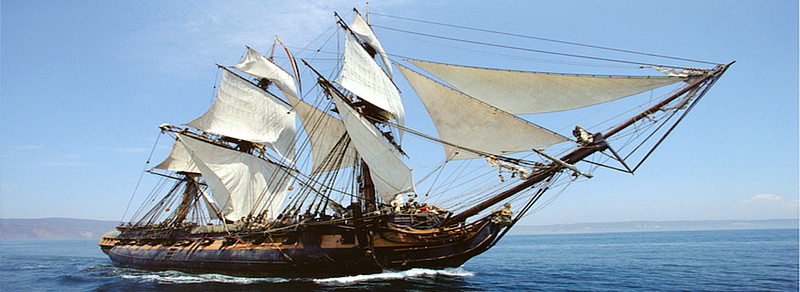
The film is known for being an Napoleonic War adventure set on the high seas as a piece of old-fashioned entertainment crafted mix of organic elegance, reflective drama and aggressive action that immerses us in a world of its people and its places. Director Peter Weir offers a most meticulously researched and realistic depiction of life at sea that’s arguably ever been shown on film with melding rip-roaring action with invigorating historical details and a real philosophical edge in displaying a memorable portrait of friendship, and a substantive exploration of leadership that’s anchored by a cast of incisive performances from Russell Crowe and Paul Bettany in this grand, sturdy, engaging and rousing romp through the Pacific high seas. The film is based from three novels in author Patrick O’Brian’s Aubrey–Maturin series, it was critically well-received though it did have some criticism towards it and failed in becoming a film franchise but it stands as one of the most exciting opening salvos in nonexistent-cinematic series history.
Here’s what some of the critical receptions have been for the film over the years:
Robert Denerstein from Denver Rocky Mountain News says: “Scrupulously detailed and handsomely mounted, ‘Master and Commander: The Far Side of the World’ sails across the screen like a well-built ship, seaworthy and stolid.”
Mick LaSalle from San Francisco Chronicle says: “The film contains brilliantly crafted scenes and shots that are as compelling as anything seen onscreen, but there are also dull stretches in which the movie seems lightweight — never in its execution but in its conception.”
Lisa Schwarzbaum from Entertainment Weekly says: “This apt and sensitive introduction to O’Brian’s ripping maritime tales manages to make a period-piece saga feel modern — capturing something timeless in the characters of all men.”
Todd McCarthy from Variety says: “Rare proof that a gigantic production in contemporary Hollywood can possess a distinctive personality, ‘Master and Commander: The Far Side of the World’ proves as bracing as a stiff wind on the open sea.”
Rick Groen from Globe and Mail says: “Beautifully directed and acted, sumptuously costumed and rigged, with no less a man than Russell Crowe filling out the Captain’s britches, this is myth making all dressed up and demanding a snappy salute — heck, it’s a Boy’s Own adventure to die for.”
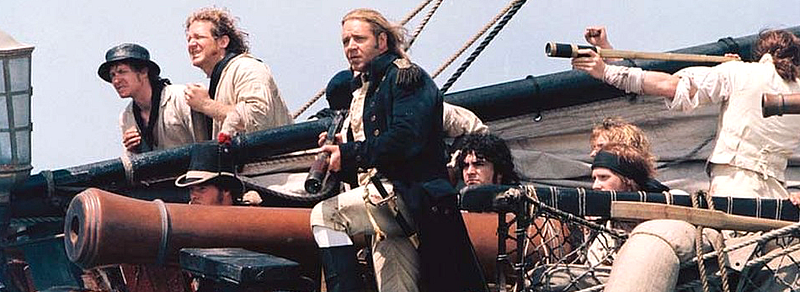
As you can tell by the critical reactions, the film was critically received positively overall although a various degree of critics found its narrative to be bloated at points and its languid pacing to be a drudgingly boring and dull experience. However, Weir creates an undeniably square, throwback nautical adventure mounted with the authentic tang of salt, sweat and gunpowder as it emphasis on characterization and not merely action, letting us not forget that all individuals are souls with flesh and blood, not merely empty casualties of war. The film lies both in it’s roaring action and its emotional intricacies, with ample doses of both tactics and testosterone fastened by performances with notable zest from Crowe and Bettany in delivering a handsomely crafted, ripping, accessible, lively, stirring and convincing depiction of the perils and thrills of sea life of an engrossingly humanistic and full-bodied seafaring exemplar. But I’ll let you decide…
So, to get a better look at the film, here’s a link to the movie trailer of Peter Weir’s “Master and Commander: The Far Side of the World”:
Here I have provided 12 interesting and intriguing trivia facts (I wanted to keep it limited) about “Master and Commander: The Far Side of the World”:
- The film combines elements from 13 different novels of author Patrick O’Brian, but the basic plot mostly comes from the novel “The Far Side of the World.” The film combines the long chase sequence of the novel “The Far Side of the World” with the furious climactic battle sequence of the novel “Master and Commander”. The stern chase around Cape Horn is taken from the novel “Desolation Island,” The episode in which Captain Jack Aubrey (played by Russell Crowe) deceives the enemy by means of a raft bearing lanterns is taken from the novel “Master and Commander,” and the episode in which Dr. Stephen Maturin (played by Paul Bettany) directs the surgery on himself, while gritting his teeth in pain, to remove a bullet is taken from the novel “HMS Surprise”. Other incidents in the film come from other various novels in O’Brian’s series.
- Although the book is set in 1812, the film is set 7 years earlier. This afforded the producers and filmmakers the chance to make the enemy of the piece not of the United States but of France. England at the time had declared war against Napoléon Bonaparte.
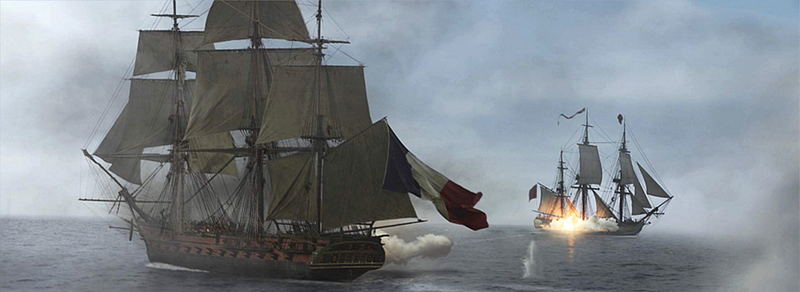
- In consequence, the fictional opponent was changed from the USS Norfolk to the French privateer frigate Acheron. Acheron in the film was reconstructed by the film’s special-effects team who took stem-to-stern digital scans of USS Constitution at her berth in Boston, from which the computer model of Acheron was rendered.
- Patrick O’Brian claims no one real captain was the model for his fictional character of Captain Aubrey. The Royal Navy Museum considers Captain Lord Cochrane as the inspiration for the character in the first novel, “Master and Commander.”
- Coincidentally, during the film’s pre-production, the replica of Captain James Cook’s ship, HMS Endeavour, was circumnavigating the globe. The production was able to fly 2 cameramen to the ship as it was about to sail round the bottom of South America, a route the HMS Surprise takes in the film. Thus, the footage of the stormy seas from that part of the voyage is genuine.
- About 27 miles of rope was used on the rigging of the replica Rose. Most of the rope had to be made especially, as modern day rope has a right hand lay (the direction the strands run in) whereas it would have had a left hand lay in Napoleonic times.
- Russell Crowe learned to play violin for the film and referred to it as the hardest thing he’d ever done for a role.
- To research for his role, Paul Bettany went to the Royal College of Surgeons in London, England to learn how to use 18th century surgical instruments.
- Russell Crowe wanted to form a sense of authority on set, so he had all the actors wear shirts according to their characters’ rank. Officers wore a dark blue, midshipmen wore a light blue, the marines wore red and everyone else wore white. The cast also had to sew their own name tags on each shirt, a tank top, a short-sleeved shirt and a long-sleeved top.
- The original HMS Rose (the replica of which became the HMS Surprise for the film) was actually a French ship, captured by the British in 1757. When it was in dry dock in Hull, England, it was modified along British lines and saw action under the British during the American Revolution. It was scuttled in 1779. The replica, based on the same plans as the original which were housed at the Admiralty in Whitehall, London, was built in Nova Scotia in 1970 by Rhode Island historian John Fitzhugh Millar. It was the only remaining working frigate in the world when director Peter Weir came across it at a maritime festival. When he learned that it was for sale, Weir concluded that he was fated to make the film after all, a project he had previously turned down. The studio of 20th Century Fox bought HMS Rose, the ship which doubles up as HMS Surprise in the film, for $1.5 million. After filming, the HMS Surprise was purchased by the San Diego Maritime Museum for an undisclosed sum, and with the proviso that the ship be loaned back to 20th Century Fox for any future film productions.
- When the character of Captain Aubrey and his crew disguise their ship to lure in the French frigate “Acheron,” the name of The Surprise is changed to “Syren,” a play on the word “Siren,” a sea nymph from Greek mythology, who lured sailors to their doom.
- Although Russell Crowe had reservations about the first drafts of the script that he had been sent, the chance of working with Peter Weir was what ultimately persuaded him to commit to the project. Crowe would park his participation in “Cinderella Man” (2005) to make the film. By the time Crowe returned to the boxing project, it had lost its original director, Lasse Hallström, who was subsequently replaced by Ron Howard.
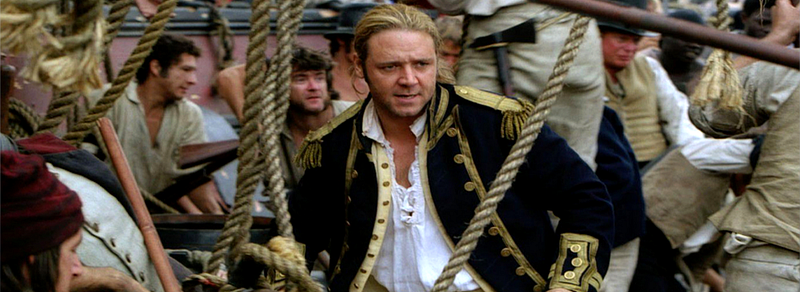
To conclude, Peter Weir’s “Master and Commander: The Far Side of the World” is an intriguing look at the evolutionary nature of British domain through buoyant, opulent and unapologetically old-fashioned tale of adventure on the high seas, that’s both rich with characterization and concussive cannon bursts that’s bracing of comradeship, courage, leadership, loyalty, oceanic hunts, pitched battles and onboard surgeries. Peter Weir mines the drama and suspense from the intricacies of 19th-century naval strategies that’s intelligent, exciting and unambiguous in its depiction which explores themes of conveyance and duty versus egotism set against colorful subplots regarding the superstitions of seamen and natural historic discoveries, all the while, dissecting the characteristic strength found in loyalty and valor through the strikingly authoritative performances by Russell Crowe and Paul Bettany in an embarking roughneck volley that steers with intense cannon fire, storm-driven vigor and swashbuckling grandeur of a historical seagoing saga tour de force.
NOTE: The article contains sources from IMDb and Wikipedia.
Follow me and check out other articles of mine:


