
A FILM TO REMEMBER: “THE LIFE AND DEATH OF COLONEL BLIMP” (1943)
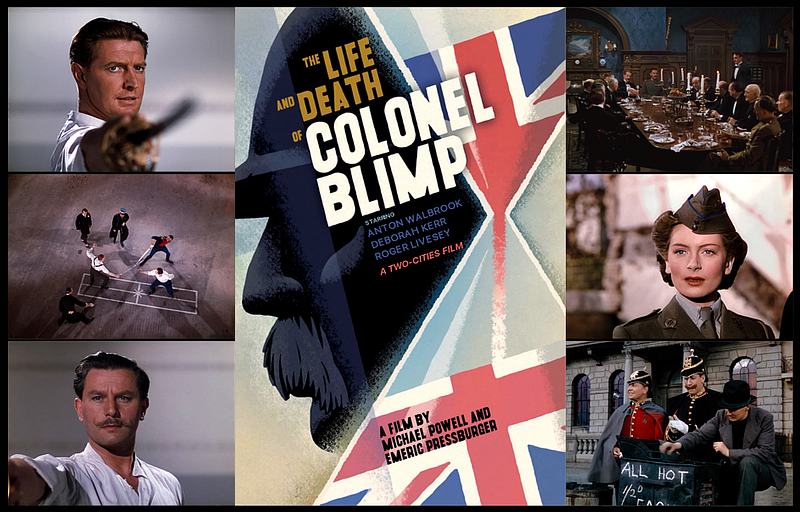
Before I get into this, I want to make mention “A FILM TO REMEMBER” will be a series about films that have reached a milestone anniversary since their origin in being culturally, historically, or aesthetically significant. The articles will contain the film’s plot outline, director, cast, a compilation of trivialities, various photos, movie trailer, critical reception and more. So, let’s start:
We are here to mark the celebration of the 75th Anniversary of Michael Powell and Emeric Pressburger’s “The Life and Death of Colonel Blimp”. Let’s take an inside look at the film:
PLOT OUTLINE:
From the Boer War through World War II, a soldier rises through the ranks in the British military.
STUDIO:
United Artists
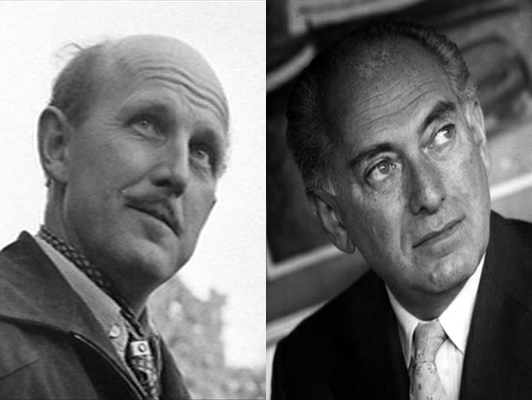
DIRECTOR:
Michael Powell and Emeric Pressburger
CAST:
- Anton Walbrook … Theo Kretschmar-Schuldorff
- Deborah Kerr … Edith Hunter / Barbara Wynne / Angela “Johnny” Cannon
- Roger Livesey … Clive Candy
- Roland Culver … Colonel Betteridge
- Ursula Jeans … Frau von Kalteneck
- Harry Welchman … Major Davies
- Arthur Wontner … Embassy Counsellor
- Albert Lieven … von Ritter
- John Laurie … Murdoch
- James McKechnie … Spud Wilson
- Reginald Tate … van Zijl
- David Hutcheson … Hoppy
- Frith Banbury … Baby-Face Fitzroy
- Muriel Aked … Aunt Margaret
- Neville Mapp … Stuffy Graves
- Vincent Holman … Club porter (1942)
- Spencer Trevor … Period Blimp
- James Knight … Club porter (1902)
- Dennis Arundell … Café Orchestra Leader
- David Ward … Kaunitz
- Valentine Dyall … von Schönborn
- A. E. Matthews … President of Tribunal
- Carl Jaffe … von Reumann
- Eric Maturin … Colonel Goodhead
- Robert Harris … Embassy Secretary
- Theodore Zichy … Colonel Borg
- Jane Millican … Nurse Erna
- Phyllis Morris … Pebble
- Captain W. Barrett … The Texan as Captain W.H. Barrett — U.S. Army
- Corporal Thomas Palmer … The Sergeant as Corporal Thomas Palmer — U.S. Army
- Yvonne Andre … The Nun
- Marjorie Gresley … The Matron
- Felix Aylmer … The Bishop
- Helen Debroy Summers … Mrs. Wynne
- Norman Pierce … Mr. Wynne
- Edward Cooper … BBC Official
- Joan Swinstead … Secretary
GENRE(S):
Drama | Romance | War
TAGLINE:
The Lusty Lifetime Of A Gentleman Who Was Sometimes Quite A Rogue!
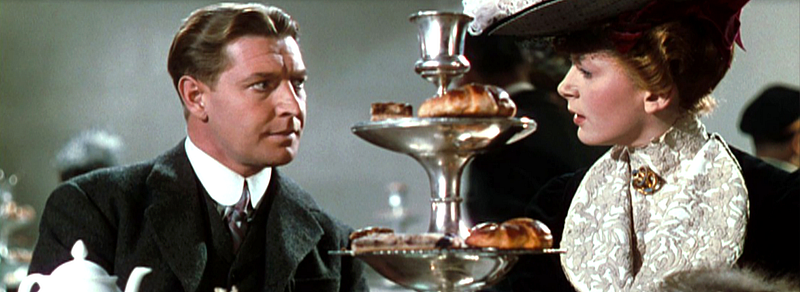
The film is known for being strongly pro-British, although it is a satire on the British Army, especially its leadership. It suggests that Britain faced the option of following traditional notions of honorable warfare or to “fight dirty” in the face of such an evil enemy as Nazi Germany. Directors Michael Powell and Emeric Pressburger gives us musical mischief, marvelous mustaches, poignancy and peculiarity in droves thanks in part of its cast and performances specifically from Anton Walbrook, Deborah Kerr and Roger Livesey in making it an essential in British cinema. The film’s title derives from the satirical Colonel Blimp comic strip by David Low, but the story itself is based from an original concept by Powell and Pressburger, it was initially not well accepted garnering heavy criticism towards it from the Britain pundits and its government as the film wasn’t released in the United States until 2 years later because of all the controversy surrounding it. However, since being re-evaluated over the course of time it since gone on to receive praiseworthy adoration from critics with many arguably claiming it being the greatest English film in the annals of cinema.
Here’s what some of the critical receptions have been for the film over the years:
Roger Ebert from Chicago Sun-Times says: “The movie looks past the fat, bald military man with the walrus mustache, and sees inside, to an idealist and a romantic. To know him is to love him.”
Anthony Lane from The New Yorker says: “The film may be the greatest English film ever made, not least because it looks so closely at the incurable condition of being English.”
Joshua Rothkopf from Time Out says: “Maybe the most wonderfully British movie ever made.”
J. Hoberman from Village Voice says: “A 1943 Michael Powell and Emeric Pressburger collaboration so unambiguously satirizing the military mind-set that Prime Minister Winston Churchill tried to have it banned.”
Alan Morrison from Empire Magazine says: “A wonderful salute to British decency and a touching portrait of a friendship that bridges national boundaries.”
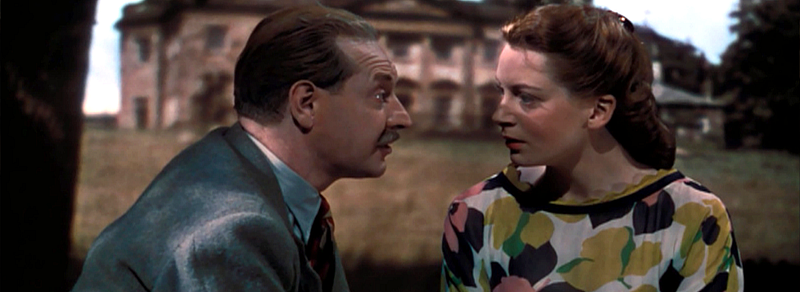
As you can tell by the critical reactions, the film is highly regarded and deemed as one of, if not, the best English film ever made but initially though the film was heavily attacked on release mainly because of its sympathetic presentation of a German officer, albeit an anti-Nazi one, who is more down-to-earth and realistic than the central British character. The film provoked an extremist pamphlet, “The Shame and Disgrace of Colonel Blimp,” by right-wing sociologists E. W. and M. M. Robson, members of the obscure Sidneyan Society, which proclaimed it “The most disgraceful production that has ever emanated from a British film studio.” Due to the British government’s disapproval and particularly Winston Churchill on the film, it was not released in the United States until 1945 and then in a modified form, as “The Adventures of Colonel Blimp” or simply “Colonel Blimp” as it wasn’t restored to its original form until 1983. It’s a blatant bit of World War II propaganda but it maybe the most essential, urgently British of all the 21 films Powell and Pressburger made together with an undeniable spirit and some Ernst Lubitsch-like comic passages carried out by its first-rate cast that’s fronted by Walbrook, Kerr and Livesey in this historical saga of an intensely personal and emotionally earnest, wartime pageantry of a British master work. But I’ll let you decide…
Unfortunately, there is no link to a movie trailer of Michael Powell and Emeric Pressburger’s “The Life and Death of Colonel Blimp” but to help give a better look at the feature film, here’s a link to a preview clip of Michael Powell and Emeric Pressburger’s “The Life and Death of Colonel Blimp”:
Here I have provided 12 interesting and intriguing trivia facts (I wanted to keep it limited) about “The Life and Death of Colonel Blimp”:
- According to the directors Michael Powell and Emeric Pressburger, the idea for the film did not come from the newspaper comic strip by David Low but from a scene cut from their previous film, “One of Our Aircraft Is Missing” (1942), in which an elderly member of the crew tells a younger one, “You don’t know what its like to be old.” Powell has stated that the idea was actually suggested by David Lean (then an editor) who, when removing the scene from the film, mentioned that the premise of the conversation was worthy of a film in its own right.
- Michael Powell wanted Laurence Olivier [who had previously appeared in Powell and Emeric Pressburger’s “49th Parallel” (1941) and “The Volunteer” (1944)] to play the role of Clive Candy however, the Ministry of Information refused to release Olivier, who was serving in the Fleet Air Arm, from active service telling Powell and Pressburger, “…we advise you not to make it and you can’t have Laurence Olivier because he’s in the Fleet Air Arm and we’re not going to release him to play your Colonel Blimp”. The role of Candy eventually went to Roger Livesey.
- Michael Powell wanted Wendy Hiller to play the triple female role but Hiller pulled out due to pregnancy. Deborah Kerr was eventually cast for the triple female role.
- The character role of Frau von Kalteneck, a friend of Theo Kretschmar-Schuldorff (played by Anton Walbrook) is Roger Livesey’s wife Ursula Jeans; although they often appeared on stage together this was their only appearance together in a film.
- Further problems were caused by Prime Minister Winston Churchill who, prompted by objections from James Grigg, his secretary of state for war, sent a memo suggesting the production be stopped. Grigg warned that the public’s belief in the “Blimp conception of the Army officer” would be given “a new lease of life”. After Ministry of Information and War Office officials had viewed a rough cut, objections were withdrawn in May 1943. Churchill’s disapproval remained, however, and at his insistence an export ban, much exploited in advertising by the British distributors, remained in place until August of that year.
- Filming was made difficult by the wartime shortages and by Winston Churchill’s objections leading to a ban on the production crew having access to any military personnel or equipment. But they still managed to “find” quite a few Army vehicles and plenty of uniforms.
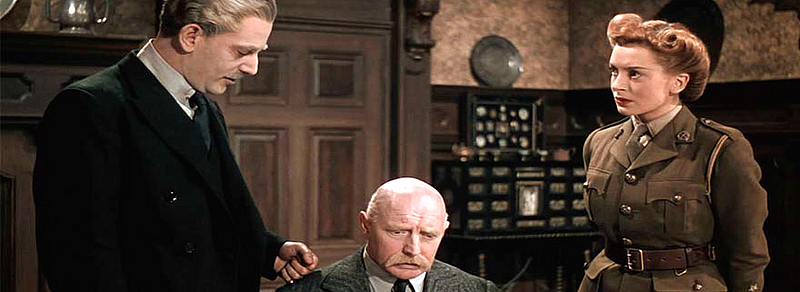
- Colonel Blimp was a British cartoon character in a then well-known strip. The producers decided to use the name for the film.
- At the end of the film, when the camera zooms in on the tapestry, the Latin phrase “Sic Transit Gloria Candy” is shown. This translates to, “Thus passes away the glory of Candy”.
- When the character of Clive Candy goes to Germany to fight a duel over propaganda about the British treatment of people in South Africa in the Boer War. Many of the cited things he was dueling over were in fact true. “Concentration camp” was first used to describe British camps in South Africa in 1899–1902.
- Early in the film, the character of Clive Candy tells Colonel Betteridge (played by Roland Culver) that he has been speaking with Arthur Conan Doyle, author of the Sherlock Holmes stories. Betteridge, an avid fan, turns and quotes to his subordinate, Major Plumley: “Lovely evening, my dear Watson…” Plumley is played by Ian Fleming, who earlier portrayed Dr. Watson in “Sherlock Holmes’ Fatal Hour” (1931), “Sherlock Holmes and the Missing Rembrandt” (1932), “The Triumph of Sherlock Holmes” (1935), and “Murder at the Baskervilles” (1937) as his Sherlock Holmes, Arthur Wontner, also appears in a small role later in the film.
- Michael Powell was intrigued by how second-unit cameraman Jack Cardiff was filming the animal heads and gave Cardiff his first big break as the cinematographer on his next film, “A Matter of Life and Death” (1946).
- Michael Powell once said of the film that it is “100% British film but it’s photographed by a Frenchman, it’s written by a Hungarian, the musical score is by a German Jew, the director was English, the man who did the costumes was a Czech; in other words, it was the kind of film that I’ve always worked on with a mixed crew of every nationality, no frontiers of any kind”.

To conclude, Michael Powell and Emeric Pressburger’s “The Life and Death of Colonel Blimp” is of few British films from this period that seems to mythologize the pre-war period of Winston Churchill’s youth and early career quite as potently. There is also a certain similarity between the central character and Churchill as some historians have suggested that Churchill may have wanted the production stopped because he had mistaken the film for a parody of himself (he served in the Boer War and First World War). Churchill’s exact reasons remain unclear, but he was acting only on a description of the planned film from his staff, not on a viewing of the film itself. Michael Powell and Emeric Pressburger tell the story of one man’s passage from youthful ignorance to wise obsolescence, from a heedless adventurer without regard for real authority to an old-world hero unable to exert his own. Its central paradox is universal: By the time a man is old enough to have gained useful knowledge and experience, he’s no longer needed or listened to as its less a narrowed character study than a work of incisive microcosmic portraiture that’s rooted in it cast of performances from Anton Walbrook, Deborah Kerr and Roger Livesey in this cycle passage of young and imprudent to old and wise of a British satirized military masterpiece.
NOTE: The article contains sources from IMDb and Wikipedia.
Follow me and check out other articles of mine:


