
A FILM TO REMEMBER: “THE HIDDEN FORTRESS” (1958)
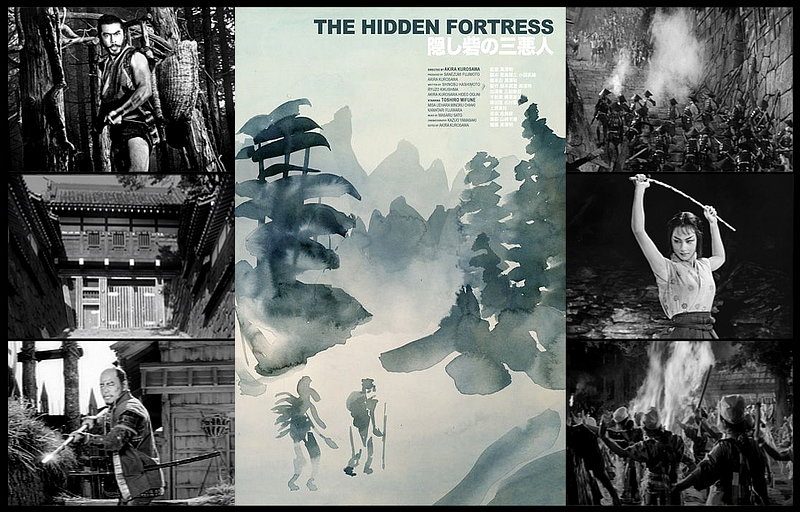
Before I get into this, I want to make mention “A FILM TO REMEMBER” will be a series about films that have reached a milestone anniversary since their origin in being culturally, historically, or aesthetically significant. The articles will contain the film’s plot outline, director, cast, a compilation of trivialities, various photos, movie trailer, critical reception and more. So, let’s start:
We are here to mark the celebration of the 60th Anniversary of Akira Kurosawa’s “The Hidden Fortress”. Let’s take an inside look at the film:
PLOT OUTLINE:
Lured by gold, two greedy peasants escort a man and woman across enemy lines. However, they do not realize that their companions are actually a princess and her general.
STUDIO:
Albex
DIRECTOR:
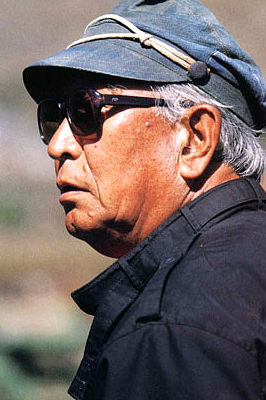
Akira Kurosawa
CAST:
- Toshiro Mifune … General Rokurota Makabe (真壁 六郎太 Makabe Rokurota)
- Minoru Chiaki … Tahei (太平)
- Kamatari Fujiwara … Matashichi (又七)
- Susumu Fujita … General Hyoe Tadokoro (田所 兵衛 Tadokoro Hyoe)
- Takashi Shimura … The Old General, Izumi Nagakura (長倉 和泉 Nagakura Izumi)
- Misa Uehara … Princess Yuki (雪姫 Yuki-hime)
- Eiko Miyoshi … Old Lady-in-Waiting
- Toshiko Higuchi … Farmer’s Daughter bought from Slave Trader
- Yū Fujiki … Barrier Guard
- Yoshio Tsuchiya … Samurai on Horse
- Kokuten Kōdō … Old Man in front of sign
- Kōji Mitsui … Pit Guard
- Toranosuke Ogawa … Magistrate of the Bridge Barrier
- Kichijirô Ueda … Slave Trader
- Nakajirô Tomita … Potential Slave Buyer
- Yoshifumi Tajima … Potential Slave Buyer
- Ikio Sawamura … Gambler
- Senkichi Ômura … Soldier
- Sachio Sakai … Captured Foot Soldier
- Makoto Satô … Yamada Foot Soldier
- Yoshio Kosugi … Akisuki Soldier
- Akira Tani … Captured Foot Soldier
- Yutaka Sada … Guard at Bridge Barrier
- Takeo Oikawa … Guard at Pass Barrier
- Tadao Nakamaru … Young Man
- Takuzô Kumagai … Yamana Foot Soldier
- Shôichi Hirose … Yamana Soldier
- Etsuo Saijô … Yamana Samurai
- Masayoshi Nagashima … Yamana Samurai
- Fuminori Ôhashi … Samurai
- Shin Ôtomo … Samurai on Horseback
- Minoru Itô … Samurai on Horseback
- Haruo Suzuki … Samurai on Horseback
- Shigekatsu Kanazawa … Samurai on Horseback
- Haruo Nakajima … Akisuki Soldier
- Ryû Kuze … Akitsuki Soldier
- Ichirô Chiba … Yamana Foot Soldier
- Rinsaku Ogata … Second Young Man
- Hiroyoshi Yamaguchi … Samurai on Horseback
- Haruya Sakamoto … Samurai on Horseback
GENRE(S):
Adventure | Drama
TAGLINE:
N/A
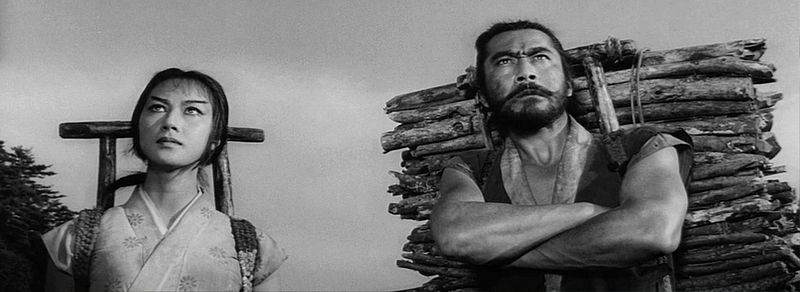
The film is known for drawing influence from American directors like John Ford, that effortlessly intertwines action, drama and comedy with a play of light and dark elements in exploring a dichotomy of the idiocy of greed and the rewards of sacrifice while also identifying the anti-heroic action hero in a vital and essential way, in cleanly redefining the western hero as, on the one side, aloof and alien, and on the other “low” and even, ridiculous. Director Akira Kurosawa stages every scene with an eye toward screen-filling spectacle, […] But he’s also concerned with the characters’ journey, and how they change-or don’t-along the way, that’s conducted through a solid cast led by Toshiro Mifune in this grand adventurous, humorously entertaining, action-filled samurai epic. The film is based from an original idea by Kurosawa, Ryûzô Kikushima, Hideo Oguni and Shinobu Hashimoto, it was critically well-praised and has since become an inspirational model of a paradigm shift for concept and themes let alone one of the greatest action-adventure films of all-time.
Here’s what some of the critical receptions have been for the film over the years:
Marc Bernardin from Entertainment Weekly says: “When you’re dealing with a filmmaker like Akira Kurosawa, even the minor entries are still dulcet movements of a grand cinematic symphony. ‘The Hidden Fortress’ is perhaps best known as one of the source materials that George Lucas used to craft a certain sci-fi blockbuster.”
Gary Arnold from Washington Post says: “Akira Kurosawa’s calculations pay off in thrills and clever character delineation. The trials of the journey impose heroic imperatives and bonds of loyalty that ennoble even the meanest characters.”
Bosley Crowther from New York Times says: “This is not to say that the action is not vivid, exciting and tense, or that Kurosawa’s camera is any less graphic than it usually is. This is simply to say, ‘The Hidden Fortress’ is essentially a superficial film and that Kurosawa, for all his talent, is as prone to pot-boiling as anyone else.”
James Berardinelli from ReelViews says: “By introducing comedy into the mixture and telling the tale from an atypical perspective, Kurosawa has differentiated ‘The Hidden Fortress’ from nearly every similar feudal era Japanese epic ever committed to the screen. This is a masterpiece.”
Jordan Cronk from Slant Magazine says: “Despite a trifling reputation for a number of years, ‘The Hidden Fortress,’ like much of Kurosawa’s cinema, has been reconsidered in light of its long-term influence. The film’s narrative triangulation has been a foundation for cinematic adventure yarns for decades, and its significance for subsequent cross-continental hits such as ‘Star Wars’ and ‘The Good, the Bad and the Ugly’ is undeniable.”
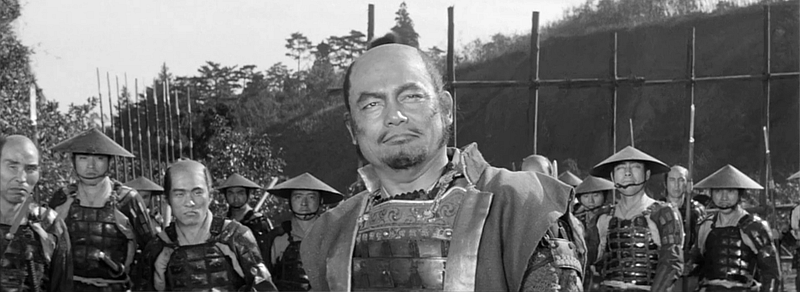
As you can tell by the critical reactions, the film has garnered critical adoration consensually though some may find that its lost some of its luster because the conceptualization and themes have been borrowed from so many over the course of time. However though, Kurosawa balances valor and greed, seriousness and humor, while depicting the misfortunes of war…that establishes a touch of a samurai honor code, an undisguised element of social commentary and philosophy to ponder. But for all its scale, by introducing comedy into the mixture and telling the tale from an atypical perspective, that shines and invigorates through a top-notch cast driven by Toshiro Mifune as it differentiated from nearly every similar feudal era Japanese epic ever committed to film as its long saddled as simply an escapist comprise that’s unabashedly entertaining, fast-paced, witty and visually stunning of a samurai classic adventure. But I’ll let you decide…
So, to get a better look at the film, here’s a link to the movie trailer of Akira Kurosawa’s “The Hidden Fortress”:
Here I have provided 12 interesting and intriguing trivia facts (I wanted to keep it limited) about “The Hidden Fortress”:
- Director Akira Kurosawa made this commercial and accessible film as a way to repay Toho Studios for allowing him to make riskier, more artistic fare such as “Rashomon” (1950).
- It was later one of the significant inspirations for George Lucas’ “Star Wars: Episode IV — A New Hope” (1977). In an interview for the Criterion Collection DVD, George Lucas stated that while this film is a story about a princess and her protectors that this was not the primary element that he employed in “Star Wars: Episode IV — A New Hope” (1977). Lucas stated that he was more concerned with the way that film is told through the eyes of 2 lesser characters. In “The Hidden Fortress” it is the 2 thieves; in “Star Wars: Episode IV — A New Hope” (1977) it is C3PO and R2D2. In both films the comical interplay between the 2 characters is a major theme.
- A bit distraught from the lack of success of his last 2 films which he deemed heavy and tragic, Akira Kurosawa took a new tone with this film, stating, “I want to make a 100% entertainment film, full of thrills and fun”.
- Depending on which set of subtitles you’re reading, Tahei and Matashichi were either Akizuki or Yamana soldiers. In one subtitle, Tahei reminds Matashichi that being on the losing side, they are forced to bury the dead. In another, he reminds him that they arrived to the war late and were mistaken for the losing side.
- Misa Uehara, who played the Princess Yuki, described her first makeup session involving Akira Kurosawa walking into the dressing room with a picture of Elizabeth Taylor, using it to explain what he was looking for in his princess concerning to the makeup.
- The Akizuki and Yamana clans existed in feudal Japan, though they reached their peaks centuries apart. The Hayakawa clan is fictional.
- The wide shot of the horsemen killing the samurai in the first scene was achieved in one take.
- The word “Akizuki” means “autumn moon,” hence the crescent moon insignia seen throughout the film.
- This was Akira Kurosawa’s first film recorded in stereo, and his first filmed in Toho Scope, which was their studio’s version of the American anamorphic widescreen Cinema Scope.
- The long rainy sequence where the farmer’s daughter returns to her company’s hideout is an Akira Kurosawa trademark with the use of weather.
- The key parts of the film were shot in Hōrai Valley in Hyōgo.
- The Japanese-inspired video game “Shogo: Mobile Armor Division” features a level called “The Hidden Fortress,” one of many tributes which also includes another level called from an Akira Kurosawa’s film, “High and Low” (1963) in the game.
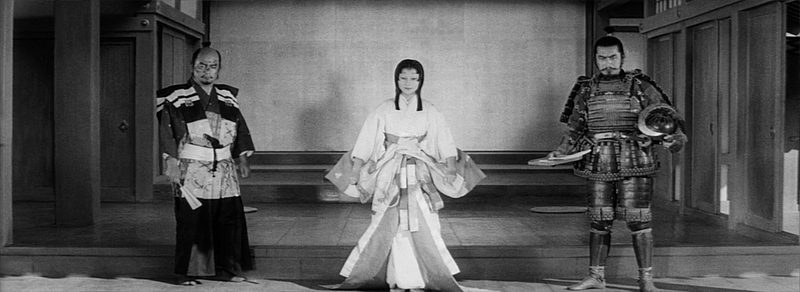
To conclude, Akira Kurosawa’s “The Hidden Fortress” is a rousing, good-humored action adventure film, not for its action sequences or overwhelming artistry, which both are calculatedly orchestrated throughout. But perhaps the most endearing aspect and serves the purpose at this juncture of film history is that it so persuasively lends meaning to a high adventure format, using the stimulation to enhance ideals of individual valor and group solidarity. Akira Kurosawa’s impact on the America’s 1970s is incalculable, it served as a bridge between America’s own western tradition, full of certainty and masculinity, and the new American hero riddled with self-doubt, psychopathy, violence and senses of honor tied to traditions long-since devalued. The film is well suited with a stalwart cast that’s presided over by Toshiro Mifune in this full of chases, near captures, sword fights and prodigious battles, as well as plenty of humor, both of the slapstick and wordplay varieties of an anti-heroic poem cinematic masterpiece.
NOTE: The article contains sources from IMDb and Wikipedia.
Follow me and check out other articles of mine: