
A FILM TO REMEMBER: “CHARADE” (1963)
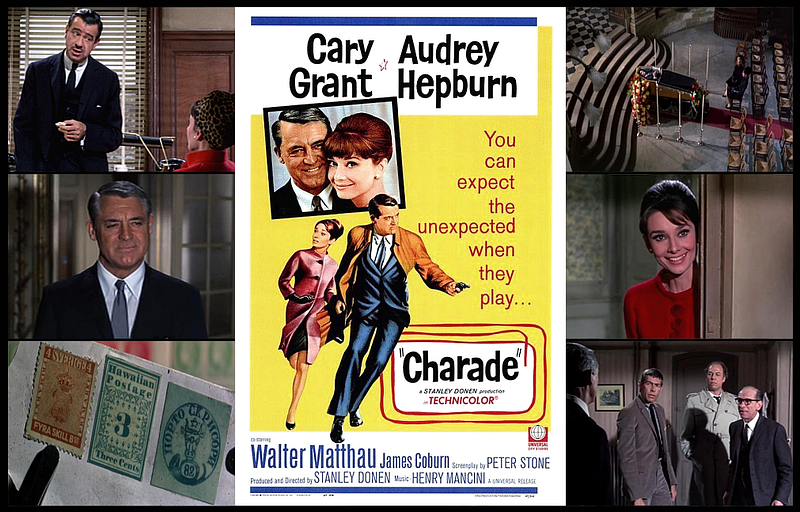
Before I get into this, I want to make mention “A FILM TO REMEMBER” will be a series about films that have reached a milestone anniversary since their origin in being culturally, historically, or aesthetically significant. The articles will contain the film’s plot outline, director, cast, a compilation of trivialities, various photos, movie trailer, critical reception and more. So, let’s start:
We are here to mark the celebration of the 55th Anniversary of Stanley Donen’s “Charade”. Let’s take an inside look at the film:
PLOT OUTLINE:
Romance and suspense ensue in Paris as a woman is pursued by several men who want a fortune her murdered husband had stolen. Whom can she trust?
STUDIO:
Universal Pictures
DIRECTOR:
Stanley Donen
CAST:
- Cary Grant … Peter Joshua
- Audrey Hepburn … Regina “Reggie” Lampert
- Walter Matthau … Hamilton Bartholomew
- James Coburn … Tex Panthollow
- George Kennedy … Herman Scobie
- Dominique Minot … Sylvie Gaudel
- Ned Glass … Leopold W. Gideon
- Jacques Marin … Insp. Edouard Grandpierre
- Paul Bonifas … Mr. Felix
- Thomas Chelimsky … Jean-Louis Gaudel
GENRE(S):
Comedy | Mystery | Romance | Thriller
TAGLINE:
Is Anyone Really Who They Seem To Be?
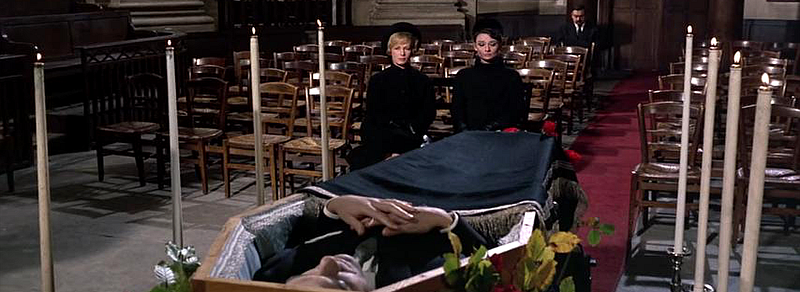
The film is known for being the best Alfred Hitchcock film that Hitchcock never made, as this sharply scripted, auteur-driven film is part thriller, part comedy and part old-fashioned romance all set against a tumultuous Paris backdrop of shifting identities, Henry Mancini’s musical score, Maurice Binder’s colorful animated titles and the containing influences of various genres. Director Stanley Donen establishes everything about it as a little bit cleverer and better than it has to be with many memorable twists and turns in its plot, and bizarre and violent situations that showcases a resplendent cast with the electrifying and charmingly elegant pairing of Cary Grant and Audrey Hepburn in this slick Hitchcockian-hybrid of a comical romance and spy thrilling, suspense classic. The film is based from Peter Stone’s novel of the same name, published and then serialized in Redbook magazine, the story was priorly written by Stone and Marc Behm as un-produced script called “The Unsuspecting Wife,” it received a generally positive reception from critics though it had some criticism towards it; it has since become an influential and transcendent genre-blended exemplar.
Here’s what some of the critical receptions have been for the film over the years:
Chris Nashawaty from Entertainment Weekly says: “When you watch that groovy, giddy Audrey Hepburn/Cary Grant classic, the chemistry between the two leads is electric, director Stanley Donen: the ritzy Euro locales, the deadly double-crosses, even the leading lady’s posh Givenchy wardrobe.”
Pauline Kael from The New Yorker says: “A debonair macabre thriller — romantic, scary, satisfying. This piece of high-style kitsch, directed by Stanley Donen, from a smooth, smart script by Peter Stone and Marc Behm.”
Robert B. Frederick from Variety says: “First-time teaming of Cary Grant and Audrey Hepburn, a natural, gives the sophisticated romantic caper an international appeal, plus the selling points of adventure, suspense and superb comedy.”
Bosley Crowther from New York Times says: “I tell you, this light-hearted picture is full of such grisly touches and gruesome violence. That much explained, however, there’s a lot to be said for it as a fast-moving, urbane entertainment in the comedy-mystery vein.”
Time Out Staff from Time Out says: “Stanley Donen’s typically slick comedy thriller, ingeniously scripted by Peter Stone, is a mammoth audience teaser, Cary Grant imparts his ineffable charm, while Audrey Hepburn is elegantly fraught.”
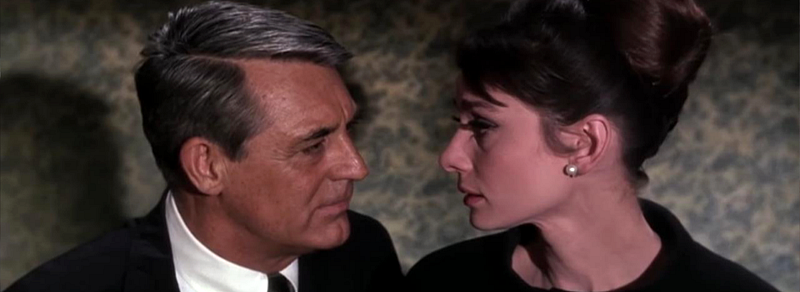
As you can tell by the critical reactions, the film has been consensually garnered with much praiseworthy adoration from critics though a few felt it was confused and all to self-aware of itself, and in some cases, too gruesome in its violence for being considered lighthearted. Still, this sophisticated romantic caper contains influences of genres such as whodunit, screwball comedy and spy thriller that is brilliantly Hitchcockian without Hitchcock himself. Donen lays forth the sparkles of all the vigor of freshly uncorked champagne, mixed with an array of genre overtones, the solid cast led by the charismatic and sexual star power of Grant and Hepburn, and the international appeal, plus all the additional selling points of adventure, suspense, comedy and romance in this entertainingly smart, stylishly elegant and mystery twisting master work. But I’ll let you decide…
So, to get a better look at the film, here’s a link to the movie trailer of Stanley Donen’s “Charade”:
Here I have provided 12 interesting and intriguing trivia facts (I wanted to keep it limited) about “Charade”:
- When screenwriters Peter Stone and Marc Behm submitted their script “The Unsuspecting Wife” around Hollywood, they were unable to sell it. Stone then turned it into a novel, retitled “Charade,” which found a publisher and was also serialized in Redbook magazine, as many novels were at the time. In Redbook it caught the attention of the same Hollywood companies that had passed on it earlier.
- Due to the suspense, the presence of Cary Grant, the structure of the screenplay, and the frequent plot twists, many people believe this was a film from filmmaker Alfred Hitchcock. Hitchcock was not involved in the making of the film at all. This confusion has prompted fans of the film to call it “the best Hitchcock film Hitchcock never made.”
- Audrey Hepburn shot the film in the fall of 1962, immediately after “Paris When It Sizzles” (1964), which Hepburn shot that summer in a number of the same locations in Paris, France but production difficulties with that film caused it to be released 4 months after this film.
- When the film was released at Christmas, 1963, Audrey Hepburn’s line, “At any moment we could be assassinated,” was dubbed over to become “At any moment we could be eliminated” due to the recent assassination of President John F. Kennedy. The dubbed word stood out quite clearly and all official video releases of the film have since restored the original dialogue, though some public domain videos taken from original release prints still carry the re-dubbed line.
- Cary Grant (who turned 59 during filming) was sensitive about the 25-year age difference between Audrey Hepburn (33 at the time of filming) and himself, and this made Grant uncomfortable with the romantic interplay between them. To satisfy his concerns, the filmmakers agreed to add several lines of dialogue in which Grant’s character comments on his age and Hepburn’s character — is portrayed as the pursuer.
- Prior to making this film, Cary Grant had a chance to work with Audrey Hepburn twice before. First, Grant was committed to a role opposite Hepburn in “Sabrina” (1954), Grant though dropped from the project last minute because of the age difference between him and Hepburn. Grant was eventually replaced by Humphrey Bogart (who ironically was even older than Grant). A few years later, Grant was originally offered Gary Cooper’s role in “Love in the Afternoon” (1957) which co-starred Hepburn as well but Grant turned down that role because yet again, the age difference between the him and Hepburn.
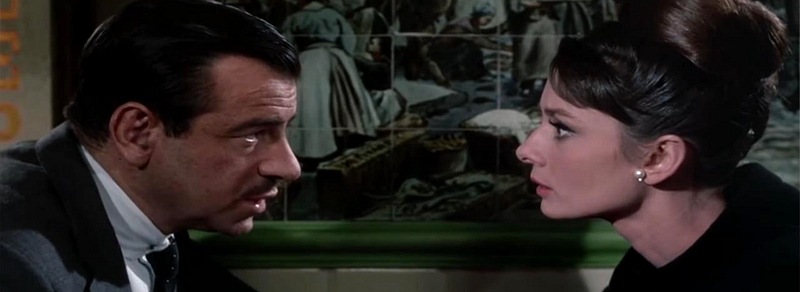
- It was agreed Cary Grant would keep all of his clothes on when he took a shower, as he was nearly sixty and slightly overweight. However, they then decided the scene was funnier that way.
- The character of Peter Joshua (played by Cary Grant) was named after director Stanley Donen’s two sons, Peter and Joshua.
- The stamps depicted in the film are fictional counterparts of real rare stamps, but have their values raised by one. The stamps they represent are the Swedish orange three skilling, the “Hawaiian Missionaries” two cent blue, and the eighty-one para blue Romanian “cap de bour” on blue paper, in total worth (as of last reported in 2007) about $3.6 million dollars.
- According to Audrey Hepburn, the scene where Regina (played by Audrey Hepburn) spilled ice cream on Alexander Dyle’s (played by Cary Grant) suit was based on a real-life accident where Hepburn spilled red wine on Grant’s suit at a dinner party.
- After finishing this film, Cary Grant was quoted as saying, “All I want for Christmas is to make another movie with Audrey Hepburn.” Although it never came to fruition, Grant was originally offered the lead role of Professor Henry Higgins (which was played by Rex Harrison) in “My Fair Lady” (1964), and requested Hepburn as his co-star for the lead role of Catherine Louise Marie Ernestine Freneau (which was played by Leslie Caron) in “Father Goose” (1964).
- The film includes a notice reading “MCMLXIII BY UNIVERSAL PICTURES COMPANY, INC. and STANLEY DONEN FILMS, INC. ALL RIGHTS RESERVED”, but omitting the word “Copyright,” “Copr.” or the symbol “©”. At the time (before 1978), U.S. law required works to include the word, abbreviation, or symbol in order to be copyrighted. Because Universal put no proper copyright notice on “Charade,” the film entered public domain in the USA immediately upon its release. Copies from film prints of varying quality have been available on VHS, DVD, and Blu-ray based on its status in the public domain. The film is also available for free download at the Internet Archive. However, while the film itself is public domain, the original music remains under copyright if outside of the context of the film.
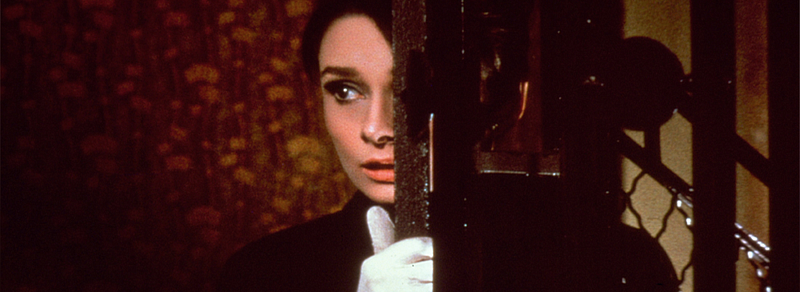
To conclude, Stanley Donen’s “Charade” is an ingeniously mammoth audience teaser that’s sly and craftily scripted of appealing compositions of assorted genres as Stanley Donen directs with a distinctly Hitchcockian style, all the while creating what has been referred to as “the best Hitchcock film that Hitchcock never made.” This gracefully stylish mystery that combines romance and comedy with surprising suspense feels fresh and quick-witted that thoroughly whisks us on a thrillingly twisting and shifting ride with the musical rhythm from Henry Mancini, the splashy animated titles from Maurice Binder and the top-notch cast and performances with the magnetic repartee and impeccable tandem of Cary Grant and Audrey Hepburn in this smooth, rip-roaring, adventurous and savvy gambit of a genre transcending, hybridize chef d’oeuvre.
NOTE: The article contains sources from IMDb and Wikipedia.
Follow me and check out other articles of mine: