avatarScott Anthony

Free AI web copilot to create summaries, insights and extended knowledge, download it at here

4746

Abstract

Boston Globe</i></b> says: <i>“Continues to resemble something a lewd, grouchy, fitfully indecent silent-movie director might have made for his first time using color and sound. That, at least, would explain the shouting.”</i></p><p id="f702"><b>Dave Kehr </b>from <b><i>Chicago Reader</i></b> says: <i>“Uneven, loosely structured, and at times pretty vulgar as well as sentimental, but with some touching and lovely episodes.”</i></p><p id="c1e0"><b>Lance Goldenberg </b>from <b><i>Village Voice</i></b> says: <i>“What positions the film among Fellini’s greatest are its punctuation points of mysterious beauty.”</i></p><figure id="647b"><img src="https://cdn-images-1.readmedium.com/v2/resize:fit:800/1*BYQHG3pZWGeNNs05sqZGgw.png"><figcaption>Still image of clowns with musical instruments in “Amarcord”.</figcaption></figure><p id="03db">As you can tell by the critical reactions, the film is sweet and endearing for many, irritating and tedious for others as Fellini shoots much of the film in a unique style with muted colors that seem slightly out-of-focus, as if he were attempting to transport us into a dreamlike state that will make you howl with laughter and then choke back a tear of images of such stunning beauty that you’ll feel you’re actually inside Fellini’s mind, seeing the things he remembers — in a highly colored fashion — from childhood. And all the while, you’ll be building your own memories of this vibrant, engaging and delightful cinematic landmark feature film. But I’ll let you decide…</p><p id="f3f8">So, to get a better look at the film, here’s a link to the movie trailer of Federico Fellini’s “Amarcord”:</p> <figure id="b550"> <div> <div> <img class="ratio" src="http://placehold.it/16x9"> <iframe class="" src="https://cdn.embedly.com/widgets/media.html?src=https%3A%2F%2Fwww.youtube.com%2Fembed%2FW5PsIpaRIFs%3Ffeature%3Doembed&amp;url=http%3A%2F%2Fwww.youtube.com%2Fwatch%3Fv%3DW5PsIpaRIFs&amp;image=https%3A%2F%2Fi.ytimg.com%2Fvi%2FW5PsIpaRIFs%2Fhqdefault.jpg&amp;key=a19fcc184b9711e1b4764040d3dc5c07&amp;type=text%2Fhtml&amp;schema=youtube" allowfullscreen="" frameborder="0" height="480" width="854"> </div> </div> </figure></iframe></div></div></figure><p id="e5b6">Here I have provided 12 interesting and intriguing trivia facts (<i>I wanted to keep it limited</i>) about “Amarcord”:</p><ul><li>Federico Fellini was born and brought up in Rimini, Italy, a small seaside town in the province of Emilia-Romagna. “Amarcord” is a neologism he contrived, which comes closest to the Emiliano-Romagnolo dialect phrase <i>mi ricordo</i> (I remember). Fellini, a great liar, denied this origin, claiming instead that it was a mysterious, cabalistic word, linked to invention rather than memory. The correct spelling should be “A m’arcord”. Whatever the meaning, “amarcord” evokes another world: evanescent, unreal, unreachable, impalpable, like an image in the depth of a mirror that can be attested to for only a brief instant before it vanishes, like the images of the cinema.</li><li>Federico Fellini has strongly denied that the movie is an autobiographical film, but agreed that there are similarities with his own childhood.</li><li>Giacomo Leopardi (1798-1837) was an Italian poet who came in touch with the main ideas of Enlightenment, and created poetic works, related to the Romantic movement, making him regarded as the greatest poet of modern Italy.</li><li>The Mille Miglia was a thousand mile endurance race conducted on open roads in Italy from 1927–1957.</li><li>Although a clip from “Beau Geste” (1939) is seen, the posters featuring Gary Cooper promote two fictional films ‘La valle dell’amore’ (“The Valley of Love) and ‘Il sole del deserto’ (“The Desert Sun”).</li><li>Titta’s (played by Bruno Zanin) sentimental education is emblematic of Italy’s “lapse of conscience.” Fellini skewers Mussolini’s ludicrous posturing and those of a Catholic Church that “imprisoned Italians in a perpetual adolescence” by mocking himself and his fellow villagers in comic scenes that underline their incapacity to adopt genuine moral responsibility or outgrow foolish sexual fantasies.</li></ul><figure id="f82d"><img src="https://cdn-images-1.readmedium.com/v2/resize:fit:800/1*cG1vglH-rkn7voaJnM-IGw.png"><figcaption>Still image of a ceremony in “Amarcord”.</figcaption></figure><ul><li>The film was screened at the 1974 Cannes Film Festival, but wasn’t entered into the main competition.</li><li>Federico Fellini had a vast archive of photographs of actors, and out of these he would begin to construct his alternative universes and find his films — not representations of the world, not verisimilitude

Options

, but deformation and contrast, literally other worlds, elsewhere, beyond.</li><li>The film rapidly was picked up for international distribution after winning an Oscar for “Best Foreign Film” in 1975, the film was destined to be Fellini’s “last major commercial success”.</li><li>Federico Fellini did sketches and doodling for the film, essentially a playing, like his tours through the photographic archive of images of women with enormous breasts, ample bottoms (the stuff of dreams and masturbation); men grimacing pathetically, at once masking and revealing their impotence (the stuff of nightmares); dwarves, giants, the misshapen, the predatory. Interestingly enough, the Federico Fellini Foundation in Italy has a section specifically named after the film which is called the “Fellini Amarcord” which has been for 9 years the official publication of the Foundation and the jewel in the crown of it’s publishing activity. It has hosted contributions of every kind: abstracts of conferences, examinations of single aspects of the artistic personality of Fellini, monographs on film, unpublished screen-plays, and reissues of texts actually impossible to be found, and so on.</li><li>The first step for Federico Fellini in doing the film was not the script or the story that the movie would illustrate but rather faces and images that would evoke a world. The film is exactly that, a “world,” part circus, part science fiction, composed of images of its inhabitants.</li><li>It was the first film ever released on home video in the “letterbox” format (on an RCA SelectaVision CED video disc, January 1984), preceding the letterbox laserdisc release of Woody Allen’s Manhattan (1979) by eight months.</li></ul><figure id="b343"><img src="https://cdn-images-1.readmedium.com/v2/resize:fit:800/1*tLl1bVkro1su-32D1Oxz2A.png"><figcaption>Still image of Bruno Zanin and Magali Noël in “Amarcord”.</figcaption></figure><p id="ecb8">To conclude, Federico Fellini’s “Amarcord” is ribald, sweet, and sentimental film, that is a larger-than-life journey through a seaside village and its colorful citizens as Federico Fellini’s at his ripest and loudest recreates a fantasy-vision of his home town during the fascist period and all with the ability, to compose a framework that oozes baroque drama and vitality that is almost unparalleled and more or less succeeds in evoking a time period through the eyes of a young boy, as it veers to the vulgar, crassly funny, tender, always affectionate nostalgic trip. The film is a beautifully, heartfelt to the satirical, the scathing to the loving, the mirthful to the melancholy — in short, it’s a personal dreamlike evocation, that’s a cinematic work of art memoir.</p><p id="ed22"><i>NOTE: The article contains sources from IMDb and Wikipedia.</i></p><p id="b5e5"><b>Follow me and check out other articles of mine:</b></p><div id="d28f" class="link-block"> <a href="https://readmedium.com/a-film-to-remember-bringing-up-baby-1938-68c349a0b917"> <div> <div> <h2>A FILM TO REMEMBER: "BRINGING UP BABY" (1938)</h2> <div><h3>The 80th Anniversary of Howard Hawks' "Bringing Up Baby".</h3></div> <div><p>medium.com</p></div> </div> <div> <div style="background-image: url(https://miro.readmedium.com/v2/resize:fit:320/1*fv_SNv4HrDjgxu1CNCCXgQ.png)"></div> </div> </div> </a> </div><div id="0127" class="link-block"> <a href="https://readmedium.com/a-film-to-remember-the-thomas-crown-affair-1968-e8b54c8f9da3"> <div> <div> <h2>A FILM TO REMEMBER: “THE THOMAS CROWN AFFAIR” (1968)</h2> <div><h3>The 50th Anniversary of Norman Jewison’s “The Thomas Crown Affair”.</h3></div> <div><p>medium.com</p></div> </div> <div> <div style="background-image: url(https://miro.readmedium.com/v2/resize:fit:320/1*xNmgSXucmER2BExXgfdD3w.png)"></div> </div> </div> </a> </div><div id="345c" class="link-block"> <a href="https://readmedium.com/a-film-to-remember-rope-1948-223e569318b8"> <div> <div> <h2>A FILM TO REMEMBER: “ROPE” (1948)</h2> <div><h3>The 70th Anniversary of Alfred Hitchcock’s “Rope”.</h3></div> <div><p>medium.com</p></div> </div> <div> <div style="background-image: url(https://miro.readmedium.com/v2/resize:fit:320/1*wn0--IyW92ToYoK_2MQDMA.png)"></div> </div> </div> </a> </div></article></body>

A FILM TO REMEMBER: “AMARCORD” (1973)
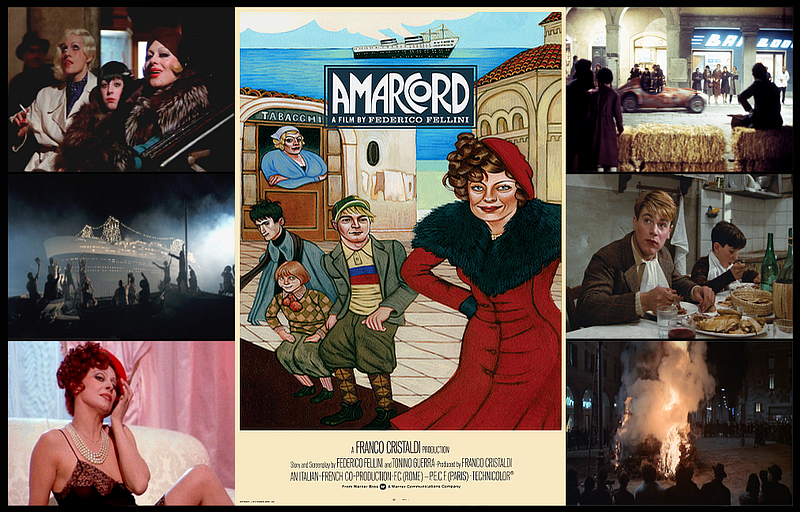
Photograph of film poster with a display of scene images from “Amarcord”.

Before I get into this, I want to make mention “A FILM TO REMEMBER” will be a series about films that have reached a milestone anniversary since their origin in being culturally, historically, or aesthetically significant. The articles will contain the film’s plot outline, director, cast, a compilation of trivialities, various photos, movie trailer, critical reception and more. So, let’s start:

We are here to mark the celebration of the 45th Anniversary of Federico Fellini’s “Amarcord”. Let’s take an inside look at the film:

PLOT OUTLINE:

An adolescent boy growing up among an eccentric cast of characters in the village of Borgo San Giuliano (situated near the ancient walls of Rimini) in 1930s Fascist Italy.
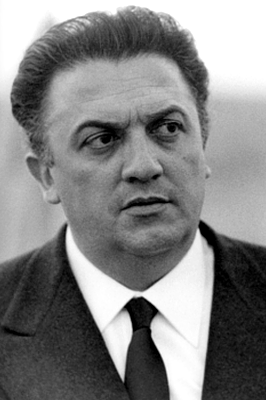
Still image of filmmaker Federico Fellini.

STUDIO:

New World Pictures

DIRECTOR:

Federico Fellini

CAST:

  • Bruno Zanin … Titta
  • Magali Noël … Gradisca
  • Pupella Maggio … Miranda Biondi
  • Armando Brancia … Aurelio Biondi
  • Giuseppe Ianigro … Grandpa
  • Nando Orfei … Lallo
  • Ciccio Ingrassia … Teo
  • Stefano Proietti … Oliva
  • Donatella Gambini … Aldina Cordini
  • Gianfranco Marrocco … Count Poltavo
  • Ferdinando De Felice … Cicco
  • Bruno Lenzi … Gigliozzi
  • Bruno Scagnetti … Ovo
  • Alvaro Vitali … Naso
  • Francesco Vona … Candela
  • Maria Antonietta Beluzzi … Tobacconist
  • Nando Orfei … Patacca
  • Luigi Rossi … Lawyer
  • Gianfilippo Carcano … Baravelli
  • Josiane Tanzilli … La Volpina
  • Ferruccio Brembilla … Fascist
  • Mauro Misul … Philosophy Professor
  • Ferdinando Villella … Prof. Fighetta
  • Antonio Spaccatini … Federale
  • Aristide Caporale … Giudizio
  • Gennaro Ombra … Biscein
  • Domenico Pertica … Cieco di Cantarel
  • Marcello Di Falco … Prince
  • Antonino Faà di Bruno … Count

GENRE(S):

Comedy | Drama

TAGLINE:

The Fantastic World of Fellini!
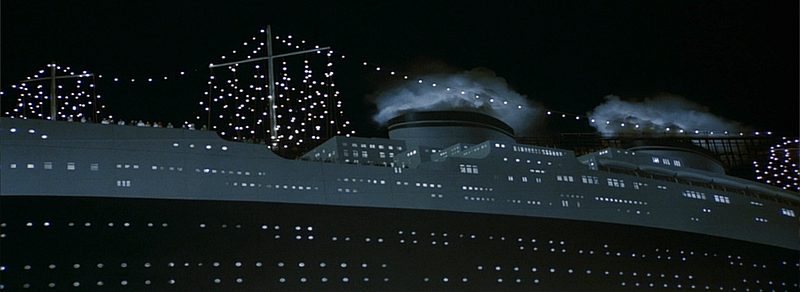
Still image of a cruise ship in “Amarcord”.

The film is known for being Federico Fellini’s scrapbook of memories culled from his own life that feels like flipping through a cartoon sketchbook of Fellini’s vivid remembrances and formative experiences in this bawdily amusing film that dispenses with a traditional plot in favor of a series of communal set-pieces that is more a detached social scrutinization of Italian society, specifically the political isolation and cultural provincialism that helped Fascism rise to power. The film is based from a semi-autobiographical tale from director Federico Fellini’s childhood, it went to garner much acclaim, though it did have it’s criticisms as some pundits felt it was “bloated” and “nonsensically structured”. But the semi-autobiographical content shows greater insight into historical factuality and of a generation through a pictorial weaving of the bizarre fragments of Fellini’s imagination and memory that is a macabre dance against a cheerful background of one of the most humane films of twentieth century.

Here’s what some of the critical receptions have been for the film over the years:

Roger Ebert from Chicago Sun-Times says: “A totally accessible film. It deals directly, hilariously, and sometimes poignantly with the good people of this small town.”

Colin Covert from Minneapolis Star Tribune says: “Federico Fellini’s films beg to be seen on a movie screen. Their panoramic, overstuffed frames and larger-than-life characters overflow the boundaries of home theater; their exuberant, generous humor is best enjoyed in a packed auditorium.”

Wesley Morris from Boston Globe says: “Continues to resemble something a lewd, grouchy, fitfully indecent silent-movie director might have made for his first time using color and sound. That, at least, would explain the shouting.”

Dave Kehr from Chicago Reader says: “Uneven, loosely structured, and at times pretty vulgar as well as sentimental, but with some touching and lovely episodes.”

Lance Goldenberg from Village Voice says: “What positions the film among Fellini’s greatest are its punctuation points of mysterious beauty.”
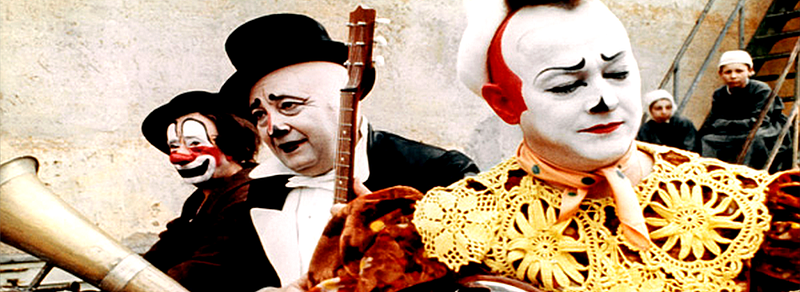
Still image of clowns with musical instruments in “Amarcord”.

As you can tell by the critical reactions, the film is sweet and endearing for many, irritating and tedious for others as Fellini shoots much of the film in a unique style with muted colors that seem slightly out-of-focus, as if he were attempting to transport us into a dreamlike state that will make you howl with laughter and then choke back a tear of images of such stunning beauty that you’ll feel you’re actually inside Fellini’s mind, seeing the things he remembers — in a highly colored fashion — from childhood. And all the while, you’ll be building your own memories of this vibrant, engaging and delightful cinematic landmark feature film. But I’ll let you decide…

So, to get a better look at the film, here’s a link to the movie trailer of Federico Fellini’s “Amarcord”:

Here I have provided 12 interesting and intriguing trivia facts (I wanted to keep it limited) about “Amarcord”:

  • Federico Fellini was born and brought up in Rimini, Italy, a small seaside town in the province of Emilia-Romagna. “Amarcord” is a neologism he contrived, which comes closest to the Emiliano-Romagnolo dialect phrase mi ricordo (I remember). Fellini, a great liar, denied this origin, claiming instead that it was a mysterious, cabalistic word, linked to invention rather than memory. The correct spelling should be “A m’arcord”. Whatever the meaning, “amarcord” evokes another world: evanescent, unreal, unreachable, impalpable, like an image in the depth of a mirror that can be attested to for only a brief instant before it vanishes, like the images of the cinema.
  • Federico Fellini has strongly denied that the movie is an autobiographical film, but agreed that there are similarities with his own childhood.
  • Giacomo Leopardi (1798-1837) was an Italian poet who came in touch with the main ideas of Enlightenment, and created poetic works, related to the Romantic movement, making him regarded as the greatest poet of modern Italy.
  • The Mille Miglia was a thousand mile endurance race conducted on open roads in Italy from 1927–1957.
  • Although a clip from “Beau Geste” (1939) is seen, the posters featuring Gary Cooper promote two fictional films ‘La valle dell’amore’ (“The Valley of Love) and ‘Il sole del deserto’ (“The Desert Sun”).
  • Titta’s (played by Bruno Zanin) sentimental education is emblematic of Italy’s “lapse of conscience.” Fellini skewers Mussolini’s ludicrous posturing and those of a Catholic Church that “imprisoned Italians in a perpetual adolescence” by mocking himself and his fellow villagers in comic scenes that underline their incapacity to adopt genuine moral responsibility or outgrow foolish sexual fantasies.
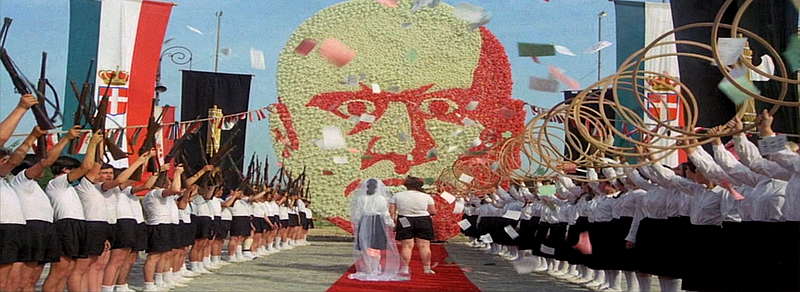
Still image of a ceremony in “Amarcord”.
  • The film was screened at the 1974 Cannes Film Festival, but wasn’t entered into the main competition.
  • Federico Fellini had a vast archive of photographs of actors, and out of these he would begin to construct his alternative universes and find his films — not representations of the world, not verisimilitude, but deformation and contrast, literally other worlds, elsewhere, beyond.
  • The film rapidly was picked up for international distribution after winning an Oscar for “Best Foreign Film” in 1975, the film was destined to be Fellini’s “last major commercial success”.
  • Federico Fellini did sketches and doodling for the film, essentially a playing, like his tours through the photographic archive of images of women with enormous breasts, ample bottoms (the stuff of dreams and masturbation); men grimacing pathetically, at once masking and revealing their impotence (the stuff of nightmares); dwarves, giants, the misshapen, the predatory. Interestingly enough, the Federico Fellini Foundation in Italy has a section specifically named after the film which is called the “Fellini Amarcord” which has been for 9 years the official publication of the Foundation and the jewel in the crown of it’s publishing activity. It has hosted contributions of every kind: abstracts of conferences, examinations of single aspects of the artistic personality of Fellini, monographs on film, unpublished screen-plays, and reissues of texts actually impossible to be found, and so on.
  • The first step for Federico Fellini in doing the film was not the script or the story that the movie would illustrate but rather faces and images that would evoke a world. The film is exactly that, a “world,” part circus, part science fiction, composed of images of its inhabitants.
  • It was the first film ever released on home video in the “letterbox” format (on an RCA SelectaVision CED video disc, January 1984), preceding the letterbox laserdisc release of Woody Allen’s Manhattan (1979) by eight months.
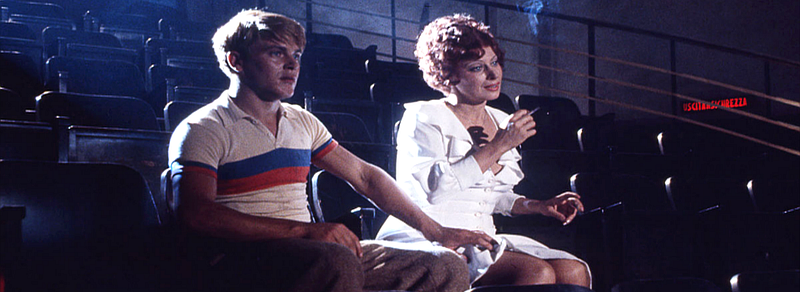
Still image of Bruno Zanin and Magali Noël in “Amarcord”.

To conclude, Federico Fellini’s “Amarcord” is ribald, sweet, and sentimental film, that is a larger-than-life journey through a seaside village and its colorful citizens as Federico Fellini’s at his ripest and loudest recreates a fantasy-vision of his home town during the fascist period and all with the ability, to compose a framework that oozes baroque drama and vitality that is almost unparalleled and more or less succeeds in evoking a time period through the eyes of a young boy, as it veers to the vulgar, crassly funny, tender, always affectionate nostalgic trip. The film is a beautifully, heartfelt to the satirical, the scathing to the loving, the mirthful to the melancholy — in short, it’s a personal dreamlike evocation, that’s a cinematic work of art memoir.

NOTE: The article contains sources from IMDb and Wikipedia.

Follow me and check out other articles of mine:

Movies
History
Trivia
Photos
Movie Trailer
Recommended from ReadMedium