
A FILM TO REMEMBER: “ROPE” (1948)
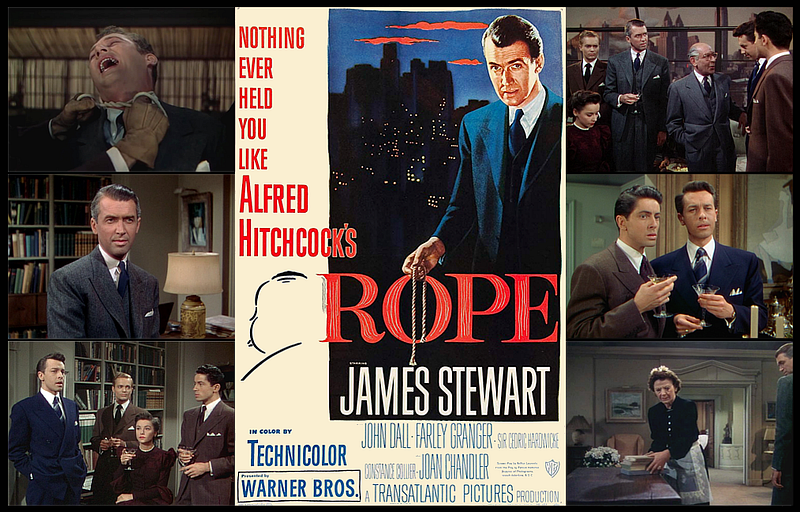
Before I get into this, I want to make mention “A FILM TO REMEMBER” will be a series about films that have reached a milestone anniversary since their origin in being culturally, historically, or aesthetically significant. The articles will contain the film’s plot outline, director, cast, a compilation of trivialities, various photos, movie trailer, critical reception and more. So, let’s start:
We are here to mark the celebration of the 70th Anniversary of Alfred Hitchcock’s “Rope”. Let’s take an inside look at the film:
PLOT OUTLINE:
Two young men strangle their “inferior” classmate, hide his body in their apartment, and invite his friends and family to a dinner party as a means to challenge the “perfection” of their crime.
STUDIO:
Warner Bros. Pictures
DIRECTOR:
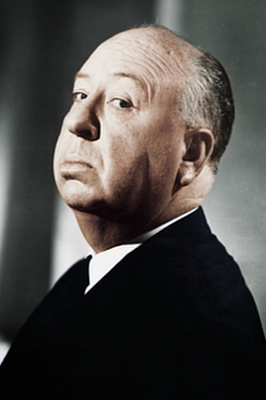
Alfred Hitchcock
CAST:
- James Stewart … Rupert Cadell
- John Dall … Brandon Shaw
- Farley Granger … Phillip Morgan
- Joan Chandler … Janet Walker
- Sir Cedric Hardwicke … Mr. Henry Kentley
- Constance Collier … Mrs. Anita Atwater
- Douglas Dick … Kenneth Lawrence
- Edith Evanson … Mrs. Wilson
- Dick Hogan … David Kentley
GENRE(S):
Crime | Drama | Mystery | Thriller
TAGLINE:
The guest who’s dead on time.
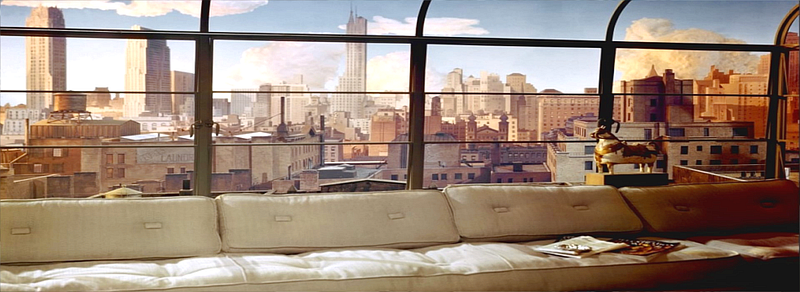
The film is known for being director Alfred Hitchcock’s experimental murder mystery, as its notable for taking place in real time using an eye-am-a-camera technique which is a single continuous shot through the use of long takes. Despite the “technical novelty,” it’s one of Hitchcock’s most subdued and affecting films as it stands out as Hitchcock’s first Technicolor film of his career and for having the presence of homosexual undertones in the relationship between the two lead characters. The film is based from Patrick Hamilton’s play of the same name, which was said to be inspired by the real-life murder of 14-year-old Bobby Franks in 1924 by University of Chicago students Nathan Leopold and Richard Loeb, as it garnered a mixed reception mainly in part, that Hitchcock could have chosen a more entertaining subject with which to use the arresting camera and staging techniques displayed in the film. While others, felt it was an interesting experiment that added intrigue to the film’s conceptualization.
Here’s what some of the critical receptions have been for the film over the years:
Edwin Schallert from Los Angeles Times says: “It is unusual enough to shine more as a technical tour de force than as a moving sort of film…The interesting experimental values in this Hitchcock production could never be denied, yet I would not rate it one of his best.”
John McCarten from The New Yorker says: “In addition to the fact that it has little or no movement, ‘Rope’ is handicapped by some of the most relentlessly arch dialogue you ever heard.”
Roger Ebert from Chicago Sun-Times says: “Alfred Hitchcock called ‘Rope’ an ‘experiment that didn’t work out,’ and he was happy to see it kept out of release for most of three decades, but ‘Rope’ remains one of the most interesting experiments ever attempted by a major director working with big box-office names, and it’s worth seeing.”
TIME Magazine Staff from TIME Magazine says: “Much of the play’s deadly excitement dwelt in [the] juxtaposition of callow brilliance and lavender dandyism with moral idiocy and brutal horror. Much of its intensity came from the shocking change in the teacher, once he learned what was going on. In the movie, the boys and their teacher are shrewdly plausible but much more conventional types. Even so, the basic idea is so good and, in its diluted way, ‘Rope’ is so well done that it makes a rattling good melodrama.”
Vincent Canby from New York Times says: “‘Rope’ is not merely a stunt that is justified by the extraordinary career that contains it, but one of the movies that makes that career extraordinary.”
As you can tell by the critical reactions, while the film received a mixed reaction from critics, its fearless attempt to do something innovatively new (at the time), makes it one of Hitchcock’s most interesting films but its still a debate though, on where the film consensually stands among the ranks of Hitchcock’s filmography. While some pundits claim the continuous action and the extremely mobile camera are technical features of which industry craftsmen will make much of, but to the layman audience effect, it’s of a distracting interest. All the while, others argue, it’s an ingenious technique, and under Hitchcock’s superb handling it serves to heighten the atmosphere of mounting suspense and suspicion that serves as perverse entertainment. But I’ll let you decide…
So, to get a better look at the film, here’s a link to the movie trailer of Alfred Hitchcock’s “Rope”:
Here I have provided 12 interesting and intriguing trivia facts (I wanted to keep it limited) about “Rope”:
- Since the filming times were so long, everybody on the set tried their best to avoid any mistakes. At one point in the movie, the camera dolly ran over and broke a cameraman’s foot, but to keep filming, he was gagged and dragged off. Another time, a woman puts her glass down but misses the table. A stagehand had to rush up and catch it before the glass hit the ground. Both parts are used in the final cut.
- The movie had a total of 10 shots within the film overall, running 9:34, 7:51, 7:18, 7:09, 9:59, 8:35, 7:50, 10:06, 4:37 and 5:40 minutes:seconds each. The film was shots, ranged from 4–1/2 minutes to just a little over 10 minutes (the maximum amount of film that a camera magazine or projector reel could hold). At the end of the takes, the film alternates between having the camera zoom into a dark object, totally blacking out the lens/screen, and making a conventional cut. However, the second edit, ostensibly one of the conventional ones, was clearly staged and shot to block the camera, but the all-black frames were left out of the final print. Most of the props, and even some of the apartment set’s walls, were on casters and the crew had to wheel them out of the way and back into position as the camera moved around the set.
- The film was banned in a number of American cities because of the implied homosexuality (which wasn’t publicly acceptable during that time) of Phillip Morgan (Farley Granger) and Brandon Shaw (John Dall). Ironically, Granger himself, in real life, was in fact a homosexual.
- Alfred Hitchcock’s film is very different from Patrick Hamilton’s play of the same name. Hitchcock made his own adaptation with Hume Cronyn and they created new dialogue and characters for their adaptation. In the play, there is no Janet Walker, no Mrs. Wilson, no Kenneth Lawrence, and no Mrs. Atwater. The play takes place in England. Brandon Shaw is Wyndham Brandon and Philip Morgan is Charles Granillo in the play. In the play, Rupert Cadell is only 29 years old and he is the current teacher of only Wyndham Brandon and Charles Granillo. In the film, Rupert looks like he is at least around the age of mid 40s. Rupert had been the teacher of Brandon Shaw, Philip Morgan, Kenneth Lawrence, and David Kentley. In the film, Rupert is currently a publisher.
- This was the only film James Stewart made with Alfred Hitchcock that he did not like. Stewart later admitted he felt he was miscast as the professor (he makes his first entrance 28 minutes into the film).
- The film was unavailable for decades because its rights (together with four other pictures of the same period) were bought back by Alfred Hitchcock and left as part of his legacy to his daughter Patricia Hitchcock. They’ve been known for long as the infamous “five lost Hitchcocks” among film buffs, and were re-released in theaters around 1984 after a 30-year absence. The others are “Rear Window” (1954), “The Trouble with Harry” (1955), “The Man Who Knew Too Much” (1956) and “Vertigo” (1958).
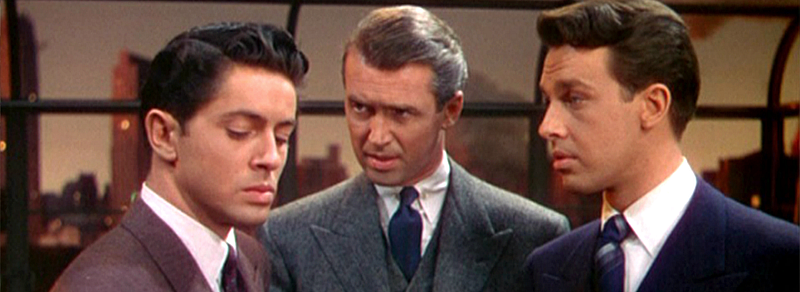
- The theatrical trailer features footage shot specifically for the advertisement that takes place before the beginning of the movie. David (the victim) sits on a park bench and speaks with Janet before leaving to meet Brandon and Phillip. James Stewart narrates the sequence, noting that’s the last time Janet and the audience would see him alive.
- Contrary to popular belief and Alfred Hitchcock’s own claims in later interviews, there are several conventional edits during the film: When Janet arrives at the party; when Phillip shouts “That’s a lie!”; when Mrs. Wilson enters the room to announce the telephone call from David’s mother; and when Brandon reaches into his pocket for his gun while Rupert narrates his theory on how the murder was committed. Some add the cut from the shot of the apartment’s exterior (with the opening titles superimposed over it) to its interior at the beginning, but that one does not genuinely contradict the claim that the film is made to simulate a single continuous take any more than the cut to the end credits does.
- Although the film lasts about 80 minutes and is supposed to be in “real time”, the time frame it covers is actually longer — a little more than 100 minutes. This is accomplished by speeding up the action: the formal dinner lasts only 20 minutes, the sun sets too quickly, and so on. The September 2002 issue of “Scientific American” contains a complete analysis of this technique (and the effect it has on the viewers, who actually feel as if they watched a 100-minute film).
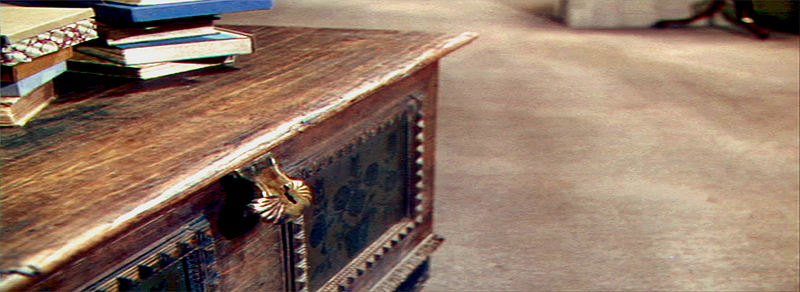
- Alfred Hitchcock’s inspiration for the long takes came from a BBC Television broadcast of “Rope” (1939). The producer, Dallas Bower, decided on the technique in order to keep the murder chest constantly in shot.
- Screenwriter Arthur Laurents claimed that originally Alfred Hitchcock assured him the movie wouldn’t show the opening murder itself, therefore creating doubt as to whether the two leading characters actually committed murder and whether the trunk had a corpse inside.
- Cary Grant was the first choice to play the role of the teacher, Rupert Cadell but the role eventually went to James Stewart. Interestingly enough, Stewart though was actually the original choice for Roger Thornhill in “North by Northwest” (1959) until it went to Grant.
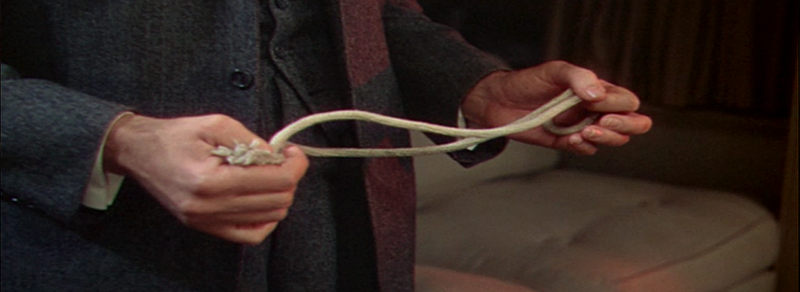
To conclude, Alfred Hitchcock’s “Rope” was said to be a “stunt,” according to Alfred Hitchcock himself but the film contains some of the most unique filmmaking of its time as Hitchcock was so far ahead of filmmakers back then and ahead of a lot of the filmmakers today. While the film has it’s criticisms from various pundits on the use of its technique, it remains a fascinating experiment trying to find the cinematic equivalent to a play, with the camera constantly searching in a singularly tense drama that doesn’t let up for its entire, very tight, 80 minutes in this innovate, psychological thriller of how a perfect crime goes wrong.
NOTE: The article contains sources from IMDb and Wikipedia.
Follow me and check out other articles of mine: