
A FILM TO REMEMBER: “THE LONG, HOT SUMMER” (1958)
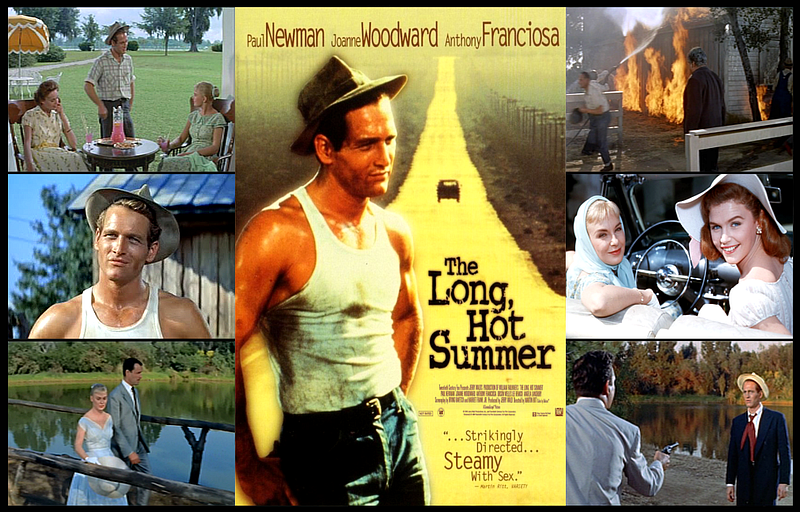
Before I get into this, I want to make mention “A FILM TO REMEMBER” will be a series about films that have reached a milestone anniversary since their origin in being culturally, historically, or aesthetically significant. The articles will contain the film’s plot outline, director, cast, a compilation of trivialities, various photos, movie trailer, critical reception and more. So, let’s start:
We are here to mark the celebration of the 60th Anniversary of Martin Ritt’s “The Long, Hot Summer”. Let’s take an inside look at the film:
PLOT OUTLINE:
When a sullen but self-confident drifter who’s an accused con man and barn burner arrives in a small Mississippi town and he quickly ingratiates himself with its richest family, the Varners which stirs much conflict in the kinship.
STUDIO:
20th Century Fox Pictures
DIRECTOR:
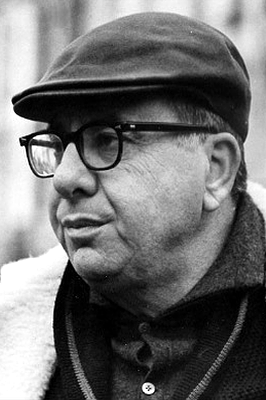
Martin Ritt
CAST:
- Paul Newman … Ben Quick
- Orson Welles … Will Varner
- Joanne Woodward … Clara Varner
- Anthony Franciosa … Jody Varner
- Lee Remick … Eula Varner
- Angela Lansbury … Minnie Littlejohn
- Richard Anderson … Alan Stewart
- Sarah Marshall … Agnes Stewart
- Mabel Albertson … Elizabeth Stewart
- J. Pat O’Malley … Ratliff
- William “Bill” Walker … Lucius
GENRE(S):
Drama
TAGLINE:
The red-hot lowdown on a southern family…that people talked about in whispers !
The film is known for being a small-town gutsy, family melodrama as director Martin Ritt strikingly conducts with themes of compulsive dramatic tension and intriguing characters, rooted with a first-rate ensemble cast and in particular, robust performances from Joanne Woodward, Orson Welles, Angela Lansbury, Lee Remick and most especially, Paul Newman which brought him to national fame. The film is based in part on three works by William Faulkner but mainly from the novel “The Hamlet” which is where the film’s title is taken from, but also uses the names of characters and a few details of the plot but significantly modifying the story in adding fragments from the novel “Spotted Horses” and the short story “Barn Burning”, as it was overall well received with critical success in which it revitalized the career of Ritt, who had been blacklisted during most of the 1950s for alleged associations with communists.
Here’s what some of the critical receptions have been for the film over the years:
TV Guide Staff from TV Guide says: “Director Martin Ritt and writers Harriet Frank, Jr and Irving Ravetch opted for a less-than-faithful adaptation of the author’s work, and the results were excellent.”
Dave Kehr from Chicago Reader says: “[An] uneasy blend of three Faulkner short stories.”
TIME Magazine Staff from TIME Magazine says: “Paul Newman’s performance as Ben Quick, before the script blunts it, is as mean and keen as a cackle-edge scythe.”
Variety Staff from Variety says: “This picture is strikingly directed by Martin Ritt.”
Emanuel Levy from EmanuelLevy.com says: “This small-town family melodrama, a quintessential 1950s film in its themes and tensions, is well acted by Paul Newman, Joanne Woodward and Lee Remick.”
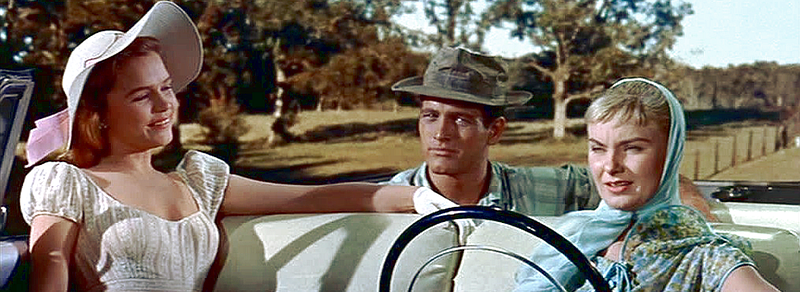
As you can tell by the critical reactions, the film was consensually well praised, though, a few pundits felt it was an uneasy, if not, a flabby blended feature. But Ritt and co. opted for a less-than-faithful film adaptation which was heavily influenced by Tennessee Williams’ play “Cat on a Hot Tin Roof,” resulted in an erotically charged and tense filled, white-hot melodrama that’s added with more dimensions do in part of it’s impressive cast and performances led by Newman, Woodward and Welles in this stirring and emotional, self-contained little southern world of feverish, dramatic, restless unravelment. But I’ll let you decide…
So, to get a better look at the film, here’s a link to the movie trailer of Martin Ritt’s “The Long, Hot Summer”:
Here I have provided 12 interesting and intriguing trivia facts (I wanted to keep it limited) about “The Long, Hot Summer”:
- A month after production wrapped, Paul Newman and Joanne Woodward got married in Las Vegas. Woodward became pregnant during production only to miscarry on her and Newman’s honeymoon, less than a month before the world premiere.
- This film marks Joanne Woodward and Paul Newman’s first cinematic collaboration.
- Paul Newman and Joanne Woodward channelled their off-screen chemistry into their characters and worked beautifully together. “They seemed to have such a total understanding of each other,” said co-star Angela Lansbury in a 2001 interview, “that they were able to work in scenes where they were at each other’s throats or falling under each other’s spell.”
- Oscar Levant said about Producer Jerry Wald, “He suddenly became involved with William Faulkner. He’d buy a Faulkner property and that turgid, incomprehensible prose was on one occasion transformed into “ The Long, Hot Summer.” In that picture Orson Welles played a “big daddy” type of role. Sometimes he was inaudible — Those were his best moments.”
- One of the very few films that had two actors who were married to each other both of whom won Academy Awards for acting-Joanne Woodward for “The Three Faces of Eve” (1957), and Paul Newman for “The Color of Money” (1986).
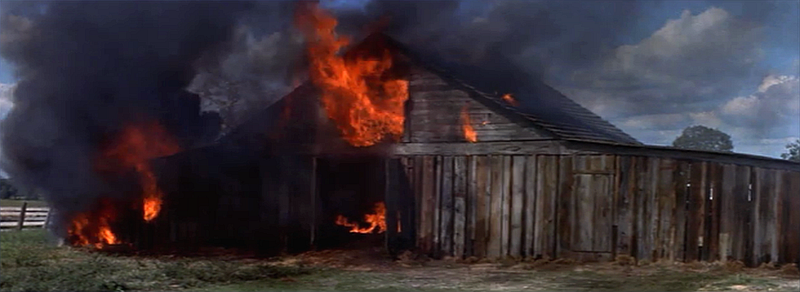
- It took five days to film the barn-burning scene because the sky, winds, or amount of sunlight were not acceptable to the director Martin Ritt.
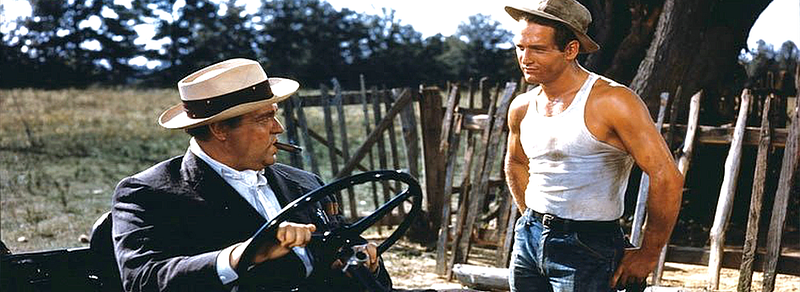
- During filming Ritt drove Welles into the middle of a swamp, kicked him out of the car and forced him to find his own way back.
- During post-production, Martin Ritt found that it was nearly impossible to understand any of Orson Welles’ dialogue. He and his team worked overtime to improve what they could through post-dubbing. Some cast members thought that Welles had done it quite deliberately as a way to show contempt for the “mumbling” method actors of the Actors Studio, but no one could ever be sure.
- Orson Welles had a rough time making the film and caused plenty of trouble. Used to being in control of his own projects, it was hard for him to do things someone else’s way. According to Angela Lansbury, “He was always nudging and pushing for things and wanted to change lines, but had to be carefully handled so that he didn’t always get his way because his way wasn’t necessarily the best way for everybody else in the scene.” Welles would irritate his co-stars by overlapping his own lines with their dialogue, ad-libbing, and mumbling to the point where his lines were barely comprehensible. “There was something you couldn’t resist about Orson,” said Lansbury, “even though he was a son-of-a-bitch at times. I mean, there’s no question about it, he was very difficult.” Joanne Woodward added in a 2001 interview, “Orson had a hard time. It must have been a terrible, terrible feeling for him to be confronted by all these young hot shots who thought they were so great because they came from New York and the Actors Studio. It was a problem.”
- The scorching Louisiana heat didn’t help Orson Welles’ temperament on the set. “He was having terrible difficulty living in his own skin,” said Angela Lansbury. “He was very very heavy. We were working under dreadful conditions of heat and he was perspiring and he seemed to have a lot of very thick makeup on.” Part of that heavy makeup was a prosthetic nose that Welles wore — something he often did for his acting roles. The heat made Welles sweat so much that his fake nose would often come unglued and ruin the shot. The make-up people had to keep applying material to keep the fake nose from falling.
- The conflicts between Orson Welles and Martin Ritt attracted media attention. Immediately after filming was completed, during an interview with Life, Welles explained that the cause of his behavior was that he did not know what kind of “monkeyshines” his co-stars would be or the “caprices” they would receive from him. He also stated that they overcame the differences and completed the film. Welles later wrote a letter to Ritt praising his work and apologizing for his interference during the making of the movie. Ritt replied, expounding his admiration for Welles. Despite the mutual apologies, during an interview in 1965, Ritt recalled an incident on the set. While the film was being shot, it was often stopped by bad weather. During a day suitable for shooting, he found Welles not ready for the scene, instead reading a newspaper in Spanish. Ritt decided to skip Welles’ scene and shoot the next one. He attributed Welles’ later cooperation to the incident, which Welles had found humiliating. Ritt thus earned the nickname “the Orson Tamer” throughout the Hollywood community.
- Angela Lansbury relished her role and thoroughly enjoyed working with director Martin Ritt — “He had a wonderful enthusiasm and earthy sexy quality himself. He loved the idea of the dirtiness of the carryings on, and he certainly brought every bit of kind of naughty sexuality out of me in that role.”
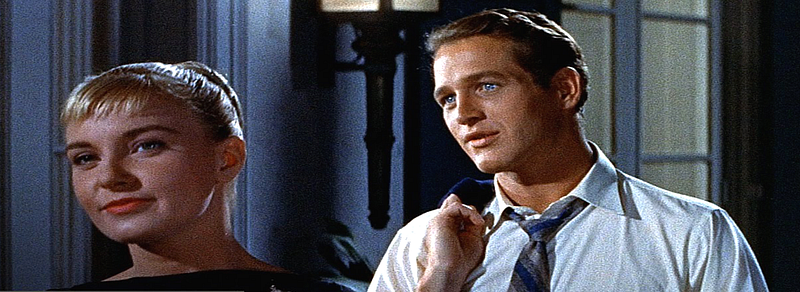
To conclude, Martin Ritt’s “The Long, Hot Summer” opted for a less-than-faithful adaptation of the author’s work in which Martin Ritt’s tended compelling direction turns it into a salaciously laden and emotively fervent, kindred story in similitude of the influential Tennessee Williams’ play “Cat on a Hot Tin Roof”. The film takes a therapeutic approach to its characterizations and themes, affirming its belief in direct confrontation in reflecting the dominant ideology of the 1950s with a top-notch cast of stout performances from Joanne Woodward, Orson Welles, Angela Lansbury, Lee Remick and in particularly, the star making one from Paul Newman in this tensity filled, sexually searing, melodramatically sparking, summertide barn burner.
NOTE: The article contains sources from IMDb and Wikipedia.
Follow me and check out other articles of mine: