
A Far Smaller Birmingham: The Best Version of Ourselves
How Birmingham leaders shape and shirk the future
Post #16 of #20: I am reflecting on twenty years of personal and professional experiences in Birmingham and beyond. Visit www.medium.com/HonestlyEd to read the full #20For20 series.
Part 1: A Far Smaller Birmingham: Origins (Click here to read) Part 2: A Far Smaller Birmingham: Sankofa (Click here to read) Part 3: A Far Smaller Birmingham: The Best Version of Ourselves (read below)
In March 2006, Alabama Power CEO, Charles McCrary publicly criticized the lack of cooperation between governments and major shareholders in the Birmingham area. He proclaimed to the leaders of Birmingham that, “there will be a far smaller Birmingham to lead unless all of us take action.” His remarks helped propel the merger of the Birmingham Metropolitan Development Board, Birmingham Regional Chamber of Commerce and Region 2020 into the Birmingham Business Alliance. — Wikipedia
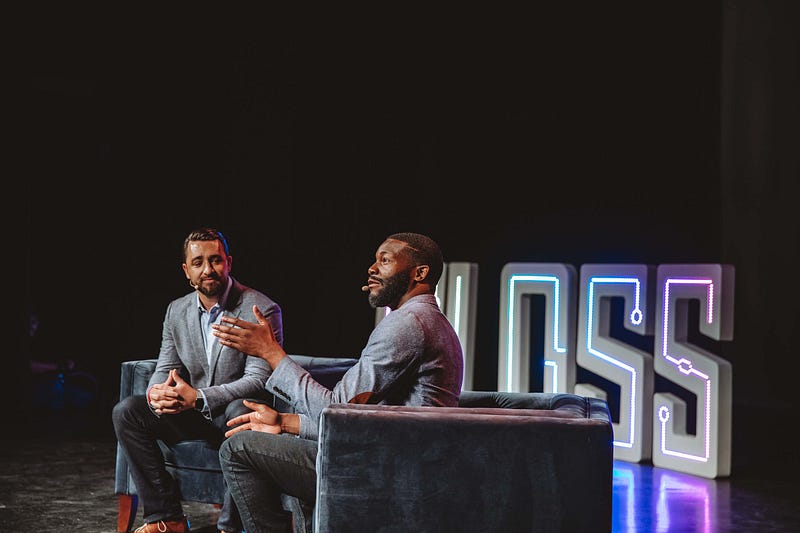
On July 13, 2018 Birmingham Mayor Randall Woodfin laced up his Chuck Taylor Converse shoes, brushed his signature beard, and donned a Birmingham “Putting People First” shirt on his way to the Historic Lyric Theatre. There, he stood before a full room of entrepreneurs and technologists and proclaimed:
“Birmingham does not need to be like any other city. We simply must be the best version of ourselves.” — Mayor Randall L. Woodfin, City of Birmingham
These words were not in his prepared remarks. They were not remnants from his political campaign. He had never uttered these words to anyone before the moment he said them. It was the admonition of a new leader finally settled into his role and expressing what he had been seeing and hearing from residents, business owners and others for more than a year.
Like an musician finding the perfect verse or hook for their song, he instantly knew his statement connected with people. He put on for his city.
After all, there were months of planning and preamble prior to that moment.
The Woodfin Era: No More Reports
Within weeks of Mayor Woodfin winning his runoff election in October 2017, the Community Foundation of Greater Birmingham had published results of its commissioned report: Together We Can: Charting a Course to Cooperation for Greater Birmingham. This was Birmingham’s most substantial evaluation of regional cooperation since the Dave Adkisson era Cool Communities initiative. (Cool Communities was an workforce development initiative borne out of Chamber-commissioned research by economist and futurist, Rebecca Ryan, in the early 2000s.)
Six months into the Woodfin Administration, another major report — Building It Together: A Framework for Aligning Education and Jobs in the Birmingham Area was published by a collective of local economic and workforce development institutions. Building It Together was different than other reports because of the type of empirical data produced by Burning Glass Technologies.They specified the number and type of degree holders, jobs and new businesses needed in Birmingham all the way down to their NAICs codes. Nerd alert: you will greatly enjoy exploring this report.
These reports were timely. Key Birmingham institutions had been experiencing a seismic shift in leadership since 2014. Founders and longtime CEOs from the Innovation Depot, YWCA of Central Alabama, Birmingham Civil Rights Institute, Community Foundation of Greater Birmingham, among others were stepping down and being replaced by new leaders. So, I think it was critically important that Birmingham had a fresh examination of our regional economic development landscape. This was especially true related to our ability to recruit, grow and keep talent.
These reports are the current bedrock of our economic and workforce development strategies. They provided common understanding and common language to define Birmingham’s challenges and solutions.
All that said, by the time the Mayor’s 2018 Transition Team wrapped up their evaluation of City Hall we had more than 800 residents, entrepreneurs and even the Mayor himself saying: “No more reports. Let’s get to work!”
The Elephant in the Room
Things have been a little awkward lately.
Despite meteoric growth and optimism in the Birmingham region — real positivity with real projects attached to them — there is a delicate veneer of hope shrouding an unsettled leadership landscape. This awkwardness threatens the velocity and sustainability of progress.
We have everything we need to win — I believe that wholeheartedly. But, a sprawling organization landscape, the pandemic, and a persistent question of community identity make all of the progress fragile.
Sprawling Leadership
Since 2016, there have been no fewer than six brand new agencies in the City of Birmingham. Heck one person — Dr. Josh Carpenter — drove the creation of at least four of them: Innovate Birmingham, Birmingham Promise, Prosper Birmingham, and Bham Strong. But, he did not act alone, he was a proxy for dozens of new leaders filling substantial leadership roles across the City.
And, other organizations, including Ed Farm, Birmingham Bound, among other efforts, filled deeper niches of need in the talent development, talent recruitment, and talent retention space. All of these organizations were founded by leaders under the age of 40 with significant support and resources from Mayor Woodfin.
Think about it — that is at least six new CEOs, six executive committees and board of directors, six organizations with multiple programs, multiple fundraising needs and multiple risk profiles. All of this in addition to the organizations we already have in place. That is an awful lot for a community with a long and short history of non-cooperation within and around the City.
This is not sustainable.
The elephant in the room is the answer to the question.
Does Birmingham need a Chamber of Commerce?
Maybe. Assuming we are asking the right question.
Better questions might be: “Why does a new generation of leaders feel they need to create new organizations instead incubating their ideas with or through the institutions we already have? Who serves as a lighthouse and on-ramp for the civic energies of both established and aspiring business leaders? Have we — present leaders who must own the consequences of those who came before us — solved for the challenge articulated by Charles McCrary or are we doomed to repeat the past? (Hint: If you are reading this, it’s too late.)
These are better questions to ask than “Does Birmingham need a chamber of commerce?”
Because, I really do not care what we call the organization. I want an organization that everyone can see themselves in. An organization that represents our highest and most collective ideals of ourselves. I want an organization whose members challenge and defend her jealousy.
If current leaders create a chamber in name only, then we just create yet another organization. We need an organization with the strategic intent to represent us all and to lead initiatives that incubate ideas until they evolve into their truest form. That form may not be be a wholly independent organization.
But, presently, that’s what we do. Turn ideas into organizations — diluting and drowning our best talent in governance and fundraising challenges.
This is not sustainable. There will be a reconciling; a purification. History requires it.
Identity Crisis
It is one thing to have a crisis. It is something altogether different to have a crisis and refuse to face it.
Five years ago I was knee-deep in programming for young professionals throughout the state of Alabama for my team at Alabama Media Group/AL.com. One day I was pecking away at my computer in the modern first floor commons when Lorenzo, an enthusiastic 20-something co-worker approached my desk. He described an entrepreneurial side project with one of his peers. He described a digital application that would identify and rank local not-for-profit organizations for the purpose of helping young professionals decide to which organizations they will contribute. The more he talked the more I realized he described everything I knew United Way to be. Vetting not-for-profits. Helping professionals to contribute through a trusted organization, etc. He said more, but the point is he was totally disconnected from the institution already invested in doing what he wants to do.
But, this isn’t about Lorenzo. It isn’t even about the United Way. This is about a generation that do not see themselves in our key institutions, including civic and economic development organizations. Why? One reason rises above them all: identity. We have an identity crisis and we won’t admit it.
To be clear, Birmingham lost something when it lost its chamber of commerce. What was lost has not been filled by any organization. The City deserves a civic organization with soul. And, I’m not talking Aretha.
Forgive me, but I’m talking about love.
I want people to love the organization, not just appreciate the good work they do.
I want my favorite food truck owner to feel a civic connection to a corporate CEO. And, I want that connection to be more than lip service. I want it to be real; tangible and sustainable.
But, people love things they seem themselves in. A shared sense of identity.
Our Business Model
Let’s talk business. There are a confluence of forces that have squeezed the classic business model of the modern chamber of commerce, including Sarbanes-Oxley (and other corporate compliance issues), the retirement of Birmingham-born leaders, and the loss of corporate headquarters and their CEOs.
Altogether, we have fewer people with the budget authority, passion and risk tolerance to spend considerable time and money in their local economic development organizations, especially as civic endeavors.
The Birmingham Business Alliance is more Metropolitan Development Board (MDB) than anything else. This is absolutely critical to understand. That merger of organizations that followed “McCrary’s Admonition” was not a merger of equals. The BBA was a bit of a negotiated settlement, with a corporate mandate to delivery technical and marketing economic development services. Often, this corporate mandate has been carried out without the dual imperative of a much larger constituency of small businesses, minority business advocates, Birmingham boosters and others who want an organization with a broader mandate.
This schizm has never been resolved, but has been revealed by the sprawling leadership landscape of a new generation and the now decade-old chatter of tenured leaders who pine for the days of old.
To be clear, the BBA is a critically important organization. Birmingham needs the BBA, or at least some version of it. We need a regional economic development agency that represents the Birmingham MSA — not just the City of Birmingham. The BBA is not going anywhere — at least, the mission of the BBA is not going anywhere. We really need it. And, we also need more.
The Five Strategies Birmingham Should be Driving
In his book, Horseshoes vs Chess: A Practical Guide for Chamber of Commerce Leaders, Dave Adkisson outlines nine elements of the ACCE Horizon Report which speaks to the forces affecting the chambers of commerce sector. While his book speaks about the Chamber world, I think several of those forces in the horizon report will affect whatever happens to make our economic and workforce development landscape more sustainable, including every organization referenced in this post. Grab his book to find all nine elements in context.
In the meantime, if I could wave my magic wand, here are the five strategies Birmingham’s key civic and economic agency (which does not exist) would be focused on with verve and vigor, day and night:
- Governance. We have too many uncoordinated organizations. Thanks to Mayor Woodfin and the cooling of Covid, there appears to be some attempt at coordination, but the long term solution will require a new governance structure. There are different models, such as the Fund for Our Future, upon which Prosper Birmingham was founded. But, this is not the only model that could work. Whatever the case, we need a bigger more accessible tent that everyone can see themselves thriving in and influencing. Here, I advocate for an organization with small dollar memberships. The form of our governance structure and organization sets the tone for buy-in.
Ultimately, not all organizations referenced in this post will survive the decade. In fact, many of them are, by definition, start-ups. And, start-ups require, by nature, a certain failure rate. Major funders will have the largest impact on the sustainability of organizations. No funder wants to be in the position of leaning into existential decisions for the organizations they support, but they will end up doing so sooner or later; de facto or by affirmation. Birmingham deserves a better contemplation of its governance structure across all agencies.
- Regional lead generation and project support. The Birmingham Business Alliance essentially plays this role (as the Metropolitan Development Board once did). This is likely what the organization is best at. They should keep doing what they are doing, increasing and improving a culture of collaboration as they go.
- Defining Success. We must have a more empirical an agreed-upon measures of success for economic progress in Birmingham and the region. An ultimate, equitable scorecard. This is precisely what Prosper Birmingham was designed to do, among other things. While the Economic Development Partnership of Alabama has a statewide mandate, I think the collection of leadership here has significant influence in defining success for the region, especially in context of other statewide and Southeastern U.S. actors.
- Industry-specific focus and services. Mayor Woodfin has been clear about his target industries for the City of Birmingham: financial services, technology, logistics, and advanced medicine in the form of precision medicine and genomics. Equally important, we need more agreement among economic development agencies about leveraging resources to go after specific industry clusters (those of the Mayor make sense, but certainly are not the only ideal targets for Birmingham.) This is one of the biggest, clear gaps currently being contemplated by the Mayor’s second term transition team.
- Power in numbers. My view on this may be unique and represent a combination of my experience as a small business owner, an association management professional, a marketer and political strategist, but it all comes down to one thing — there is powers in numbers. Everything from swaying public opinion to lead generation to marketing reach to add-on/non-dues revenue. The City of Birmingham issued 23,000 business licenses in 2021 — shouldn’t we have an organization that represents a larger share of our business community? Small business services aside, we need a savvy organization that understands the economics, lifetime value and emergent business opportunities that flow from harnessing civic enthusiasm.
- Storytelling. Economic and workforce development is so much more than just job recruitment, inventory management and marketing. There is power in storytelling (that is why the longtime ownership of Birmingham magazine by the Chamber was both a strategic and financial asset.) Economic developers sell their cities as “products” to companies they seek to expand or recruit. Cities and their resident-workers bursting with pride, loyalty and enthusiasm help differentiate their city-products from our national competition. People under the age of 40 want Birmingham to be two things: a platform for their personal progress and a place that understands and embraces its complex history. They don’t want a sanitized version of Birmingham, but this is another tough conversation current leaders likely need to have: who speaks for Birmingham?
An Actual Smaller Birmingham
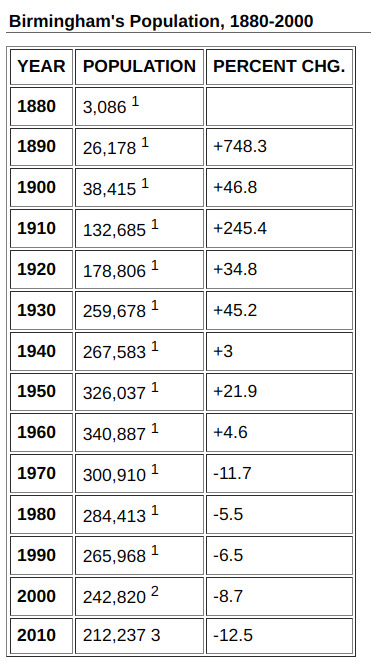
Birmingham is smaller today than it has ever been since 1960.
For perspective, the City of Birmingham lost 100,000 (30%) of its population from 1960 to 2000. A peak population of 340,000 had fallen to 240,000. And, from the day I stepped into my role at the Chamber on August 15, 2000 until December 31, 2021, the City lost another 40,000 people. According to the U.S. Census, our current population sits at 200,733, — about one hundred people more than the capital city of Montgomery (200,603) and 14,000 behind Huntsville who now touts the title of Alabama’s largest city (215,006).
This is not a nihilistic exercise in negative self-talk about our community. This is a clear-eyed, hindsight view of erosion.
Our population loss is akin to the family member we all know that has lived dubiously on the margins of our lives. At first, they were infrequent at family gatherings. We used to ask about them, then we didn’t. They faded into marginal existences in marginal spaces. Eventually, they were gone long enough to disappear from our lives altogether. Birmingham’s margins have eroded and we don’t want to talk about it. We have lost a lot of family members.
A far smaller Birmingham, indeed.
A Far Better Birmingham
According to a 2020 analysis from the City of Birmingham’s Department of Innovation and Economic Opportunity, our population loss of 5% over the past 10 years has likely leveled off.
Birmingham is poised for population growth in the next ten years, i.e. the next U.S. Census could realistically show Birmingham population growth for the first time since 1960.
Birmingham has always struggled with cohesion and cooperation since its founding. It is in our DNA . Thankfully, we have a future in genomics.
I am optimistic about our ability to get our collective act together. Because we have done it before and because I believe in the people of this city. The question is: Do we believe in one another?
We don’t have to lead a far smaller Birmingham, but we must lead a far better Birmingham — the best version of ourselves.
Did you miss the first posts in this mini-series? Read them here and then drop me a line at [email protected] with feedback.
Part 1: A Far Smaller Birmingham: Origins (Click here to read) Part 2: A Far Smaller Birmingham: Sankofa (Click here to read) Part 3: A Far Smaller Birmingham: The Best Version of Ourselves
Ed Fields is a marketer and strategist celebrating 20 years in Birmingham with #20For20 — a series of reflections, insights and homages. All posts are featured at www.medium.com/HonestlyEd. Follow Ed on LinkedIn, Medium, or Instagram.