
A Far Smaller Birmingham: Sankofa
How Birmingham leaders shape and shirk the future

Post #16 of #20: I am reflecting on twenty years of personal and professional experiences in Birmingham and beyond. Visit www.medium.com/HonestlyEd to read the full #20For20 series.
***
This three part mini-series seeks to provide both historical and contemporary context for Birmingham’s economic development landscape. The perspectives shared here are rooted in my lived experiences and personal theories of community transformation.
Part 1: A Far Smaller Birmingham: Origins (Click here to read) Part 2: A Far Smaller Birmingham: Sankofa Part 3: A Far Smaller Birmingham: The Best Version of Ourselves (Click here to read)
In March 2006, Alabama Power CEO, Charles McCrary publicly criticized the lack of cooperation between governments and major shareholders in the Birmingham area. He proclaimed to the leaders of Birmingham that, “there will be a far smaller Birmingham to lead unless all of us take action.” His remarks helped propel the merger of the Birmingham Metropolitan Development Board, Birmingham Regional Chamber of Commerce and Region 2020 into the Birmingham Business Alliance. — Wikipedia
The Akan people of Ghana have a phrase commonly known as “Sankofa”. It means “it is not wrong to fetch what is at risk of being left behind” or, more commonly stated, “go fetch it and bring it forward.” The concept of Sankofa is represented by Ghana’s Sankofa bird.
I want to take you back. Back to a Birmingham of not long ago featuring a few stories, characters, and efforts that anchored my professional experience and perspective. Frankly, I don’t know how to talk about the future in my next and final post without considering this history; my history. I would not want to.
Chamber World
I was rooted and raised, professionally speaking, in the Birmingham Area Chamber of Commerce where I spent the first seven years of my career. Upon graduation from Alabama State University in May 2000, I lived in Montgomery, but frequented Birmingham’s spoken word scene as I applied for jobs throughout the Southeastern U.S. One day, I passed my resume to a young professional who, through a series of contacts, shared it with Yvonne Baskin, the Chamber’s inaugural Vice President of Community Development.
Yvonne introduced me to the relatively new Chamber CEO, Dave Adkisson, who shared his vision to increase the number of women, people of color and HBCU graduates working at the Chamber. I got the job doing workforce development — connecting Birmingham City School high school students at career academies with local employers in healthcare, manufacturing and construction industries. This was the beginning of my seven year trek at the Chamber and the springboard for the remainder of my career.
I was 25 years old. Confident, prepared and eager to contribute.
In the Room
I was injected directly into the civic heart of this city from the day of my arrival. In the daytime, I worked with industry leaders, small business owners and high school teachers and students on every side of town. In the night time, I socialized and organized with spoken word artists, young professionals and activists. I was immediately well-connected among very different networks in the city.
Then, there was Von.
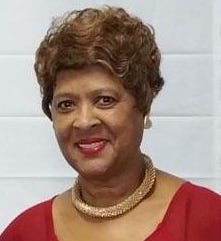
Yvonne, or “Von” as she was commonly known, was a true leader about town. Poised, professional, stylish and steeped in the ways of Birmingham, I marveled at how many people loved her. Von was a daughter of the city and seemed to be known by everyone. From former Mayor Richard Arrington for whom she previously worked, to TW, the man who cleaned Morris Avenue (and still does as a 52-year Public Works employee of the City of Birmingham!)
One day we were headed to the Sheraton Hotel Ballroom for a business luncheon and bumped into an older gentleman standing outside the venue, romancing a cigarette. Von introduced him as Shelley Stewart, a local advertising agency executive and an old friend. Of course, I would soon learn more about Shelley’s storied past as Shelley “the Playboy” Stewart and his role during the crucible of the Birmingham Civil Rights Movement. I was honored to be personally introduced to living history.
Von graciously introduced me to these people and many more. From my perspective, there is no way I would have had the career and civic success I have enjoyed in Birmingham without the transfer of credibility from someone as connected and respected as Von.
Birmingham intends to be a welcoming place, but often contradicts itself by making it difficult for new residents to navigate social and civic structures.
Having someone like Von at the chamber of commerce was an elegant solution to a classic Birmingham problem — a deficit of bridging social capital.
Von’s intentional engagement put me on a high velocity trajectory in proximity to people, information and rooms that many people don’t find themselves in until much later in their careers.
Representation Matters
Within five years into my tenure at the chamber I was promoted to the Executive Leadership Team in the role of Vice President of Business Services.
I recall sitting in a meeting of the African American Business Council, a chamber auxiliary group founded in the late 1980s — and one member pulling me aside shortly after my promotion to admonish me to purchase a new planner. I admit, I proudly carried my well-worn Franklin Covey planner and did not think much about it. It was not shabby by any means, just worn.
“You are an executive now,” she pleaded. “How you show up in the boardroom is how we show up in the boardroom.”
That is why those of us who lead spaces in legacy organizations must remain authentically connected to the communities that shaped us. They keep us honest and, by extension, keep the organization an honest reflection of a broader set of values and identity.
My very presence as a proud HBCU alum with my hair in locks communicated more to the community than any strategic initiative ever could. And, I wasn’t the only person representing new energy and new perspective in the Adkisson era of the Chamber. There were several of us; younger, browner and more female than male.
In 2002, I was named Minority Business Advocate of the Year by the City of Birmingham. I was surprised by the honor at first, because I was so new to the business community. But, over the years I better understand and appreciate why I received it. Because people that care about representation saw a credible advocate in me. Wet behind the ears with plenty to learn, but generally showing up like leaders like Bob Dickerson, CEO of the Birmingham Business Resource Center — a major player in Birmingham’s economic development scene — would expect and often encourage.
Bob is still busy keeping Birmingham business leaders honest, including me.
Key economic development and civic agencies like the Chamber should be cauldrons of talent, including authentic representatives of people historically found on the periphery of the marketplace.
And, my identity is one thing. But, what about the overall identity of the Chamber as a whole? Well, that’s another story.
1887 — 2002: Birmingham Area Chamber of Commerce 2003–2008: Birmingham Regional Chamber of Commerce 2009 — present: Birmingham Business Alliance
One Chamber
“If you have seen one chamber, then you have seen one chamber.” — Popular chamber aphorism
When I joined the staff of the Birmingham Area Chamber of Commerce in August 2000, the organization was still early in a significant shift in strategy and culture. Just two years prior, some staff were allowed to smoke cigarettes in their offices and the organization did not have an accessible 401(k) plan, tuition reimbursement and other elements needed to attract new talent. However, there were still some triplicate carbon copy forms lingering around the office! NOTE: If you are under the age of 40, then you should please google “carbon copy” the meaning and present use of the term will blow your mind.
The organization boasted a staff of nearly 50 people (including Birmingham magazine, a wholly-owned subsidiary of the Chamber), nearly 4,000 dues paying members, dozens of active committees, and a proud yet mixed legacy of representation for the City of Birmingham. The Chamber was the primary platform upon which Birmingham leaders expressed their individual and collective civic enthusiasm.
The Chamber Board had just elected the first woman (Dr. Judy Merritt, Jefferson State Community College) as Chairman of the Board a few years before I joined the staff. And, the first African American to serve as chairman (J. Mason Davis, Sirote & Permutt) was presiding over the board the year I joined the staff.
In 2002, the Chamber moved from the 14-story historic headquarters on 1st Avenue North to the more modern Financial Center. Employees were encouraged to participate in blue jean days to support the cleanout of the building. Most of us took turns going to the basement of the historic building. There we found a massive stockpiles of many things, including “It’s Nice to Have You in Birmingham” paraphernalia and founding documents of civic organizations created and spun off from the Chamber over many decades.
In fact, I discovered and read the founding/charter documents of many Birmingham organizations over the years. It was like my own personal orientation to the history of the city. Organizations like the Birmingham Junior Chamber, Vulcan Park & Museum, Leadership Birmingham, Project Corporate Leadership, TechBirmingham, the Birmingham Education Foundation, and the Birmingham Venture Club, among others were directly or indirectly borne out of chamber efforts. That doesn’t even include the incubation of organizations like Historic Rickwood Baseball Field who had offices in the Chamber’s headquarters.
I could go on and on — I-20/Corridor X, the 1996 Olympics, and more.
This is what a chamber of commerce is uniquely positioned to do. Unlike any other civic, community or economic development agency, chambers are generative entrepreneurial enterprises that become whatever they must to satisfy the civic desires of their communities. From my perspective there must be an agency — call it whatever you want to — that serves this incubation role in a community. If not, the community stands the risk of stagnation and an organization stands the risk of holding on to initiatives no longer suited to its mission. Simon Sinek calls it existential flexibility.
If you are not willing to blow up your company, then the market will do it for you. — Simon Sinek
(My third and final post will seek to reconcile the McCrary-inspired movement to streamline economic development through the Birmingham Business Alliance, the constant question of ‘should Birmingham have a chamber of commerce’ and, the significant number of new generation leaders and institutions who will ultimately be responsible for leading all of us — really soon.)
Key Initiatives
The initiatives at the Chamber were very exciting to me. I absolutely loved the work.
Our initiatives were a good blend of evidenced-based research and best practices, futurism, and city promotion. There were dozens of them, but I will highlight two of them here.
Live the Dream
Live the Dream was an internal public relations campaign, i.e., it was designed to improve morale of current residents, not to recruit people to Birmingham. The concept of the campaign was inspired by community surveys and a general feeling among locals that Birmingham was stuck.
Remember my points in the first post in this series: Birmingham was ego-bruised from massive population and headquarters loss. Thus, Chamber leaders recruited corporate partners and local media to fund a massive year-long campaign on television, radio, and billboards featuring local entrepreneurs, young professionals and nationally-known Birmingham-born entertainers.
As an aside, I was a part of a community branding discussion in early 2020, right before COVID changed the world. Atticus Rominger of REV Birmingham took inventory of the number of Birmingham-centric public awareness campaigns and found no fewer than a dozen in development. It seems that we have gone from a need to have at least one good public awareness campaign to arguably having too many uncoordinated efforts. But, that’s another story.
The BIG Trip
Close your eyes and recall the best road trip you ever took with friends or colleagues. Could you have replicated the depth of connection by staying in town? Heck no!
Our Chamber-led BIG (Birmingham Innovation Group) Trip inter-city visits facilitated ideation, cross-sector collaboration, team building, big vision casting and challenging dialogue in safe environments. We travelled with approximately 100 business, education and other leaders from Birmingham to other cities for best practices about how to move a region forward. Baltimore, Charlotte, St. Louis, Nashville, and Pittsburgh. These trips created space for improving rapport and camaraderie among key business and civic leaders.
For instance, Birmingham got the idea for its 311 non-emergency service center from the Baltimore BIG Trip. Former Mayor Bernard Kincaid was on that excursion, came back to Birmingham and said, “let’s do it!” I remember riding on a coach bus across from Mayor Kincaid, his chief of staff and his economic development director, Carol Clarke. There, I discovered that Carol and I shared love for jazz and maintained a very positive relationship. Today, she is a newly minted City Councilor.
After a dinner event in the host hotel, Kelly Roadbuilders CEO, Robert Kelly, found a piano in the Presidential suite and played a whole, complex song from memory without missing a beat. Who knew he could play the piano?! It was an incredible moment to see major leaders crowded around him on the same sheet of music, metaphorically speaking.
There were other eureka-inspired moments, delight and challenging conversations.
We cannot script these moments, but they will happen if we make space for them.
Today, we have too many leaders in too many new spaces with too little connectivity and too many big ideas to not have more dynamic, experiential activities like the BIG trip. We urgently need something like this, especially in the aftermath of COVID.
Level Five Leadership
Like most immersive experiences it is not one factor or one person that defines the totality of the experiences. However, there are outsized personalities that become the adhesives of our revelry and put the entire experience into perspective.
Dave Adkisson was one of those personalities to me.
A Harvard-educated former Mayor of Owensboro, Kentucky, Dave’s humor, energy, and quick-wit were only outmatched by his clear thinking for what collective economic strength would mean for the Birmingham region.
I was very fortunate to have several situations and big moments with Dave that affected how I saw (and still) see what Jim Collins defined Level 5 leadership today.
For instance, there was the time Dave, Mayor Bernard Kincaid and Jefferson County Commissioner Larry Langford got into a literal screaming match in his office. Everyone in the building was buzzing about it. It never made news, it didn’t need to. In my optimism I thought it was the sound of progress. But, it turned to be a simple case of an elected official cussing out the chamber guy. It happens every once in a while. Our team was proud that Dave stood his ground, but it was an early lesson for me: Beware, leadership rooms can be really emotionally charged. Nobody ever told me that in college.
And, Lord knows we have seen enough of it in Birmingham.
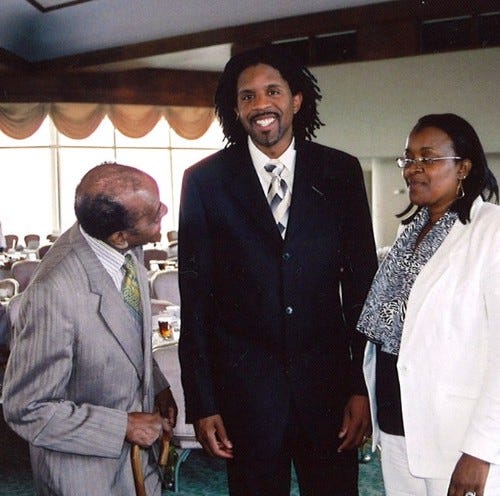
In late 2002, I started growing my hair into a short afro. And, one Saturday I decided to start the process of coiling my hair for preparation for locking. The very next day I was working in my cubicle — the only soul in the entire building on a Sunday afternoon— so I thought. Dave popped around the corner, saw my hair and without hesitation said “Oh, you are growing locks!” I was immediately appreciative of the fact that he knew what to call them — not braids, not twists, not dreadlocks. Locks.
But, that’s the benefit of having a culturally curious and politically-savvy CEO. He knew to stop by the Platinum Nightclub on a Tuesday night because community members would be there to cheer on Ruben Studdard as he competed to win American Idol. I rarely see or hear of current business leaders crossing railroad tracks to the Westside of town for events outside of their own focus groups and special programs.
Dave just seemed to get it. A chamber guy through and through, he shared his leadership and industry insights, inclusive of some stories about his time in Birmingham in his recent book.
Book Recommendation: Horseshoes vs Chess: A Practical Guide for Chamber of Commerce Leaders by David Adkisson
Dave’s Opus
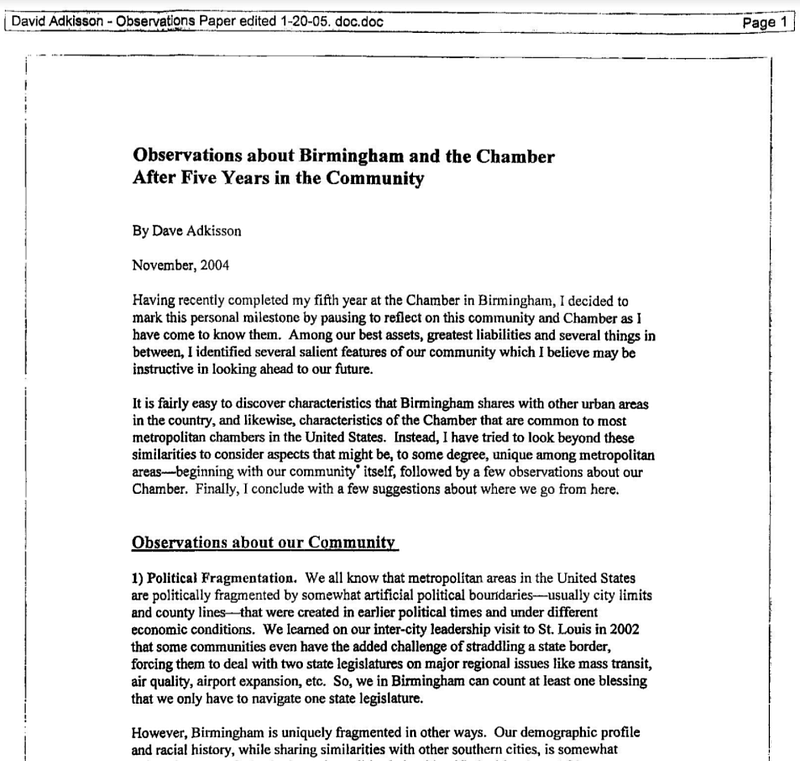
Dave announced his resignation in January 2005. Before he left he stood before the Chamber’s board of directors and read highlights of a fourteen page public memorandum he wrote for the community. The memo was reported in The Birmingham News. If you were to read the memo, you might see that Birmingham has made progress on some of the themes presented. Other themes still have too much resonance and prominence in Birmingham today.
I was in the back of the room when Dave read that memo and I clearly remember thinking: “Wow! This fellow is leaving town and sharing observations that could be received as a snub by leaders of an ego-bruised city.” There were nearly 100 people in the room, there surely were some people that were not interesting in hearing what he had to say. I thought it was bold, yet appropriate.
Clearly, Dave’s salient opus had impact because two years later Charles McCrary warned of a “a far smaller Birmingham.” And, I held on to this memo all these years only to experience the manifestation of McCrary’s warning.
Observations About Birmingham, Dave Adkisson, Jan. 2005.pdf
My final post in this mini-series will address the future of economic development in Birmingham and why it matters to the work I am doing to drive the economic agenda of Mayor Randall L. Woodfin.
Part 1: A Far Smaller Birmingham: Origins (click here to read) Part 2: A Far Smaller Birmingham: Sankofa Part 3: A Far Smaller Birmingham: The Best Version of Ourselves (Click here to read)
Ed Fields is a marketer and strategist celebrating 20 years in Birmingham with #20For20 — a series of reflections, insights and homages. All posts are featured at www.medium.com/HonestlyEd. Follow Ed on LinkedIn, Medium, Instagram or Twitter.


