
I Got A Few Things Right — 7 Lessons Learned in Business
Seven well-earned insights for entrepreneurial success

Post #15 of #20: I’m reflecting on twenty years of personal and professional experiences in Birmingham and beyond. See the full list of #20For20 stories here.
This is part one of a two-part post.
There is something primal about entrepreneurship. It is the ultimate hunt. A unique and certain toughness is formed in the spirit when you only eat what you kill. You win, you starve, or worse, you live in obscurity.
I spent the better part of eight years running a business. They were incredibly challenging and intensely gratifying years. The hunt came with its glory and its scars. Over the years, I have shared some of those scars and the mistakes that caused them — operating too many lines of business, weak pricing, and not enough focused time on quality sales. So many others.
Despite the challenges, we also did some things right and eventually sold the business. The Pareto principle is in full effect here — about 80% of our wins came from about 20% of our actions. I have distilled that 20% into seven strategies that will help current and aspiring professional service providers improve their odds for success.
About Our Firm
Relax, It’s Handled was founded in 2007 as an Alabama S-corp under a different name. We did not end as we began. We started as a general project management firm, but within six months we transitioned to an association management company (AMC), serving membership-based organizations as their operating nerve center and de facto staff solution. Our core competence was conference and fundraising event production. In fact, event production was a separate line of business that grew to make up 50% of our revenue as well as our best profit margins.
We served local, statewide, and national organizations, building an amazing network and body of work along the way. We spent thousands of hours supporting industry leaders who served on the board of directors of their professional membership organizations.
Take a look at our full 2013 Company Annual Report.
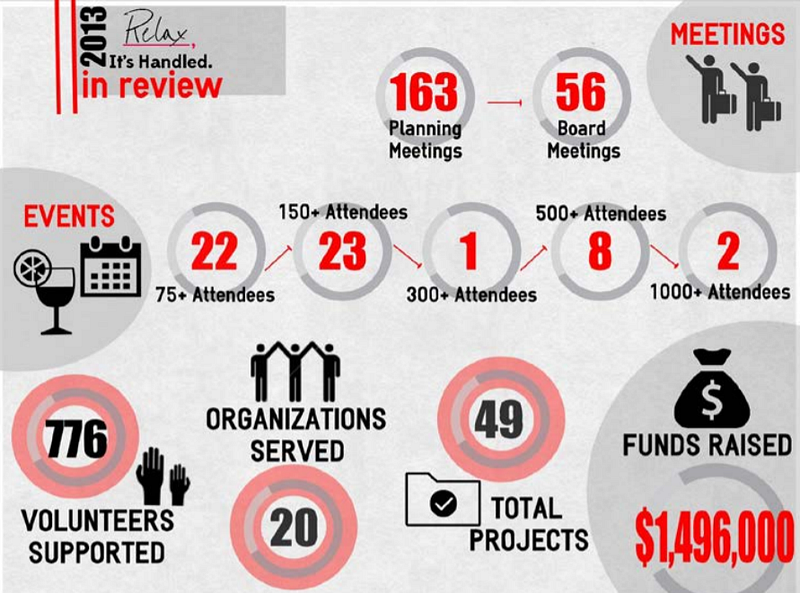
Here are the first two of seven strategies that can help you build and grow a business that others will believe in:
1. Write a business plan, not a sketch
A business plan is just a work of fiction until something happens. — Robert McLeod, Business Professor, The University of Alabama
Business planning has evolved over the years. Classic, dense, and fully-formed business plans have been eschewed in lieu of one-page business canvases or replaced altogether by high-iteration, high-intensity market testing. The newest version of business planning is more like scientific research; testing and retesting a hypothesis until the right formula works. I do believe in this approach for the purpose of testing products and gaining a better understanding of one’s customers. But, generally speaking, I think this thin planning approach can also be counter-productive.
You lose absolutely nothing by writing a fully fleshed business plan. Our original business plan included a target revenue number, geographic market considerations, and a projected timeline for selling the business. After we sold the company I reviewed an earlier version of our business plan (I never stopped modifying the plan — I ended up with seven versions) and discovered that we were within about 25% of our original revenue and within months of our goal to sell the company within seven years.
After all the twists and turns, we were still on the right track! In hindsight, this insight makes sense, but when you are on the entrepreneurial hunt it is easy to lose perspective. The age-old wisdom prevails — if you want to accomplish something then write it down. And, if you really want to understand what you accomplished, then go back and look at what you wrote down, for better or for worse.
It is easy to lose perspective when you are on the entrepreneurial hunt.
Write your business plan, make a commitment to your idea, and begin to move resources toward it. Do your homework, but don’t fiddle too much. There is real power in bold action, not just in collecting market data and insights. You don’t really know your business until you are committed inside of it. The same is true for marriage, servant leadership, and growing in your spiritual faith. Do not test, flirt and fiddle your way out of the deepest insights of your business idea. Growth is on the vertical axis; go deep.
Tip: Quit flirting with your idea — plant a darn shovel in the ground and start digging.
2. Every company is a technology company
In 2006, I read a case study about a concept called “thin computing”. The case suggested that we would eventually live in a world where nearly all business would be done in the cloud and that new physical devices would only need to connect to the internet to work. It was a very novel idea at that time. Notable, but not quite actionable.
So, in 2007 I purchased a $2,000 Microsoft small business server. I hired a tech guy to set up our e-mail and shared files network and, of course, called him to our offices at the Innovation Depot every time something went wrong. This was the way business was done at the time, after all, Google Apps and Amazon Web Services (both founded in 2006) were not the first option solutions they are today.
As my server and its warranty aged, requiring more maintenance and service, I resolved to move to the cloud. Not only did we move to Google Apps, but we also transitioned our clients from desktop Quickbooks to QuickBooks online. We moved away from Excel spreadsheets for project management to Basecamp. Eventually, my administrative-heavy business began to feel very tech-forward bringing our vendors and clients along with us into a more digital future. Our combination of technologies and business processes is what distinguished us from our competition and added unique value to our clients.
Moving aggressively to Google Apps, Basecamp and other productivity tools was one of the best things we ever did. That was well over a decade ago. If I was in business today, I would be looking at and beyond artificial intelligence, NFTs, and other technological innovations.
Tip: No matter what business you are in, as a 21st century leader a part of your professional identity should include ‘technologist’. You do not need to be an expert, you need to be a continuous learner. Leverage strategy #6 in part two of this series to help you cover this base.
Continue reading part two of the Relax, It’s Handled success series featuring five more strategies:
3. Hiring and Empowering Interns 4. Tracking Time & Templating 5. Re-Branding 6. Creating an Advisory Board 7. Maintaining a Marketing Program
Co-founding, growing and selling Relax, It’s Handled was one of the most gratifying experiences of my professional life. I learned a lot about myself. Equally important, I learned how value is created and destroyed for the people I serve — past, present and future.
In 2014, Relax, it’s Handled was presented with the U.S. Chamber of Commerce Blue Ribbon Award, an annual recognition presented to the nation’s top 100 small businesses.
I am a poet, essayist, and civic strategist based in Birmingham, Alabama. Get to know me better here.


