
I Got A Few Things Right — 7 Lessons Learned in Business (part 2)
Seven well-earned insights for entrepreneurial success
I Got A Few Things Right — 7 Lessons Learned in Business
Seven well-earned insights for entrepreneurial success

Post #15 of #20: I’m reflecting on twenty years of personal and professional experiences in Birmingham and beyond. See the full list of #20For20 stories here.
This is part two of a two-part post.
In part one of this series I provided more background about my entrepreneurial journey at Relax, It’s Handled, the company I helped build, and two of seven success strategies I believe every winning professional services firm should employ:
Strategy 1. Write a business plan, not a sketch Strategy 2. Every company is a technology company
Here are the five remaining strategies.
3. Hire and empower interns
If you are running a small business you barely have time to take care of yourself and employees, let alone neophytes that know little about your business and even less about life. But, the right collegiate interns will provide both tangible and intangible benefits you cannot replicate.
College interns bring fresh perspective and fresh legs to the entrepreneurial hunt. They are comfortable with new technologies. They are appreciated by older people — including your clients — who like to see you investing in young talent. If utilized appropriately, they can cover your weak spots — like writing thank you notes, making courtesy calls, and doing more to fortify your customer relationships if you will just build a program around them. Ultimately, your interns become your best pool of potential employees in the short term or long term. They can also support your civic endeavors.
Our first intern, Caroline, interned with us as a junior at Samford University. Upon graduation, she moved to Colorado to pursue her Masters in Marketing. We hired her as our full-time marketing manager while she was in graduate school. She helped lead our company's rebranding (see strategy #5 below). We didn’t have to orient someone new to the firm, she was already familiar with our culture and clients and already a believer in our mission.
Our second intern, Dwain, joined us as a junior at Birmingham-Southern College. During Dwain’s tenure, I had a personal friend running for political office as a school board member for a local school system. My friend needed a voter database analyzed, so I unleashed Dwain who assisted the candidate using his new computer science training. This was my first and only local political campaign action or contribution until the same school board candidate (who lost that race) later asked me to help him run for Mayor of the City of Birmingham.
Each of our six interns added value in different and unique ways. You should recruit them as talent and expect more of them. Don’t stick them in a corner and think you are doing them or yourself any favors.
Tip: Your interns will be someone’s future employees, maybe even yours. Act like it.
4. Track time and build templates
I used to have very strong feelings against tracking time. I thought it was a behavior that made businesses more focused on nickeling and diming their clients instead of adding value. Plus, my business partner had an advertising agency background (requiring billable hour tracking) and she did not want to track time either. So, we launched a business focused on achieving project milestones instead of tracking time. Noble, right?
Within months of starting the business we visited with SCORE (Service Corp of Retired Executives) and sat down with two retired entrepreneurs. Our business coaches, two much older gentlemen with manufacturing backgrounds listened to our state of affairs and shared a powerful insight.
SCORE is a free SBA-sponsored business coaching program that I recommend for anyone. Learn more here.
First, they suggested we were in too many lines of business. We agreed with them but were unsure about what to do next. They suggested we track our time for a few weeks. We balked. But, as our business grew — clients and staff — we needed to better understand where our time was going. Are we spending more time as an AMC or event planning company? Which business functions are taking the most time? More importantly, how do I know how much to charge for services when I cannot account for the only inventory my professional services firm has — time?
So, we started tracking time in Basecamp, one of the new virtual tools we embraced as we moved from local server to the cloud. The results were absolutely astounding. We could see where our collective (not just individual) time was being spent. Some months our company timesheet looked like the work of a nonprofit consulting firm and other months we looked like a bookkeeping firm, marketing firm, or event planning firm.
The insights were powerful, given the number of projects and tasks that we repeated every single month. Running dozens of small to medium events per year we eventually used our time tracking insights to predict how long certain meetings and events took to produce. We could tell you it takes about 12 to 18 hours for a three-person team to produce a good one-hour board meeting from beginning to end no matter what industry or profession. And, orienting new staff and training them based on templates with time estimates meant I could have less experienced employees benefit from the collective wisdom of the team. This required less of my time which freed me to focus on higher-level efforts while gaining utilization of less expensive employees.
Most of our clients and competitors did not have those insights which kept us positioned as a value-added provider. I am very glad we took the advice of those seasoned entrepreneurs! Take mine and do the exercise of tracking time in .25 (15-minute increments) for two or three weeks.
Tip: In business, you are what you do, not what you say you do. Take a moment and jot down answers to these questions: Who do you really serve? What business are you really in based on where you spend your time?
5. Re-brand

The official name of our company was Projects Unlimited, Inc., but our tagline and website were always “Relax, It’s Handled.”
People loved the tagline. Friends and colleagues would usually reference the business by the tagline instead of our official name. And, they would be all giggly about sharing the company name as if it was the punch line of a joke, “…..and then he said just relax, it’s handled.”
This was important because most people we interacted with never heard of an association management company. It was an early marketing challenge to sell a service very few people knew existed.
Having a sticky company name helped us punch through mental barriers and energize our network. Once people really understood what we did, they were eager to share it.
We were about five years into our business and we finally heard what the market was telling us — we don’t understand Projects Unlimited and what you do, but we love Relax, It’s Handled, and how it makes us feel. We were an idea people could believe in. That is an important sentiment, especially for a professional services firm.

We made a strategic shift to increase awareness of our brand and to start marketing the firm more aggressively. We lured an art director from an advertising agency to develop a new logo for us as a side gig.
Then, a fellow entrepreneur at the Innovation Depot launched a raffle to other residents for a free $10,000 website. We won the raffle. Our very first intern, Caroline, returned to work with us full-time as our marketing director. She supported the development of the site, incorporating the new logo and folding my marketing ideas into an updated marketing plan.
I got other employees involved in the process of selecting our new mark. The new look and feel was something everyone could get excited about.
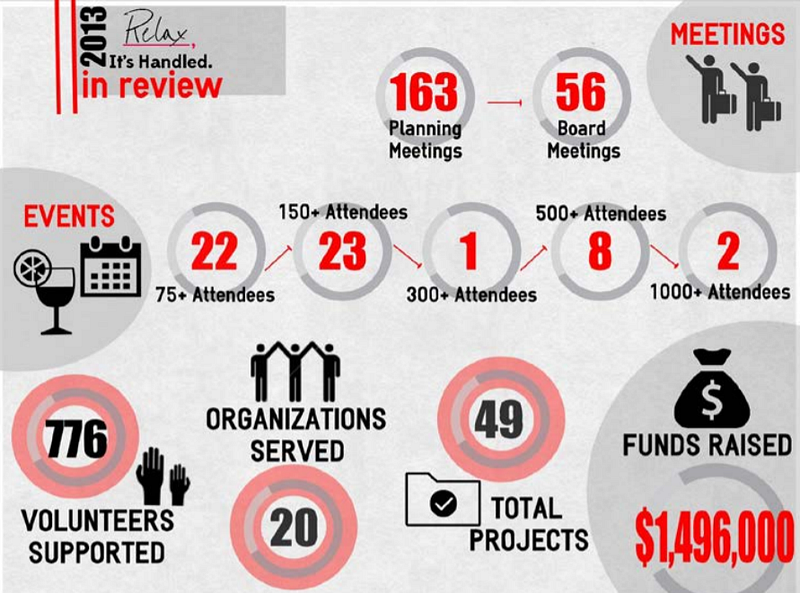
Take a look at our full 2013 Company Annual Report.
We eventually registered a DBA (“Doing Business As”) with the State of Alabama, launched the plan, and enjoyed new energy.
Tip: Your business is not just what YOU want it to be. Eventually, your employees and customers may have a better understanding of your company brand than you do. Listen to them.
6. Create an advisory board
Every credible book about entrepreneurship and start-ups encourages the formation of informal advisory boards for founders, but many people do not create one. I get it. They don’t add direct revenue to your company and the idea of creating one is intimidating to the uninitiated.
I had no idea how much impact our advisory board would ultimately have on the company. They only met 2 or 3 times altogether — separate from our one-on-one meetings, but those meetings changed the trajectory of the company. The group was comprised of our accountant, our personal financial advisor, two existing clients, a human resource expert, and a spiritual leader.
The goal of the advisory board was to help people with a vested interest in seeing our company perform well gain deeper insights and offer even better advice or guidance. We only surrounded ourselves with people we believe had our best interests at heart and could add intellectual value to our strategies. Not people that just made sense on paper.
I really wanted our advisory board members to find value in connecting with one another, making our firm the catalyst for potential partnerships and opportunities for everyone involved. That was my vision for the space we were creating — to add value to our advisors by making sure they found value in the time they spent with us.
It was an awesome accountability measure for me as a leader. Putting together presentations and memos for the group forced me to think about my business from the outside-in and articulate our status like a classic business school case — and I love business school cases. I did not expect to generate $50,000 in new business from this group, but we did. How? Because once these people really understood what we were doing and our value they unlocked their networks and made connections for us.
Tip: People want to help you. Create an advisory board to harness their contributions to your vision. You don’t have the time, give something up to get this done.
7. Maintain a Targeted Marketing Effort
The single most valuable marketing tactic for our firm was our company newsletter. Produced bi-monthly, we showcased our client work, shared best practices for nonprofit governance, and maintained top-of-mind awareness during decision-making season for our services.
It was a great sales lead tool as well. Every newsletter issue eventually conjured the business services inquiry from someone who read or received a forwarded note from our newsletter. These inquiries would usually come months later, which let me know people were saving our newsletters and referring to them as a resource. In addition, we used the insights from our Constant Contact account to see exactly what content was of greatest interest to our readers and to which readers the content was most relevant.
We were also able to help our friends, family, and national network understand what was happening in Birmingham, both our paid client events as well as our many civic endeavors. With more than 5,000 key Birmingham influencers on our distribution list, we were helping to set the culture and own the narrative for our firm and spaces we regularly engaged.
Honestly, I am skeptical about the conventional wisdom of e-mail still being king. E-mail certainly still matters, but omni-channel marketing is the new standard. New marketers have the burden of getting much more clarity about where their current and prospective customers consume content and meeting them in all the places they will be.
Tip: Don’t spread yourself too thin. Pick a strategy, invest in it and drill. Opportunity privileges the focused.
In 2014, Relax, it’s Handled was presented with the U.S. Chamber of Commerce Blue Ribbon Award, an annual recognition presented to the nation’s top 100 small businesses.
Co-founding, growing, and selling Relax, It’s Handled was one of the most gratifying experiences of my professional life. I learned a lot about myself. Equally important, I learned how value is created and destroyed for the people I serve — past, present, and future.


