
Activity U (XI): Process, Position, and Zone of Project
In order to understand the internal structure and dynamics of Project, I propose the concept of Zone of Project which is inspired by Lev Vygotsky’s Zone of Proximal Development and Roger Barker’s Behavior Settings theory.

The previous article presents a new concept of Projectivity. In the end of the article, I propose the concept of Zone of Project. As an important step of expanding the approach of Project-oriented Activity Theory, the concept of “Zone of Project” is an outcome of a conceptual curation which is inspired by the Ecological ZONE framework and Project-oriented Activity Theory. The theoretical resources of these two frameworks are ecological approach and cultural-historical approach. Thus, it is a challenge to achieve this goal.
I have discussed the possible connection between Ecological Psychology and Cultural-historical Theory of psychology in the last past of Activity U (X): Projecting, Projectivity, and Cultural Projection. This article focuses on the thread of “Vygotsky-Cole-Barker”. The following diagram represents my strategy for this complex conceptual curation.
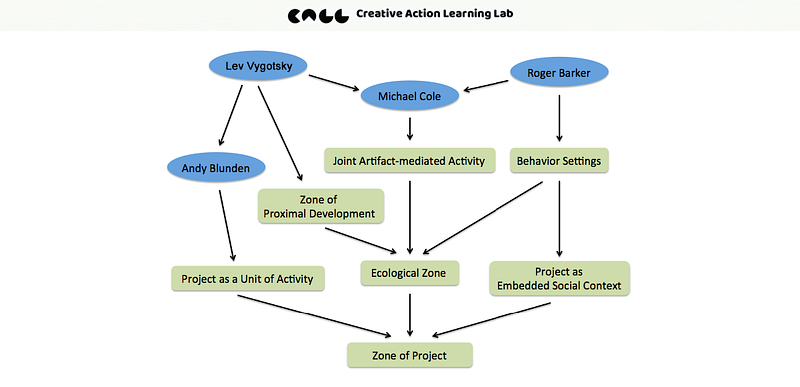
First, I will provide some background for this work with Part 1 and Part 2. Second, I will introduce the “Ecological Zone” framework in Part 3 and explain the conceptual curation work behind the framework. Third, I will present a concrete framework for “Zone of Project” with Part 4 and Part 5.
Readers can directly jump to Part 5 to quickly view the diagrams and go back to the other parts to read theoretical discussions about conceptual curation.
Contents
Part 1: Lev Vygotsky, Michael Cole, and Roger Barker
1.1 Lev Vygotsky and Kurt Lewin 1.2 Kurt Lewin and Roger Barker 1.3 Michael Cole and Roger Barker
Part 2: Bark Roger’s Behavior Settings Theory
2.1 Kurt Lewin’s “psychological ecology” 2.2 Standing Patterns of Behavior-and-milieu 2.3 Zone of Penetration 2.4 Virtual Behavior Settings 2.5 Setting Program
Part 3: Ecological Zone
3.1 Diagrams of Ecological Zone 3.2 Principles of Ecological Zone 3.3 Behavior Settings and Ecological Zone 3.4 Vygotsky’s “Zone of Proximal Development” 3.5 Vygotsky’s “Ecological Mind” and “Dramatic Development” 3.6 Michael Cole: Joint Artifact-mediation Activity
Part 4: The Concept of “Zone of Project”
4.1 Project as Embedded Social Context 4.2 An Archetypal Unit of Projects 4.3 Internal Structure and Dynamics of Projects 4.4 Position, Process and Themes of Project
Part 5: Five Zones of Project
5.1 The Basic Model of Zone of Project 5.2 The Standard Model of Zone of Project 5.3 The “Idea” Zone 5.4 The “Resource” Zone 5.5 The “Program” Zone 5.6 The “Performance” Zone 5.7 The “Solution” Zone 5.8 Domain-specific Zone 5.9 Network of Zones
Epilogue
Part 1: Lev Vygotsky, Michael Cole, and Roger Barker
In the previous article, I have mentioned that there is an indirect connection between Cultural-historical psychologist Lev Vygotsky and Ecological Psychologist Roger G. Barker.
1.1 Lev Vygotsky and Kurt Lewin
According to Yasnitsky (2019), “As it is already perfectly clear from considerable research and publications (Chaiklin,2003; Valsiner & van der Veer, 1993), ‘Vygotskian ZPD’ is neither original, nor the most essential of Vygotsky’s contributions to the social and human sciences. First, the notion of ‘zone’ migrated into Vygotsky’s work from his contemporary German American scholar Kurt Lewin (1890–1947), the founder of the so-called ‘topological and vector psychology’ and, allegedly, ‘field theory’ in psychology. The analogy between the ‘zone’ and ‘field’ is quite clear, and Lewin’s considerable in fluence on Vygotsky of the last two or three years of the latter’s life is well documented and discussed at length (Yasnitsky, 2018; Yasnitsky & van der Veer 2016a).”
1.2 Kurt Lewin and Roger Barker
Roger G. Barker was a postdoctoral student with Lewin at the University of Iowa, and this contact with Lewin had a lasting effect on him. Barker went a further step than Lewin. While Lewin focuses on the psychological environment, Barker moves to the ecological environment. In Behavior Settings (1968, 1989), Barker says, “The ecological environment shares with the first of these two conceptions a concern for the physical and geographical environment but, more than this, the ecological environment includes also the objectively observable standing patterns of behavior of people — that is, specific sequences of people’s behavior that regularly occur within particular settings. For example, the standing patterns of behavior in a basketball game include the playing of the players, the watching and cheering of the spectators, the refereeing of the referees, and the recording and posting of the scores by the scorekeepers.” (1989, p.3)
1.3 Michael Cole and Roger Barker
In fact, we can find a direct connection between Vygotsky and Barker in the development of Activity Theory and CHAT (Cultural-historical Activity Theory). One of the leading scholars of CHAT is Michael Cole who aims to bridge the Cultural-historical Psychology and American Anthropology. Michael Cole is a student of Alexander R. Luria who is one of the founders of Cultural-historical Psychology and a leader of the Vygotsky Circle also known as “Vygotsky-Luria Circle”.
Cole focused on the study of the culture’s role in the mental life of human beings and developed a new approach called Cultural Psychology. Cole didn’t copy all ideas of Vygotsky and others, he said, “I could not simply embrace the form of cultural psychology that the Russians offered. On the basis of my own research. I rejected their inferences about cultural differences and was skeptical of their broad conclusions concerning the cognitive impact of writing and schooling. Over time, however, I began to see ways to combine key insights and methods of the cultural-historical approach with equally important insights and methods from American approaches.”(p.107)
Michael Cole echoes Barker’s idea in his 1996 book Cultural Psychology. In particular, he writes about “Context/Practice/Activity and Ecological World Views” and encourages readers to embrace ideas from ecological psychologists. He says, “There are important affinities between the various views about a supra-individual unit of analysis associated with the notions of context, practice, activity, and so on, and the views of those who identify themselves as ecological psychologists (Altman and Rogoff, 1987). These affinities grow out of a common starting point, the ecology of everyday human activities, and are evident in the proclivity of researchers of both views to conduct their research in naturally occurring social settings rather than experimental laboratories. These affinities can also be seen in the appearance of the metaphor of weaving in the writings of both groups. The following example is taken from the work of the pioneer ecological-developmental psychologists Roger Barker and Herbert Wright, who were attempting to characterize the relation of ecological setting to psychological processes.” (1996, pp. 141–142)
Following Cole’s strategy, it is possible to expand Project-oriented Activity Theory with the new concept of “Zone of Project” which is originally inspired by Bark Roger’s Behavior Settings theory.
Part 2: Bark Roger’s Behavior Settings Theory
Bark Rogers’ work is supported by the legacy of his teacher Kurt Lewin. According to Heft, “Lewin (1946/1951c) conceptualized behavior as being a function of the constellation of factors present in the phenomenal field (i.e., the life space) at a particular time. It is this multifactor psychological environment as experienced by the person that is critical, according to Lewin, for an analysis of behavior. Lewin also recognized that environmental features outside of the individual’s life space at a particular time, comprising what he called the ‘ecological environment,’ have significant, if indirect, effects on behavior. In his view, these so-called ‘nonpsychological’ factors residing beyond the life space have their origins in physical environmental conditions and sociocultural processes. ”(2001, pp.247–248)
2.1 Kurt Lewin’s “psychological ecology”
Lewin also used the term “psychological ecology” to describe the “nonpsychological” factors. Heft points out, “Because of their impact on the psychological field, the study of such nonpsychological factors is important. In fact, Lewin asserted in his later writings that an initial analysis of the field of behavior should begin with a determination of relevant boundary conditions. This type of analysis Lewin (1943/1951c) called ‘psychological ecology’: ‘Only after these data are known can the psychological study itself be begun to investigate the factors which determine the actions of the group or individual in those situations which have been shown to be significant [by the initial ecological analysis]’(p.170). Psychological ecology, then, is an attempt to reveal ‘what part of the physical or social world will determine during a given period the ‘boundary zone’ of the life space’ (Lewin, 1943/1951a, p.59)” (2001, p.249)
Unfortunately, Lewin didn’t complete this project of “psychological ecology”. Roger Barker and his colleague Herbert Wright, also a Lewin postdoctoral fellow, continued the project and finally developed the theory of Behavior Settings. According to Heft, “In fall 1947, Barker and Wright opened a research office in Oskaloosa, Kansas (population about 700), which served as their base of investigations of life in a small town. In doing so, they established the first field research station in psychology for the study of human behavior. ” (2001, p.249) Cole also points out, “On the basis of their detailed records of children’s activities, Barker and Wright were impressed that children’s behavior appeared to be very strongly controlled by the settings they inhabited. They also noted the wide range of different behavioral settings children participated in daily.”(1996, p.142)
2.2 Standing Patterns of Behavior-and-milieu
Barker and Wright published their research insights and records as the book One Boy’s Day in 1951. In a major research report, Midwest and Its Children, Barker and Wright (1955) describe their discovery of behavior settings as arising from their research. In 1968, Barker published Ecological Psychology which presents the basic theoretical statement on behavior settings and new data from behavior setting surveys of the Midwest. The book was revised by Phil Schoggen with a new title Behavior Settings: A Revision and Extension of Roger G. Barker’s Ecological Psychology and published in 1989.
So, what is the core of the Behavior Settings theory?
According to Barker, “A behavior setting is defined in terms of two kinds of properties: structural and dynamic. On the structural side, a behavior setting consists of one or more standing patterns of behavior-and-milieu, with the milieu circumjacent and synomorphic to the behavior. On the dynamic side, the behavior-milieu parts of a behavior setting — that is, the synomorphs that comprise the setting — have a specified degree of interdependence among themselves that is greater than their interdependence with parts of other behavior settings. These are the essential properties of a behavior setting.” (1989, p.30)
The most hard part is the concept of “behavior-and-milieu” which is the core of the Behavior Settings theory. Barker emphasizes, “The behavior-milieu parts are called synomorphs. The physical sciences have avoided phenomena with behavior as a component, and the behavioral sciences have avoided phenomena with physical things and conditions as essential elements. So we have sciences of behavior-free objects and events (ponds, glaciers, lightning flashes), and we have sciences of phenomena without geophysical loci and attributes (organizations, social classes, roles). We lack a science of things and occurrences that have both physical and behavioral attributes. Behavior settings are such phenomena; they consist of behavior-and-circumjacent-synomorphic-milieuentities. The synomorphic relation between milieu parts and standing patterns of behavior identifies the basic elements upon which behavior settings are built. To find such a relationship provides the first clue that a behavior setting may be at hand. Without such a relationship, there is no possibility that a behavior setting exists.” (1989, pp 33–34) Barker also gives an example, “…we identify as a synomorph the behavior-milieu configuration of the pastor reading or preaching from the pulpit, the physical dimensions and shape of which fit and support the behavior patterns: reading from the Bible or notes for the sermon…Most behavior settings include a number of such behavior-milieu synomorphs.” (1989, p.34)
Heft points out that behavior settings have the following properties (2001, pp.253–254):
- Behavior settings occur naturally as a function of the collective actions of a group of individuals. (They are not constructions of a scientist.)
- Behavior settings have a specifiable geographical location. (Where a setting transpires can be stipulated.)
- Behavior settings have temporal boundaries that are self-generated and maintained by the dynamics of its occupants. (Settings have understood beginning and end points.)
- The boundaries of behavior settings are discriminable; that is, they can be perceived. (One is typically aware of entering/leaving a behavior setting.)
- Behavior settings are quasi-stable; they manifest mechanisms in response to perturbations, and in so doing, within limits they preserve their integrity.
- Behavior settings exist independently of any single person’s experience of them (They are identifiable by independent observers; accordingly, they meet the essential scientific criterion for being real in an objective sense.)
- Individuals who occupy a particular behavior setting are to an appreciable degree interdependent. (This means that actions by one person in a behavior setting are likely to affect others in the same behavior setting.) Indeed, interdependence of actions is the primary criterion used in identifying a behavior setting.
2.3 Zone of Penetration
Barker also developed a systematic analysis method for the Behavior Settings theory. One module of his method is “Zone of Penetration” which refers to the penetration dimension of Behavior Settings. He identified seven Zones of Penetration(1989, p.127–128).
- Zone 6: Single leader. Zone 6 is the most central zone. Included here are the positions of all persons who serve as single leaders of behavior settings. Persons in zone 6 have immediate authority over the whole setting during one or more regular occurrences of the settings.
- Zone 5: Joined Leaders. Persons who enter zone 5 lead the setting jointly with others in this zone during a single occurrence of a behavior setting. Persons in zone 5 have immediate authority over the whole setting, but their power is shared more or less simultaneously with others during one occurrence of the setting.
- Zone 4: Active functionary. Inhabitants of this zone have power over a part of a setting, but they do not lead it. The people in this zone have direct power over a limited part of the setting.
- Zone 6, 5, and 4: Operative or performers. Inhabitants penetrating to any of these zones are referred to as behavior setting operatives or performers.
- Zone 3: Member or customer. Occupants of zone 3 have great potential power but usually little immediate power. They are the voting members, the paying customers who ultimately make or break the setting.
- Zone 2: Audience or invited guest. The inhabitants of this zone have a definite place; they are welcome, but they have little power in the setting; at most they can applaud or express disapproval.
- Zone 1: Onlookers. This is the most peripheral zone within the setting. Persons in this zone take no active part in the standing pattern of behavior; at most they are onlookers. They are tolerated but not welcomed; they have no power within the setting.
- Zone 0: Potential inhabitants. Persons outside the setting itself but who occupy regions surrounding the setting are in zone 0; they are potential inhabitants.
The following table presents the attributes and nomenclature of the penetration zones of Behavior Settings. The term “Habitat-claims” refers to “Habitat-claims for human components” which are stable structural and dynamic features of the habitat provided by a community or an institution. The term “Implemented habitat-claims” refers to habitat-claims in operation. According to Barker, “Habitat-claims, human components, and implemented habitat-claims are all attributes of the habitat of the community or institution under study; they are whole-entity properties, created by the component behavior settings of the habitat (1989, pp.130–131)
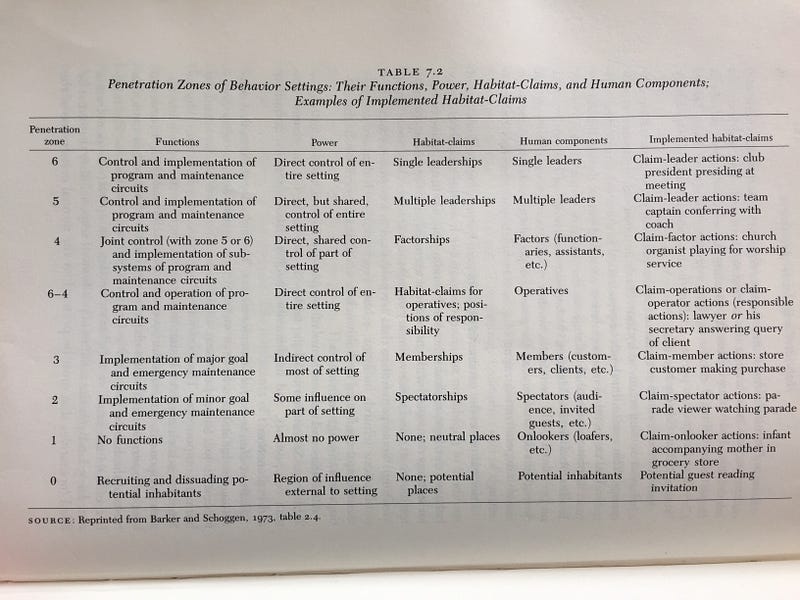
The above table and the Zone of Penetration analysis module is only one piece of Barker’s Behavior Settings theory which is an outstanding work well done at the theoretical construction level and empirical analysis level. Readers can find many analysis frameworks from his books for conducting a concrete study of Behavior Settings.
2.4 Virtual Behavior Settings
I have to point out an interesting fact that the behavior setting theory has not been widely accepted within mainstream psychology even though it has positively influenced a number of sub areas within psychology and outside of the discipline. According to Lubomir Popov and Ivan Chompalov (2012), “One reason is probably the breadth and wide scope of the theory. Another, according to psychologist Richard Price (1990) is the fact that ecological psychology, which behavior setting theory is a part of, does not have a lot to say about motives, personality, or emotion, and these have, after all, been the chief arenas for current theory and research in psychology.…although behavior setting theory has not been widely accepted and implemented in mainstream psychology, it has become a cornerstone of a number of research areas and disciplines like ecological psychology, environment and behavior studies, behavioral ecology, environmental psychology, and sociological social psychology.”
One application of behavior setting theory is worth mentioning here for readers. In 2006, Anita Blanchard published a paper titled Virtual Behavior Settings: An Application of Behavior Setting Theories to Virtual Communities. The author proposed that virtual communities can be understood as operating within an emerging environmental form: virtual behavior settings. According to the author, “Although virtual behavior settings are not completely analogous to face‐to‐face (FtF) behavior settings, the behavior setting concept as developed by Barker and his colleagues (1978a) and further advanced by Wicker (1987, 1992) can clarify virtual behavior settings and their potential for understanding virtual communities.”
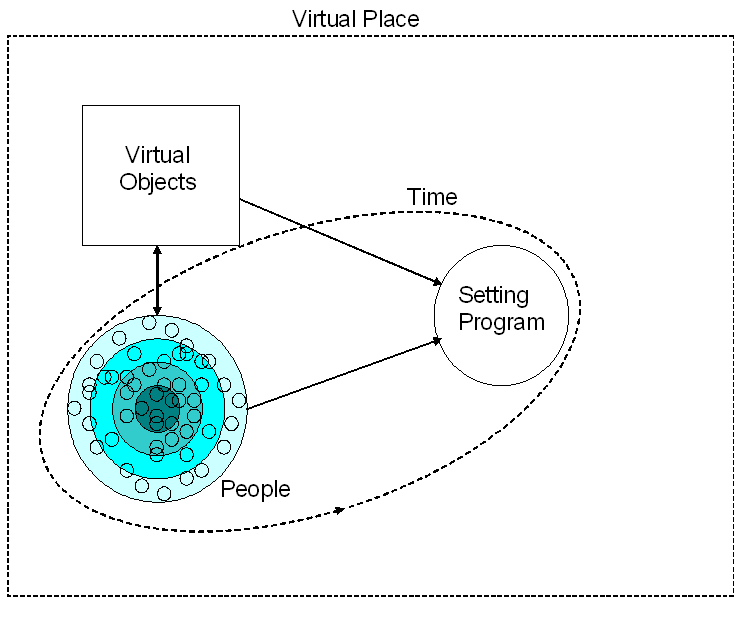
Blanchard used the above diagram to summarize the virtual behavior settings framework. She said, “This framework highlights how people and objects affect each other and the setting program. The solid lines indicate what is objective in the setting and can be seen by others. The dotted lines show what is subjectively perceived by each participant (i.e., time and place) and may be individual to the participant. The grouping of the participants ranges from the most central members (i.e., leaders) to the most peripheral (i.e., lurkers). Each member’s perceptions of the group and its setting program overlap to various extents with other members. The central members’ perceptions are more likely to agree than members in the periphery. The notion of time in this model is that members enact the program which subsequently constrains how the members act. Researchers have assumed that asynchronous and synchronous virtual communities are essentially the same. However, member behavior and community functioning may differ in synchronous and asynchronous virtual communities due to both the demands of the community’s setting program, the necessity for member co‐presence, and the possibility of lurking.”
2.5 Setting Programs
Blanchard also emphasized the importance of setting programs. She said, “The most important component of the virtual behavior settings framework is the setting program. It is the set of behaviors in which members engage that keep the virtual community functioning. Within each virtual behavior setting, members are constrained by what they can do with the objects within the setting and the virtual place in which it occurs.”
Though Barker setted the geographical aspect and the temporal aspect as properties of behavior settings. I think it is possible to adopt the behavior setting theory for digital environments. Blanchard’s work is a great example.
Furthermore, it is also possible to adopt some ideas of the behavior setting theory — not the whole framework — for developing new theoretical concept and continually work on Lewin’s vision of “psychological ecology” — ‘what part of the physical or social world will determine during a given period the ‘boundary zone’ of the life space’ (Lewin, 1943/1951a, p.59)
The notion of “Setting Programs” is very close to “Activity” of Activity Theory. Thus, it is possible to find a way to connect Behavior Settings theory and Activity Theory.
Part 3: Ecological Zone
Gibson’s Affordance Theory is placed at the animal-environment analytical level while Barker’s Behavior Settings Theory is placed at the level of higher order extra-individual social activity. However, the concept of Behavior Settings is defined as a combination of social program and physical place. Thus, there is a room for developing a new analytical level which should avoid the restriction of physical place.
3.1 Diagrams of Ecological Zone
In 2018, I developed the Ecological Zone framework to highlight this theoretical creative space. I used the term Ecological Zone to describe a basic unit of my social analysis. It refers to an interactive space between two subjects with a shared activity in a short duration or long duration. Though a ZONE is a basic unit, I use at least three ZONEs together for concrete analysis because I need one ZONE as an environment for another ZONE.
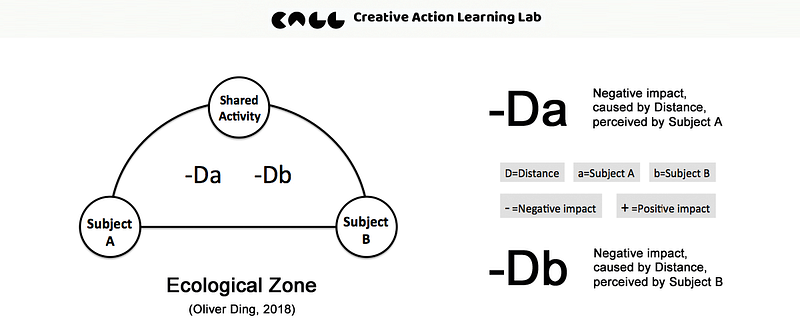
The above diagram is the basic model of the Ecological Zone framework. This is not a normal account of intersubjectivity because my focus is Ecological Aspects. My goal is adding a layer between Gibson’s Affordance Theory and Barker’s Behavior Settings Theory. It is also inspired by Gibson’s idea “Ecological Self”.
One ecological aspect of the Ecological Zone framework is “Ecological Force”. The term “Force” is inspired by Lewin’s topological psychology. However, my term “Ecological Force” highlights the source of force. I pay attention to the ecological source of force. For instance, the above diagram displays two signs:
- - Da
- - Db
D refers to Distance which is claimed as an ecological force from the perspective of Ecological Zone. Distance is a fact which exists due to two people. If there is only one person, there is no Distance. The fact of Distance doesn’t depend on any person of the two people, but on their relative positions.
Let’s say the shard activity is a project of remote work in which Distance is a solid ecological force. For person A, he perceives a negative impact from the remote work due to the Distance. This experience is represented by the sign “-Da”. In like manner, I use the sign “-Db” to represent a negative impact perceived by person B.
Due to the individual difference, person B may perceive a positive impact caused by Distance from the project of remote work. Furthermore, Distance is only one type of ecological force, there are many types of ecological forces in different types of activities.
The above diagram is the basic model. However, the standard model of the Ecological Zone framework is its “Tripartness” version. See the right diagram in the following picture.
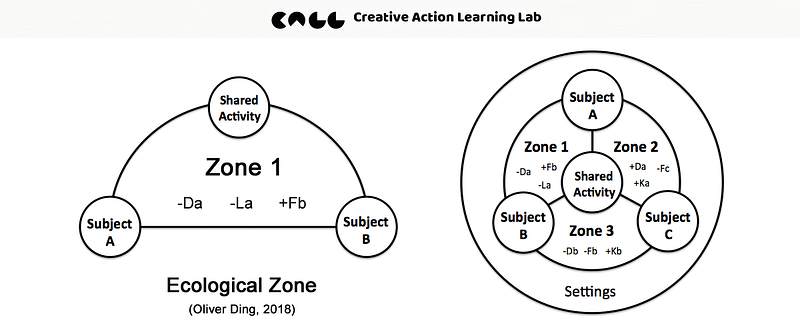
I usually use the Ecological Zone framework with at least three zones together. The tripartness version of the model represents the standard usage and its unique theoretical values.
3.2 Principles of Ecological Zone
There are four concepts for understanding ZONE: Structural distinctions, Situational dynamics, Themes of Practice, and Boundaryless Echoes.
- Since three subjects have their own identities, positions, and motivations, there are Structural Distinctions between three ZONEs.
- There are personal differences between individual members of each ZONE. The real interactions happen between real people. So, there are Situational Dynamics inside each ZONE.
- In order to curate various experiences of daily interactions, I adopt the concept Themes of Practice from Curativity Theory for ZONE. A Theme of Practice refers to a set of interactions which share a common issue, an agenda or a theme.
- For each subject/person, they have their own experience of each ZONE. These experiences can be negative or positive. In order to cope with negative experiences at one ZONE, the subject/person can utilize positive experiences from other ZONEs. Also, the subject/person can curate interactions from different ZONEs with similar Themes of Practice. I call this notion Boundaryless Echoes.
I have recently applied the Ecological Zone framework to the Activity U project. The center of the diagram is the “Shared Activity”, for the Activity U project, the Shared Activity is “learning activity theory”. The three small circles at the middle loop refer to three types of subjects. For the Activity U project, I consider the following subjects:
- Subject 1: “You” (readers).
- Subject 2: Oliver Ding.
- Subject 3: Activity Theorists.
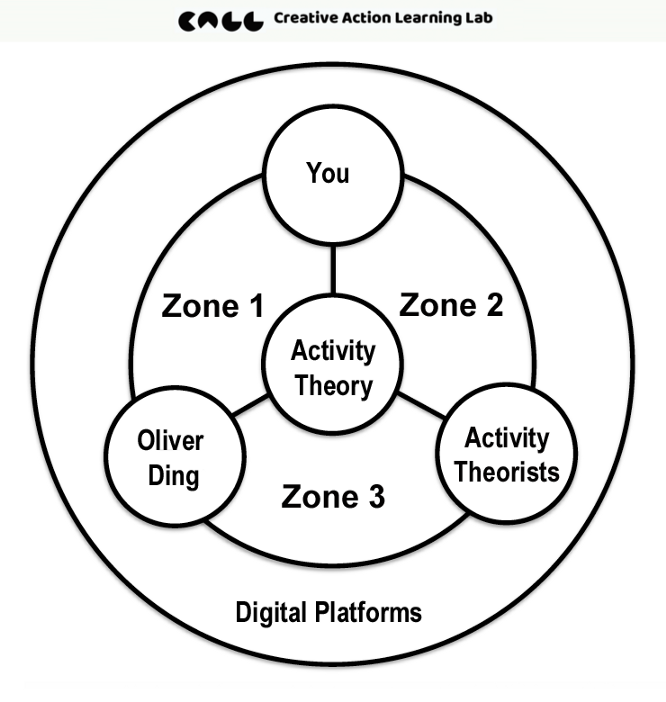
The peripheral circle refers to settings. For the Activity U project, the settings are digital platforms such as Medium, Twitter, Linkedin, Miro, Google Books, Academic.org, and Gmail. Zone 1 refers to interactions between “You” and Oliver Ding. Zone 2 refers to interactions between Oliver Ding and Activity Theorists. Zone 3 refers to interactions between Activity Theorists and “You” (Readers).
The Zone diagram matches the status of the Activity U project. It is still a personal project, however it has its own social context. There are social interactions generated by the project. For example, I connected to some Activity Theorists through Twitter, Gmail, and Academic.org during the past several months. I also got feedback and advice from these Activity Theorists.
3.3 Behavior Settings and Ecological Zone
One thing I learned from the Behavior Settings Theory is its theoretical construction, especially the two kinds of properties: structural and dynamic. I adopt this idea as the primary principle for developing the Ecological Zone framework. That’s the reason why I pay attention to the Ecological Force of Zones.
The name “Zone” of Ecological Zone is inspired by Zone of Penetration. As mentioned above, the Zone of Penetration framework describes the structural positions and the distribution of power of Behavior Settings. However, the Ecological Zone framework describes the social space between two subjects. These two frameworks can work together since they target different analysis levels.
I personally believe the Zone of Penetration framework is very useful for Project-oriented Activity Theory at the practical study situation. I consider it as a heuristics for the Activity U project.
3.4 Vygotsky’s “Zone of Proximal Development”
Though Lev Vygotsky is best known for his cultural-historical theory of psychological functions, he certainly developed at least three ideas for understanding social context and environment: Zone of Proximal Development (ZPD), Perezhivanie, and Social Situation of Development. These three ideas work together and form an “ecological mind” account in a broad sense.
- Zone of Proximal Development (ZPD) : “…the distance between the actual developmental level as determined by independent problem solving and the level of potential development as determined through problem solving under adult guidance or in collaboration with more capable peers. (Vygotsky, 1978, p. 86, originally Vygotsky, 1935, p. 42)”
If we go deep to the theoretical development of Vygotsky’s creative thinking, it is not surprising that Vygotsky developed this “ecological mind” account because Kurt Lewin (1890–1947) is his major theoretical inspiration in his later years. This cue is very important for connecting my idea “Projectivity” and “Zone of Project” with Vygotsky’s “ecological mind”.
According to Yasnitsky (2019), “As it is already perfectly clear from considerable research and publications (Chaiklin,2003; Valsiner & van der Veer, 1993), ‘Vygotskian ZPD’ is neither original, nor the most essential of Vygotsky’s contributions to the social and human sciences. First, the notion of ‘zone’ migrated into Vygotsky’s work from his contemporary German American scholar Kurt Lewin (1890–1947), the founder of the so-called ‘topological and vector psychology’ and, allegedly, ‘field theory’ in psychology. The analogy between the ‘zone’ and ‘field’ is quite clear, and Lewin’s considerable in fluence on Vygotsky of the last two or three years of the latter’s life is well documented and discussed at length (Yasnitsky, 2018; Yasnitsky & van der Veer 2016a).”
We have to notice that Vygotsky’s “ecological mind” account is not a complete project because he died in 1934. According to Yasnitsky, “…the ‘ZPD’ does not appear in Vygotsky thinking and writing until 1933, and figures on the margins of his work at the time(Chaiklin, 2003).” A classic text about Vygotsky’s “ecological mind” is The Problem of the Environment (1934) which is a text of a lecture delivered in 1934.
Jaan Valsiner and Rene van der Veer share a story of the development of ZPD in their article Encountering the border. The authors use ZBR (zona blizhaishego razvitia) which is the original Russian of ZPD. They points out, “Around 1931, Vygotsky had reached the theoretical necessity to conceptualize the “making of the future” in human ontogeny (Zaretskii, 2007, 2008, 2009)…The earliest documented mention of ZBR can be found in a lecture in Moscow, at the Epshtein Institute of Experimental Defectology on March, 17, 1933…The third relevant presentation involving the introduction of the ZBR concept took place two months later — when Vygotsky gave a presentation on the development of everyday and ‘scientific’ concepts at Leningrad Pedagogical Institute on May, 20, 1933 (Vygotsky, 1933/1935e)…with in the two-month period (March — May, 1933) Vygotsky was observed to pick up the concept of ZBR and use it actively in different contexts. In all of these uses the concept remained a descriptive one — marking the emphasis on the study of developing (as opposed to already developed) psychological functions. In the final fifteen months of his life, Vygotsky made numerous (but often passing) use of the ZBR concept. The surviving texts of Vygotsky provide us with a potpourri of examples of the use of the ZBR concept. ”
Jaan Valsiner and Rene van der Veer also point out a methodological challenge to the concept of ZBR. They says, “Hence a methodological paradox emerges: while the teaching — learning process ‘creates’ the ZBR (Vygotsky, 1933/1935a, p.134; 1933/1935c, p.16) in the present, there is no way in which anybody can study that process directly, within that present. Here is the paradox that stands in the way of empirical use of Vygotsky’s ZBR concept — it refers to the hidden processes of the present that may become explicated in reality only as the present becomes the (nearest) past, while the (nearest) future becomes the present. However, any empirical research effort (including Vygotskian ‘teaching experiments’ using the ‘method of double stimulation’) can take place only within the present (given the constraint of irreversibility of time). Each particular developmental event is unique — as it can only occur once, given irreversibility of time — yet the logic of development that it fulfills in universal. The ZBR/ZPD concept — charted out by Vygotsky and still in need of further advancement — teaches us a lesson about how to create a future for an internally insecure science that has imported its main inferential techniques without consideration of the quality of their phenomena under study.”
Ecological Zone is similar to ZPD. First, they both use the term “Zone” which is inspired by Kurt’s “Field”. Second, they both have a same structure “subject 1 — subject 2”. Third, they both have “a shared activity”. The difference between two ideas is while ZPD focuses on education and development, the Ecological Zone aims to develop a general framework of intersubjectivity. The essential of ZPD is “Actual — Potential” of individual development. The core of Ecological Zone is Ecological Force between two subjects.
According to Jaan Valsiner and Rene van der Veer (2014), “the idea in ZBR — conceptualizing the processes of emergence of novelty in field terms — has had a recent parallel in the Trajectory Equifinality Model (TEM — Sato, 2009; Sato et al., 2007 2009, 2010, 2012). TEM grows out of the theoretical need of contemporary science to maintain two central features in its analytic scheme — time and (linked with it) the transformation of potentialities into actualities (realization).”
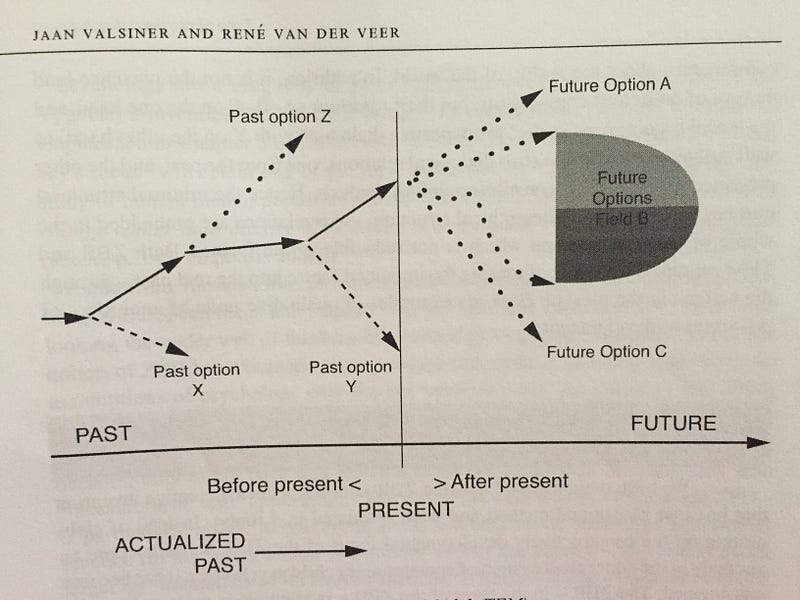
The above diagram represents the Trajectory Equifinality Model. The uniqueness of the model is that it includes both “real” (actual developmental trajectory up to the present) and “ir-real” (possible trajectories that existed in the past and are assumed to exit for the future). Jaan Valsiner and Rene van der Veer said, “TEM thus transcends the preponderance of psychology to include in its schemes only real phenomena, and treats reconstructions and imaginations as equal to the former.”
I consider TEM is a general model of the “Actual — Potential” of individual development.
As I mentioned above, one theoretical statement of Ecological Zone is Themes of Practice. It is possible to consider “Development” as a Theme of Practice of a particular Ecological Zone. In order words, we can consider Zone of Proximal Development as a special type of Ecological Zone. However, the missing piece is the part of “Actual — Potential” of individual development. So, it is possible to adopt the idea of “Actual — Potential” of individual development from ZPD to expand the Ecological Zone framework.
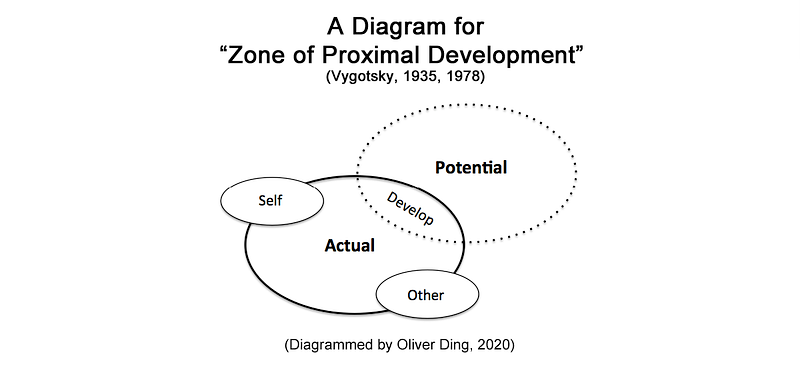
The above diagram is a generalization of ZPD. While the “Teacher — Student” is replaced by “Self — Other”, the “Actual — Develop — Potential” is remained. If we put this diagram and the Ecological Zone diagram together, we can consider this one is a reasonable extension of Ecological Zone because the development is driven by dramatic experience, according to Vygotsky.
The following section will put the concept of ZPD back to the context of Vygotsky’s “ecological mind” and discuss the relationship between dramatic experience and Ecological Zone.
3.5 Vygotsky’s “Ecological Mind” and “Dramatic Development”
Vygotskian scholars don’t use “Ecological Mind” to describe Vygotsky’s ideas. I just use the term to highlight Vygotsky’s three ideas which are highly relevant to ecological approaches of psychology: Zone of Proximal Development (ZPD), Perezhivanie, and Social Situation of Development. These three ideas are important for understanding Vygotsky’s thought on social context and environment. It is better to consider them as a whole.
According to Andy Blunden, “Perezhivanie is a Russian word, usually translated as ‘a lived experience.’ and used in connection with ‘social situation of development,’ which has multiple shades of meaning. It indicates a person’s situation with special emphasis on the subjective significance, especially the emotional and visceral impact of the situation on the person, recollection of which summons up the entire situation.”
Aaro Toomela also points out the difference between perezhivanie and opyt. He says, “The Russian words perezhivanije and opyt are both translated into English as experience. These two Russian terms, however, refer to psychologically very different phenomena. Perezhivanije is ‘unity of personality and environment . . . Perezhivanije must be understood as an internal relationship of a child as a human being toward this or that moment of reality’ (Vygotsky, 1984b, p. 382). Vygotsky, before becoming a psychologist, studied literature, art, and theater. Several central concepts he used, such as stage and category, can be understood only in the context of theater (Veresov, 2010). The concept perezhivanije belongs to this list; the complex meaning of the term should be related to Stanislavski’s system of training actors (cf. Vygotsky, 1984a). Opyt, in turn, refers to knowledge and skills that develop in the interaction with the environment.”(2014, p.102)
The concept of Perezhivanie is similar to ecological psychology’s ideas on rejecting the mind-matter dualism and the subject-object dualism. For ecological psychologist Gibson, the concept of Affordance “refers to both the environment and the animal in a way that no existing term does. It implies the complementarity of the animal and the environment.” (1979, p.119). For Cultural-historical psychologist Vygotsky, “…So, in a perezhivanie we are always dealing with an indivisible unity of personal characteristics and situational characteristics, which are represented in the perezhivanie. (Vygotsky, 1934, p. 342)”.
Nikolai Veresov emphasizes the concept of Perezhivanie is related to the principle of refraction. He says, “What is important is that perezhivanie is a tool (concept) for analyzing the influence of sociocultural environment, not on the individual per se, but on the process of development of the individual. In other words, the environment determines the development of the individual through the individual’s perezhivanie of the environment (Vygotsky 1998, p. 294). This approach enlarges the developmental perspective as it introduces the principle of refraction. No particular aspects of the social environment in itself define the development, only aspects refracted through the child’s perezhivanie (Vygotsky 1994, pp.339–340). The perezhivanie of an individual is a kind of psychological prism, which determines the role and influence of the environment on development (Vygotsky 1994, p. 341). The developing individual is always a part of the social situation and the relation of the individual to the environment and the environment to the individual occurs through the perezhivanie of the individual (Vygotsky 1998, p. 294).” (2020)
According to Andy Blunden, “In The Problem of the Environment, Vygotsky illustrates the idea of perezhivanie by the case of three siblings coping or not with their single mother who is a drunk. The infant is indifferent to this situation, being too young to know; the middle child is traumatised; and the oldest child, a teenage boy, understands that he must become ‘the senior man’ in the family, makes an accelerated development and takes responsibility for looking after his siblings and his mother. That is, it is only the adolescent who is able to master the perezhivanie, and even in his case, without outside assistance, his own development may be damaged by his loss of childhood. In this way, Vygotsky showed how not just the social environment, but the significance of features of the environment for the subject and the subject’s capacity to process them, make up the essential units of analysis for understanding the development of the child.” This is the core of Vygotsky’s concept “Social Situation of Development”. This statement also echoes Gibson’s Affordance since it points to both the features of the environment and the subject’s capacity.
The dialectical approach is the foundation of Vygotsky’s thinking. Nikolai Veresov points out, “The principle of refraction shows dialectical relations between significant components of the social environment and developmental outcomes (changes in the structure of higher mental functions). This principle shows how the same social environment affects unique developmental trajectories of different individuals. Vygotsky’s famous example of three children from the same family shows that the same social environment, being differently refracted through perezhivanie of three different children, brought about three different developmental outcomes and individual developmental trajectories (Vygotsky 1994, pp. 339–340). In a certain sense, it would not be an exaggeration to say that the social environment as a source of development of the individual, exists only when the individual participates actively in this environment, by acting, interacting, interpreting, understanding, recreating and redesigning it. An individual’s perezhivanie makes the social situation into the social situation of development.” (2020)
Now we can connect Vygotsky’s “Ecological Mind” with “Ecological Zone”. The Shared Activity within the Ecological Zone framework can be considered as a Social Environment from the perspective of Vygotsky’s “Ecological Mind”. The Ecological Zone can be considered as a Social Situation of Development. The negative impact and positive impact caused by ecological forces can be considered as one type of perezhivanie. Of course, there are other types of perezhivanie.
Furthermore, we can also adopt Vygotsky’s “Drama” as a useful concept to expand the Ecological Zone framework. Vygotsky said, “The basic principle of the functioning of higher functions (personality) is social, entailing interaction of functions, in place of interaction between people. They can be most fully developed in the form of drama” (Vygotsky 1929/1989, p. 59). According to Nikolai Veresov, “The dramatic frame of the personality as the unique organization and hierarchy of mental functions is the result of unique dramatic inter-psychological collisions that have happened in the life of the human being and their overcoming by a human being, the intra-psychological result of the individual’s unique developmental trajectory. Therefore, the psychology must be developed in the concepts of drama, not in the concepts of processes’ (Vygotsky,1929/1989 p. 71). Overcoming social dramatical collisions (dramas of life) the human being creates his/her unique personality.” (2014)
As mentioned above, the ecological force is a unique aspect of the Ecological Zone framework. Now we can consider the ecological force as one type of source of drama of life. Nikolai Veresov points out, “The drama of the personality as a participant in the drama of life is the essential contradiction and the moving force for development. Thus, the intra-psychological consists of internalized dramatic social interactions: ‘the dynamic of the personality is drama’ (Vygotsky, 1929/1989 p. 67). Here an abstract dialectical idea of a contradiction as a moving force of development obtains its concrete psychological content in the concept of the drama of life as a moving force in the development of human personality. This introduces a theoretical perspective of rethinking human psychology in terms of drama.” (2014)
In summary, by adopting Vygotsky’s “Ecological Mind”, we can expand the Ecological Zone framework with adding “Dramatic Development” as a new theoretical statement.
3.6 Michael Cole: Joint Artifact-mediation Activity
It’s time to share more background of the Ecological Zone framework. Why did I develop it in 2018?
In 2017 and 2018, I worked on designing an iPhone app which supports one-on-one video talks. This experience inspired me to reflect on social design of digital platforms in general. At that time, I was learning Activity Theory by reading Bonnie Nardi’s books about Activity Theory and HCI. In fact, the focus of her books is only about two accounts of Activity Theory: A. N. Leontiev’s Activity Theory and Yrjö Engeström’s Activity System model. I tried to apply these accounts to explain the digital one-on-one interpersonal social practice, however I found the result was not ideal as I expected.
So, I moved to search for a more suitable approach for my study. I realized I need an approach which takes intersubjectivity as its level of analysis. Then, I started reading more papers about Activity Theory and CHAT in general. Finally, I found there is a level of analysis: Joint artifact mediated activity. According to Andy Blunden, “Michael Cole (2000) reads Vygotsky’s unit of analysis for psychology as ‘joint artifact mediated activity.’ Following Vygotsky, Cole does not make a distinction between ‘action’ and ‘activity’. Absent the specialized meaning given to ‘activity’ as opposed to ‘action’ by Leontyev, this is not an issue of principle. For his own work, Cole extends this unit of analysis to ‘joint, mediated, activity in context’.”(2009)
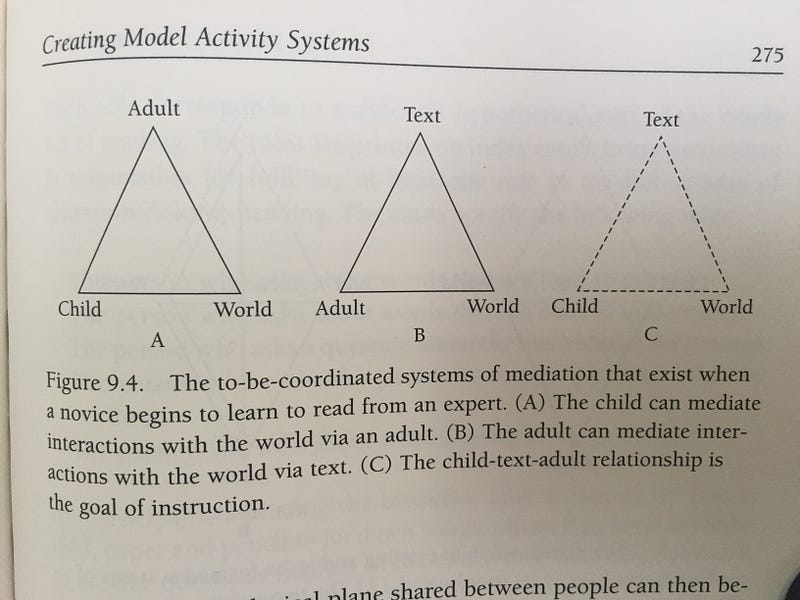
Finally, I found an exemplar of empirical study from Michael Cole’s book Cultural Psychology. The study focused on the diagnosis and remediation of children’s reading difficulties as part of a singly system of activity. Cole and his colleagues believed that reading is a developmental process and that the goal of reading instruction is to provide means for children to reorganize their interpretive activity using print. They developed a model to represent their conception. The below diagram is one of several diagrams of their model.
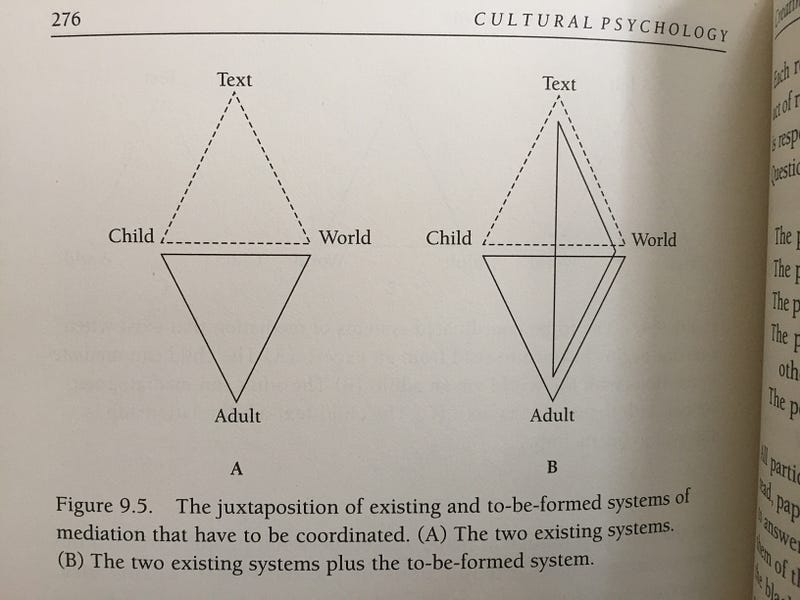
The following diagram is the final model. According to Cole, “… the given and to-be-developed systems of child mediation are juxtaposed and the given adult system is then superimposed, to reveal the skeletal structure of an ‘interpsychological’ system of mediation that, indirectly, establishes a duel system for the child, which permits the coordination of text-based and prior-world-knowledge-based information of the kind involved in the whole act of reading.” (1996, p.275)
I suddenly realized it is possible to design some new models with theoretical concepts adopted from the Vygotskian tradition. That was my dramatic movement of appropriating Activity Theory, CHAT and Vygotsky’s ideas.
Thus, the Ecological Zone framework is also inspired by Michael Cole’s level of analysis: Joint artifact mediated activity. The Shared Activity of the Ecological Zone framework can be considered as Joint Activity. Though the diagram of Ecological Zone doesn’t highlight artifacts in a notable way, the Settings of Ecological Zone refers to artifacts, environment and social context of shared activity, it echoes Michael Cole’s focus on artifacts, ecological and cultural contexts.
Moreover, the emotional encouragement I earned by reading Michael Cole’s book and studies is a positive impact which accelerates the development of the Ecological Zone framework.
Part 4: The Concept of “Zone of Project”
The part 3 introduces the Ecological Zone framework (2018 version) and expands it with concepts from Vygotsky’s “ecological mind”. Now we have a 2020 version of Ecological Zone which is the foundation for “Zone of Project”.
The Zone of Project can be considered as an application of the Ecological Zone framework and Project-oriented Activity Theory. The goal is identifying the internal structure and dynamics of Project. Before we reach the concrete level of Zone of Project, there is a need to discuss some issues at theoretical level.
- Project as Embedded Social Context
- An Archetypal Unit of Project
- Internal Structure and Dynamic of Project
- Position, Process and Themes of Project
4.1 Project as Embedded Social Context
As mentioned above, the Ecological Zone framework echoes Michael Cole’s focus on artifacts, ecological and cultural contexts. I want to apply the same idea to Project with the statement of “Project as Embedded Social Context”.
The term “Embedded Social Context” is inspired by American psychologists Richard M. Ryan and Edward L. Deci who are founders of Self-Determination Theory (SDT). According to Ryan and Deci, there are two types of social contexts:
- Proximal social contexts
- Pervasive social contexts
Ryan and Deci point out, “…we have focused primarily on the influences of proximal social contexts — for example, families, peer groups, schools, teams, and work organizations — on the individuals’ motivation, development, and wellness. We describe these contexts as ‘proximal’ in the sense that the individuals have direct interpersonal contacts with the people who make up these contexts. As SDT evidence has shown, proximal social contexts have a powerful impact on motivation, behavior, and experience, effects that are strongly mediated by basic psychological need satisfactions and frustrations.” (2017, p.561)
Pervasive social contexts refer to abstract social cultural systems. According to Ryan and Deci, “Yet proximal social contexts are themselves embedded within broader or more encompassing social systems, both formal and informal, which influence need satisfaction and behavior in myriad ways. These pervasive contexts include the overarching cultural and religious identifications, political structures, and economic systems within which proximal social contexts are constructed and occur (Ryan & Deci, 2011).”(2017, p.562)
For Project-oriented Activity Theory, there are two ways to understand the term “Project”. The first one is understanding it as “social movement” at the abstract level. The second one is understanding it as regular work project at the concrete level.
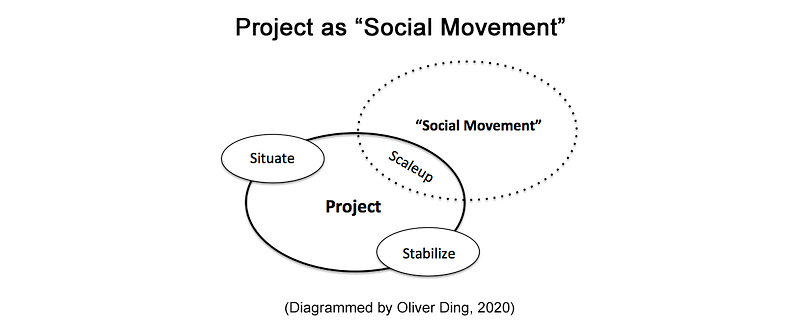
The abstract projects can be considered as pervasive social contexts and the concrete projects can be considered as proximal social contexts. We should notice that pervasive social contexts don’t always affect people’s behavior indirectly. As Ryan & Deci emphasize, “Pervasive contexts can at times directly affect people’s behaviors and need satisfactions by actively regulating or even blocking their activities…cultural or religious authorities can prohibit or even punish certain lifestyle choices.” (2017, p.562) From the perspective of Project-oriented Activity Theory, there is a concept behind a project. The formulation of a concept has three phases: Initialization, Objectification and Institutionalization. At the last phase, the project becomes a “social movement”. It is possible there are some cultural authorities behind the institutionalization of a concept. Thus, the project(social movement) is definitely a pervasive social context.
However, at phases of Initialization and Objectification, the project always exists as some concrete projects which are proximal social contexts. Ryan & Deci points out, “Yet the primary influence of these distal contexts is typically more indirect, as pervasive cultural norms or economic structures present ‘invisible’ or implicit values, constraints, and affordances, which are then reflected in more proximal social conditions and conveyed by socializing agents from parents and teachers to cultural messengers such religious leaders, politicians, and celebrities.” (2017, p.562)
I want to emphasize that concrete projects should not be limited to organizational work settings. We can find various concrete projects in our daily family life, community events, political campaigns, and etc.
Indeed, the statement of “Project as Embedded Social Context” is inspired by Roger Barker’s Behavior Settings theory. If we zoom in to look at the “Setting Programs” of Behavior Setting theory, we can find that “Project” is just like “Setting Programs”.
4.2 An Archetypal Unit of Projects
Blunden gives an archetypal unit of project in his 2010 book An Interdisciplinary Theory of Activity.
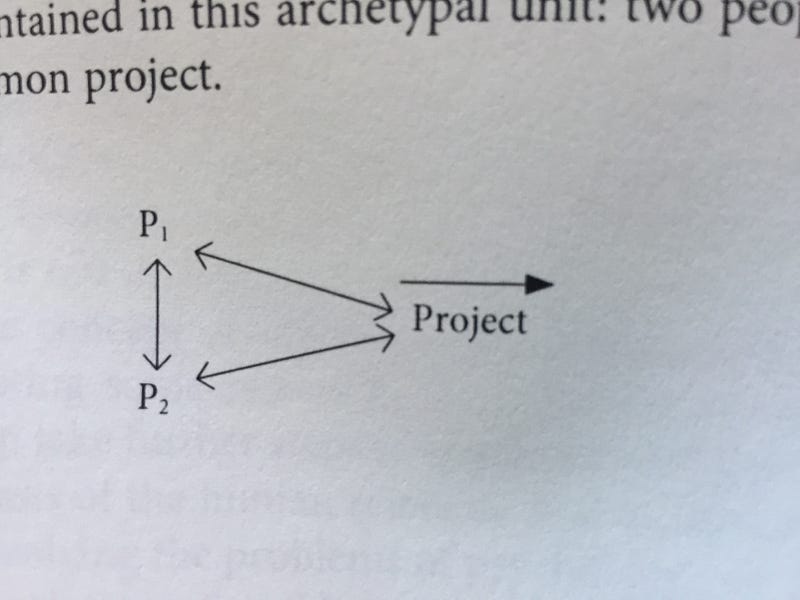
He says, “The rich context of the notion of collaboration also brings to light more complex relationships. The notions of hierarchy, command, division of labor, cooperation, exchange, service, attribution, exploitation, dependence, solidarity, and more can all be studied in the context of just two individuals working together in a common project. And yet almost all the mysteries of social science as well as a good part of psychology are contained in this archetypal unit: two people working together in a common project.” (2020, p.315)
I wish I could read this idea in 2018. As mentioned above, I developed the Ecological Zone framework in 2018 in order to explain the digital one-on-one interpersonal social practice. I used “shared activity” as a term for the Ecological Zone framework. I didn’t realize that it is possible to develop a new definition of “Activity”.
What Blunden suggested are that 1) we can use “Project” as a new unit of analysis for Activity Theory, and 2) the archetypal unit of “Project” is two people working together in a common project. Though my term “shared activity” echoes the “common project”, my original intention is not to develop a new definition of “Activity”.
It is surprising that Blunden doesn’t mention this archetypal unit of “Project” in his 2014 book Collaborative Projects: An Interdisciplinary Study. It seems he also doesn’t develop a deep analysis model based on the archetypal unit.
I’d like to claim that the “Zone of Project” is an expansive work of Blunden’s archetypal unit of “Project”.
4.3 Internal Structure and Dynamics of Projects
In the 2014 book Collaborative Projects: An Interdisciplinary Study, Andy Blunden points out that he is not going to develop an alternative theory to Activity Theory, but introduce the concept of “Project” as a new unit of analysis. He says, “All the past gains of Activity Theory and Cultural-Historical Psychology need to be retained. But the introduction of this new concept of the unit of activity will have not just an additive effect, but a transformative effect on the theory as a whole. The notions of the norms and rules, instruments, community, etc., and the understanding of interaction between activities will be radically changed by the introduction of ‘Project’ as a unit of analysis. ”(2014, p.370)
Blunden doesn’t give a complete description of internal structure and dynamics of Projects. He just reviews Yrjö Engeström’s Activity System model and comments on elements of the model. Let’s look at the model first.
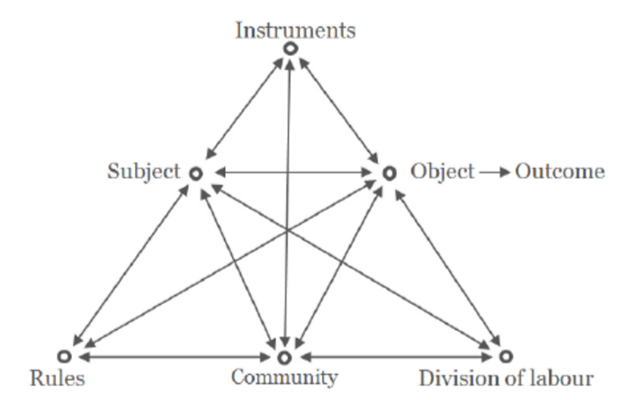
According to Blunden, “Engeström’s expanding triangle logo, for example, is a proven mnemonic reminding researchers to identify and track these elements. But whereas these elements are distinct from subject and object, which are in turn separate from one another, for an Activity Theory based on ‘projects’, all these elements have to be conceived integrally.” (2014, p.371)
The following statements is Blunden’s original comments:
- In particular, the norms and rules have to be understood as objectifications of the object of the project.
- The object here is not as it is for Engeström, but more like it is for Leontiev, that is, the imagined objective situation attainment of which is the source of motivation for the project and its self-concept, which arises from the project activity.
- The subject is not to be taken as an individual or group at some location within the project’s division of labor, but rather the project itself is to be conceived as a subject-object in the Hegelian sense. In these circumstances, norms are both deontological objectifications of the project concept (Blunden, 2012) and the material by means of which the researcher can determine what the object of the project is.
- Likewise, “outcome” is not something other than the object, but is the realization or “unfolding” of the object itself.
Blunden also mentions Jean Lave and Etienne Wenger’s notion of “Community of Practice” as reference for understanding the internal workings of Projects. Though the idea of “Legitimate Peripheral Participation” from Jean Lave and Etienne Wenger is pretty good, the notion of “Community of Practice” is an established theory for social learning and community building.
As Blunden claims, “…But it is early days. This book marks only the very first effort.”(2014, P.370) I think it is possible to develop a framework for understanding internal structure and dynamics of Projects. And the starting point should not be the Activity System model or Community of Practice since these two approaches are established accounts.
I’d like to adopt the idea of “immanence” from Blunden to expand his approach. As Blunden emphasizes, “The formation of a project with a concept of the problem is an original and creative social act. From that time forward the project, with its object, continues to develop according to its own logic, so to speak. Where a project may ‘end up’ cannot be determined in advance. The plot unfolds according to its own dynamic and through interaction with the wider community. This what is meant by immanence.” (2014, p.25)
If we consider Blunden’s approach and Project-oriented Activity Theory as a project, then we could ask a question: what is its own logic?
My answer is that we can start from Blunden’s archetypal unit of “Project”. Then, we can adopt more theoretical resources from Vygotsky and use these resources to develop a new framework to explain the internal structure and dynamics of Projects. In particular, my strategy is adopting Vygotsky’s “ecological mind” to expand “Ecological Zone” and generate a new framework called “Zone of Project” which is a tool for achieving this goal.
4.4 Position, Process and Themes of Project
Position and Process are two useful concepts for discussing internal structure and dynamics of Projects. In addition, I also add Themes as an important concept for this discussion.
In particular, I use a unique way to explain these three concepts by curating “Project as a Unit of Activity”, “Ecological Zone” and “Project as Embedded Social Context”. The final outcome is the new concept of “Zone of Project”.
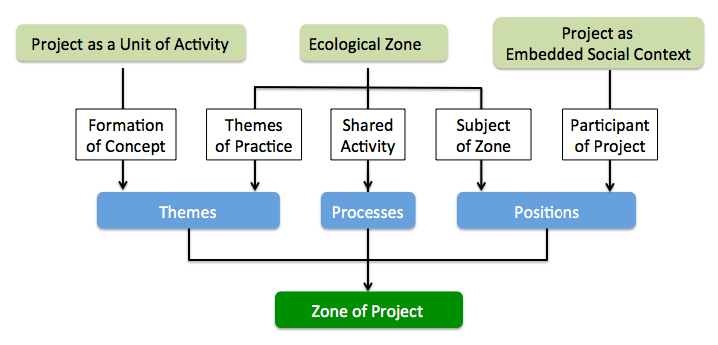
The above diagram represents the structure of this conceptual curation.
As mentioned above, the Shared Activity of Ecological Zone refers to processes of project. Each zone of project has several processes as its shared activity.
One of theoretical statements of the Ecological Zone framework is “Themes of Practice”. In order to curate various experiences of daily interactions, I adopt the concept Themes of Practice from Curativity Theory for ZONE. A Theme of Practice refers to a set of interactions which share a common issue, an agenda or a theme.
Since Theme is a particular concept, I can adopt Blunden’s proposal — the “Hegel-Marx-Vygotsky” account of “Concept” — as a theoretical foundation to support the concept of “Themes of Practice”. Also, the notion of “Formation of Concept” is the foundation of Blunden’s Project-oriented Activity Theory.
The result is a new concept “Themes of Project”. I have to emphasize that “Themes of Project” expands Blunden’s “Concept of Project”. I will discuss this issue in the next section.
Finally, we see “subject” in the Ecological Zone framework. It is also easy to understand that there are “participants” within embedded social context. This leads to the idea of Positions.
Part 5: Five Zones of Project
The above discussion establishes a new concept “Zone of Project”. Now we can use this concept to generate a concrete framework for discussing the internal structure and dynamics of Projects.
5.1 The Basic Model of Zone of Project
The preview article has presented the following diagram which highlights the concept of “Zone of Project”. However, it only points to a space between two participants within one project. This is the basic model of Zone of Project.
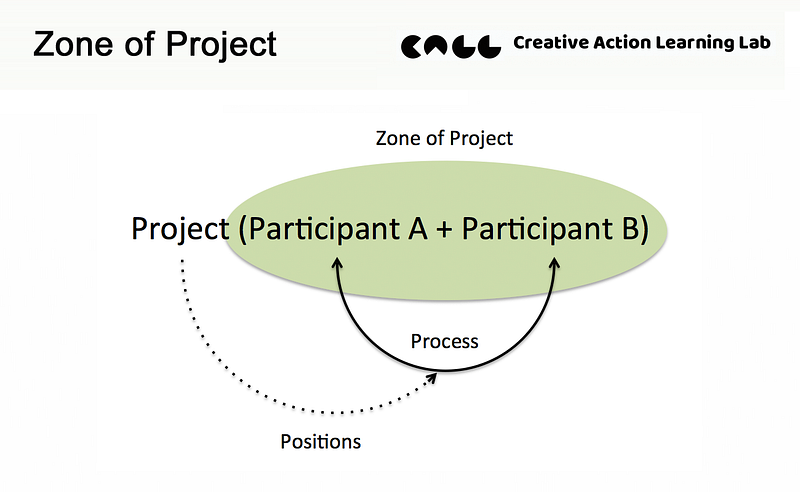
For practical usage, we need a more concrete diagram which can represent more than one zone of project.
5.2 The Standard Model of Zone of Project
The standard model of Ecological Zone presents three zones. Following this approach, I use five zones as the standard model of Zone of Project.
I have mentioned in the previous article, I find the following “Themes of Practice” are ideal concepts for discussing “Themes of Project”.
- “Idea”
- “Resource”
- “Program”
- “Performance”
- “Solution”
I also find the following five positions are ideal for discussing “Positions of Project”.
- Initiator
- Supporter
- Leader
- Member
- Advisor
If we combine these five themes, five positions and five zones together, we can get the following diagram. This is the initial version of the standard model of Zone of Project. It gives a concrete example of the ideal standard model of Zone of Project: a diagram which presents five zones. The name of five zones, five positions and five positions can be revised in future versions.
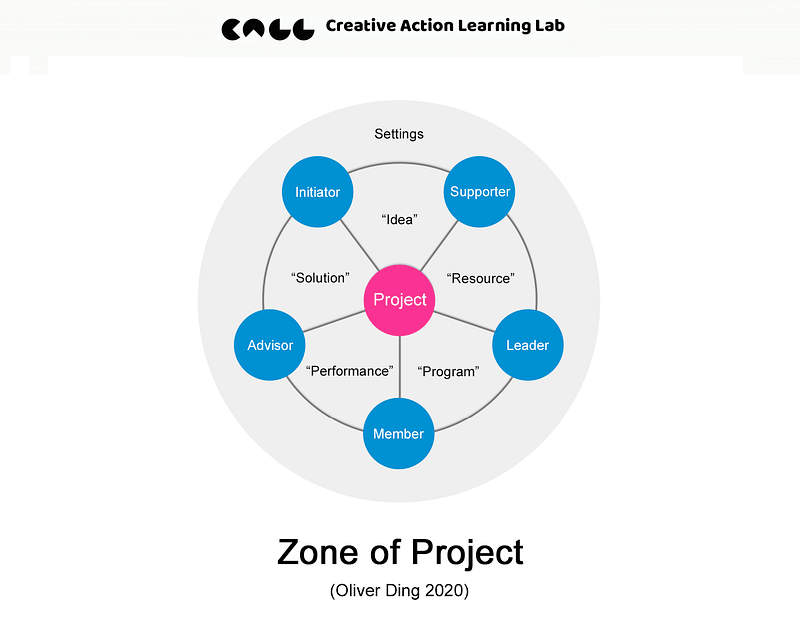
A diagram is a way of objectification of theoretical concepts. We should not only use a diagram without understanding related theoretical concepts. If someone understands the concept of “Zone of Project”, he should not limit his imagination on the above diagram.
Also, we don’t have to limit on five zones, five positions and five themes. It is possible to discover more than five zones in a particular study. Anyway, readers can use the basic model of Zone of Project for any situation.
5.3 The “Idea” Zone
The “Idea” Zone refers to the dynamic process of sense making of the object of project, the theme of project, and the concept of project. The positions of the “Idea” zone are “Initiator” and “Supporter”.
I have to point out the naming approach of Zone of Project. In fact, I want to claim there are several themes inside a zone. However, there is a primary theme in each zone. So, I use the primary theme to name a zone. This statement also points out that all themes of a project are shared by all participants of the project.
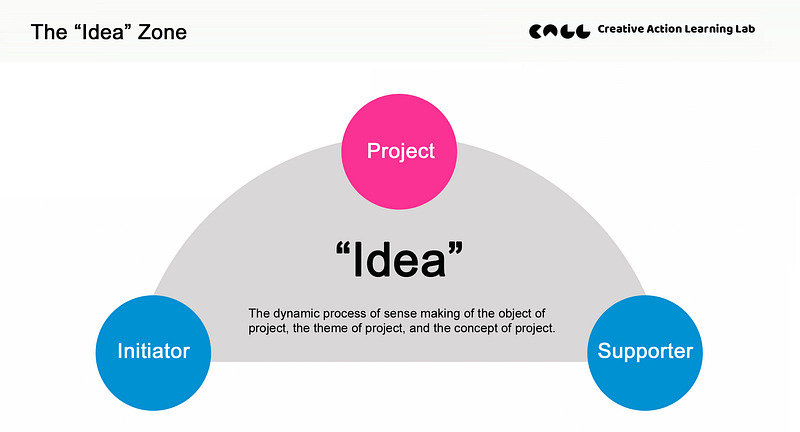
The term “Idea” refers to a Concept. This means it is both a theme and a process. As mentioned above, this is the theoretical claim of both “formation of concept” and “Themes of Practice”. In particular, we can understand “Idea” as “Idea Development”. For each project, there is a process of its idea development. Someone initiates an original idea which leads to a project, then the project grows and people revisie the original idea, and so on.
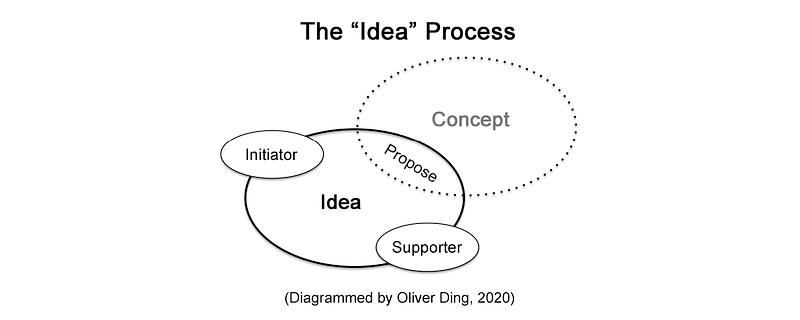
I have made a distinction between Idea and Concept from the perspective of Project-oriented Activity Theory. As Blunden emphasises, “The formation of a project with a concept of the problem is an original and creative social act.” However, it is hard to require every project to be an original and creative social act. In order to keep using the term “Project”, I suggest that it is possible to allow the formation of a project with a regular idea which refers to normal works. In this manner, I keep a room for normal projects within Project-oriented Activity Theory. Anyway, an Idea is the beginning of a Concept.
5.4 The “Resource” Zone
The “Resource” Zone refers to the dynamic process of perceiving and developing supportive assets and opportunities in order to function effectively. The positions of the “Resource” zone are “Supporter” and “Leader”.
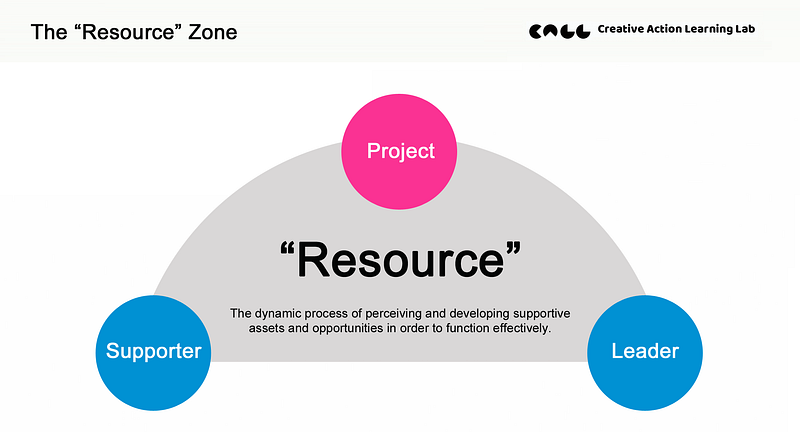
For Project-oriented Activity Theory, one phase of formation of concept is Objectification. I have mentioned that there is a need for a dimension of Resource for discussing objectification.
Low cost — (Resource) — High cost
From language to material, from material to environment. It is clear there is a tendency of increase in resource consumption. I think this dimension is useful for empirical research and practical works.
Besides, the social change about supportive resources is a promising direction for applying Project-oriented Activity Theory. For instance, the concept of “Crowdfunding” and the concept of “Micro-Sponsorship” represent emergent digital practices. According to Wikipedia, “Crowdfunding is the practice of funding a project or venture by raising small amounts of money from a large number of people, typically via the Internet. Crowdfunding is a form of crowdsourcing and alternative finance. In 2015, over US$34 billion was raised worldwide by crowdfunding.” Kickstarter is a digital platform which is based on the concept of Crowdfunding. Traditionally, sponsorship is adopted by institutions. Patreon creates a digital platform which allows fans to sponsor individual artists and creators through monthly membership.
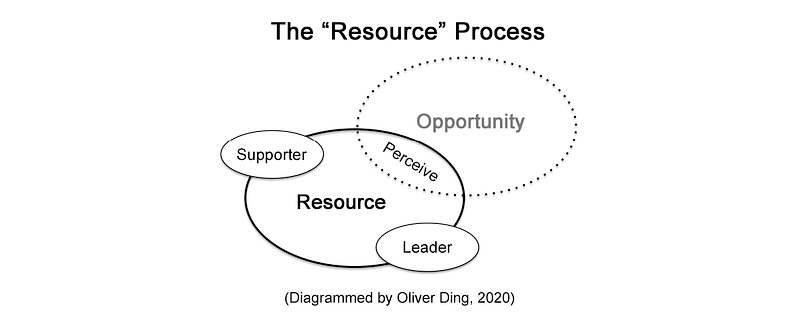
The above diagram uses the germ-cell diagram of Project-oriented Activity Theory to represent the “Resource” process. Here I highlight “Opportunity” as a potential resource for the development of Project. I want to emphasize a creative view of “Resource”.
5.5 The “Program” Zone
The “Program” Zone refers to the dynamic process of curating the configuration of various actions for actualizing the idea with resources. The positions of the “Program” zone are “Leader” and “Member”.
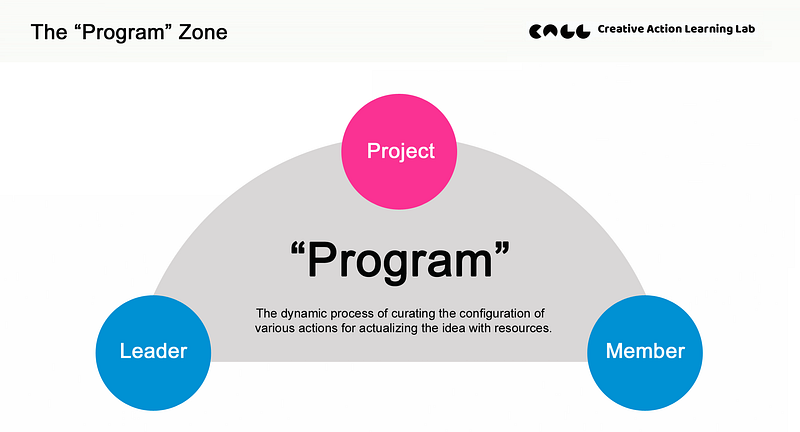
The “Program” zone is similar to the traditional idea of “Project Management”. According to A Guide to the Project Management Body of Knowledge (2000), from the perspective of project management, the project is defined as “a temporary endeavor undertaken to create a unique product or service”. From the perspective of Project-oriented Activity Theory, the concept of “Project” refers to the process of formation of a concept. For Project-oriented Activity Theory, there is no strict boundary for a “Project”. However, in the particular process of objectification of a concept, there is a concrete project which can be learned something from the Project Management area. So, I use “Program” to make a balance between the abstract “Project” and the concrete “Project”.
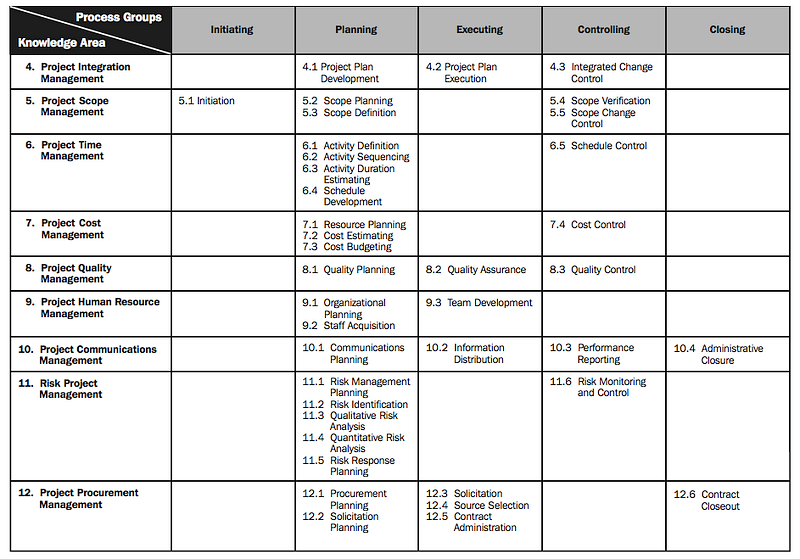
According to the A Guide to the Project Management Body of Knowledge (2000), “Project management is the application of knowledge, skills, tools, and techniques to project activities to meet project requirements. Project management is accomplished through the use of processes such as: initiating, planning, executing, controlling, and closing.” (2000, p.6)
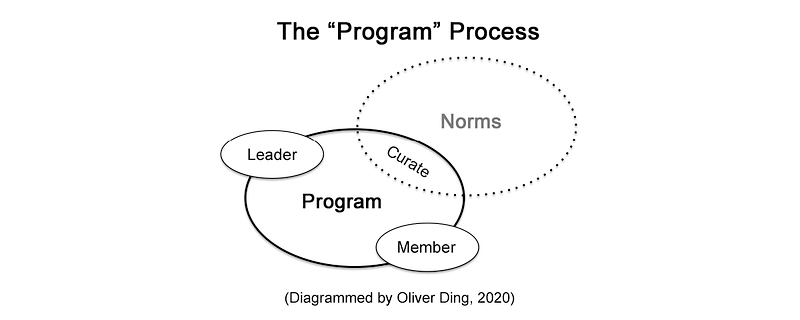
From the perspective of Project-oriented Activity Theory, the “Program” process is related to Program and Norms. And, both Program and Norms are curated by Leader and Member in a collective dynamic way.
5.6 The “Performance” Zone
The “Performance” Zone refers to the dynamic process of doing something and saying something about the project. The positions of the “Program” zone are “Member” and “Advisor”.
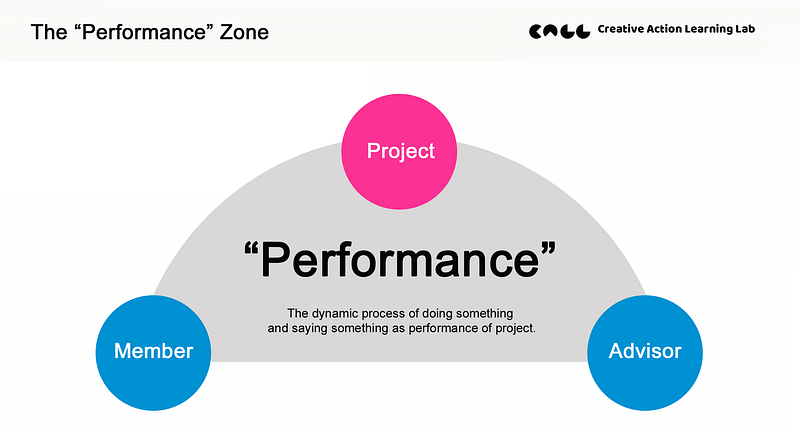
The “Performance” refers to the concrete actions of a project. It also refers to the various ways of participating in a project. For example, I have mentioned the TEDx project in the previous article. According to the official website of TED, as of December 31, 2020, there are 35,713 local TEDx events which were held in more than 130 countries. The TEDx Talks library contained over 30,000 videos from these local TEDx events. There are various ways of participating in the TEDx community, such as organizing, curating, hosting, designing, speaking, sponsoring, photographing, videoing, lighting, translating, listening, watching, sharing, etc. It’s not the word “TEDx” and the slogan “independently organized TED event” define the movement, but real actions of thousands upon thousands volunteers define the movement.
Let’s look at the “photographing” zone between speaker and photographer in the TEDx Project. The official TEDx Organizer Guide gives some suggestions about the photographing process. Obviously, the TEDx events only allow official photographers to take pictures on the stage. While there is a photographer on the stage, some novice-level speakers might perceive the photographer’s actions as disturbances. Also, the novice-level photographers have to learn how to find the best timing and the best perspective to take pictures while a speaker walks around on the stage.
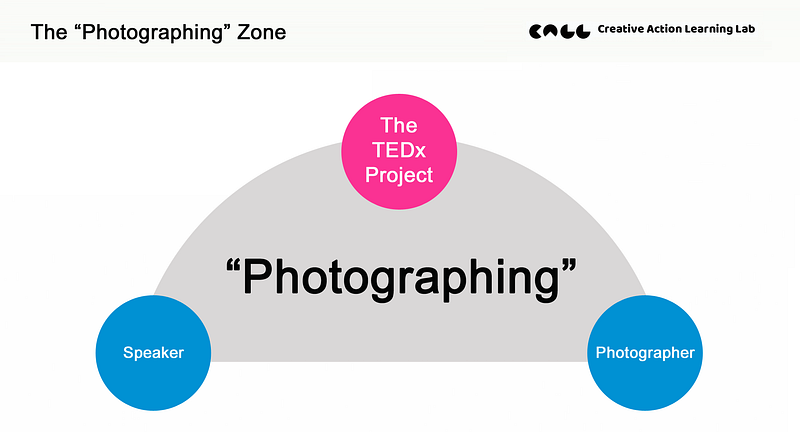
In the situation of real study, it is valuable to take deep into some particular performances and use the Ecological Zone framework for deep analysis. Here I only present the general diagram of the “Performance” zone and give an example of a particular performance zone. Readers can develop their own diagrams.
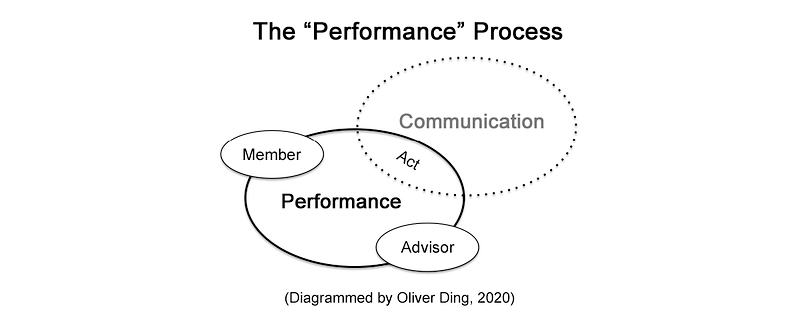
The “Performance” process includes “doing” and “saying”. The above diagram represents this idea with “Performance” and “Communication”. In most cases, “saying” means talking about some “doing”. I consider “Communication” as this type of “saying”. For example, “performance review” in the work setting is “Communication”.
For some cases, the performance is just “saying”. For example, a TEDx talk speaker gives a speech on the stage. Or, a host interviews a guest in a podcast episode. In this situation, we should consider “saying” as “doing”. This type of “saying” is “Performance” and reviews on the speaker’s TEDx talk or the podcast interview episode should be considered as “Communication”.
5.7 The “Solution” Zone
The “Solution” Zone refers to the dynamic process of finding means in order to cope with contradictions, paradoxes, and dramatic situations. The positions of the “Solution” zone are “Advisor” and “Initiator”.
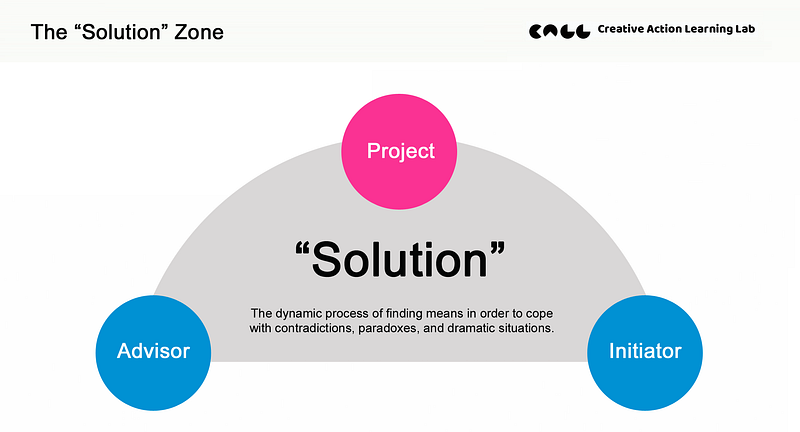
We can understand “contradictions”, “paradoxes” and “dramatic situation” as normal words. Also, we can understand them from the perspective of the tradition of Activity Theory and Cultural-historical Theory. For example, the Activity System model emphasizes contradictions four levels of contradictions within the human activity system. Cultural-historical Theorists follow Vygotsky’s term “drama” as mentioned above. In general terms, we can consider them as a moving force of development of projects.
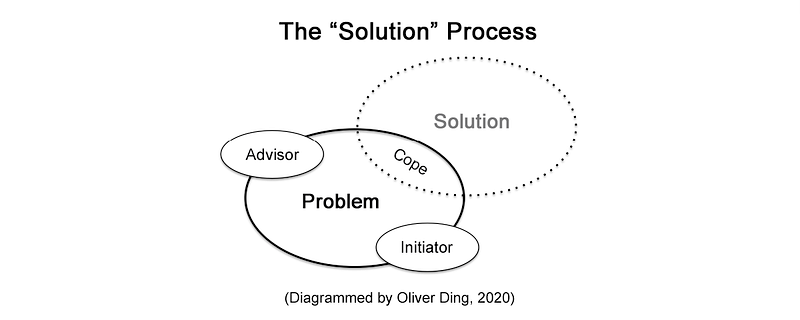
The above diagram also emphasizes both “problem” and “solution”. In fact, the problem is real while the solution is potential. Sometimes people can’t find feasible solutions for a particular problem. Sometimes the solution can solve the problem with the cost of changing the original direction or idea of the project. Thus, it is possible the “Solution” process leads to the “Idea” process. In other words, the problem or the solution can inspire an idea which leads to a new project. This is the reason I put “Initiator” in this zone.
5.8 Domain-specific Zone
The above discussion represents a basic model of Zone of Project and a standard model of Zone of Project. As mentioned above, models and diagrams are thinking tools. The most important thing is understanding the concept of Zone of Project and applying it to real studies.
Though the standard model presents five zones, five positions and five themes. It is possible to discover more than five zones in a particular study case. Anyway, readers can use the basic model of Zone of Project for any situation. I want to encourage readers to develop their own domain-specific zones and share it with others. For example, the fundraising process is common in the startup domain. Let’s make a model for the “fundraising” zone.
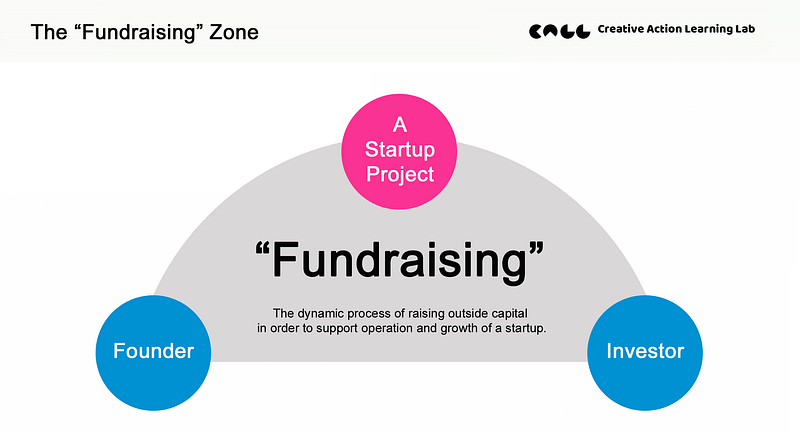
For a startup project, the fundraising process aims to seek and gather financial resources such as outside capital to support the operation and growth of a startup. Startup companies need to develop products, hier staff, purchase equipment, rent offices, etc. Also, the growth of a startup is based on the product adoption and product consummation. The marketing process requires financial resources too.
For this domain-specific zone, the two “Positions” are Founder and Investor. The “Theme of Zone” is Fundraising. We can also apply the germ-cell diagram to represent the process. For example, we can claim Seed Round as an “Actual” process and Series A as a “Potential” process. Of course, we can claim Series A as an Actual process and Series B as a Potential process, so on. In addition, the “Orientation” is Grow which leads to the next round of fundraising.
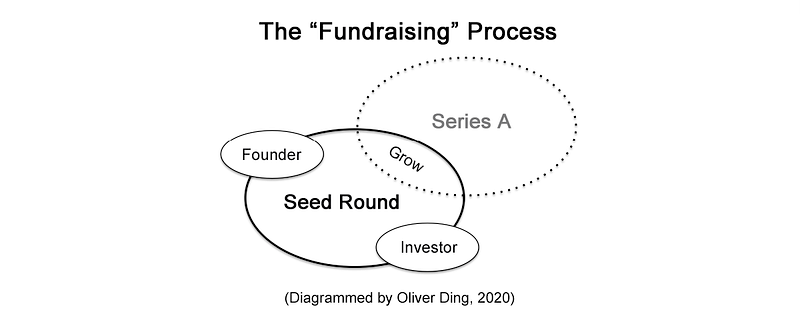
Readers can apply the above method to develop and design their own domain-specific zone with the diagrams.
5.9 Network of Zones
Once you discover several essential domain-specific zones in a particular domain, you can draw a map of the network of zones. Eventually, you will get meaningful insights about structure and dynamics of the domain.
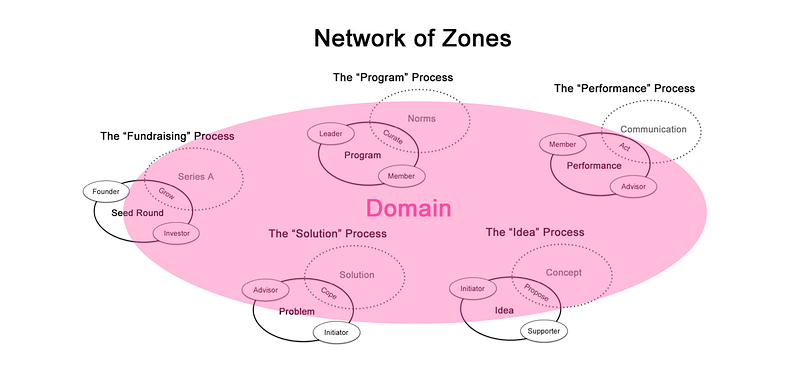
Finally, you can go back to the standard model of the Zone of Project and put your insights about the domain into the “Settings” of Pojoject.
Epilogue
I am recently working on two frameworks which are both inspired by Activity Theory. The first one is the Life-as-Activity approach, I adopted Yrjö Engeström’s Activity Systems model (1987) which is a popular theoretical approach of Activity Theory and Howard E. Gruber’s Evolving Systems approach to the study of creative work as major theoretical resources for discussing biographical studies. I use trem “life, projects, and events” for the Life-as-Activity approach. The term “Project” is adopted from Gruber’s approach.
The second one is the Platform for Development (P4D) framework, I adopted Andy Blunden’s Project-oriented theoretical approach (2014) which is the newest development of Activity Theory and James Gibson’s Ecological Psychology as major theoretical resources for discussing platform-based activities. Inspired by Ecological Psychology’s concept Affordance, I developed a new concept called Supportance for defining Platform. By adopting the notion of “Project as a unit of Activity”, I defined a nested social structure Platform[Project(People)] as the core of the framework.
The Activity U project has been planned to introduce Andy Blunden’s Project-oriented theoretical approach. The recent articles form a sub-series of articles and achieve this goal. You can find related articles from the following links.
- Activity U (VIII): Project as a Unit of Activity
- Activity U (VIIII): Project-oriented Activity Theory
- Activity U (X): Activity U (X): Projecting, Projectivity, and Cultural Projection
- Activity U (XI): Process, Position, and Zone of Project
- Activity U (XII): 136 Ideas for Impact Projects and Micromovements
- Life as Activity (version 0.3)
- The Platform for Development (P4D) Framework (1.0)
It’s a pleasure to work on this special sub-series of articles. On Aug 20, 2020, I shared HCI-Activity Theorist Bonnie Nardi’s story and suggested the concept of Appropriating Theory as a way of knowing. Now I have a deep understanding of the concept of Appropriating Theory.
You are most welcome to connect via the following social platforms:
Twitter: https://twitter.com/oliverding Doowit: https://doowit.co/profile/gm0k2ax9 Linkedin: https://www.linkedin.com/in/oliverding
License
This work is licensed under the Creative Commons Attribution-NonCommercial-ShareAlike 4.0 International (CC BY-NC-SA 4.0) License. Please click on the link for details.
References
Andy Blunden (2009) An Interdisciplinary Concept of Activity. Outlines. Critical Practice Studies, 11(1), 1–26. Retrieved from https://tidsskrift.dk/outlines/article/view/2119
Andy Blunden (2010) An Interdisciplinary Theory of Activity. Brill.
Andy Blunden (2012) Concepts: A Critical Approach. Haymarket Books.
Andy Blunden (2014) Collaborative Project: An interdisciplinary study. Brill.
Andy Blunden, Translating perezhivanie into English
Anita Blanchard (2004) Virtual Behavior Settings: An Application of Behavior Setting Theories to Virtual Communities. Journal of Computer‐Mediated Communication, 9: 00–00. https://doi.org/10.1111/j.1083-6101.2004.tb00285.x
Anton Yasnitsky (2019) Vygotsky’s Science of Superman: From Utopia to concrete psychology in Anton Yasnitsky (Eds.) Questioning Vygotsky’s Legacy: Scientific Psychology or Heroic Cult. Routledge.
Harry Heft (2001). Ecological Psychology in Context: James Gibson, Roger Barker, and the Legacy of William James ’s Radical Empiricism. New York: Psychology Press.
Jaan Valsiner and Rene van der Veer (2014) Encountering the border: Vygotsky’s zona blizhaishego razvitia and its implications for theories of development. In Anton Yasnitsky, Rene van der Veer and Michel Ferrari (eds.), The Cambridge Handbook of Cultural-Historical Psychology. Cambridge University Press.
James J. Gibson (1979/2015). The ecological approach to visual perception: classic edition. New York: Psychology Press. (originally published in 1979).
Lubomir Popov and Ivan Chompalov (2012) Crossing Over: The Interdisciplinary Meaning of Behavior Setting Theory.
Michael Cole (1996). Cultural psychology: A once and future discipline. The Belknap Press of Harvard University Press.
Nikolai Veresov (2020) Identity as a Sociocultural Phenomenon: The Dialectics of Belonging, Being and Becoming. In Adolfo Tanzi Neto, Fernanda Liberali and Manolis Dafermos (eds.) Revisiting Vygotsky for Social Change: Bringing together theory and practice. Peter Lang.
Richard M. Ryan and Edward L. Deci (2017) Self-Determination Theory: Basic psychological needs in motivation, development, and wellness. The Guilford Press.
Roger Barker (1968, 1989). Behavior settings: A revision and extension of Roger G. Barker’s ‘ecological psychology’. Stanford University Press.


