
18 Fascinating Facts about Sexual Reproduction and Attraction in Humans That You Probably Didn’t Know
All sexually reproducing animals have a common ancestor, women’s sex drive is linked to the seasons, men’s is not, and much more

The science of sexual reproduction and attraction is an ever-growing field, and the more we learn about it the more we learn about ourselves. Here are 18 facts about sexual reproduction and attraction in humans that you probably didn’t know.
Disclaimer: this post goes all David Attenborough on humans in digesting sexual reproduction and attraction in humans, keep that in mind.
All sexually reproducing animals have a common ancestor
It is believed that all sexually reproducing animals — along with sexually reproducing plants, fungi and protists—evolved from a single-celled eukaryotic species.
That would mean that all sexually reproducing entities are likely linked by a common ancestor.
Asexual reproduction suits a stable environment, sexual reproduction suits an ever-changing one
All asexual reproducing species evolve slowly mainly because all the offspring are clones of the parent, this means that asexual reproducing species can only continue to exist if their environment remains relatively stable.
For example, water fleas, their environment changes very slowly, which is why they have not needed the rapid evolution that comes through with sexual reproduction, and as such reproduce asexually.
But in less stable environments and environments more likely to see rapid change — at least by evolutionary standards — sexually reproduction is the only way to survive and thrive.
This is why the majority of land-dwelling species evolve through sexual reproduction.
Asexual reproduction dampens competition, sexual reproduction promotes it
Asexual species have no need to fight with each other because they are all clones of each other, so there is no need to prove that they have the best genetics. This is highly useful for stability but is terrible if you need to discover who has the most suitable genetics for the current environment.
Step forth the power of sexual reproduction to induce competition. In sexual reproduction, every single child that is born is unique and unlike any other child that has ever been born or ever will exist again.
This increases the probability that a child will be born with the right tools to survive in the present environment — whatever that environment is like. But for the strengths of that child to be felt by the whole species, that child has to fight to ensure that they have as many offspring as they can.
In females, there is a limit to how many offspring they can have, but in males, the only limit is the number of females available. Hence, why the males in sexually reproducing species fight with each other for the right to mate with all the females. The practice ensures that the best genetics for the environment are passed on to the most offspring.
Sexual reproduction creates the seeds for rapid evolution
Sexual reproduction — due to the competition it creates — creates the perfect recipe for continuous and rapid evolution.
This continuous and rapid evolution eventually led to the human race. It would be nigh on impossible for any asexual reproducing species to ever evolve this way simply because of the lack of competition.
That means one of the most integral elements of sexual reproduction is the fact that it creates a world of permanent competition. The more competition there is, the more rapid the evolution.
Infidelity is a result of the competing desires of sexual attraction
Promiscuity is an inevitability of our instinctual desire to always find the best partner and to forever compete over the right to mate with that partner. Monogamy is an inevitability of our desire to create stability.
If you add our desire for stability to our desire to always mate with the best available option, you get monogamy and its unwelcome friend, infidelity.
This internal competition that exists inside all of us — along with all sexually reproducing animals — inevitably is what has created the monogamous world that we desire and the mass infidelity that we can’t escape.
So, infidelity happens in all sexually reproducing species because the instincts of sexually reproducing species are forever torn between the desperate desire for stability, and the inescapable need and want to always mate with the strongest and to prove we are the strongest.
Sexual connections are formed in humans through the rule of opposing sides of the same coin
There’s a very good reason why men — at least instinctually speaking — are predominantly so sex-focused, whereas women — again, at least instinctually speaking — are predominantly so connection-focused. It’s the best way to form sexual connections.
For example, imagine a surgeon who, rather than focusing on specialising in one area, tries to be able to do every form of surgery possible. Would that person ever be able to do, for example, brain surgery of any kind to the same standard as a surgeon who specialised in brain surgery?
Everyone knows the answer, which is why surgeons specialise.
The reason men’s instinctual mating drivers are so sex-driven, and women’s are so connection-focused, are for the same reason. It is far more optimal when forming sexual connections to have one party “specialise” on the sex side and the other party “specialise” on the connection side.
To put it a little simpler, men’s desire for sex added to women’s desire for the people they have sex with to stick around, induced, for opposing reasons, both men and women to greatly desire sex and connections, and as such led men and women to begin forming sexual connections.
Attraction in sexual reproduction operates in a complementary manner
As said, specialising is really beneficial. This is why men and women predominantly focus on different factors when it comes to mate selection — they are different and as such both specialise in their own areas.
If this were not the case, and they were not different, there would be no point to men and women existing i.e. if women could do everything men could, and men could do everything women could, there would be no point to men and women both existing.
Inevitably, this is why what women look for in men are things they do not have, and what men look for in women are things they do not have. Over time this has led men and women to evolve to be increasingly different but in an increasingly complementary manner.
This is why men focus on appearance, because they don’t have the ability to rear babies whereas women do and appearance is the best way to judge a person’s baby-rearing potential.
As men don’t rear babies, men’s appearance is not really much use to women other than to answer the question, is he big and strong. This is why men typically look for the most attractive woman, whereas women typically look for the strongest man.
Over time, the parameters of what makes a woman the most attractive woman and a man the strongest man have changed, but the primary factors remain the same. Men look for the most attractive woman because that helps them pick the best babymaking partner, women look for the strongest man because that helps them pick the best babymaking partner.
This is only the case because sexual attraction is all about the males and females being different but in a complementary way.
The focus on women’s looks is linked to the fact that historically women have been unable to compete against each other in the way that men could i.e. violently
There is a very good reason why men are so focused on women’s appearance, but women are not so focused on men’s. It’s not just for the most documented reasons, which is that as a woman’s main job is to get pregnant, appearance is the only tool that can be used to judge how good she will be at the job. There is much more to it than that — much more.
As said earlier, the entire purpose of sexual reproduction is to create competition. That means all men compete for the right to mate with women and all women compete for the right to mate with men.
However, as women can only have one child a year, they cannot risk fighting violently with other women to prove their genetics. The reason, if they did, then the human race would have died out long ago simply because too many of the women would have hurt themselves or killed each other fighting over men.
So, only men can kill each other with a high level of consistency because they can impregnate lots of women over a year. This is why historically men have been so violent to each other so consistently — because they can be. Because women cannot be because it would doom the human race, historically, women have had no other available option but to use their appearance to attract a mate, and men have had no other option but to judge women’s desirability based on their appearance.
That’s the main reason why women are judged so much on their appearance is that historically, it was the only option that created competition that did not involve women killing each other for the right to mate with men.
On the physical appearance scale, women are rated more attractive than men — not for the reasons people most often think
It’s popular to say that women are more attractive than men and that whereas men rate the appearance of women highly, women do not rate the appearance of men highly.
The below widely shared graph perhaps encapsulates where this thought process comes from.
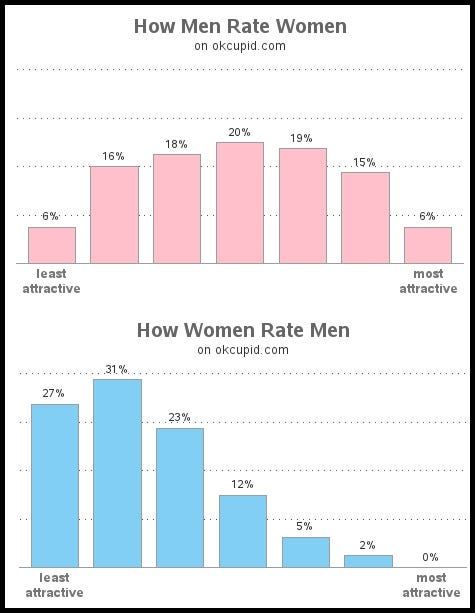
However, the above graphs do not show that women judge men cruelly on their looks, or that they think men are ugly, nor do they are that women are more physically appealing than men. What they show is that women have not evolved tools to rate men’s genetic compatibility based upon their aesthetics alone, but men have, which is how men are able to rate women more highly on their appearance than women are men.
If the female graph was like the male graph, and women rated men as more attractive, it would show that women used appearance as a primary factor when selecting a mate.
They don’t, they use other factors. So it’s not that women think men are ugly, it’s not that women are more attractive per se, it’s just attraction works differently between men and women.
What this means is women are only more physically attractive than men because men have evolved to use appearance to rate women’s merits as a sexual partner, whereas women have not — at least not to the same extent.
On a side note, if an alien race came along, they likely would not rate women as more physically attractive, based upon how we rate animals in the animal kingdom, they would likely rate men as more attractive because of their superior physicality. Think how we favour male lions over the females on the appearance scales, and male silverback apes over female apes.
What this means is that looks truly are in the eyes of the beholder.
The female mate selection method is more complex and pickier than the male due to females having been sex-selective for longer
Because women can only have one child a year, it has always been imperative that they select the best option to mate with. For men, it’s never been as imperative simply because the aim was — at least prior to our evolution to pair-bonding — always to impregnate all the women i.e. if they had a choice the choice was always all of them.
This is why men more often use looks when they have a choice over who to date and progress with i.e. the more a man finds a woman physically attractive, the more his instincts are saying that they are a good genetic match.
Scarily, this selection method is so powerful in men that some studies have even shown that even if they are told the best-looking one is a psychopath, they still more often select her. Whether they would do this in practice of course is an entirely different story.
Regardless, the male mate selection process — at least the early stages of it, so selecting who to progress with — is not as nuanced or advanced as the female simply because men have not spent as much time evolving tools for selecting just one person from the get-go as women have.
So, the male sex selection process is rather crude and simplistic, at least the early stages of it are, women’s on the other hand is highly advanced. To aid with mate selection women have evolved tools to literally test the genetic compatibility of themselves and a prospective partner, and that is literally, so not in the crude way like men have evolved to which is through appearance. Women literally analyse men’s genetics in a way superior to even how scientists analyse genetics in a lab under a microscope.
For example, women can analyse a man’s genetic compatibility through his smell. No jokes, women are capable of telling by the smell of a man, so his pheromones, whether they are a good genetic match. Men can sort of do this, but nowhere near to the level women can.
Countless studies have even been done to back this up. For example, a popular one replicated numerous times sees women asked to rate men on attractiveness, before being asked to smell T-shirts that these men had worn without knowing which T-shirts belong to whom. The results show the T-shirts they pick as being the nicest smelling most often belong to the men that they rated the most attractive.
But it isn’t just smell, it’s kissing as well. So, if a woman’s internal computer has confirmed a prospective partner’s pheromones are a good match, she will desire to kiss. When women kiss, chemical reactions occur inside which basically allow them to further analyse their prospective partner’s genetics.
In terms of what they are looking for from kissing, to test whether a potential mate has an immune system that is different from theirs. The more different the immune system, the more they will desire to keep kissing, the less different, the more they will desire to stop — at least this is what all the evidence from recent research appears to show.
That means the early stages of the male mate selection method are crude whereas the females are in-depth and complex, and this is all because men evolved from a base of trying to compete to mate with all the women, whereas women evolved from a base of wanting to mate with the best one person.
Promiscuity likely created sexual connections
Historically, all the males would compete for the right to mate with all the females, whereas the females would focus on mating with only the strongest of their available options. This means that promiscuity is in the nature of both males and females.
However, male promiscuity is rooted in the idea of mating with all the females at once, whereas, female promiscuity is rooted in the idea of mating with one male at a time i.e. the most worthy male and the male she would stick with until a more worthy male came along.
It is the latter factor which likely gave birth to sexual connections. It is likely that females began increasingly demanding loyalty from one male at a time rather than allowing the male to mate with all the females.
Increasingly, this likely led the males to stop competing with each other over all the females and to instead start competing over just one female. Eventually, this process likely led to the birth of sexual connections i.e. where males give connections to females as the price of sex.
That means sexual connections were likely born through the female desire to stop males from mating with other females while mating with her.
Testosterone levels are not per se the main driving force of the male sex drive
Testosterone levels are not as important per se when it comes to the male sex drive as people think. Because all men have a good level of testosterone, even the men who have lower levels have enough for it not to be the largest influence on how much they want sex i.e. once you have a certain amount of testosterone, testosterone’s ability to further influence how much sex you want diminishes.
So, testosterone levels in men only start to play a part in how much sex they want if they start dropping to abnormally low levels — or they are born with abnormally low levels.
This means — because male testosterone levels are already so high — how much sex a man wants is far more driven by inbuilt psychological factors than by their testosterone levels.
Testosterone levels in men can impact how aggressive and competitive they are
Men with high levels of testosterone tend to be very competitive, while men with lower levels tend to be less so. Changes in men’s testosterone also typically can affect how competitive and aggressive they are at that moment, so when levels go up, they become more aggressive and competitive, and when they go down, the opposite happens.
This is why when a man has a child, his testosterone levels drop — because it makes him less aggressive and competitive, which makes him more suitable for parenthood.
Paradoxically, this means often the reason men with high levels of testosterone chase more sex than those with lower levels, is not because the testosterone per se makes them desire sex more, it’s because it makes them become more competitive.
Women’s sex drives are linked to the seasons, but men’s are not
Changes in the seasons do not affect men’s desire for sex. It is permanent pretty much all year round. Cold, hot, winter, summer, it doesn’t matter. However, studies into human physiology have indicated that it is different for women, women’s sex drives do seem to be linked to the seasons.
It has been shown that sex hormones, especially testosterone, in women increase massively in autumn, but then start falling outside of that period. They are at their lowest during the summer, with female testosterone levels being half the autumn level in summer.
So, women’s sex drives are designed to peak in autumn, with spring births being the aim, because that would allow them the warmest and calmest months for the child’s early months, boosting survival chances.
It’s believed that this is typically why couples have more sex in the autumn and winter i.e. it may not be just because people are inside more, it may also be because women are more likely to be into sex in those months because they are technically in heat during them. At least that’s what the present evidence seems to show.
Intrapersonal verbal violence is how women have evolved to overcome their need to not fight each other violently
Because women have never been able to fight each other violently over men as men have been able to over women — at least not to the same level of consistency — women have evolved other methods outside of their looks to try to get a man to favour her over other women.
Basically, to try to curry favour with a man who has picked another woman — or who she fears may pick another woman or leave her for another woman — women have evolved to use disparaging remarks. So, intrapersonal rivalry.
This is why women can be so vicious to each other with their remarks and have a tendency to spread vicious gossip behind each other’s backs — amongst other methods.
For example, the behaviour in the Middle Ages of women being killed after being accused of being a witch is often postulated to have been used as a form of intrapersonal rivalry. It’s believed many women made accusations simply to get rid of love rivals.
More modern-day examples are women calling women sluts, especially attractive ones, to make them seem less sexually appealing to men, and the extremely common behaviour of the bullying of women by women based on their looks and/or personality.
Note: it should be noted that men also do this, but because men have evolved to use their fists to prove they are the strongest, historically, if a man utilised these tactics and was found out, it could have led to him meeting a violent end. Historically, women have never had to worry about this to the same level, which is why the tactics have been and are far more commonly utilised by women.
Intrapersonal rivalry often leads people to try to make those they want to date see themselves as less desirable
Many men and women take intrapersonal rivalry so far that they try to make a person they want to date see themselves as less desirable than they truly are so that they will date them.
That means men and women alike don’t just try to bring down their rivals by slating them, they try to bring down the people they want to date by attempting to make them feel worth less than they are.
They do this due to the fact that they fear that their rivals are more attractive than they are, and yet rather than attempting to better themselves, they instead attempt to make their love target feel unworthy of others.
A prime example of this is disparaging people around age. For example, a common trope, “You’re old, nobody will want to date you. You should be lucky that I stick with you.” The flipside of this, “You’re young and naïve, people will take advantage of you. But I will protect you, that’s why you should be lucky I’m around.”
Yep, men and women can be cruel — especially when they feel threatened by potential love rivals.
Some men utilise intrapersonal rivalry between women to try to curry favour with women — and vice versa, some women utilise intrapersonal rivalry between men to try to curry favour with men
In an effort to gain favour with women, it’s believed that many men back the women attacking other women, and attack the men favouring the other women — all to try to curry favour with the women doing the attacking.
This is often why so many women can end up being so heavily ganged up on, women who are threatened by them attack them to try to bring them down and assert their dominance as the alpha women. Men who wish to date the women doing the attacking jump on the bandwagon in an effort to curry favour with those women.
The same happens on the opposite side of the coin, men gang up on men they view as love rivals and women — who want to curry favour with the men doing the attacking — join in the abuse in an effort to curry favour with them.
This is often why many men, just like many women, find themselves getting ganged up on by so many.
Intrapersonal rivalry massively increases the desire to call men creeps and pervs for looking at women
Every time a man looks at a woman, he will instinctually use her appearance to in effect read her DNA and compare it to his own i.e. he will rate their sexual compatibility. Women do the same, but not to the same level mainly because they do not use appearance in the same way men do.
This means that a man looking at a woman on an instinctual level can be threatening to his present partner i.e. he may rate the women he is looking at as more attractive.
This has profound effects when added to the fact that, firstly, a man looking at a woman also can have threatening undertones due to the instinctual reality of men using women’s appearance to rate them sexually, but also men can feel threatened by the idea of other men looking at their partners — especially if they fear those other men are more suitable partners than they themselves are.
These realities create a recipe for both intrapersonal rivalry and defensive tactics to combine into trying to create a world where men are not allowed to look at women.
To explain, take the full-body Burka. It is likely it came into being as a result of these realities combining. For example, what is the one big benefit of the burka for women from an intrapersonal rivalry standpoint? Their partner has no hope of ever rating another woman as being more physically attractive than her herself because they never get the chance to see other women.
That means the full-body Burka creates a world where every woman is always the most attractive woman to her husband, because a man will never see other women because they are all covered from head to toe by the Burka.
On the flipside, it also creates a world where no man has to worry about other men deciding to take their woman off them i.e. if your woman is hidden, rival men are not going to be able to decide whether they find her attractive or not.
A modern world example is men walking with their heads down for fear of looking at women and being called creeps and perverts, this reality is the invisible version of the Burka. If men are not looking at women and are afraid to look at women, then there is less chance that men will identify women they are attracted to and even less chance men and women will interact.
That means by calling men creeps and perverts for looking at women, men and women are most likely engaging in intrapersonal rivalry i.e. women are trying to stop men finding better mates, men are trying to stop women being found by better mates.
That’s all from me, thanks for reading! If you enjoyed this post, you may also enjoy the following:
Four Fascinating Facts about How Men and Women Have Evolved to Work Together
Why Opposites Really Attract — It’s Not for the Reason You Think
17 Facts About Infidelity That Will Open Your Mind To How Big The Problem Is
To learn more about me see this link, to support me click the link below:


