
3 Insights From Cognitive Behavioral Therapy You Need to Know
How to be your own therapist

Everybody needs help: you, me, the therapist, the Queen of England, the Pope of the Catholic Church. Everyone has a mentor and a guide, someone who helps them see differently, clearly, objectively.
We get lost in our heads way too often, most of the time, without even realizing it. Our brain is painfully powerful. Our thoughts can pretend to be our best friends while actually being our worst enemies. This is what happens when someone develops stress, panic attacks, anxiety, phobias, eating disorders, etc.…
The common denominator? The way we interpret ourselves, our environment, and other people. And I emphasize ‘interpret’ because most of the time, the problem is inside of us, not outside.
Enters CBT.
What is CBT?
CBT stands for Cognitive Behavioral Therapy. It is recognized and verified that a few sessions of CBT can put someone back on their feet.
In fact, research showed that for people struggling with any form of anxiety or depression, CBT is the most effective intervention — a 50–75% recovery rate after 8 to 15 sessions.
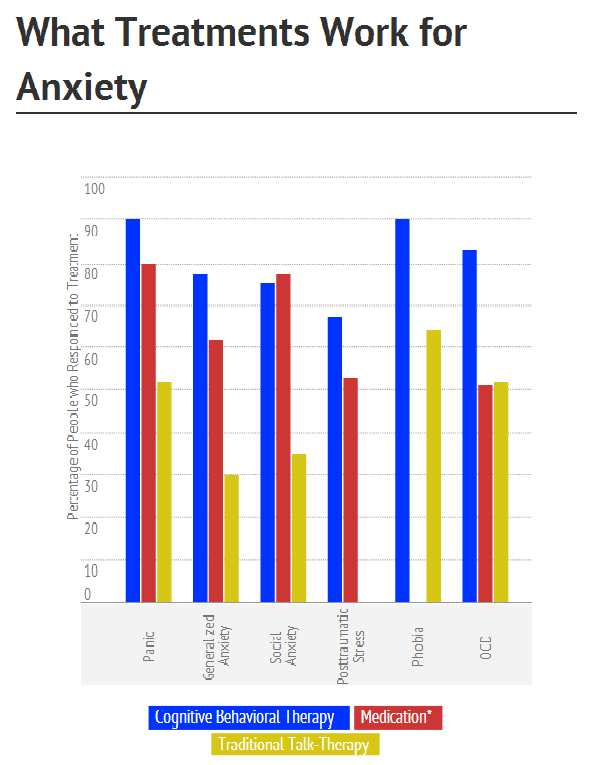
So what exactly is CBT? And what does the science say?
CBT is a type of intervention that aims at recognizing and changing the automatic negative thoughts and biases. These thought patterns can cause or worsen emotional difficulties, depression, and anxiety, with a detrimental influence on mood and quality of life.
Sometimes, we don’t realize the negative self-talk that goes on in our head, so let me give you some examples:
- Overgeneralization: “I’ll be single forever”, after a date goes wrong.
- All or nothing: “If I fail this exam, my life is over.”
- Personalization: “I’ve ruined everything. This breakup is all my fault.”
- Mind-reading: “I’m sure they all think I’m stupid!”
- Bias conclusions: “He doesn’t look happy, I’m sure he’s mad at me.”
- Catastrophization: “This is going to be the worst day of my life!”
- Ignoring the positive: “They’re only nice to me because they have to be.”
- Should/must: “I should be better at this, I must eat less, I should be promoted.”
It’s the simplest things, really, that might be affecting your life. Anxiety, fears, and depression are most often within us, not around us.
CBT is not a specific type of therapy but rather an umbrella term encompassing different types of psychotherapy techniques with the same fundamental process: identifying irrational beliefs, change these beliefs, modify the behavior.
There are three general categories of irrational beliefs: about one’s self, the environment, or the future.
The way CBT therapists tackle the problem is by investigating a person’s past experiences and how these belief systems were developed.
If you’re interested in CBT but don’t have the time, money, or even courage to consult a therapist, that’s okay; you might not need one. As a first step, you can try it on your own. The most crucial part is to learn a little more about it.
Uses of CBT
This form of therapy can be used to treat a wide variety of conditions:
- Phobias¹
- Addictions
- Anxiety²
- Depression
- Eating disorders
- Personality disorders
- Sleep disorders
- Bipolar disorder
- Stress
- Panic attacks
- Anger issues
It’s usually sufficient as a short-term treatment for people with a particular problem, aimed at developing skills and thought patterns that can alter harmful emotional responses. In meta-analysis studies, the evidence-base of CBT is very strong³.
The basic premise of CBT is the following:
It’s difficult to directly change our emotions. Instead, CBT targets thoughts and behavior patterns that contribute to the distressing emotions.
The cognitive model⁴
The cognitive model explains how thoughts, feelings, and behaviors are associated.
Most people think that a specific situation gives rise to their emotions.
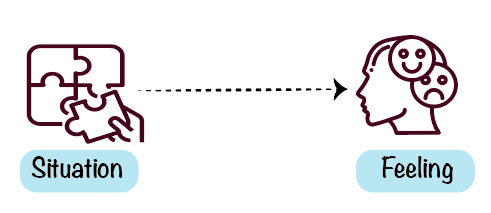
In reality, the thoughts we have about a particular situation give rise to our emotions.
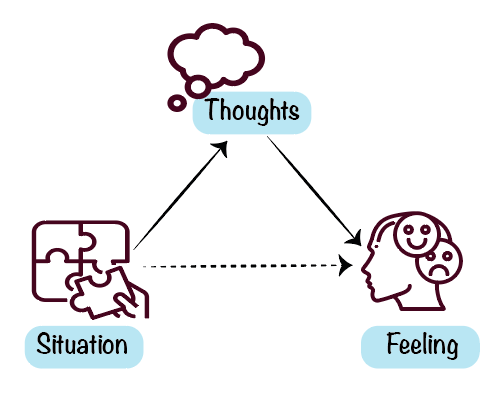
The cognitive elements of CBT help a person modify the way he or she thinks about situations. The behavioral aspect of CBT addresses how behaviors influence mood, and works towards decreasing negative triggers and increasing positive ones.
Social learning theory suggests that the likelihood of a behavior is determined by its consequences, which stands as the premise of behavioral activation.
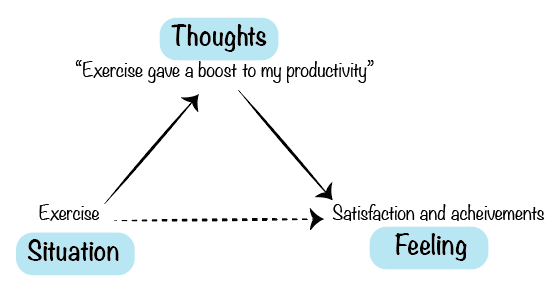
So why try it? Because we should all learn the following: while we cannot control every aspect of the world around us, we can and should take control of the way we interpret and deal with the environment and society. Once we become aware of the negative and unrealistic thoughts that dampen our moods and feelings, only then can we start engaging in healthier thinking patterns.
Are you prone to low-moods, depression, or anxiety? Here are a few symptoms.
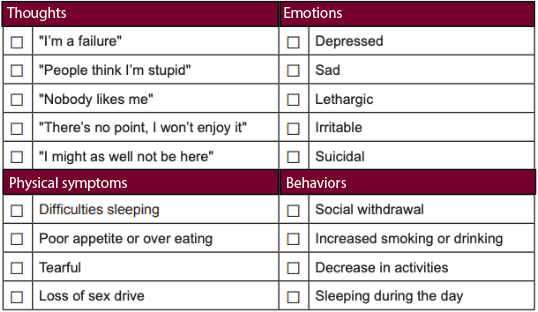
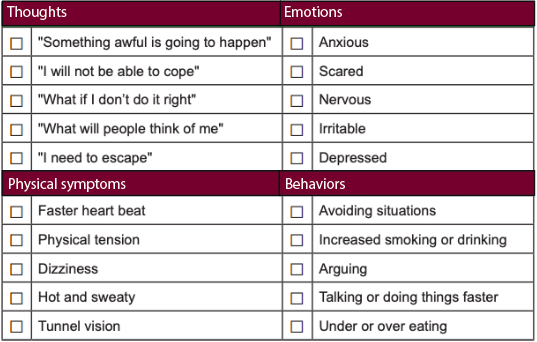
Other conditions include panic and worry, with different symptom patterns for thoughts, emotions, physical symptoms, and behavior. For more info on all 4 conditions, refer to this NHS leaflet.
CBT is easy, effective, short-term. It is supported by research and empirical data and can help people with certain types of emotional distress that don’t require further professional help and medication. PS: If you or anyone you know suffer from suicidal thoughts, seek the help of a professional. They’re here to help you through the more challenging times.
How to use CBT⁵ ⁶
So here’s a crash-course to try anywhere and anytime.
This isn’t a complete CBT. These are insights just to improve daily life. The full CBT intervention includes many other components.
The gist is the following: have a clear understanding of the problem, set your goals, and think about how your values and strengths will drive your change.
Step 1 — The problem
Let’s start by identifying the problem or triggers.
Exercise 1: To do this, you need to understand the situation’s ABC: Antecedent, Behavior, Consequence of the behavior. Some books or schools of thought refer to this as Behavior, Cognition, and Autonomic response, but the core is the same.
Mike feels lonely because no one called him today (situation). He thinks no one’s bothered about him (problem). He becomes more withdrawn (behavior), and ends up feeling tired and irritable (consequence).
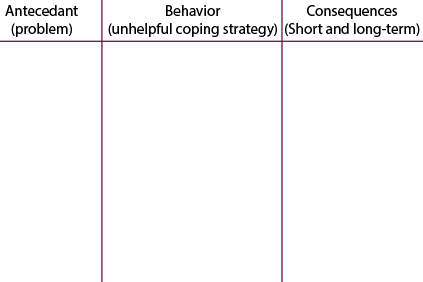
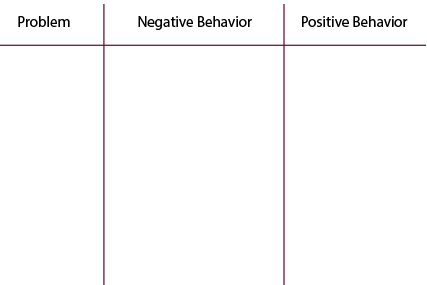
- Exercise 2 Now that you’ve identified the problems that you want to work on, and the unhelpful or unsustainable coping strategies, the next exercise is to identify helpful, workable and sustainable coping strategies that fall under your goals and personal values.
Instead of being withdrawn (negative behavior), Mike decides to give a friend or a family member a call (positive behavior).
Step 2 — The goals
Next, we need to set SMART goals: Specific, Measurable, Achievable, Relevant, Time Limited goals.
Think of this as a journey, and you need directions to reach your destination. Is it possible to get directions to a destination that you do not know yet? Your destination, in this case, is your goal.
So our friend Mike decides to do something about his loneliness: “I would like to meet a friend for drinks or food twice a week and spend an hour with them. I want to achieve this by next month!”
This is a SMART goal. Mike saying he wants to stop feeling lonely isn’t a SMART goal.
Exercise 3: To create your goals, think about the following questions:
- What do you hope to achieve?
- What will be different?
- What can you do to make the change?
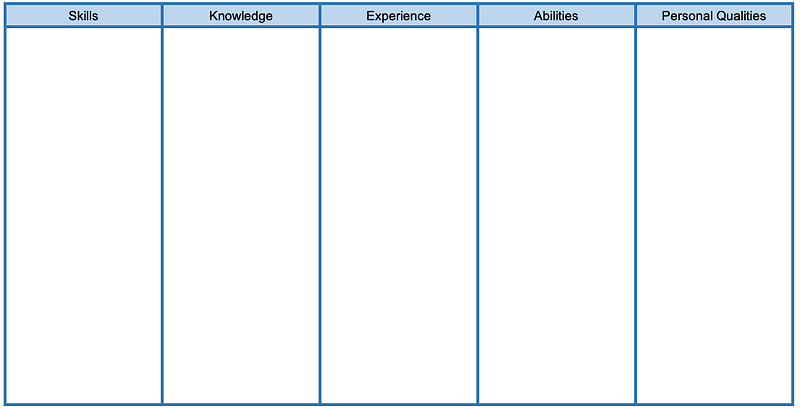
When setting your goals, think about the COST (what will you be losing) and BENEFITS (what you will be gaining) of each one. Benefits should always outweigh the costs for this exercise to be applicable and effective.
Be on the look-out for the following obstacles when trying to set your goals. They happen to everyone. • Worries about getting things ‘right’ • Feeling unmotivated when the improvement is not immediate • Not prioritizing the goal you’ve set
Once you’ve started your process, take some time to review your goals. • Do you need to adjust them? • Are they taking you in the desired direction? • Are there other problems to consider?
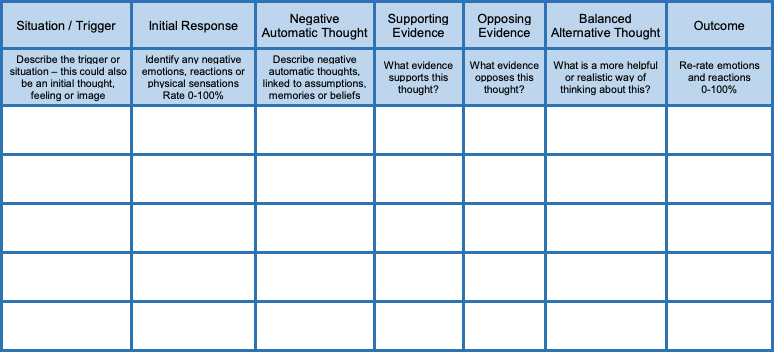
At this point in the process, keep a thought record with you. Below is an example.
Step 3 — The change
It’s time to consider lifestyle changes and incorporate them in day-to-day life:
- Sleep
I’m not going over the crucial importance of sleep, I’m just going to say sleep is indispensable for your brain and your body’s health.
If you can answer yes to all the following questions, you have a good sleep quality.
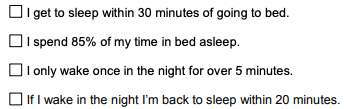
If not, this might help you. Contemplate your sleep hygiene. Here are some factors to consider.
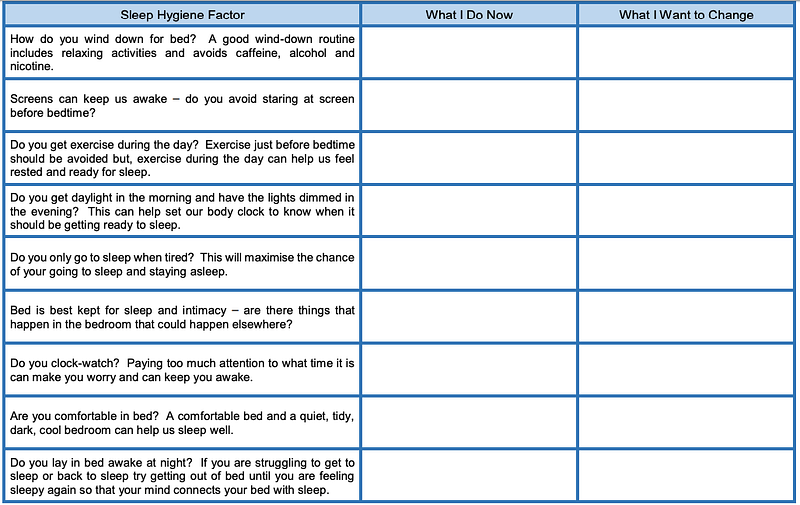
-Don’t go to bed unless you are sleepy. - Do something relaxing, not stimulating. - Stay away from screens. - If you can’t sleep, get out of bed and find something else to do. - Begin a routine that helps you relax each night before bed. This helps the body recognize a routine for sleep. - Avoid naps or limit it. - Keep a regular schedule. - Try to limit caffeine. - Do not have a cigarette or alcohol to help with sleep problems. - Don’t go to bed hungry, but don’t eat a big meal near bedtime. - Make sure your bedroom is dark, quiet, cool.
- Diet
Let’s aim for a healthy and balanced diet. Diet has a significant impact on our brain and our mental health. Many of us consume more calories than we need to( male average is 2,500 calories per day, female average is 2,000 per day).
Here are some tips:
-Get your fruit and veggies portions (5!) - Eat more fish. They’re full of proteins, vitamins, healthy fats, and minerals. - Don’t shy away from a balanced amount of starchy food. - Reduce fat, salt, and sugar. - Drink plenty of fluids (1.2L of water)
- Exercise
Exercising keeps you healthy, but -more importantly, in this context- releases your brain’s ‘feel-good’ chemicals to help with stress, low moods, and anxiety.
The Department of Health recommends 150 minutes of moderate activity each week, or alternatively, 75 minutes of vigorous exercise.
Examples of Moderate activities: Fast walking, hiking, cycling, skateboarding, volleyball, basketball.
Examples of vigorous activities: Jogging or running, swimming, football, tennis or rugby, fast or hill cycling, tennis, aerobics, martial arts.
Examples of muscle-strengthening activities: Body-weight and free-weight, yoga, heavy gardening.
- Mindfulness and breathing
Mindfulness is a way to turn your attention to yourself, the present moment, on purpose, and without interference, judgment, or criticism. It requires practice, lots of it, and involves bringing one’s complete attention to the present experience. Research shows that mindfulness can contribute to resilience, lower levels of depression and anxiety, improved working memory and concentration, increased focus and attention, and reduced physiological arousal.
Breathing is more complicated than you might think. There are correct ways of breathing -yes, sir- and it can have a considerable impact on your wellbeing.
What you want to achieve ultimately is abdominal breathing. Like any other muscle, the abdominal muscle requires training to function at its full capacity.
See the post below for a step-by-step how-to guide.
- Reward system and behavioral activation
Not a post goes by without me mentioning the brain’s reward pathway. And not a post goes by without me saying: Use it to your advantage!
Your brain is very similar to a dog in training — I’m sorry, but it’s true. It does something right, you give it a treat, it will do it again.
If an activity pleases you, do it, make time for it, regardless of how busy you might be. What maintains a low mood is a circle of reduced activity.
Behavioral Activation (BA) focuses on increasing the reinforcement of desirable behaviors and decreasing the rest. By slowly integrating structured and positive actions, BA breaks this vicious cycle and encourages you to continue incorporating effective practices in the future.
Exercises 4 to 8 There are 5 steps to BA to complete the cycle:
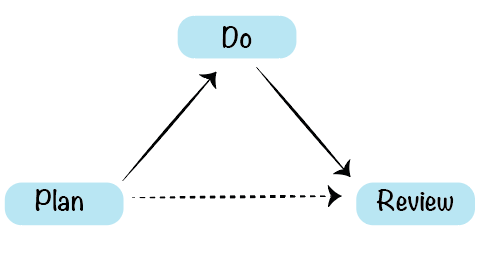
- Start by making a list of the following:
Routine Activities: waking up, general hygiene, cleaning the house, cooking, etc. Pleasurable Activities: activities which we get enjoyment from; hobbies, friends or family, sports, etc. Necessary Activities: paying bills, completing an important form, errands, etc.
2. Create a hierarchy of the list above by arranging activities from easiest to hardest.
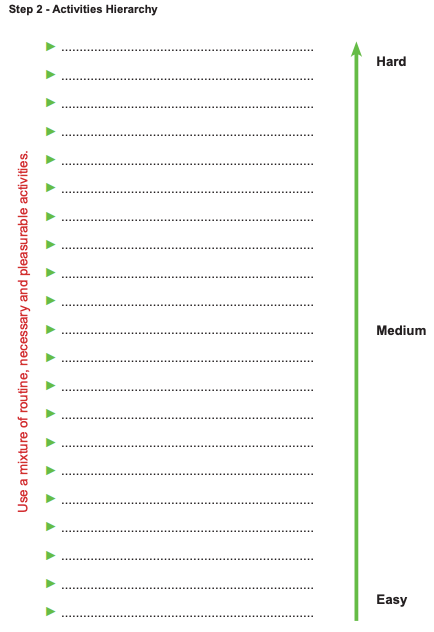
3. Make a schedule of your activities. Start with the easiest, and build in over time. Remember your SMART goals when building your schedule.
4. Stick to your schedule!!
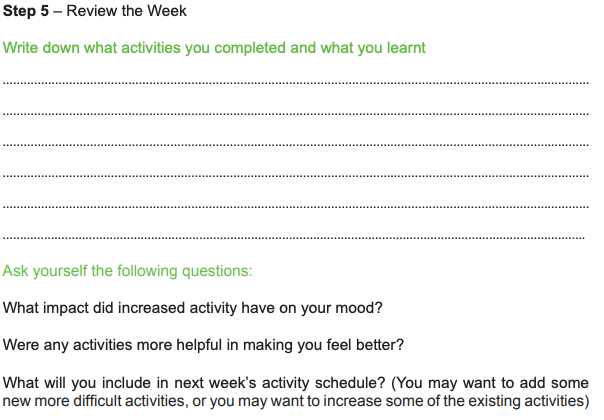
5. Always review your week.
Here is a concise list of other lifestyle changes and how they impact your brain.
The first step to any self-help is introspection. You’ve got flaws and ups and downs like anyone else; ignoring and burying them won’t make them disappear. You can be your greatest friend, but you can also be your worst enemy. The choice is yours.
“Start by doing what’s necessary, then do what’s possible; and suddenly you are doing the impossible.” — Saint Francis of Assisi
~Adriana~
Thank you for taking the time to read.
Stay updated with my future stories & recommend your topic of interest through my AudRec page.
For more interesting facts and information about the human brain.
Sources: ¹https://www.cureus.com/articles/8283-the-effectiveness-of-internet-based-cognitive-behavioral-therapy-in-treatment-of-psychiatric-disorders ²https://www.pagepressjournals.org/index.php/hpr/article/view/hpr.2014.1603 ³https://link.springer.com/article/10.1007/s10608-012-9476-1 ⁴https://www.mirecc.va.gov/visn16/docs/therapists_guide_to_brief_cbtmanual.pdf ⁵https://www.thinkcbt.com/images/Downloads/PRINT-WORKBOOK-THINK-CBT-V-09.05.17.pdf ⁶https://www.hpft.nhs.uk/media/1655/wellbeing-team-cbt-workshop-booklet-2016.pdf


