
Toscana Sketches
The Legend of the Italian Farmacia
Pharmacies in Italy play an outsized societal role
In small towns the world over there is usually a token establishment that acts as the social glue for its residents. In the British Isles this will often be the pub; in France the local brasserie or bakery; in India the chai shop; in rural America the Wal-Mart. But what about in Italy? Is it the pizzeria or the coffee shop? The gelateria or the local football stadium? What if I told you that it was none of these and that, instead, it was the local pharmacy?
In Italy, pharmacies are king. There is always a queue under the blinking green cross no matter the time of day. Smallish towns of under ten-thousand inhabitants often have three such establishments within striking distance of the central square. The average age in these queues reflects the demographics of an aging society like Italy’s — closer to eighty than seventy. Most of the patrons are habitual, of which a significant cohort is daily. You can tell who they are by the fact that they rarely buy anything more than a fresh box of aspirina and they often address the pharmacist like an old acquaintance. For an entire generation of Italians and their offspring, the farmacia has become a meeting point.
In small towns the world over there is usually a token establishment that acts as the social glue for its residents. In the British Isles this will often be the pub; in France the local brasserie or bakery; in India the chai shop; in rural America the Wal-Mart. But what about in Italy?
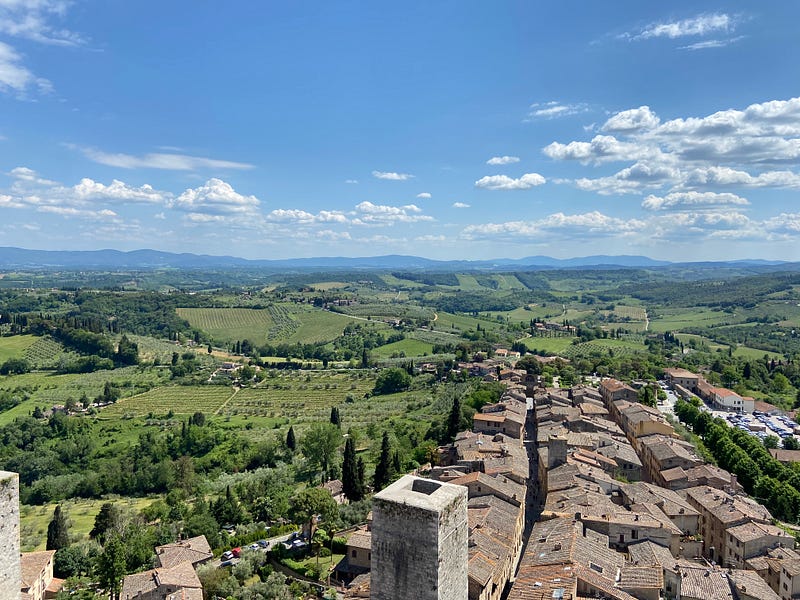
On a recent visit to San Gimignano in the Tuscan countryside, I was frustratedly waiting in line with my wife and mother when a lady dressed in her Sunday best opened the door, came in and yelled across the shop to the chief pharmacist, “I will leave this door open for you to get the air circulating better.” She then left abruptly, not having bought anything or even attempted to. Rather, she needed an excuse to pop by the pharmacy and show the local tourists that she was someone to be reckoned with. After all, one does not simply just get to informally dare del tu to a powerful figure the likes of an Italian pharmacist. The elderly lady in front of us — still wearing a double FFP-2 facemask three years on from a pandemic — seemed to agree. After much talk to the pharmacist about the adventures of her grandkids off in a faraway land, she left with her daily dose of aspirina.
While waiting for the next customers, I noticed the vast array of health gadgets lining the checkout. A few, in particular, caught my eye: a mask hooked up to a steam machine, typically used to alleviate early cold symptoms for little kids; an extra large blood thinness measurer; special home covid tests, which claimed a higher accuracy than others. Next to all of those innovations, were endless amounts of dermatologically recommended sunscreens. Most of these were ten to fifteen SPF. After all, health precautions can only go so far, they may not interfere with an Italian’s maintenance of a tan.
After fifteen minutes, it was finally our turn. The pharmacist — dressed in a typically Italian understated style under her white lab coat — took her time with us as well. She adjusted her glasses with an air of authority and analyzed every item we had picked out before scanning them at the checkout. She asked precisely what I was feeling in my throat to make sure that the spray I chose was, in fact, going to prove the most effective.
Smallish towns of under ten-thousand inhabitants often have three such establishments within striking distance of the central square. The average age in these queues reflects the demographics of an aging society like Italy’s — closer to eighty than seventy. Most of the patrons are habitual, of which a significant cohort is daily.
A couple of days later, with my sore throat turned into full-fledged flu, I found myself queuing again, this time for something a bit heavier. It was only then that it finally hit me why the farmacia is such a hot spot. For starters, although they may not provide your daily espresso (yet), they do have a near monopoly on over-the-counter medicine. If you need anything more than shampoo or deodorant, this is where you must come. Furthermore, the pharmacists on duty are, more often than not, highly-trained and skilled individuals who, due to the constant influx of clients and an aging population, have seen almost everything. As a result, they can act as shadow-general practitioners. It should thus be no surprise that the farmacia has become many Italians’ first port of call with any ailment. To my own amazement, in the days following my recovery, I had to resist the urge to casually stroll into the pharmacy for no particular reason. I was hooked.
My travel storytelling centers on long form first-hand accounts with a focus on vivid depictions of the local culture through the people I meet along the way. I also work as a travel advisor tailoring travel adventures all over the world, more info here: https://www.foratravel.com/advisor/nicola-volpi
Stay tuned! In the meantime you can find some of my other pieces below:


