15 Top Machine Learning Projects for Final Year Students
Machine learning (ML) has become one of the most in-demand skills in the world of technology. Whether it’s predicting house prices or detecting fake news, ML projects offer a hands-on experience that is both challenging and rewarding. Even if you are new to the world of ML, this guide will help you understand the basic concepts and step-by-step implementation of these projects.
Introduction
As a final-year student, choosing the right project can be a daunting task. With the rise of technology, Machine Learning (ML) has become a popular choice among students. But what is Machine Learning, and why should you choose it for your final year project? In this article, we will explore the concept of Machine Learning, its benefits, and provide you with 15 top Machine Learning projects that you can consider for your final year project.
Why Choose Machine Learning for Final Year Projects?
Machine learning allows you to build systems that can automatically improve with experience. Imagine creating a program that can predict trends, understand human language, or classify images! By choosing machine learning for your final-year project, you’ll not only learn cutting-edge technologies but also gain skills that are highly sought after in industries like healthcare, finance, and marketing.
Benefits of ML Projects:
- Problem-Solving Skills: ML helps you tackle real-world problems.
- Career Opportunities: ML experience makes you attractive to potential employers.
- Interdisciplinary Learning: ML draws from fields like statistics, computer science, and data analysis.
1. House Price Prediction
In this project, you will create a model that predicts house prices based on features such as location, size, and number of rooms.
Key Algorithms:
- Linear Regression
- Decision Trees
Implementation Steps:
- Collect a dataset of house prices.
- Clean and preprocess the data.
- Train the model using Linear Regression.
- Test the model and evaluate its accuracy.
Link to Code: House_Price_Prediction_and_Geospatial_Analysis.ipynb
Link to Article: house-price-prediction-and-geospatial-analysis
2. Sentiment Analysis on Social Media
Sentiment analysis helps to understand the emotions behind text data, like whether a tweet is positive or negative.
Key Techniques:
- Natural Language Processing (NLP)
- Text classification
Dataset and Implementation:
- Use social media datasets (e.g., Twitter API).
- Preprocess the text (remove stopwords, tokenize).
- Train the model with techniques like Support Vector Machines (SVM).
- Analyze results.
Link to Code: Real_Time_Twitter_Sentiment_Analysis.ipynb
Link to Article: Real-time-twitter-sentiment-analysis
3. Fake News Detection
With the rise of misinformation, detecting fake news is a critical challenge.
Key Algorithms:
- Naive Bayes
- Random Forest
Steps for Implementation:
- Obtain a dataset containing both fake and real news articles.
- Clean the text data.
- Train a classifier using Naive Bayes.
- Test the model on new articles.
Link to Code: Update Soon
Link to Article: Update Soon
4. Image Classification with CNNs
Image classification involves categorizing images into different categories (e.g., dog vs. cat).
Key Libraries and Tools:
- TensorFlow or PyTorch
- Convolutional Neural Networks (CNNs)
Implementation:
- Collect an image dataset.
- Build a CNN model.
- Train the model on the dataset.
- Evaluate the model’s performance.
Link to Code: Introduction-to-object-recognition-with-deep-learning
Link to Article: Introduction-to-object-recognition-with-deep-learning
5. Breast Cancer Prediction
This project aims to predict whether a tumor is malignant or benign using ML techniques.
Key Algorithms:
- Support Vector Machines (SVM)
- Logistic Regression
Dataset:
Use the Breast Cancer Wisconsin dataset, which is widely available online.
Steps:
- Preprocess the dataset.
- Build a classifier.
- Test the model’s accuracy.
Link to Code: Update soon
Link to Article: Update soon
6. Time Series Forecasting
Time series forecasting involves predicting future values based on historical data, like stock prices or weather trends.
Key Models:
- ARIMA (AutoRegressive Integrated Moving Average)
- LSTM (Long Short-Term Memory)
Steps for Building the Model:
- Collect time series data.
- Choose the appropriate model.
- Train and test the model.
Link to Code: arma-time-series-model
Link to Article: arma-time-series-model/
7. Chatbot using NLP
Chatbots are AI systems that can simulate conversations with humans.
Tools & Libraries:
- NLTK (Natural Language Toolkit)
- TensorFlow
Implementation:
- Preprocess the training data (e.g., previous chat logs).
- Train the chatbot with deep learning models.
- Test and deploy the chatbot.
Link to Code: Update Soon
Link to Article: Update Soon
8. Handwritten Digit Recognition
This project focuses on recognizing handwritten digits from images, a core problem in computer vision.
Dataset and Tools:
- MNIST Dataset
- Keras and TensorFlow
Implementation:
- Use the MNIST dataset to train a CNN.
- Test the model on handwritten digits.
- Evaluate accuracy.
Link to Code: Update soon
Link to Article: Update soon
9. Customer Segmentation using Clustering
Customer segmentation divides a customer base into groups based on similar characteristics.
Key Algorithms:
- K-Means Clustering
- DBSCAN (Density-Based Spatial Clustering)
Implementation Steps:
- Collect customer data (age, purchase history, etc.).
- Apply clustering algorithms.
- Visualize the segmented groups.
Link to Code: Customer_Segmentation_for_E_Commerce
Link to Article: project-customer-segmentation-for-e-commerce
10. Recommender System
Recommender systems suggest products or content based on user preferences like Netflix recommending movies.
Key Techniques:
- Collaborative Filtering
- Content-Based Filtering
Steps for Building:
- Collect user-item interaction data.
- Train a recommendation algorithm.
- Test its performance.
Link to Code: Movie_Recommendation_System
Link to Article: project-movie-recommendation-system
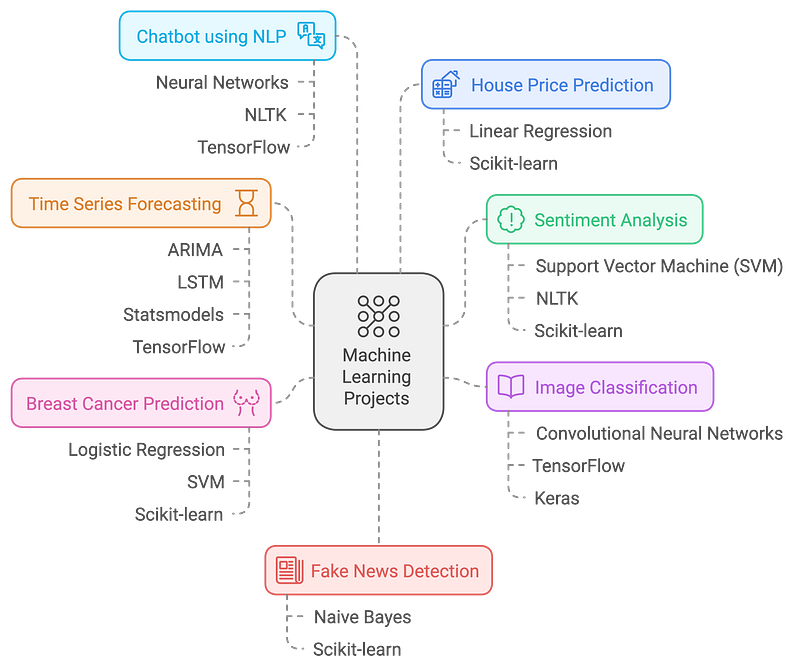
Key Algorithms for Different ML Projects
FAQ:
1. Do I need to be a programming expert to start ML projects? No, basic programming knowledge in Python will be sufficient to start with machine learning projects.
2. How long does it take to complete these projects? Depending on the complexity, it may take from a few weeks to a couple of months to complete a project.
3. Can I use open-source datasets? Yes, many projects rely on freely available datasets from platforms like Kaggle or UCI Machine Learning Repository.
Conclusion
Machine learning presents a broad spectrum of engaging and applicable projects for final-year students. These 15 projects not only instruct on the implementation of diverse ML algorithms but also assist in addressing real-world issues. From predicting housing prices to identifying fake news, each project provides a distinct educational opportunity that equips you for a future in data science or artificial intelligence. Enjoy modeling!


