
I Analyzed 100 ‘Popular on Medium’ Stories: Here’s What I Found Out
Here’s what I found out about the list of popular stories, their number of claps, headlines, publications, topics, and authors

Lately, I’ve been curious about what makes a post popular on Medium versus a viral blog on the rest of the interwebs. Many of us love to write on Medium, but outside of a few top individuals, many of the underworkings of this platform remain a mystery.
I wanted to see if I could find some common underlying factors in what curators might be looking for in general. Luckily for me, there’s a curated section called “Popular on Medium” that is made by staff at the company. You can find the section here.
The topic linked to above can go on for miles and miles, so I decided just to stick with the 100 most recently selected stories that are listed there.
Here’s what I found out!
Note: Just in case you haven’t become a Medium member yet, I’d love you eternally if you signed up using my referral link! I’ll get a small commission at no cost to you and you’ll get eternal love — win-win!
What is the single best statistical way to get selected in Popular on Medium?
- Travel back in time to the end of October and publish then (10% of all stories)
- Change your name to Drew Magary (7%) or run for president of the USA
- Get published in OneZero (19%)
- Use a directly related topic image (37%)
- Write an article on life advice (32%) or society problems/solutions (25%)
- Use a headline that tells people what they should or shouldn’t do (31%)
Easy right?
I’ll try to stick to the point and break down each category below for easy reading, starting with the ranges I used.
Ranges and Categories
Below are the ranges for each of the categories I noted down. Some of the figures, like number of claps, surprised me. These can’t be the most popular stories on Medium. Rather, I get the feeling that a staff member at Medium selects a few stories every few days that fit their goals that month.
- Stories Reviewed: 100
- Claps Range: 400 to 69,000
- Date Range: 14 March 2017 to 27 December 2019
- Publications Used: 30
- Different Authors: 82
- Image Categories: None, Semi-related Cartoon, Semi-related Image, Topic Image, Topic Cartoon
- Topic Categories: Business XYZ, Life Advice, Politics, Reviews, Scary Thing, Scientific, Society Problems/Solutions, This Happened to Me/Person
- Title Categories: Expert Says XYZ, Extreme Possibility Statement, I Did XYZ and Here’s What I Found, Review of XYZ, Scary/Exciting truth about group XYZ doing XYZ, Story Title (relies on the description), Time X Something Happened, You Shouldn’t/Should XYZ
Claps
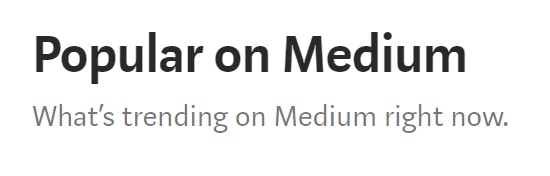
Before I started this analysis, I really expected to see claps for all stories being at least 10,000. I thought that would be the case based on what Medium labels the page as being:
I was very wrong!
- Only 25% of the selected articles had more than 10,000 claps!
I think we should still be able to use this as a generic test for readership, even though Medium changed their MPP system. There might be fewer claps today, but they can still be used as a level of reading assessment.
- 67% of the stories had between 1,000 and 9,999 claps.
- With the remaining 8% being below 1,000!
- Two articles even had below 500 claps and yet we’re still selected as ‘trending’ — hmm.
Dates
The dates we’re also interesting. Before beginning, I expected to see a good mix of really old but very SEO strong Medium articles, as well as topical ones from more recent months. Wrong again J.J. Pryor!
- 80% of the articles were from October 2019 until now.
- 5% were from 2017 and 10% from 2018.
I suppose the curators or staff who select these are trying to keep things more up to date. Can’t argue with that, but I do believe we’re seeing evidence that these aren’t actually the most ‘trending’ articles at any given point.
Publications
I had expected about half of the publications to be from Medium’s own just based on their recent statements. And I was finally right — Woooooo!
Medium has stated that they will be pushing their own publications more than others. And that’s certainly evident here!
- 56% of the stories I went through were published through a Medium owned publication.
- 9% were published in Coach Tony’s three magazines — Better Humans, Better Marketing, and Better Programming.
- 9% were interestingly self-published (several of these were famous politicians running for president).
- P.S. I Love You had 4 stories of the 100.
- The rest were the usual mix of big publications and a surprisingly large amount of small ones I haven’t heard of before (usually 1 off)
Authors
I was pleasantly surprised with the diversity and range of the authors in this list. As mentioned above, there were 82 different authors out of the 100 stories.
I also half-expected to only see really big Medium-famous names on most of these articles. Again, I was happy to see that it was quite a mix.
We do see Tim Denning, Jeff Goins, Darius Foroux, Coach Tony, Dave Schools and Thomas Oppong — but they only have a total of 10% of the articles combined.
None of the articles I came across were about writing, blogging, or improving at Medium!
I’m sure that’s a fresh dose of relief as that’s usually the majority of my main page — granted its what I read a lot about and the algorithm ‘helps’ me keep that habit.
Some other interesting names to see were Joe Biden, Pete Buttigieg, and Rep. Beto O'Rourke — no Republicans here.
Images
I should’ve made more categories for images, but I’m only human and was getting short of time. I ended up using some broad categories instead, as I listed above.
For the most part, the images were all applicable, with a few even making me chuckle after reading the story title.
- 37% showed a direct topic image. If the article was about Starbucks, it showed a picture of the brand or store.
- 36% used a semi-related direct topic image. These would be ones that showed a picture of a generic fancy coffee.
- 21% used a semi-related cartoon professional drawing. These often tended to be publications like OneZero or Gen. I suppose they have a professional artist on hand that makes these for the articles. Imagine a wacky coffee drawing.
- 5% showed a direct topic cartoon professional drawing. A cartoon version of a Starbucks branch.
- 1 had no image at all! But was from the politician Beto O’Rourke so I guess that faux-pas can be forgiven.
Most of the images were of professional quality and outside of the cartoons, were probably taken from Unsplash. In an older article or two, I did see some pixelated images that may have been taken in real life or from somewhere on Google. The image quality has clearly been made generally better over time.
Topics
This one was a bit difficult to classify before I sat down to research. I debated using the tags of the stories but found them a bit of a hassle to keep track of in Excel. Many of the stories also had quite strange and uber-specific tags. So I decided to make my own general categories and ended up with 8 different ones (listed above).
- 32% were listed as life advice. I guess people are truly suckers for finding solutions to our everyday lives.
- 25% were about problems or solutions in society. Some were telling stories about why wars were happening or people being oppressed. Some were about work-life and groups of people being ostracized.
- 11% were stories that I love to read — This Happened to Me kind of articles.
- 11% were also about specific businesses and something they have done, are doing, or want to do.
- 7% talked about a scientific advancement or issue.
- Of course, we have politics at 5%, and most of those were written by a politician themselves (or rubber-stamped probably)
- Interestingly, 5% of the stories were reviews of some kind. Whether raving about a product or reviewing an ingredient.
- The remaining 4% was about scary things that occur or exist
Titles
For the last aspect of these stories I researched, I had to make a decision on how to classify them. There’s many different ways a title can be written, but I came up with 8 ways to specify them for this review.
- 31% of the stories gave advice on what you should or shouldn’t do. This included a few different ways to say the same idea though. Do you want to drink coffee? Should you drink coffee? 10 ways to drink a cup of coffee. You get the idea.
- 28% of the stories were about a scary/exciting subject, and a group/company/product that is doing making it happen. Mostly fear-mongering but some positive articles as well. Coffee drinkers are killing the tea industry! — type of thing.
- Fortunately, one of the topics I tend to enjoy reading more was at 16% — Time(s) X-something happened to me/that person. These are often very interesting true stories and wrap up what they did in the end with a lesson. The time I drank too many coffees and wrote a Medium story about popular Medium Stories!
- 10% had a title that was vague like you would see as a title of a book. The descriptions of these stories usually would then explain the title and what you could expect in the story. Partying Monkeys! With a description of Why monkeys love to party when they eat lots of coffee beans.
- 6% of the articles were a review of some sorts. I tasted Starbucks super premium extra fragalistic pumpkin butter pickle coffee and loved it!
- 3% of the stories were discussing what an expert thinks about a subject. Carrot Top’s expert opinion on snorting caffeine pills every day.
- Another 3% were another kind of story I enjoy reading — I did XYZ and here’s what I found out. We all like to learn from the experience of others right? I had a Starbucks coffee and found a roach in it, here’s what I found out about alternative protein sources!
- The last 3% were extreme statements of possibilities with two of them being scientific in nature. Aliens will be coffee addicts within 200 years!
Wrap up
I went down this rabbit hole to see if I could discover some commonalities in what Medium is looking for in a good story. I didn’t realize that these wouldn’t be a list of the most-read articles, nor that it turned out to not be a true ‘top-trends’ list of stories.
It’s clear to me that there is a human hand in selecting which articles get chosen in this list and that makes it a bit less meaningful to me. It’s not showing what the crowd wants, rather more of what Medium staff want (or are directed to want).
But that last point is then useful. If you want to write an article suited for Medium, then this review should be able to help with that.
So, if you’re aiming to do just that, I’d suggest taking a look through the statistics above and finding what topics and publications are more suitable to your writing style.
Quick review:
- Pick a few topics
- Write an article
- Try to mimic one of the popular title styles
- Go apply to the publications!
Thanks for reading! To get other helpful lists and advice for Medium, be sure to follow the Feedium publication!
Please also consider following my free newsletter to keep up with me and my crazy shenanigans!
Note Again: Just in case you haven’t become a Medium member yet, I’d love you eternally if you signed up using my referral link! I’ll get a small commission at no cost to you and you’ll get eternal love — win-win!
The 100 articles I looked at:
- Authoritarian Nations Are Turning the Internet Into a Weapon — MORGAN MEAKER
- Science Confirms That the Vagus Nerve Is Key to Well-being — Markham Heid
- Inside Discord’s Thriving Black Market for Stolen Credit Cards and Gift Cards — Luke Winkie
- You Shouldn’t Have to Be Good at Your Job — Drew Magary
- It’s Time to Leave San Francisco — Sunil Rajaraman
- The Three Bay Areas — Keith A. Spencer
- How Traveling Back In Time Could Really, Physically Be Possible — Ethan Siegel
- The Latest Science on Chronic Pain Is Fascinating — Robert Roy Britt
- I’m a 37-Year-Old Mom & I Spent Seven Days Online as an 11-Year-Old Girl. Here’s What I Learned. — Sloane Ryan
- What Working-class and Poor White People Need to Understand About Rich White People — Jonna Ivin-Patton
- The Decade the Internet Lost Its Joy — Clio Chang
- I Once Talked To Seth Godin On The Phone: Here’s How It Changed My Life and Business — Jeff Goins
- The 3 Best Business Books of 2019 (According to Every Other Best-of-2019 List) — Todd Sattersten
- The Least Influential People of the 2010s — Drew Magary
- The Most Radical Artists Today Are the Ones Who Know How to Draw — David Hopkins
- The Decade Comic Book Nerds Became Our Cultural Overlords — Alex Pappademas
- The Influencer and the Hit Man: How a Years-Long Domain Name Feud Ended in a Bloody Shootout — Ian Frisch
- What’s the Least Amount of Exercise You Need to Stay Healthy? — Markham Heid
- I’m the Woman from the Peloton Commercial, and Your Jokes Only Make me Stronger — Laura Slade Lewis
- Psychologists Explain How To Stop Overthinking Everything — Thomas Oppong
- My Clients at McKinsey and My Commitment to You — Pete Buttigieg
- How to Tell a Woman Is into You Without Asking — Tara Blair Ball
- My Son Wore a Dress for Picture Day, and It Reaffirmed My Faith in Humanity — Alex Richards
- Scientists Are Contemplating a 1,000-Year Space Mission to Save Humanity — Corin Faife
- The Simple 10-Step Morning Routine That Changed My Life — Jeff Goins
- Do These Things Before Going to Bed and You’ll Wake up Energized for Tomorrow — Tim Denning
- The Absurd Story Behind China’s Biggest Bank Robbery — David Gauvey Herbert
- A Nude ‘Playboy’ Photo Has Been a Mainstay in Testing Tech for Decades — Corinne Purtill
- Stop Obsessing About Focus: Here’s What Your Mind Really Needs — Sílvia Bastos
- The Self-Help Movement That Is Upending American Christianity — Allegra Hobbs
- Three Magical Phrases to Comfort a Dying Person — Jenny Harrington
- Apparently I Was Nothing But A Woo-Girl — Michelle Ann
- The Magical Science of Wi-Fi on Airplanes — Sarvesh Mathi
- How My Startup Got Acquired After Six Months — Josh Howarth
- Why Amazon Is Betting You’ll Buy a Million Dollar Prefab Home — Ross Ufberg
- It Was Only a Matter of Time Before I Cheated on My Husband — Tara Blair Ball
- The Case of the Accidental Edible, or How I Melted My Brain With THC — Chris Thompson
- Everyone’s Wrong About the Streaming Wars — Mike Raab
- Dumping Kids with IEPs into General Education Classrooms is not Inclusion — Laura J. Murphy, MFA
- Big Calculator: How Texas Instruments Monopolized Math Class — Maya Kosoff
- The Boomers Are Not OK Why Tesla’s Cybertruck Might Flop — Alex Foley
- Planes Are Ruining the Planet. New, Mighty Airships Won’t. — Starre Julia Vartan
- Everyone’s Missing the Obvious About the Declining U.S. Birth Rate — Amanda O
- How My Friend Made $400K From Selling an Insanely Simple eBook — Tim Denning
- Nunes slapped with House Ethics Complaint for encouraging foreign interference in our elections — The Democratic Coalition
- You Don’t Need More Motivation — You Need a System — Darius Foroux
- Wildlife Cameras Are Accidentally Capturing Humans Behaving Badly — James Dinneen
- How to Talk to People Who’ve Been Through Some S#@t — Drew Magary
- The 2-Word Trick That Makes Small Talk Interesting — Dave Schools
- Are You Drinking Too Much Sparkling Water? — Katie Couric
- The Unparalleled Genius of John von Neumann — Jørgen Veisdal
- Apple Has Been Gaslighting Us for Years — Owen Williams
- I Hung Out with Andrew Yang and His Gang at a Weezer Show in Iowa — Drew Magary
- 3 Ingredients I Think You Should Give Up Forever — Tim Rees
- A Blind Man Sees His Birthday Candles Again, Thanks to a Bionic Eye — Emily Mullin
- How to Configure Your iPhone to Work for You, Not Against You — Coach Tony
- Inside the Underground Baby Trade in the Philippines — Lynzy Billing
- New 16" MacBook Pro Review: A Developer’s Dream Come True — Kaya Thomas
- The Companies Venture Capital Isn’t Allowed to Invest In — Supermaker
- Hong Kong is at war, and why should the world be worried. — 置地記者 LM Reporter
- Bolivia in Crisis — Jim Shultz
- Why xHamster Is So Much Better at Content Moderation Than Facebook — Lux Alptraum
- The System I Used to Write 5 Books and Over 1,000 Blog Posts — Jeff Goins
- The Unforgettable Relationship Advice My Ex-Girlfriend Gave Me — Nico Ryan
- Apple Is Trying to Kill Web Technology — Owen Williams
- You Won’t Want to Stop Eating Yewande Komolafe’s Spice Blend — Mark Bittman
- Do You Make This Mistake In Conversations? — John P. Weiss
- How to Train Your Brain to Remember Almost Anything — Thomas Oppong
- Inexpensive Ingredients to Get You to Payday — Becca Bycott
- Undercover in the Orthodox Underworld — Dan Slater
- Facebook Empowers Racism Against Its Employees of Color — FB Blind
- It’s Not Enough to Be Right. You Also Have to Be Kind. — Ryan Holiday
- EXCLUSIVE: This Is How the U.S. Military’s Massive Facial Recognition System Works — Dave Gershgorn
- Marinated Sandwiches Like This One Are Some of the Most Beautiful You’ve Ever Seen — Mark Bittman
- Why Fasting Works — Markham Heid
- This Science Vigilante Calls Out Bogus Results in Prestigious Journals — Gemma Milne
- How to Quit Sugar Without Being Miserable — Katie Couric
- Monsta X: Being a K-pop Idol in the Age of Online Harassment — Matthew Watts
- The Hater’s Guide to Mayor Pete — Drew Magary
- I Have Fought for the Democratic Party My Whole Career — Joe Biden
- The 10 Types of Tippers, According to Servers — Gerikoeppel
- An Error in a Python Script May Have Invalidated 150+ Research Projects — SeattleDataGuy
- Inside Discord’s Unmoderated, Potentially Dangerous Teen Dating Network — Luke Winkie
- Your Office Chair Is Hurting You — Ashley Abramson
- How to Support Your Fat Friends, as a Straight Size Person — Your Fat Friend
- Blackface Minstrel Songs Don’t Belong in Children’s Music Class — Dr. Katya Ermolaeva
- How To Learn Any New Programming Language Quickly — Bob Roebling
- My Goodbye to Deadspin — Drew Magary
- Want a data science job? Use the weekend project principle to get it — Daniel Bourke
- How To Wake Up at 5 A.M. Every Day — Bryan Ye
- Thank you. — Beto O'Rourke
- What Just Happened In Mexico? The Disaster of Culiacan — Shameen Yakubu
- Unraveling the Secret Origins of an AmazonBasics Battery — Sarah Emerson
- The House of Lost Souls — Patrick Glendon McCullough
- How To Fake Being a Good Programmer — Sten Sootla
- Fecal Transplant Death Mystery Solved — Dana G Smith
- Yes, I Am a Capitalist — Drew Magary
- Microsoft Access: The Database Software That Won’t Die — Matthew MacDonald
- It Has Been Twenty Years Since Fabio Killed A Goose With His Face On A Roller Coaster — Mike Toole


