
Beware: Remote Working Tools May Be Ruining Your Productivity

Now that we’re in the early stages of COVID-19-inspired working from home, the internet is flush with giddy professionals posting group selfies, like the one above.
It seems that organisations are finally discovering, or at least making use of what were — outside of the startup ecosystem anyway— previously neglected collaboration tools.
Large companies have a way of anchoring to the past, and it has taken a global pandemic to get them to try what are not so new ways of working. It has taken a global pandemic to effectively demonstrate that perhaps the entire notion of everybody going to a central meeting point, every day of the week, is redundant.
Note from the author: Hide your private meeting ID when you’re sharing these selfies online dummies!
Tools are only as good as how you use them
For some organisations, the transition has been a somewhat seamless one on the back of multi-million dollar investments into mobility and collaboration infrastructure (let’s forego the fact that numerous secure off-the-shelf tools exist for a fraction of the price and in some cases for no cost at all).
But despite all of this, what leaders at these organisations and what a lot of the remote working ideas suddenly flooding the internet seem to forget, is that a tool is only as good as how you use it.
It’s easy to spend your entire work from home day sitting in back-to-back, hour-long and unimportant Zoom calls with a cast of thousands while you respond to non-consequential emails and notifications on your smartphone, and chat with colleagues via Slack — it’s no different to a typical day at the office for many folks!
Some might even be engaging in extra-curricular activities like young Calum here.
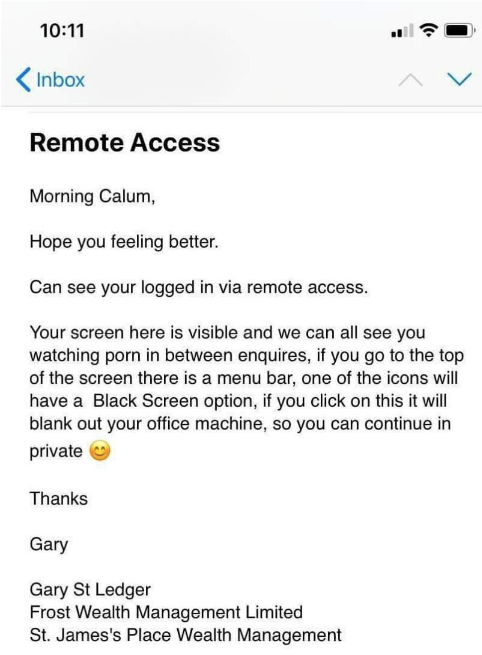
But none of this — especially not the extra-curricular activities — makes you even remotely productive…excuse the pun.
* 10X Your Productivity with the Time Rich Online Course*
Get more done in less time, with the companion course to my book, Time Rich. Watch the trailer below, and find out more at bit.ly/timerichcourse
Insecurity work is like junk food
All of this insecurity work (a term coined by Scott Belsky) is kind of like junk food — it might make you feel good and productive in the moment, but afterwards you’re left feeling like crap for the lack of genuine achievement moving you no closer to your goals.
Used poorly, instant messaging, email, videoconferencing software and other collaboration tools can actually become serious distractions as opposed to enablers of good work.
When we’re distracted, it can take us about 23 minutes to get back in ‘the zone’. Even the slightest distraction, such as the 1/10th of a second it takes to glance at a notification on your smartphone, can add up to a 40% productivity loss if you do lots of this throughout your day. This is why task switching is to be avoided at all costs.
Paradoxically, we can actually become more productive when we turn these tools off.
We are our own worst enemies
It’s not a lack of tools that get in our way of being productive from home — it’s us that gets in our way.
Human beings are programmed to take the path of least effort — or doing the easiest and least valuable thing — in order to conserve energy, with our brains tricking us into thinking that the lowest hanging fruit really is the ripest.
Not only are we battling biological predispositions that helped us survive on the African savanna, our homes are also full of distractions — there’s the internet to play with on our desktops (sans colleagues peering over our shoulder) with its rabbit-hole wonders of YouTube and Reddit, there’s Netflix and other streaming services, our fellow residents to engage with, and of course, the refrigerator.
The wrong things done right?
As with so many billion-dollar ‘digital transformation’ initiatives, if you digitise a broken process, the process is till broken. So too with remote work — a pointless one hour meeting is still a pointless one hour meeting, regardless of whether it takes place on Google Hangouts or in conference room 17B.
While there is definitely utility in connecting face-to-face during this time of social distancing, there is a right way to do it and a wrong way to do it — 5pm videocalls seem to be popular ways to connect socially without distracting you during your workday.
In order to truly become productive and effective at home, we need to shift the conversation from what we work with to how we work, because as Peter Drucker put it, there’s nothing worse than the wrong things done right.
Moving up the five levels of remote work towards a more asynchronous organization is key to effective remote work, and project management tools like Monday help facilitate that transition.
For more on how to actually work effectively from home, check out the article below.
Steve Glaveski is the co-founder of Collective Campus, author of Time Rich, Employee to Entrepreneur and host of the Future Squared podcast. He’s a chronic autodidact, and he’s into everything from 80s metal and high-intensity workouts to attempting to surf and do standup comedy.


