13 Tips to Crush Working From Home During COVID-19

Our behaviour is often a by-product of our immediate environment.
And many of us the world over are finding ourselves in a new environment — at least when it comes to work.
COVID-19 is seeing more white collar professionals working from home than ever before, and in many ways it is a long overdue transition, one that required a pandemic to finally stop leaders anchoring to the past.
But it might not be such a smooth transition for some, given the numerous distractions at play in our ‘home offices’.
Our Homes are Full of Distractions
When we’re distracted, it can take us about 23 minutes to get back in ‘the zone’. Even the slightest distraction, such as the 1/10th of a second it takes to glance at a notification on your smartphone, can add up to a 40% productivity loss if you do lots of it throughout your day.
Apart from said smartphone, there’s the internet to play with on our desktops (sans colleagues peering over our shoulder) with its rabbit-hole wonders of YouTube and Reddit, there’s Netflix and other streaming services, our fellow residents to engage with, and of course, the refrigerator.
Not only that, but as with those colleagues no longer peering over our shoulder, working from home lacks many of the things that serve to keep us accountable — or at least force some people to give the impression that they’re being productive. Think conversations about work by the water cooler, having to actually turn up at a certain time and you know, put on pants… hopefully not in that order.
We Fall to the Level of Our Systems
We might have good intentions when it comes to working from home, but as Atomic Habits author James Clear puts it, “we don’t rise to the level of our goals, we fall to the level of our systems”.
For example, if you want to stop devouring that bag of Dorito’s late at night when your willpower is depleted, then having several bags on hand in your kitchen pantry won’t help your cause. Having no such bags in the house is a far more effective environmental measure, and might see you reaching for a healthier snack instead.
When it comes to working from home, we need to be just as diligent with the design of our systems.
If we‘re intention, we can actually be considerably more productive when working from home, sans all of the non-consequential meetings and the 50–60 interruptions per day that typical employees contend with, most of which are unimportant.
I’ve worked remotely for several days a week for a number of years.
During this time, I’ve learned — out of sheer necessity — how to create an environment and put in place systems to consistently perform at what I think is a reasonably high level.
Doing so has been key to my writing several books — one of which, Time Rich: Do Your Best Work, Live Your Best Life, is on productivity — in addition to running a boutique consultancy, launching an ed-tech startup and hosting a 373 episode strong podcast.
With that, here are my 13 quick tips for crushing it while working from home during COVID-19.
1. Actually Prioritise Your To-Do List
It sounds obvious, but so many people sit down to their desks with a to-do list and just pick the easiest thing to work on, which more often than not turns out to be email or checking LinkedIn.
Human beings are programmed to take the path of least effort, according to a study out of University College, London. Researchers found that our brains trick us into thinking that the nearest beach has the best waves.
While easy, such tasks don’t deliver much value, and we can quickly find ourselves an hour or two into our day without having achieved much except immersed ourselves in some of what Behance founder Scott Belsky calls ‘insecurity work’.
By starting with the highest value activities, what I often find isthat by midday, I’ve done my best work for the day. The momentum and dopamine hit that comes with genuine achievement — as opposed to getting to inbox zero — not only motivating, but also helps us to feel good.
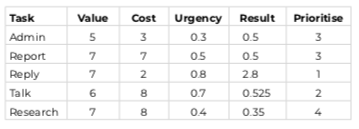
A simple way to prioritise your tasks:
Start by creating a backlog of tasks, as per the example Step 1: Give each task a rating out of 10 in terms of the value you think it will deliver. Step 2: Give it a rating out of 10 for cost (time and money — the higher the cost, the higher the rating). Step 3: Divide value by cost. Step 4: Apply a weighting to the urgency of step 3 (optional step) Step 5: Prioritise by the final result (the higher the number, the higher value the task)
Bonus tip: Prepare your to-do list for the next day before you call it a day. This way you’ll be able to hit the ground running the following day instead of get to your desk and waste time figuring out what to work on.
Bonus tip 2: Using a project management tool like Monday can help you stay on top of your tasks and create a super effective workflow.
2. Make Momentum Your Friend
If my highest value task is to write a 2,000 word article, then staring at a blank piece of paper can be paralysing.
However, as Isaac Newton’s first law of motion states, ‘an object in motion stays in motion until it meets an unbalanced force’.
Ultimately this means that it’s much easier to keep going once we’ve started, and that start doesn’t need to be big.
Returning to my 2,000 word article, I might instead set myself a goal of writing 100 words, or as several-times bestselling author Tim Ferriss likes to put it, “just two crappy pages”.
Committing to and starting on a small and achievable unit of work will set your proverbial object in motion, and make it easier to keep going.
If you’ve ever put off picking up a book on your coffee table while lounging on the couch, but summoned up the mental strength to read a page, you would have found that turning to the next page is so much easier than getting started. That’s the power of momentum.
3. Pulse and Pause
It’s inevitable that we will experience cognitive decline as the day unfolds, so it is critical that we incorporate frequent breaks into our day — to create a ‘pulse and pause’ cycle.
As angel investor and philosopher, Naval Ravikant puts it, “work like a lion who hunts for food, “train hard, sprint, rest and reassess — then go at it again”.
Set yourself a goal — whether that be completing a specific unit of work, or working (without distraction) for a specific period of time that works for you before taking a short break.
Francesco Cirillo developed the popular Pomodoro Technique in the late 1980s. It essentially involves breaking work down into 25 minute intervals, separated by five-minute breaks. After four rounds, Cirillo suggested taking a long break of between 15 and 30 minutes, before repeating the cycle.
This is just a guide though. Figure out what your rhythm looks like — it could be 60 to 90 minutes of pulsing followed by 15–20 minutes of pausing, as is the case with me — and commit to it. You might want to use an external timer as an aid to help you.
It helps to reward yourself not just with a break, but maybe a conversation with a family member, or perhaps even, a walk outside…
4. Incorporate Movement Into Your Day
It doesn’t need to be deadlifting 300 pounds, but something as simple as incorporating short walks into your breaks can do wonders for your focus and output.
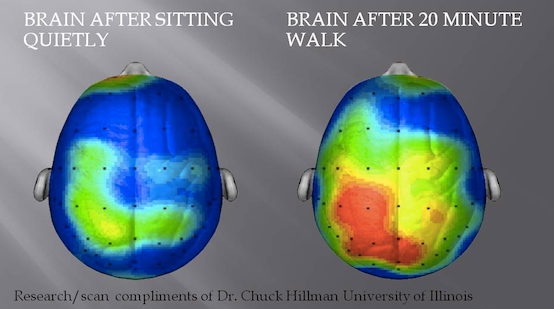
It turns out that when we move, our caveman brain recognises it as a moment of stress. It thinks we’re fighting an enemy, or fleeing, and as such, it releases BDNF (brain-derived neurotrophic factor). This ultimately acts as a reset switch, which is why we feel happier after exercising or going for a walk.
In fact, researchers from the University of Illinois found that our brain lights up like a Christmas tree after a short walk.
Perhaps we should take the two millennia old advice of Roman philosopher, Seneca on this one: “we must go for walks out of doors, so that the mind can be strengthened and invigorated by a clear sky and plenty of fresh air”.
While you’re at it, incorporate some sunlight into your morning.
Exposure to sunlight in the morning elevates mood by boosting serotonin levels in our body, which makes us perform better when we get down to work. Author of Stress-Proof Dr Mithu Storoni also found that morning sunlight improves our sleep — ‘the brighter your daylight exposure, the more melatonin you produce at night’ — again helping us to perform better when we’re at work.
If you need an external sleep aid to help crank up melatonin production, check out Melatolin.
* 10X Your Productivity with the Time Rich Online Course*
Get more done in less time, with the companion course to my book, Time Rich. Watch the trailer below, and find out more at bit.ly/timerichcourse
5. Set and Reach Targets
Rather than busying ourselves with said insecurity work and being busy all day, only to have nothing to show for it come the end of the day, we should set ourselves targets.
Don’t just prioritise those high value tasks and get started, but aim to complete them.
Ben Mezrich, author of 20 books including several bestsellers that were adapted into box office hits such as The Social Network, was asked about his productivity in an episode of the Future Squared podcast.
He credits his prolific output to discipline, eliminating distractions and locking himself in a room with a clear and specific goal of writing six pages a day. And he doesn’t stop for anything until those six pages are done.
“It could take two hours, or it could take all day”, he said.
6. Eliminate Notifications and Batch Your Work
A simple, often spoken about, and little practiced hack that can keep you focused for longer is to simply turn off your push notifications.
Remember, even the slightest distraction can incur a 23 minute refocusing, or ‘cognitive switching penalty’. As such it’s important to not pepper throughout our day task switching such as short glances at email or social media. Batch such tasks instead by doing them at set timeframes.
You’ll also want to minimise task switching across your value chain of work. For example, social media could be broken down into numerous component parts — do them sequentially.
For starters:
- Disable all notifications on both your desktop and smartphone.
- Turn off your phone or set it to Airplane mode for set periods of time.
- Use the Freedom app or Blocksite to block non-mission critical applications (such as social media) for set periods of the day.
- Use Google Chrome’s “compose email” plugin to see only the compose window when writing an email, which allows you to circumvent the temptations waiting in your inbox (or use Inbox Pause to pause inbound email).
- Set windows of time to check and batch-respond to email.
7. Eat Well
For many of us working from home, the fridge can become our best friend and our worst enemy.
It can make us feel temporarily happier, but destroy our waistlines and confidence in the long run. And it’s a killer for productivity.
I’ve often found myself taking one too many trips to see my friends Fisher & Paykel. But by practicing the pulse and pause cycle, you can use trips to the fridge, or cupboard, or cafe down the road, as rewards for focusing and knocking tasks off your to-do list throughout the day.
Just keep the rewards sensible — try and limit your intake of simple carbs and sugary treats until later in the day if you must have them at all, as this will help you to avoid sugar crashes.
Protein, good fats and complex low-GI carbs provide you with slow burn energy so you can stay focused for longer. Ensure you’re stocked up on the good stuff.
8. Maintain a Sense of Team and Shared Mission
Being part of a tribe with a common goal is a source of both accountability and motivation, and the isolation that comes from working from home can suppress our motivation and our sense of belonging.
As such, create rituals to check in with your team on a daily or at the very least, weekly basis. This could be as simple as a group Google Hangout, or daily standup using Slack.
As in daily standups:
- share what you completed yesterday
- share what’s on your plate today (your to-do list will come in handy)
- share if anything is getting in your way that you might need help with.
Doing so will serve to maintain that feeling of community, accountability and keep everybody rowing in the right direction.
9. Put Some Pants On
It might feel good to roll out of bed and into your study with your pyjamas still on, but studies show this won’t be so good for your focus.
A study published by Wiley found that participants who worked from home reported feeling more authoritative, trustworthy, and competent when wearing formal business attire.
Now, I’m not suggesting you put on power suit to work from your study, but wearing what you might to a casual office day should suffice.
I find that just the act of putting on a pair of jeans and a crisp t-shirt or shirt helps my brain click into gear.
10. Work From a ‘Work Room’
It might be tempting to work on the living room table, in full view of the latest episode of Black Mirror.
Even with the television turned off, as with clothes, our brains associate this space with leisure and relaxation, and as such, won’t be as focused to get stuff done.
If you can, work from a space in your house that you associate with work and work only — not sex, not television, not eating…. just work.
11. Change of Scenery
While we should be trying to isolate ourselves as much as possible during these uncertain times, changing up our scenery and working from a reasonably quiet cafe nearby — one that doesn’t require you to mix with large crowds on your commute — might also help our focus.
Research shows that a moderate level of ambient noise — like that found in cafes — can actually help us to focus. But if you’d rather stay away from people and mitigate the risk of infection as much as possible, then there are always binaural beats.
12. Binaural Beats
First discovered in 1839 by physicist Heinrich Wilhelm Dove, binaural beats play different audio frequencies in each ear, which coalesce to trigger brain activity, getting you into the flow state.
Try listening to some beats for free at myNoise.net and Brain.fm the next time you’re doing something that requires full concentration.
On audio, Matt Mullenweg, founder of WordPress, says that listening to the same song on repeat gets him into flow. Arkansas psychologist Elizabeth Hellmuth Margulis echoed these thoughts in her book, On Repeat: How Music Plays the Mind.
Excuse me while I put on some Iron Maiden on repeat to finish this article…
13. Communicate Effectively
Finally, ensure that once you’ve found your rhythm and committed to a certain way of working, that you have a conversation with your fellow residents, be they your family members, significant other or housemates.
Make it clear that your work is important to you and that during certain times of day, unless something is genuinely urgent (most things aren’t), they should do their best not to interrupt you.
Over time, they will come to appreciate your way of work and respect your boundaries, but it’s imperative that you make them clear from the get go.
Sharing this article with them might help.
So there you have it, 13 quick tips to help you weather the COVID-19 storm, and not only maintain, but crank up your productivity while working from home.
Working from home is, for the moment, a privilege and not a right, so let’s be intentional about how we work, show that we can be productive away from the office, and earn the right to work from wherever we please more often.
Now read this…
Rich, Employee to Entrepreneur and host of the Future Squared podcast. He’s a chronic autodidact, and he’s into everything from 80s metal and high-intensity workouts to attempting to surf and do standup comedy.