
Your Money Doesn’t Make You Special
You’re just a product of where and when your parents decided to have sex

Quick tip: If you write for a platform that allows for responses or comments, mine these reactions. They’re often thoughtful and insightful (especially on Medium). They can lead to your next article and the one after that.
More importantly, this feedback helps gauge what resonates with readers. Who has an affinity for your weirdness and the random things you obsessively deem important. Over time, what readers say can help you unpack the most salient elements of the narratives you attempt to weave.
In this article, we explore one of the most important traits you need to not only be good with money but be a good person with money.
If I had to distill it to one super straightforward phrase, I’d say don’t be a self-entitled, pretentious dick born on third base thinking you hit a triple. But let’s elaborate a little.
Consider Karen Cherry’s response to my recent Making of a Millionaire article, The Easiest Path to $1,000,000 in 20 Years:
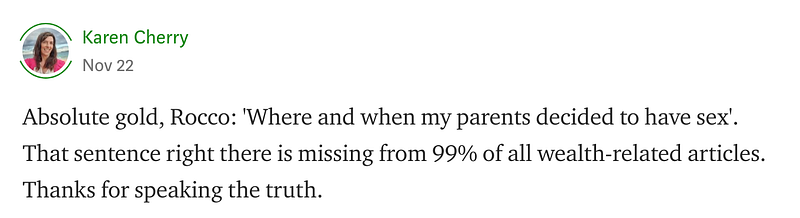
Here’s the full context surrounding that statement:
So when I say it’s easier than you think to amass $1 million in 20 years, I say it from a position of privilege to an audience largely comprised of people on the same perch. This isn’t to say hard work doesn’t get you anywhere. It does. But, speaking for myself, I’m aware I have a head start. And it has little to do with anything other than my place in life. Hard work didn’t get me here. Luck and where and when my parents decided to have sex mainly did.
If you’re one of the lucky ones to earn, say, $50,000 a year or more, you have a better than fighting chance to amass $1,000,000 (or more) within 20 or so years.
And here’s the funny thing. I come from a working-class background. My dad worked in a carbon plant for like 30 years and took a forced early retirement before doing maintenance for the local housing authority and painting houses on the side. My mom stayed at home. We weren’t poor. But we certainly weren’t rich.
My parents rented one unit in a duplex until I was in like first grade or something. Then we moved into our first house. A decade or so later, my parents bought the house they still live in today. It cost about $80,000. It’s long paid off and worth, if they’re lucky, $110,000 today.
My parents live comfortably on the aforementioned pension and Social Security. From time to time, they’ll drop a check in the mail, addressed to me for $1,000, even if I don’t need it. On holidays and my birthday, they send $100. They do likewise for my daughter.
To the best of my knowledge, we started out relatively poor. But my dad worked his ass off. When I was a kid, he left for work at 5 in the morning and sometimes didn’t get home until 6, 7, or 8 at night. He cemented us as comfortably middle class. This is how my parents live today.
Not taking anything away from my dad — because his work ethic deserves my and your respect — but it’s much easier to pull off what he pulled off for himself and his family in the small city we’re from than it is in more populous places, such as my adopted home — California. It’s not simply that he worked hard. It’s that he was positioned — even if not perfectly — for his super hard work to actually pay off in our society.
I see people every single day who probably work every bit as hard as my dad did — doing far more menial work — yet they don’t own a house outright or send a thousand bucks of discretionary income (that’s the key) to their kid for the heck of it.
People like my dad are a rare and special breed. They’re also beneficiaries of circumstance. I’m pretty sure my dad grew up poor, but it’s not the same type of poor other people grow up in and have to deal with. It’s way “easier” for a working-class white man in a small city, comprised primarily of other working-class white people, to break into the middle class and stay there.
Here’s why. And I fucking cringe as I admit these realities of my childhood. The move we made to the home my parents still live in today was a classic case of “white flight.” I still remember the front porch conversations among neighbors:
Are you thinking about putting the house up for sale? The blacks are moving in.
It’s true. As African Americans encroached on my predominantly white neighborhood, a vast majority of my white neighbors — including my family — got the hell out.
When I worked summers with my dad at the housing authority, there was a sense that black co-workers were lazy. For the record and to be clear, my dad never perpetuated this type of bull shit. There never was a person he didn’t like or respect, regardless of how they looked or what others thought of them. But, generally, if you were white, you instantly held higher status than your Black co-workers.
It’s quite remarkable when you think about it. My working-class father, who grew up some flavor of poor and worked his way out of it, operated and definitely operates from a position of privilege, particularly because he has never had to deal with the systemic racism and resultant inequality that directly and indirectly stigmatizes and thwarts the middle class dreams of so many People of Color.
I’m better off than my father was. He and my mother helped set me on the path to doing better than they did (depending on how you measure these things — I mean, I don’t own a home at all, let alone free and clear). But he was able to do what he did — for himself and his family — because of chance. The same goes for me.
It comes down to little more than luck, of being born a certain color in a particular place where the odds stack in a way that hard work absolutely can and often does prevail.
Today, I live in an apartment building in rapidly gentrifying East Hollywood. I have written about my small but sweet New York City-style studio before.
Across the hall from me, three fifty-something Latino laborers live — together — in the same tiny apartment I keep for myself. As long-time occupants move out of the building, the owner remodels their rent-controlled units and rents them— at market rate — to somebody more like me. White and privileged. The wheels of gentrification turn. (I’ll write more about this in future articles).
But the point here is that these three men remind me of my father in many ways. They’re gone early, home late. By all accounts, they work their asses off. And, even if they don’t, I can find equivalent examples of working-class people in Los Angeles — and elsewhere — who absolutely do, yet don’t have a mortgage-free house and $1,000 checks (just for the heck of it, seeded by disposable income) sent to their kids to show for it.
If one of these guys happened to be born someplace small in the American Northeast, they might be more like my father — materially. They wouldn’t sleep on a mattress on the floor of a 350-square foot studio apartment.
We can talk all day about what it means to be good with money and how to get there. But, as Karen indicated (it must be tough to have the name “Karen” these days), we don’t talk enough about being a good person with money in articles about wealth and personal finance.
We don’t acknowledge the role luck and chance play in not only where we end up in life and how much money we have, but how and why we got there. It’s easier to set goals and have dreams when you were born on the relatively comfortable turf of third base.
I guess we call this perspective. It’s definitely a good thing to have when you think about money. Beyond it making you a better person — and, hopefully, a good person with money — it strikes a healthy amount of fear into your heart.
It makes you realize the thing people often say about money and wealth isn’t so cliche after all — many of us are just an unfortunate event or two away from not being so fortunate. However, even armed with that humility, we also have to realize that many of the same us stand to bounce back better from unfortunate events directly because of our place in life. Because of where and when our parents decided to have sex. Something we — thankfully — have no control over.