
Structural Inequality, Systemic Racism, and Money
On writing about personal finance from a place of privilege
There will not be a conclusion to this article. It’s not possible to write one. In fact, there probably never will be a conclusion. At least not in my lifetime.
However, I feel the need to address the writing I do about money as it relates to structural inequality and systemic racism in our society. Some of the response to my recent Making of a Millionaire article — Young People Are About to Get Rich in a Massive Transfer of Wealth — compelled me to focus on the subject:
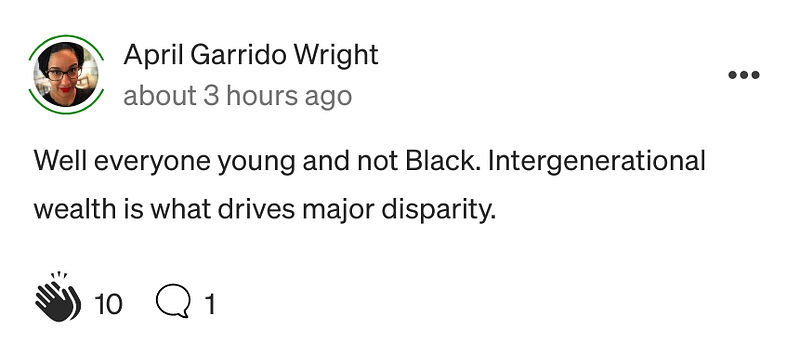
Thank you, April Garrido Wright, for the response. I appreciate it.
Shortly before writing the aforementioned article, I addressed an overarching theme related to this topic in another Medium article:
I’m under no illusion. I write these articles about personal finance from a privileged position. There’s a good chance you read them with privilege fully intact. If we spend our time thinking about building wealth rather than how to make ends meet, chances are we were born on third base. We didn’t hit a triple.
So when I say it’s easier than you think to amass $1 million in 20 years, I say it from a position of privilege to an audience largely comprised of people on the same perch.
So it’s no surprise that an article about passing down wealth would elicit the response it did from April. I’m happy she made the comment.
Because I don’t have a clear story to tell (yet), it’s best if I write in bullet points for a minute. This is more like my thought trajectory than it is any attempt to come up with an answer or direct reply. Bear with me, please.
- I come from a working-class background. My parents live in a small city in upstate New York. They bought a house for $80,000 about 30 years ago. It’s probably worth something like $100,000 today. That’s the bulk of the wealth I stand to inherit.
- While I don’t plan to rely on this money in the future (for a whole host of obvious reasons), I’d be foolish to at least not factor it into my thinking and long-term financial planning.
- Part of what got me thinking about generational wealth transfer is what I studied in graduate school — gentrification.
- I live in a rapidly gentrifying, predominately Latinx neighborhood in Los Angeles, broadly known as East Hollywood.
- When I go by old Craftsman and other classic Los Angeles homes for sale in and around my neighborhood, I wonder about the circumstances. Who owns the home? Who’s selling it? And why?
- When one of these houses sells, one of two things tend to happen (as I see it):
- A developer buys it, tears it down, and builds market-rate, multi-family housing, multi-family affordable housing, or a mix of both.
- A private person buys the house and either fixes it up or tears it down, usually resulting in a refresh of the original architecture or a modern structure.
- Are children inheriting these homes from their parents?
- If so, they’re *smart* to sell, given the price of real estate in Los Angeles today. It’s entirely possible they’re selling homes for close to or more than seven figures that their parents bought for six figures, maybe less. Is there a wealth transfer happening in working-class neighborhoods? If so, what does it look like?
- I live in this neighborhood because (a) I like it and (b) the rent fits my budget and relatively low cost of living.
- I am somewhat obsessed with three seemingly divergent academic disciplines:
- Urban studies, with a focus on urban sociology, urban housing, gentrification, inequality, and the built environment.
- Community and social psychology, particularly sense of community, happiness, and well-being research.
- Economic psychology, which focuses on “the psychological mechanisms that underlie economic behavior. It deals with decisions (individual or interactive), preferences, judgments, and factors influencing these, as well as the consequences of judgments and decisions for economics and society.”
- In my previous life, focusing on disciplines #1 and #2, I studied the relationship between the built environment and health and well-being.
- I dropped out of that Ph.D. program but intend to go back to graduate school. I am devising a plan to combine all three disciplines, looking at factors such as wealth, personal finance, inequality, diversity, and how they relate to constructs of community, happiness, and well-being at the neighborhood level across divergent neighborhoods (racially and economically) in Southern California and (maybe) elsewhere.
- I want to bring a public policy component into this research that addresses the very fact that a vast majority of people who participate in conversations about money — like the ones we have on Medium — operate from a position of privilege, often white privilege.
So I present this thought trajectory for a few reasons:
- There’s guilt and shame in play. I’m open and honest about this. It’s an ongoing intellectual conflict, knowing that I write in a space that’s really emblematic of the structural inequality and systemic racism that exists in our society.
- I want to let readers inside the process of how I come to write about what I write about. My passion lies in the broad urban sociological space. I don’t think we connect this area to money, personal finance, and all that they entail enough. There’s an opportunity here. And it could help broaden the discussions we have.
- I write about personal finance the way I do — conversationally and from personal experience — in an attempt to individualize it. How can I advance my work — be it here, elsewhere, or in a future academic setting — to make it not only more inclusive but relevant to people who might not normally participate in these privileged interactions?
- Because I want more feedback, I would love responses to any of the thoughts I’ve thrown out here. I’d love ideas on how to take things to the next level. It’s one thing to take the relatively unique approach I do to connect with other privileged people like me. It’s entirely another to create a more welcoming playing field that addresses the needs of underserved populations. I am fully aware that one of these needs might just be access. Many of the principles I write about apply regardless of how much money you make, have or will inherit. It’s about bringing more people into the fold.
- How do we not just create a more welcoming playing field, but a more level one? I think it’s possible, even in a capitalist society with considerable Trumpism and a relatively moderate Democratic party, to level the playing field to some extent, particularly if we focus on public social policy at the community, city, and regional level.
- This thought trajectory might help me make the connection between the type of stuff I’m writing now, what I wrote about/studied/researched in my past academic life, and how I might tie them together and expand the scope and impact in my present writing and future academic endeavors.
- Because I seek broader ideas on how to work a more diverse set of voices into what I do — into my writing specifically — and the broader personal financial media landscape. Help me do this. Let’s do this.
Bottom line — it’s not lost on me. The notion of privilege as it pertains to personal finance writing and discussion. This said we’re never going to bring more people into the conversation if we stop the conversation.
It’s a challenge. And sometimes I have no fucking idea how to rise to it. Sometimes I make mistakes in my writing and interactions that I don’t even think about. But this is part of the problem. I’m white. I’m privileged. I don’t *have* to spend much time considering systemic racism. As much as I think I care and am passionate about it, it doesn’t have to be on my radar like it does for other people. Sometimes I let it fall off of my radar. I’m not proud of this.
In closing (hey, there is a conclusion!), I’ll relay part of an excellent email interaction I had with a Medium publication editor earlier this week. After I pitched this editor a story where I mentioned a handful of Medium’s top writers (all white, all male), the editor responded with this:
Also, do you notice anything in common about all the writers you mentioned? It’s… not exactly a step towards a more diverse platform. I’d rather give attention to writers who aren’t getting it, and who deserve to!
Part of my response:
Thanks for this feedback. I really appreciate it. In fact, in a good way, it put me in my place. It’s easy to do what i did — rattle off the names of all white men without even thinking about it. I’m embarrassed, but in a good way.
It’s not easy to get called out like that. However, it’s required. I’m happy it happened. It made me uncomfortable and, yes, embarrassed.
I want to be better. I want to take the work I do to the next level. I think it’s possible to do this from various standpoints. I can expand my audience. I can write one set of articles for one or more audiences and another set for one or more different audiences. Some writing can apply across readerships. I don’t know.
At the same time, I don’t think the answer is to simply stop writing for the privileged audience. This would be counter-productive. Money matters. We just need to find ways to cast wider, more thoughtful, and inclusive nets.
I have ideas. I’ll better formulate them and present them in articles in future days and weeks. But I think we’d all benefit from a larger discussion that goes beyond the things running around my head. I appreciate April and the unnamed editor bringing these things to the forefront of my mind this week.
Thanks, in part, to them. I hope this rough sketch of an article leads to more.
This article is for informational purposes only. It should not be considered Financial or Legal Advice. Consult a financial professional before making any major financial decisions.