
You Can Have an Insanely Low Cost of Living (and a Great Life)
There’s no excuse for spending too much, even in big cities

Readers often push back when I detail living in Los Angeles (and eventually Portland) on $2,500 a month. I can’t wait until I hit my goal — hopefully sometime next year — of doing it on less than $2,000.
While it’s not for everyone, there’s no excuse for not being able to do it. You can save most of what you earn — and live well — if you want it bad enough.
Maintain an insanely low cost of living and the word “retirement” doesn’t even have to be part of your vocabulary.
Work you love that doesn’t break your back, alongside thoughtful budgeting and investing plans, eliminates the need to ever officially retire. You can live a new definition of retirement now — when you’re young — on your terms if you’re willing to compromise and make the choice to not defeat yourself.
In this article, I consider the three most common objections to my low cost of living assertions.
Nobody Wants To Live In A Studio Apartment Forever
Make compromises, because that’s life.
In Los Angeles, I live in a studio apartment that costs $1,350 a month.
That’s below the $1,549 citywide average for a studio (as of August 25, 2020) and significantly lower than the $1,860 average for a studio in West Hollywood, the neighborhood where I’d live if money wasn’t an object. Start dealing in one- and two-bedrooms and you head north of $2,000.
I could technically afford to pay $2,000 or more, but I compromise.
I live in a small apartment in a second-tier neighborhood. I give up things West Hollywood offers (mainly walkability) to keep a low cost of living. This doesn’t make unhappy. I have a great life.
Compromise isn’t a bad word.
It’s just a choice you make in one area to get something you want more in another.
I want walkability. I want a newer, more modern apartment. Because I can’t get these things on my budget in Los Angeles, I will move to Portland. In Portland, I’ll be able to live in one of the city’s best, most walkable neighborhoods in a better apartment for roughly what I pay in Los Angeles.
That’s not a compromise (I love Portland). That’s just a common sense choice.
It’s akin to somebody trading in city life for suburbia so they can own a home. I’m trading in one city for another so I can live in my neighborhood of choice without increasing my monthly spend.
If you don’t want to live in a studio apartment, find another way to make it work.
Get a roommate or save money elsewhere (e.g., don’t have a car, don’t eat at restaurants, don’t drink) so you can afford higher rent and still maintain a low cost of living.
If you don’t want to make these compromises then you want these things more than you want a low cost of living. As such, a low cost of living isn’t inherently impossible. You’re making it so via your refusal to compromise.
You Can’t Live Like This And Have A Family
Pick the right partner and extrapolate the numbers out.
I make my calculations as a single person. If you’re part of a couple and have two incomes, you can simply extrapolate it out.
For example, as an individual, let’s say I earn $5,000 a month, spending half of it and saving the other. If I get into a relationship where we end up living together, we have to, at least on paper, combine our finances.
To keep the math clean and easy, we’ll say both partners make the same amount of money.
In this hypothetical, I would go from spending $2,500 a month to spending $5,000 a month as a couple. The savings numbers extrapolate exactly the same way. If we decide to have a family, we might need to adjust our expenses, not save as much, or both.
This is why it’s so important to have the “money talk” before you get too serious. Katrina Di made an excellent case for this in her recent Medium article, Why Talking About Money While Dating Is Important.
Here again, it can be done. You just have to want to do it and plan accordingly.
You Can’t Do This In A Big City
Research, adapt, compromise.
I recently visited San Francisco, the city where I lived for seven years before moving to Southern California. I saw plenty of “for rent” signs advertising units for less than $2,500 a month. I bet I could pound the pavement, navigate neighborhoods, and negotiate rent to fit my budget. The pandemic has likely made this easier than usual in San Francisco.
But I’ll give you this, San Francisco and parts of New York City (Manhattan and Brooklyn) don’t neatly fit into my plans. You might have to up the numbers all the way around to make it work in these places.
Everywhere else, you can do this.
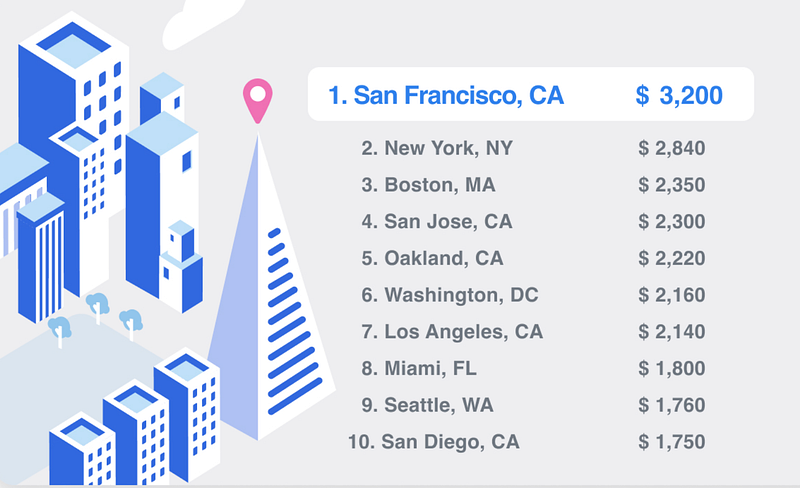
That’s the median price for a one-bedroom in the nation’s largest cities, as of August 2020.
If you’re in the market for a studio — a compromise you might have to make to make it work in these places — you’re talking considerably less money than what you see here. For example, my Los Angeles studio costs $790 less than the median one-bedroom in the city.
As a side note, it’s not a dump. It’s a nice place. I can just have more in a city I like better, thus the pending Portland move.
If you get to know a city well enough, you know how to live well for less. I can direct you to the finest burrito in San Francisco, the tastiest tacos in LA, and the most kick ass yogurt and granola breakfast parfait in Portland.
It’s a lie that everything’s more expensive in big cities (and great) cities. It’s the best kept secret that it actually isn’t.
But That’s Too Much Compromise
How much is an extra $790 (or whatever your actual number would be) to spend elsewhere, or better yet save and invest, worth to you?
Ask yourself this question. Ask it regardless of how much money you make.
That’s the biggest money trap people fall into — as they make more, they spend more.
Set your cost of living as low as you can while having a life you love. Your surplus is just that — surplus. Excess cash to facilitate financial freedom as soon as possible.
There’s no need to give up everything you want. But there is a need to not have the things that require significant monthly obligation s— be it a big apartment or car payment. If you can’t go without the square footage or the car, then you don’t want the lowest possible cost of living bad enough.
It’s not the cost of living’s fault.
If you enjoyed this article, consider subscribing to Medium through my profile.
This article is for informational purposes only, it should not be considered Financial or Legal Advice. Consult a financial professional before making any major financial decisions.