
Your Crib Sheet for Making Your Articles Pop — Medium Style
Advice for Rooted publication writers and beyond
It took me an expensive course and approximately 200 articles to get “good” at writing on Medium (and because I’m my own worst critic, I use the term good loosely).
My progression wasn’t linear. I had a few large leaps forward that happened when writers much cleverer than I landed knowledge on my ass.
The knowledge I’m about to share.
It’s a cliché to say I wish I had this information when I started on Medium, but I really, really do.
And with Rooted publication starting to gain traction — I’m adding new writers almost daily — I think it is high time I share this knowledge so Rooted writers (and others) can up their game, get noticed, and ultimately get paid.
Well.
Nothing works without the internal plumbing in place
There is a TON of information about how to format your articles for Medium out there, so I won’t labor the point too much. These are the main formatting points you need to format the way Medium likes:
Title case the crap out of your titles
My husband and Rooted editor Sam Dixon Brown has just launched a new Title Case Converter created specifically for Medium writers. Use it for your title.
Make use of your subtitles
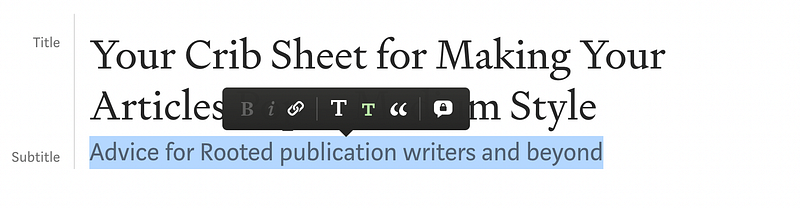
I’ve seen a lot of articles that don’t make use of Medium’s subtitle feature. Make sure you do. It looks like this:
Use a strong picture and always credit
The best advice I was ever given about pictures on Medium was:
- Sort pictures on Unsplash etc. by newest. The last thing you want is a picture that’s been used thousands of times.
- Scroll royalty-free photo sites quickly until something catches your eye. If it catches yours, it’ll catch someone else’s.
- Black and white never works. The contrast just isn’t enough to stop people in their tracks (which is your aim).
- Find the most striking picture you can.
I’m also adding to the mix:
- If there’s a Medium writer you think always nails their pictures — and they use a royalty-free site like Unsplash — follow the credit and browse related photos.
- As much as possible, use your own photos. It makes you unique.
For the love of God, install Grammarly
You don’t have to take all their suggestions, but at least you’ll not use the wrong to / too / two or there / they’re / their.
The internet loves short paragraphs and you should too
Short.
Sweet.
Like this.
No one wants lines and lines of text. Cut that shit up.
The most important thing to nail is…
The title.
It MUST have something in it for the reader. As much as possible, make your title about them.
Be specific. Yes, sometimes cryptic-titled stories blow up. But in my experience, they’re the exception rather than the norm. The reader wants to know what they’re going to get by delving into your story and they’re not going to do that if your piece is called “On Writing.”
You’re not Stephen King.
Follow people on Medium who write titles you love. Break them down. How are they structured? What words do they use?
Nail the title and the rest will follow.
The best advice I ever received about how to keep people on the page
Write an incredibly strong first sentence.
Some of my best stories have started with sentences like:
- I think I’m going to piss some people off with this article (Everything I couldn’t say about wine when I was a Sommelier).
- What you really need to know about wine is never what people say you need to know about wine. (Here is everything I wish people knew about wine).
Get to the point. Quick.
Speaking of which…
Get to your point as quickly as you can
No one will read five minutes of introduction. Get your main point in the first few lines. Even better in the subtitle or title.
Some say successfully writing for the Internet is the opposite of how you’re taught to write at school.
That’s not entirely true.
Remember how Mrs. Smith would tell you to structure essays? Make your point in the introduction then spend the rest of the essay backing up that point.
Like the time I wrote an essay at school called Othello is a misogynist.
I got an A+ with a note from my English teacher saying “I don’t agree but you stated your claim and spent 1500 words comprehensively backing it up. Well done, I guess.”
Medium is no different.
The best thing to do with subtitles is…
Make them strong. Funny. Quirky. Different.
Many people scroll a page and the subtitle is what catches their eye. Would they prefer:
What I think about Provence rosé
Or
Provence Rosé is the Volvo of the wine world
See what I mean?
Boosty, boosty!
I can’t say I have the secret sauce to being boosted. BUT I had a 60% boost rate this month, so I have some experience.
First, read Medium’s quality guidelines. They hold the secrets to boost heaven.
In my experience, the following helps:
- Come from a point of authority, and tell your readers what that authority is. It doesn’t have to be professional authority, it could be as simple as I spent 2 weeks eating my way around Oaxaca, Mexico. These are the best things I put in my mouth. Personal authority counts.
- Be strong in your convictions and back them up with scientific or social proof when applicable.
- Draw as much as possible from your own experiences.
- Dig deep. No 2-minute surface reads.
Use publications as much as possible
Publications have clout. So use them. Get your work into them.
Don’t worry if you’re new, plenty of publications will still consider your work. Check the submission guidelines of any publication you think will suit your work, and submit, submit, submit.
For Rooted, it’s easy — you just need to send me an email to [email protected] and I’ll add you as a writer. You’re then free to send me articles.
Our submission guidelines are here.
Important final words
The best advice I ever received about conclusions was:
Try swapping your introduction and conclusion around.
It doesn’t work all the time, but often people write better conclusions than introductions because they’re less intimidated by them. Sometimes the best thing you can do is swap them around.
Remember, put your best writing first, not last.
I want the writers of Rooted to thrive. I want to prove that you can make money writing about food and drink here on Medium.
It all starts and ends with a well-crafted article. Follow the above tips and you’re halfway there.
Become a Rooted writer today — check out our submission guidelines


