
Here’s Everything I Couldn’t Say About Wine When I Was a Sommelier (But Wished I Could)
Now I’m freelance, I can shoot my mouth off

I think I’m going to piss some people off with this article.
In fact, I hope I do.
Too much of the wine world is scared of saying what they really think. We’re terrified of being associated with the gold-button blazer snobbery that most people think the wine world is full of (granted a small part of it is but most of it is not).
We’re all in a position where we love this complicated beverage with a passion but know that it’s hard for others to understand. So we keep schtum, nervous of scaring off potential customers (or in the case of some wine pros, scared of pissing off big-brand partnerships) with what we really think about Provence rosé. Of big-brand Champagne. Of wine gadgets. Of people who want us to validate their crappy wine choices.
But I don’t have to do that anymore. I’m now freelance and answer to no one.
Now — with all the love in the world because honestly, this comes from a place of love for both my readers and wine — I get to shoot my mouth off about everything I had to bite my tongue about when I owned my wine store and bar.
Here’s everything the wine world wished they could say to you but are too scared to say it.
Strap yourself in.
Most wine is completely and utterly boring
Finding decent wine at a decent price to stock in my store and bar was like finding a polar bear in a snowstorm — almost impossible. Because most wine is totally boring.
Like most things in this modern world, wine has fallen victim to being dumbed down to suit people who, frankly, don’t really like wine, all in the name of making a few more bucks.
It’s not just me. Here’s something Christopher Bates, a Master Sommelier (i.e. someone who has spent a lot more money on their wine education than me) says:
A lot of modern wines tend to be focused on just fruit. And oftentimes, I find them to be a bit boring. They’re missing those savoury, spicy things that made classic wines so delicious.
There are plenty of wines that don’t fall foul to this. I know. I stocked them. They were often in scarce supply because there are plenty of people who do want something interesting in their glass.
But they are dwarfed by the number of bland, boring wines that do little more than act as a social lubricant without causing too much offense.
It’s a shame. There are plenty of alcoholic beverages that can be as boring as you like (looking at you, mass-produced lager) and do the same job without having to pull wine into the mix.
Wine is supposed to be interesting. Tricky. Difficult. That’s what makes it so damn fascinating.
More people — even in the wine trade — need to remember that.
I can’t demystify wine for you because it’s a complicated subject
Everyone wants to demystify wine but honestly, you can’t. Wine is something people dedicate their lives to and still barely scratches the surface. It’s a melting pot of culture, history, and biology that spans thousands of years.
I will hand you over to the brilliant Instagram account Shitty Wine Memes here:
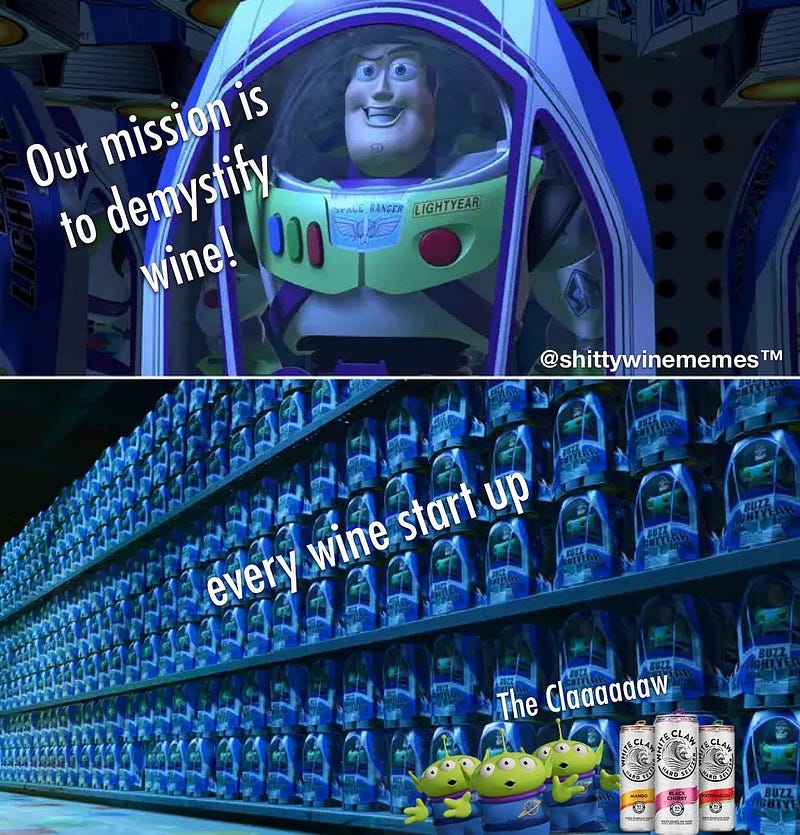
Wine is one of those weird subjects that a little bit of knowledge can be more dangerous than knowing next to nothing because there are no sweeping statements. Chardonnay isn’t always oaky. Dark rose isn’t always sweet. Spanish wine isn’t always cheap.
It sounds bleak, but it’s actually kinda exciting. If you stop trying to demystify the subject and start using a beginner’s mind approach, you’ll open yourself up to far more exciting wine experiences than any TokTik wine influencer promises you.
Just because you like a certain wine doesn’t make it good
Just to be clear, you can like whatever the hell you like.
But just because you like something doesn’t make it good. You can try to convince me that the local discount supermarket “has some really great wines under $5” but I’m not going to agree with you.
This is something I had to keep quiet about my whole wine career because it’s hard to explain to people that this doesn’t come from a place of snobbery, but from a place of fact. Some wines are good quality. Many are not.
The best way to explain this is with a McDonald’s hamburger. They are delicious but that doesn’t make them good.
We all know McDonald’s hamburgers are bad. We laugh about how we know they’re terrible for us and made of shit but we love them anyway. With wine however, people get defensive. They worry when a wine pro says this that it’s a slight on their taste.
It’s not. A lot of crappily made wine can be manipulated to taste pretty good. But I’m not going to coddle people and tell them that yes, just because you like it makes the wine a good wine.
It doesn’t.
This is closely related to…
“As long as you like it, that’s all that matters” is BS
We live in a world where there is so much more at stake with food and beverages than if it tastes good or not.
It’s about the environment. It’s about the people who make and sell the product. It’s about ethics. Politics. Morals.
I’ve seen how mass-produced, poor-quality wine is made.
I’ve seen what poor-quality wine does to the environment — soil erosion is not pretty, and neither are the pesticides they spray on the fields in hazmat suits.
I know how little some big wineries pay their staff and how hard they make them work. I know the damage these sorts of wines do to nearby independent wineries trying to do a decent job. After all, it’s not easy to grow organic fruit when there’s pesticide drift from the big-brand vineyard next door.
Believe me, whether you think it tastes good or not is the last thing that matters here.
This might sound harsh but the only way you can really, truly believe the only thing that matters is if you like the taste of the wine is if you don’t care about anything but your own pleasures.
And I know you’re not that much of a douchebag.
I get why people say it. It’s a nice defense mechanism. It shuts down uncomfortable conversations about how terrible the commercial food and beverage industry really is and whether we should continue to support them with our dollars. Conversations people really don’t want to have.
But it’s not true. Sorry.
Most wine gadgets are completely pointless
Nearly every day someone would come in and ask me what I thought about some dumb-ass wine gadget they picked up. This is what I really think about them:
Sulfite remover = Why don’t you just buy wine with no added sulfites if you’re worried about them?
Fancy wine preserver = More expensive than throwing half your wine away. Only useful in professional situations.
Stupid-shaped decanter = A jug does the same job and will save you $200.
Aerators = Pour out a glass, put the cork back in, shake up the bottle, and boom. You’ve aerated wine.
Over-engineered corkscrews = I’ve said it before, I’ll say it again. A double-reach waiter’s friend is all you need.
The only wine gadget worth its salt is a wine cooler that actually works. The ones that are like bottle-shaped icepacks and cost very little.
The rest of them are a waste of your money.
Most big-name champagne is overpriced
Big-name Champagne is ripping you off.
I have visited every single big-name Champagne house in my time. I know how exactly they make their wines. Or more accurately I know how some are made. You’d be amazed how many evaded the most basic of questions in that department.
I’m naming no names here but take it from me, it’s never worth the price tag. Don’t be duped into believing that because it’s got a prestigious name on the bottle that the juice inside is any good.
Stick with grower Champagnes — the name for small often independent Champagne houses that grow their own fruit and make incredible bubbles for sometimes half the price (or at least double the quality) of some of the bigger guys.
And for fear of having the Champagne police on my ass, that’s all I’m going to say.
Provence rosé is the Volvo of the wine world
It’s perfectly reliable. It’s perfectly fine. But it’s a bit meh.
And yet for four months of the year, I would literally sell pallets of the stuff.
This is a subject that some wine writers will touch on because we’re all kinda sick of having to smile and say “mmm yes, Provence rosé is quite nice, isn’t it.” And there are only so many ways you can describe a pale, dry rosé without using the word strawberry, raspberry, or watermelon.
I place much of the blame on big-brand Californian wineries that flooded the cheap wine market with dark White Zinfandel roses, sweet as candy and just as sickly. It means no one wants to touch a rose unless it’s so pale you think, have they just poured me a glass of water?
The reality is that the most exciting roses are the darker roses. The Spanish rosados, the French Tavels, the almost completely unknown Italian Cerasuolos. The ones made in amphora or aged in old oak barrels. The ones that exude character.
Provence rosé is what we call a vin de piscine — a swimming pool wine.
For me, that’s as far as its appeal goes.
Remember. Everything I’ve said above, I say with love. I want people to have a good — no, great — time with wine which is why I’m being harsh here. Let’s call it tough love.
Boring, badly made, environmentally shitty, rip-off wines offend me.
Companies that try to tell you “wine can be easy!” irritate me.
Wine gadgets that promise the earth for the low, low price of $199 annoy me.
And if you are in any way interested in wine, they should offend / irritate / annoy you too. Because once you get over everything I’ve talked about above, there’s a whole world of exciting, good value, interesting wine, and interesting people to discover.
You’re never going to find them however in the bottle of a Champagne whose name rhymes with Poet.
Now if you’ll excuse me, I’m off to pour myself a glass of something interesting. I hope you do too.
Sign up for The Capsule Pantry, a Substack designed to have you eating incredibly well whilst saving money and reducing food waste through highly customizable recipes


