
As a Sommelier, Here Is Everything (Else) We Wish People Knew About Wine
A decade of wine knowledge condensed into (another) 7-minute read

Last year I sat on my sofa and punched out an 11-minute article about everything I wish people knew about wine from my decade in the wine trade.
It went viral.
It turns out it could have been an 18-minute read because I forgot a load of super important winey-based things that will make the enjoyment of your evening glass all the better.
You don’t need expert-level wine knowledge, you don’t need a ton of money and you don’t need to study to elevate your wine experience.
All you need is your friendly Medium-based Sommelier (that’s me) to drop some knowledge into your noggin. Knowledge that few people outside the wine trade know.
But they should.
Matching food and wine isn’t about flavors, it’s about structure
TV wine personalities with their ridiculous food and wine pairings have got a lot to answer for. You’ve probably seen them trying to match some tiny little flavor from a dish with some “flavour note” in a $7 liquor store wine.
They don’t tell you what’s truly important in food and wine matching. Most of it is not about flavor.
It’s about the structure.
Here’s what you need to know:
Acid and salt in food = good for wine
Sweetness and bitterness in food = bad for wine
This is how it plays out IRL:
Acid in food reduces bitterness and dryness in wine. That’s why Italian foods — which are often high in acid (think tomatoes or lemons) — work so well with Italian wines which, with the reds at least, tend to be high in tannin.
Salt acts in a similar way. Season your food properly and it’s going to taste banging with most wines.
Sweetness in food increases bitterness in wine. That’s why you’ve gotta pair a sweet wine with a sweet dish. Your fresh dry white just ain’t going to cut it with a sticky toffee pudding.
Bitterness in food increases bitterness and dryness in wine. If you’re serving asparagus — a notoriously difficult pairing thanks to its bitterness — you want to look for low tannin or fruit-forward wines like Beaujolais or Pecorino.
A bonus tip:
Flavor concentration counts for a lot. And as I mentioned in part one, concentration is connected with the quality of the fruit, not just the grape variety. Thus it occurs in both rich and light wines.
For instance, if you have a well-made, concentrated Beaujolais from a good producer, it will stand up perfectly well to a rich dish like roast lamb. The same goes for a concentrated light white like a good quality Chablis.
That’s why you can match fish with red wine and beef with white. So long as the structure of the dishes matches the structure of the wine, the world is your food-pairing oyster.
Do these two actions to make every wine explode with taste
Don’t be shy — swirl and slurp.
Swirling both introduces oxygen and also shears molecules off the side of your glass.
And the day my training taught me how to slurp wine was the day wine started to taste bigger, better and more concentrated. It’s magic.
To slurp properly, take a small amount of wine in your mouth, part your lips a little bit, and draw air in. It’s best to tip your head down to practice so you don’t accidentally choke on your Sauvignon Blanc.
The difference between swallowing straight and slurping then swallowing will have you looking like an idiot in front of everyone you know in no time.
Serve your red wine cooler than you think
The age-old advice says to serve your whites, roses, and sparkling at fridge temperature and your reds at room temperature.
The problem is, most people’s rooms are too hot.
Room temperatures have drastically risen in the last 40 years. Back in the 1960s, the average temperature of a British house during winter was 12C (53F). Now, it’s 18C (64F)— and I’ve been in homes kept much hotter than that.
Red wine should be kept at around 14–16C (57–61F). If it’s a lighter red, I personally prefer it even cooler than that.
The best way to do this? Stick it in the fridge for an hour before you serve it. You can always serve it too cold and let it warm up in the glass.
Too-warm red wine tastes like crap. You lose the freshness, the drinkability. It becomes a chore. Keeping it cooler keeps it delicious.
For the love of God, stop popping your sparkling wine
I know it makes a fun sound. But popping your sparkling wine with a bang is a) a hazard — an astonishing 24 people die every year from popped sparkling wine corks — and b) lets out all the carbon dioxide thus flattening your sparkling wine quicker than it should.
Back in my training days, we were taught that a correctly opened bottle of sparkling wine should sound like a pffft — or in more sexist circles (welcome to the wine trade), a nymph’s sigh.
There’s a good video of how to open a bottle of sparkling wine here but the basic premise is to control the cork coming out of the bottle so it doesn’t go bang.
Loosen the cage but keep it on for extra grip. Once that cage is loose, GRIP THE CORK WITH THE WHOLE OF YOUR HAND, PUT YOUR THUMB ON TOP AND DO NOT LET GO. This is when people die — that cork is under a hell of a lot of pressure and wants to be free. You don’t want that fucker in your eye.
Grip the cork and top of the bottle and slowly turn the bottle — not the cork. You’ll start to feel the cork come out of its home. Keep the pressure on it to control it until it comes out of the bottle into your hand with that gentle pffft.
Easy (kind of).
This is when you need to decant a wine
When it comes to decanting wine, you’re doing two things:
- You are separating the sediment from the juice. This sediment forms in older wines or if a wine has been left heavily unfiltered.
- You are letting oxygen into a wine to let it “open up” which basically means you’re speeding up the development of that wine, allowing for more aromas and softening the mouthfeel.
It’s not an exact science, but here are some rules of thumb:
- Oftentimes, wines that people think need decanting do not — and vice versa. For instance, old wine doesn’t need long in a decanter because it’s already been exposed to oxygen whereas a younger wine might benefit from it.
- Many commercially made red wines can be made in a “reductive” way — that is, with very little contact with oxygen. If your wine smells a bit stinky or like it’s not especially fruity, give it some air.
- Wines under screwcap can benefit from decanting because they are exposed to less air than those under cork.
- Some grape varieties grown in certain areas benefit from oxygen more than others. Examples include Syrah (especially from its home in the Northern Rhone), Pinotage from South Africa, Chardonnay from Burgundy, and many Bordeaux.
A note on decanters — put the fancy stuff away. You can use somethig as basic as a plastic jug. You can even take a glass of wine out of a bottle, put the cork back in, and give it a shake.
You don’t need the likes of this to make your wine better:
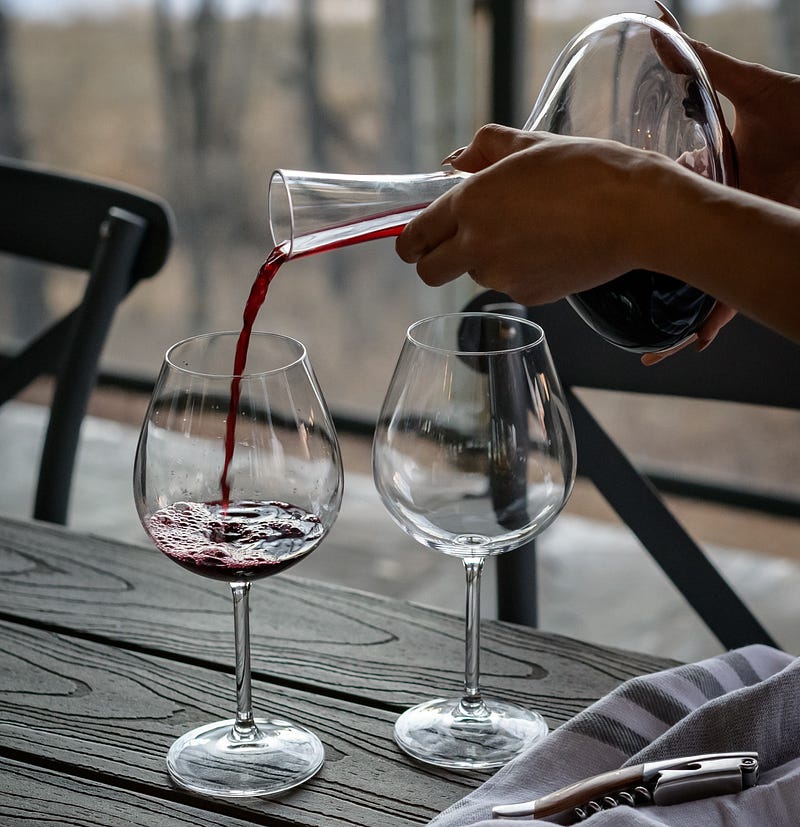
Don’t listen to the BS about decanters. Simple is better.
You don’t need a fancy corkscrew — one of these will always do the job
These are the best corkscrews known to man:
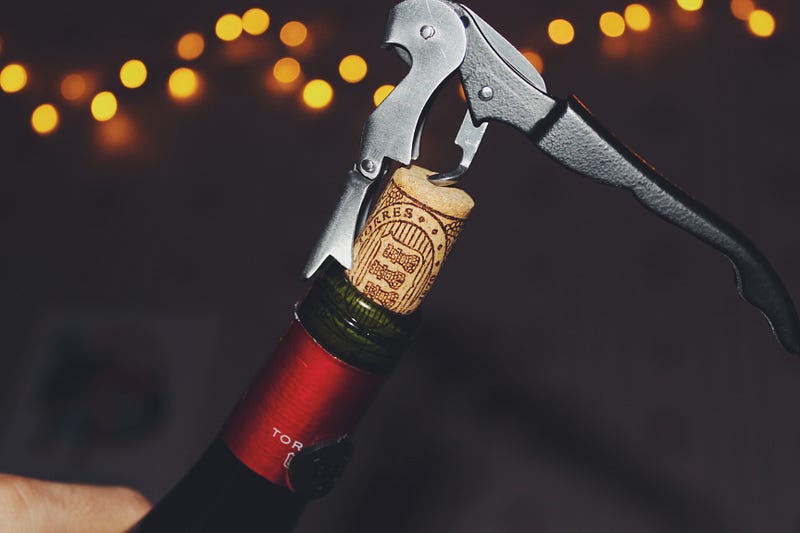
They’re called a Waiter’s Friend or a double-reach corkscrew and you can pick them up for almost nothing. Once you learn how to use one, it means all the fancy, complex corkscrews — that frankly can f**k up a cork in seconds — can go bye-bye.
Always always ALWAYS store open wines in the fridge — even your reds
The colder your wine, the slower it will develop. Thus I keep every single bottle in the fridge once it’s opened. It can give you days of extra time to drink it.
Speaking of which…
This is how long you should keep your wine open for
The answer is, it depends (the answer is always it depends).
You can’t even rely on a rule of thumb here. Conventional wisdom says if it’s a commercially made, stable wine it’ll last longer than say a natural wine. But that’s not always the case — commercially made wines can be horribly unstable thanks to a lack of oxygen during the winemaking process, whilst some naturally made wines can last days on end.
Most wines will start to lose their fruitiness after 2–3 days in the fridge. Beyond that, it’s a taste-it-and-see kind of situation.
If you think it’s lost its original freshness or fruitiness, then stick it in a casserole or make vinegar from it.
If you think it tastes fine, then by all means drink it for as long as you want.
I’m sure that as soon as I hit publish, I’ll think of a ton more things we Somms wish people knew about wine.
For now, if there is anything you want to know, hit me up. I need fodder for part three, after all…


