
You Don’t Know Someone Until You Marry Them
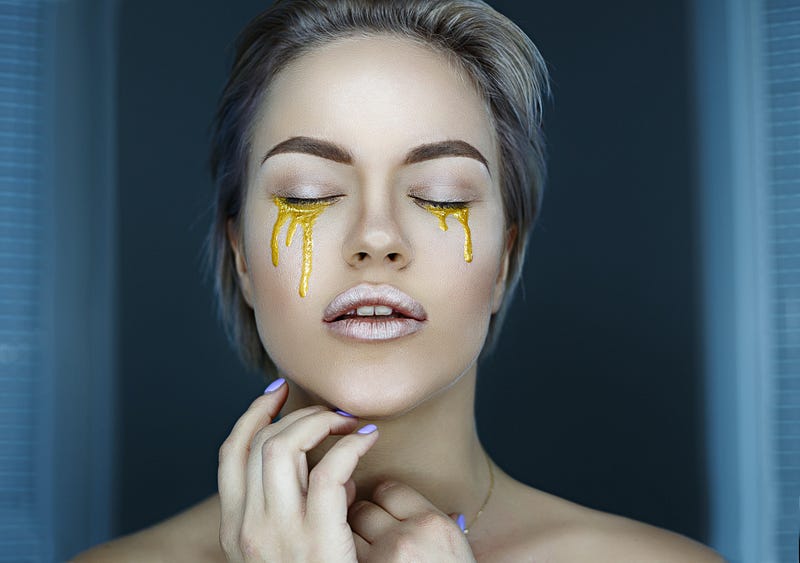
I shed years of tears with that white dress
I am chatting with someone about relationships. I’ve spent a decade in the counseling and research of love. Unfortunately, there’s no secret ‘tell’ sign as we jump from dating to marriage.
“You don’t know someone until you’ve married them,” I say.
“I’ve heard that before,” they respond.
Some may find my story hard to believe. Common sense would dictate a long-term relationship with a person means you know them. But this happened to me.
I dated a man who never made me cry.
I married one who was unmerciful. My eyes would swell until tears could barely make their escape. The unceasing duration of saltwater left welts upon my face. These weren’t the cries of the faint-hearted. They were the violent sobs of a strong young woman.
A resilient woman can fall prey.
Tears mean something. They are submissive. They aren’t combative. They are purging pain not unleashing it with harsh words. They are meant to be caught, triaged, and stopped.
Not commanded by a person demanding their release.
I gave my heart to one man and married another. This is a cautionary tale. It can take a vow to understand who someone is. And worse, make us tolerate the intolerable because of the seeming permanence.
It can take a marriage to reveal the extent of a person’s personality.
This doesn’t happen in every union, it’s not all or nothing.
But it is a personal truth for some. A passive-aggressive individual may appear laid-back. Within years you understand they are controlling. A person may seem like the life of the party. Eventually, you realize they shouldn’t drink. An insecure spouse can morph into an extremely jealous partner.
These examples are extreme; they don’t happen to everyone.
But once married, you may witness subtle differences too.
It’s a phenomenon.
It can take this degree of commitment for people to expose themselves.
And you didn’t see it coming. Why? Is it being young? Is it seeing the best in people? Is it repeating mistakes from our family of origin? Is it denial? Is it making a commitment against our better judgment?
It’s not easily answered.
It can take time to realize you’ve attached yourself to someone who is difficult, uptight, or manipulative. Or unmotivated, selfish, or disrespectful. You could lose your independence, your access to finances, or your voice.
Again, this doesn’t happen to everyone, plenty of marriages are successful.
The exchange of rings incites emotional concrete. It can make one spouse unashamed to behave badly. The other spouse remains confused by the bounds of forever. They feel the need to stick it out.
The man I dated never once made me cry.
The first encounter was mild. I was a newlywed and my husband came back from the store without a necessary ingredient. When I expressed my frustration it elicited alarming anger. I was told to go to the store myself and not to question him.
The violent tears followed soon afterward.
The type that curls you into a ball.
The circumstances would vary but they were cold and irrational. He refused to drive me to oral surgery where I would be put under anesthesia. He and his friends left us, girls, at a bar with no way home. He stayed out all night playing poker. He then refused to speak to me for three weeks because I got upset.
I’d make plans and he’d arrive home so late they had to be canceled. He would go out of town for a week and never call. He ruined holidays. Birthdays were absent of presents or a cake.
He would say, “I’m a big boy and you’re a big girl. I don’t ask anything of you and you don’t ask anything of me.”
Who was this person? We rarely exchanged bad words while dating. We had a few arguments during our college years. That was it. My mom used to say she never saw two people who got along so well.
Looking back, there was only one hint of what was to come.
The college arguments in the early days of dating I dismissed. I attributed it to him being clueless. He seemed like a great guy, I assumed it was because I was his first real girlfriend. Prior to that, he had dated but nothing long-term.
I found some old notes he wrote me.
He apologized for being cold. It was foreshadowing a nineteen-year-old girl would never have recognized. He wasn’t a reflective guy. This made it likely others had used the word to describe him. Maybe a family member, a friend, or one of the short-term relationships he had.
At the end of our relationship, I called someone close to him.
“You knew who he was when you married him. You knew what you were getting yourself into.”
I’ve politely left out the explanative they used to describe him. I will use the word ‘jerk.’
They were wrong. They might have known him but I didn’t. I never would have married a guy who made me cry. I had too much self-respect to allow myself to be treated like that.
I stayed because an exchange of rings confused me.
A resilient woman can fall prey.
Tears mean something. They are submissive. They aren’t combative. They are purging pain not unleashing it with harsh words. They are meant to be caught, triaged, and stopped.
Not commanded by a man demanding their release.
Follow my quotes on Instagram or me on Twitter or LinkedIn or Facebook
If you would like to read more of my stories and support me as a writer, consider signing up to become a Medium member. For just $5 a month, you will get unlimited access to Medium.


