
You Can’t Be an Expert at Everything
Especially not infectious diseases.
Lots of people in the world have multiple talents or skills. Some are related — I have a knack for research that augments my writing — while others are unrelated, like an accountant who also draws portraits. Some people are so good at both their primary and secondary skills that they are considered experts in both areas.
Let’s be real, that’s not most of us. I write for a living, and part of that is writing every day, so I naturally improve more and more over time. In my job, I’m considered an expert. Yeah, I’m pretty good at research, but I’ll never be an expert at that.
Then there are areas where I am absolutely not an expert, like science and medicine. Don’t get me wrong, I can slog through scientific or medical papers with some degree of understanding, but that’s more a function of my technical writing abilities. I can’t fully grasp the science behind genetics, for example. Most of us can’t.
For me, that’s the primary reason that I rely on experts to inform my decisions. Whether that’s research into healthy eating habits or crime statistics, I rely on the people who know how to determine and interpret these things.
That’s why, to me, it’s difficult to watch the anti-expert push in America. For some reason, a whole group of people has decided that experts are untrustworthy. “Do your own research,” they say while flouting things like mask mandates and vaccine science. “It’s not that bad, it’s just like a cold,” they say while nearly 700,000 people have died and the pandemic drags on.
There are whole groups of people — primarily but not exclusively in the American right-wing — who have decided that people like doctors and scientists are untrustworthy for some reason. Meanwhile, they turn to pseudo-experts who have some sort of miracle cure, like ivermectin or nebulizing hydrogen peroxide.
These “cures” range from minimally harmful (getting a prescription for the human variant of ivermectin will probably give you side effects but not cause too much harm) to deadly (taking veterinary ivermectin in large doses or nebulizing hydrogen peroxide at higher concentrations). They’re all pseudoscience cures, sold by snake oil salespeople who likely have a financial interest in whatever they’re hawking like the preacher who sold colloidal silver to his congregation as a COVID cure.
I cannot say this enough: experts are experts for a reason. Dr. Anthony Fauci has been working for the National Institute of Health as the director of the National Institute of Allergy and Infectious Diseases since 1984. He has literally been the director of that agency for longer than I have been alive, and that’s based on his body of work prior to that point. At 80 years old, he’s been working in the field for upwards of 55 years.
So, when he says that vaccinated people should still wear masks in public, I listen. Sure, I could do a quick Google search and find some random website that says I’d be fine, but between some random web search and an expert in the field, I’m listening to the expert.
The reason I listen to the experts, in this case, is that, again, I am a writer. My expertise lies in language, not science. So, when I want to take advice from someone on the topic of COVID, I’m going to listen to Dr. Fauci and the scientists who have spent their lives studying disease transmission and vaccine science. Sure, there are pages out there that explain why masks don’t work or why vaccines cause autism or whatever, but the science has been established: masks and vaccines work.
Of course, the anti-expert and anti-science movement is deeply rooted in the Dunning-Kruger Effect. Put simply, the Dunning-Kruger Effect is the premise that gaining a small amount of knowledge on a subject makes you feel like an expert, but the more knowledge you gain, the less you feel confident in that expertise. As you learn more, you realize that the subject is much more complicated than you originally thought. Only after significant study do you reach the point of feeling like an expert again. It is commonly represented by this graph:
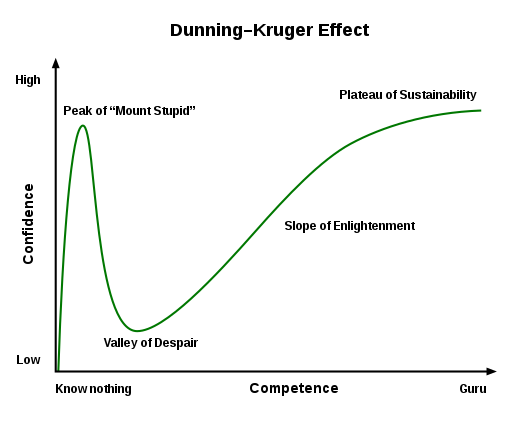
The issue this causes is when someone who distrusts an expert “does their own research” and attains the peak of “mount stupid.” They gain a basic understanding of a subject, often twisted by bad actors and reinforced by confirmation bias, and feel like they know more than someone who has dedicated their lives to the subject. Meanwhile, the talking heads in their echo chambers explicitly lie to them about the actual experts, because apparently their shows aren’t meant to be factual.
Of course, none of us is immune to confirmation bias, echo chambers, and the Dunning-Kruger Effect. With that in mind, how can I be sure that I can trust the science from Dr. Fauci and others?
First off, considering all of the different medical institutes and agencies that came out in support of Fauci’s recommendations, I feel confident that the medical community strongly supports the science put out by the NIH. Second, considering that the majority of disinformation about COVID and vaccines can be traced back to just twelve individuals, I’m reasonably confident that the anti-science push is not backed by strong science and has minimal support from scientists and doctors.
The fact of the matter is, you don’t have to distrust the prevailing science because it’s the commonly accepted practice. Running counter to popular belief is fine when it comes to things like music and media; running counter to popular science is dangerous for you and everyone around you.
I openly admit that I am not an expert at infectious diseases. I’m just a writer. However, I suspect that the vast majority of people reading this aren’t experts at infectious diseases either. That’s okay.
Because I’m not an expert in infectious diseases or medicine in general, I trust Dr. Fauci, the NIH, and the CDC. I have a search engine and publicly available information. They have multi-billion dollar budgets dedicated to researching infectious diseases.
Honestly, I’d have to be pretty bold to think that I, a writer, could do better research in ten minutes with Google than the NIH, which is full of experts with advanced degrees and decades of experience, could do in a year with a billion dollars and high-tech lab equipment.
On top of that, anyone who gripes about the fact that the advice coming out of the experts keeps changing, I’d like to remind you that that’s how science works. As we learn new things about a subject, we expand our understanding of it, and sometimes that means we realize that what we thought was correct is actually wrong. It’s not waffling or flip-flopping, it’s the scientific method.
I trust the experts because they are experts and I am not. It’s that simple. We can’t all be experts at everything, and spending ten or twenty minutes doing Google searches is no substitute for a Ph.D. in infectious diseases.
It is exciting to sit atop “mount stupid” and think you know better than anyone else. Those so-called “experts” don’t know what they’re talking about, you think to yourself, self-satisfied in your intellectual superiority to someone who has been working in the field for longer than you’ve been alive. Plus, you’ve got that Facebook group full of people who agree with you, so obviously you’re all ahead of the curve.
Don’t fall victim to that mindset. We can’t be experts in everything because the world is a complicated place with millions of sub-sub-sub-categories of different fields of expertise. Someone who is an expert in a particular phylum of fungi can’t be reasonably expected to also be an expert on ancient Athenian philosophy and 12th-century lute songs, never mind the thousands of other sub-specialties across hundreds of other areas of study.
It’s okay to acknowledge that you don’t know everything and aren’t an expert at something. That’s not a moral failing, that’s the human condition. As such, it’s okay to trust experts in areas that you’re unfamiliar with. That’s not a weakness of character, that’s having the wisdom to know when to defer to someone who knows better.
Trust the science, trust the experts, and admit to yourself that you are not and cannot be an expert at anything and everything. It will help us kick this pandemic much quicker.
Then maybe we can address global climate change and deal with that crisis. Hey, I can dream!
If you liked this, please subscribe to my publication, Thing a Day. I publish something every day on a variety of topics, so you never know what you’re going to see!
Here are some other things I’ve written:


