
Dunning-Kruger vs. Imposter Syndrome: Battle of the Century
Or: Why I don’t understand modern debate practices.

In the blue corner, we have an expert in his field who has been working on the same subject for 40 years!
In the red corner, we have a 20-something at a bar who read an article once!
Who will win the war of words?!?
There is a sort of dichotomy that has risen up in the past century of the confident jock versus the stuttering nerd in a bow tie. The jock is a smarmy character who can talk his way out of anything with his trademark charm. The nerd has low self-esteem and spends his Saturdays alone building computers and talking to his pet rat.
Very often in the story, the nerd is a secondary character who only becomes useful in the third act when it is revealed that he is an expert in a very particular thing that the protagonist needs. Up until that point, he was largely crapped on by the cast but gains newfound respect when he becomes useful.
Unfortunately for us, the real-world jock-versus-nerd debate is being dominated by the metaphorical jock. We all know them: they claim that they’re the only ones who can solve all of our problems, they denounce experts while claiming to know more than anyone else on every topic, and they cast derision upon people who are educated as “elites.”
This results in a bunch of followers attending to a cult of personality where they mindlessly follow the leader while blocking out everyone who is pointing out that the emperor has no clothes. Amazingly, there is a term for this: the Dunning-Kruger Effect.
In short, the Dunning-Kruger Effect states that the less someone knows about a topic, the more they think they know, while the more they know about a topic, the less they think they know. It is often represented with a graph that looks like this:
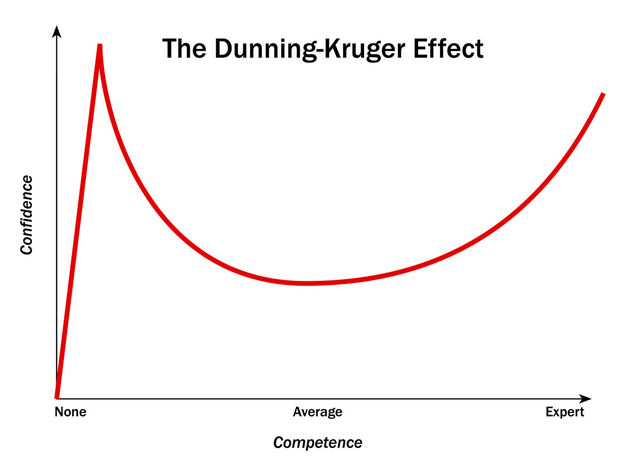
While I could write at length about certain public office-holders in several countries, I’d instead like to turn my attention to the quiet partner of Dunning-Kruger: Imposter Syndrome.
Imposter Syndrome is not quite as formally laid-out as Dunning-Kruger but is just as potent. Essentially, a person who is reasonably knowledgeable or qualified on a subject and has seen some success from their knowledge believes that they are actually an imposter. Instead of hard work and skill, their success comes from people’s inability to see that they are a fraud and have been unknowingly deceiving everyone. It’s like low self-esteem and self-confidence, but supercharged.
I have seen Imposter Syndrome amongst many of my friends, all of whom have worked hard to get where they are. I have a friend who was an explosives tech in the Army for decades. He has literally slept next to nuclear weapons as part of his job. He is familiar with many, many types of explosive ordnance, and has a functional knowledge of numerous weapons and other military technology, as well as chemistry and physics.
But, for all the blood, sweat, and tears he put into his army career, for all the knowledge he picked up along the way, he doesn’t feel like he deserves his success. He essentially feels like he just kind of convinced everyone in the army that he was competent when he wasn’t, and managed to serve for many years without anyone figuring out that he had no idea what he was talking about.
I am mildly paranoid that the curtain will fall and they will see the strange incompetent man pulling the levers.
I have similar experiences, and it’s really hard to talk about because I don’t consider myself an expert in my field, although my boss thinks otherwise. I am a grant writer for a nonprofit. I have been writing grants in some capacity since 2008, and I got my first professional job in 2010. I have raised millions of dollars that have helped hundreds of thousands of people receive the services that my agencies provide.
In spite of that, I feel like I’m at the far left of the curve. Never mind that I manage a deadline schedule that runs 6–12 months ahead at any given time and I write probably over a hundred thousand words of narrative every year. Ignore my success rate, the amount I’ve brought in, the length of time I’ve committed to honing my craft. Do I really deserve my success? I mean really?
In college, I wanted to be a chemist, but I found myself struggling with mid-level science and math courses. Instead, I switched to focus on technical writing, which was a certificate program that I’d been taking parallel to my sciences. I bashed together a degree out of the technical writing certificate and a minor in communications using an obscure degree program they had at my school and bounded off towards writing.
My parents thought they’d have to remodel the basement because I’d be living there indefinitely. Instead, I stumbled into an internship writing grants and the rest was history. I graduated with my cobbled-together degree at the lowest point of the recession and managed to find a part-time entry-level job a year after I graduated, picking up volunteer work in the interim.
Eventually, I got a full-time job, started making connections, and then landed where I am now, making more money than I ever thought I would. Everyone in the agency defers to me as the grant expert. It all feels very phony.
To me, I sucked so hard at my degree that I flopped into an easy-A track. I got my internship because nobody else wanted it, conned some agency into letting me volunteer, conned another agency into paying me and have continued conning the people in charge into giving me more money for my con-job. I am mildly paranoid that the curtain will fall and they will see the strange incompetent man pulling the levers.
Again, I am, by many standards in my field, rather successful. My boss at my current job was also my boss at my last job, and when he came here, he offered me the chance to work for him again, based either on my successes working for him in the past or on a delusion that I am a functional human being that is worthwhile to have on his team when I’m really just worthless pond scum.
Nobody has any time to check if the meme they’re posting to social media is correct or not. We just get enraged by whatever it says and smash the “share” button. There is no time for context or fact-checking.
Taking this into consideration, I spend a significant amount of time reading articles online. I read opinion pieces on Medium and elsewhere, I read factual news articles, I read technical articles that dissect the latest advances. I have familiarized myself with basic economics and finance, I’m not afraid to read science journals, and I find the tax code fascinating.
I have worked very hard to get myself to the middle of the Dunning-Kruger chart in a lot of topics so I can speak with some authority that the answer is much more complicated than I or most people know.
To me, watching somebody on the left of the chart is a nightmare. Speaking with authority based on very limited knowledge and essentially no research is not something that I can fathom doing. I want to know for sure what the answer is, and I’m willing to spend hours researching to find out. Sometimes, when I’ve researched something, I’ve found that what I believed was not completely correct and had to recalculate on the fly.
But people at the top of that spike just boldly assert their position as the one correct position. Maybe their favorite commentator said something on cable news and they just assume it’s correct. Maybe they spent ten minutes reading an article on astrophysics and thinks they are “basically an expert now.”
I can’t imagine having that much confidence in myself or my words. Sometimes, it feels like every answer I give to any question starts with “well, it’s complicated, but I’ll do my best to sum it up.” So I stutter through an explanation with caveats and exceptions, and I get brushed off by people who are sure that their side is right and there is no room for disagreement.
I see people have arguments over (for example) whether trickle-down economics always works or never works, and I start thinking “well, it’s more complicated than that,” and I fall down the rabbit hole of research while they sling bombs at each other. Two days later, I emerge with the beginnings of a picture on how and why it works or doesn’t and under what circumstances and both sides bite my head off for daring to suggest that there are shades of gray.
And, in the areas where I am (arguably) an expert, I hesitate to speak up for fear of being proven wrong. Never mind that neither side is using any manner of research or evidence, they could be right! I’d rather keep quiet and be thought a fool than open my mouth and remove all doubt of my foolishness, to paraphrase the famous quote.
Unfortunately, in the world of the internet, this is life. Everyone is an armchair quarterback, and a quick google search (phrased just so) can easily back up any point. Thanks to confirmation bias, every piece of evidence we find during that search either confirms our point or is obviously wrong.
We put our faith in people who speak confidently that they know what they’re talking about and ignore or denounce uncharismatic experts. Never mind that the experts bring experience and evidence to bear, while the confident speakers come with political speeches and anecdotes from a friend of a friend.
Nobody has any time to check if the meme they’re posting to social media is correct or not. We just get enraged by whatever it says and smash the “share” button. There is no time for context or fact-checking. It has gotten so bad that there are multiple sites built solely to fact-check things, and they can barely keep up, not that many people check them anyway.
In this world of instant gratification, we have a bunch of people yelling that they have the only way forward, lots of experts who are getting drowned out by all the yelling, and a bunch of people who know enough to know that the people yelling are wrong but don’t feel qualified to speak up.
That said, one of the best ways to insulate yourself against the Dunning-Kruger effect is to know what it is and when it applies to you. Unfortunately, self-awareness is a trait that is sorely lacking in the modern age on any side of any issue. This currently shows no signs of improving.
All we can do is police our own thoughts and actions to look for bias and recognize when we don’t know something.
So what have we learned from this whole exercise? First off, be aware of what you know and what you don’t. Having a career spanning decades is a reasonable way to become an expert; skimming an article from Facebook is not.
Second, having a career spanning decades is a reasonable way to become an expert, so if you have one of those, you might actually be an expert. Even if you believe that you have spent the past 20 years conning people into believing you, then you are obviously an expert conman and probably picked up a few nice tidbits during your streak.
Third, pick your battles. If you encounter a debate online where two people are screaming at each other in black-and-white terms, resist the urge to jump in. Any nuance you provide is probably lost on them. Unfortunately, this is the direction we’re heading, and I don’t know how to fix it. I don’t know that anyone does.
All we can do is police our own thoughts and actions to look for bias and recognize when we don’t know something. Hopefully, the thoughtful people in the world will win the day and we can start having civil conversations again. Meanwhile, for the foreseeable future, I will be in my corner doing research and screaming internally.