
You are not my mirror- You are my mother
An Art Journey to Alchemize the Lies of Racism — Part 3
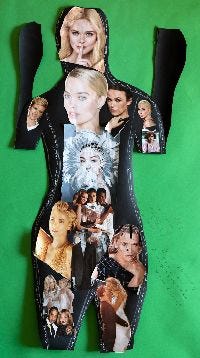
As I made that collage with all the white (and a few black)
faces within the outlines of my body,
I felt all the old anger and resentment rise.
I didn’t know what to do with these feelings.
I felt like the art was making me feel worse.
Should I cover the white faces with pictures of myself?
But I’d always had access to pictures of myself
and could look at myself in a mirror.
That was never enough to heal me.
Perhaps pictures of my mom or ancestors?
To honor who I’ve come from?
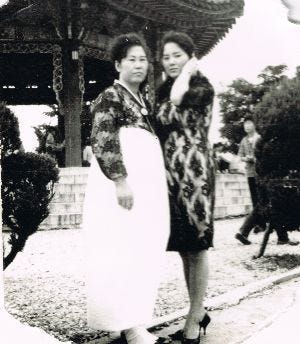
My grandmother- my mother’s mother-
passed away last year.
What I remember her lamenting about most often
when I was a child was that her perfect skin was becoming wrinkled.
She had beautiful, unmarred skin even until her 60’s and 70’s.
My grandmother grew up in a coastal town
in what is now part of North Korea.
It was famous for its mineral springs,
and my grandmother attributed the quality of her complexion to those waters.
In Korea, my grandmother was
tall, commanding, hard-working, wealthy and vain.
She could also be very generous- but she believed
she was better than most people she met.
She didn’t have any friends and her relationship to my mother was probably the closest thing to intimacy she experienced.
Her own mother — my great grandmother-
left her when she was just a baby to make a new life in a foreign country.
My grandmother never really felt supported and loved
by her father or step-mother.
She suffered from this mother wound her entire life.
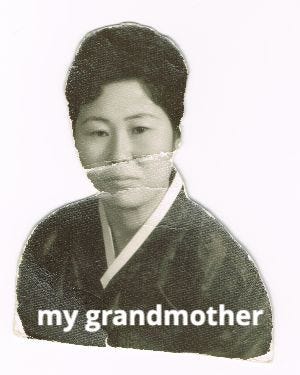
My grandmother never wanted to have children or get married.
She wanted to become a singer.
Not only did she marry, she had 8 children!
(She tried to run away several times and suffered from depression throughout her adult life).
All her children were boys, except for my mother.
Like many people in Korea at the time,
she was conditioned to prefer boys over girls and said things to my mother like,
“If not for you, it would have been perfect
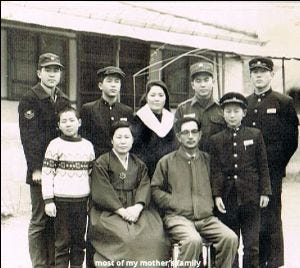
My mother inherited her mother’s beautiful skin,
pride, hard-working spirit, aesthetic sensibility, perfectionism and generosity.
But, she was much more compassionate
and lived to serve others, including her mother.
Neighbors would comment that she was being
treated like a step-child or a slave.
But my mom never recalls having felt anything negative towards her mother.
Even now, her brothers complain about the lack
of maternal love they received from their mom.
But my mom only ever felt sorry for her.
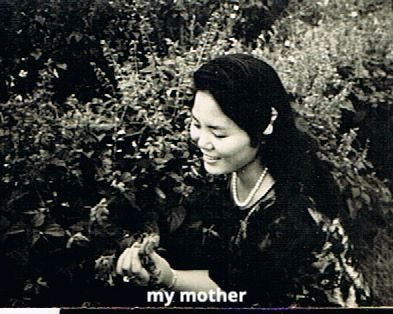
My mother was also considered beautiful-
beyond just her complexion.
She attracted attention everywhere she went
for her beauty, style, and grace.
She was also wicked sharp, eloquent, skillful and physically unstoppable.
So, as a child, of course I looked up to her.
And felt deficient.
I remember sitting next to my mother while she looked at magazines,
and she would compliment the white models,
making comments like,
“Wow, Asians don’t even look like fully-developed people
compared to them. Look at those amazing eyes and legs.”
And I would cry with indignation,
“How can you say that?
You are just as beautiful as them,
You are more beautiful.”
And she would smile, “No, not like that.”
The thing was, she didn’t seem jealous.
She owned her own beauty.
But, I couldn’t stand to hear her say these things.
Not about herself, and not about me.
Because if she- to me, the most beautiful woman in the world-
was not even comparable to these white models,
then where did that leave me?
It was strange.
At the same time that I was being
ostracized and felt ugly for being Asian
I also knew what it was like to be favored
because of my appearance- among Koreans.
I remember my grandmother saying often,
“If we were in Korea, you could be Miss Korea.”
(“Well, we’re not. And here, people tell me I’m ugly everyday.”)
I remember saying to myself as a kid
“If only they (boys I liked) would take the time to get to know me.
If only they could ignore the way I looked and see how great I am.”
Later in college, that became
“If only boys would like for me the real me, and not just for my looks.”
I remember one of my white boyfriends had dated an Asian girl before me,
and I was relentless in my assertion
that he had an “Asian fetish” and that it disgusted me
(while still engaging with him).
I realized this obsession with physical beauty-
beyond racism- was a source of misery.
If you are perceived as beautiful,
you engender jealousy in others.
And you are always afraid of losing your looks,
because it becomes part of your identity
if you are constantly praised for it.
And if you aren’t considered beautiful,
you’re taught to feel less than those that are.
My mom told me stories of how she didn’t have
any friends when she was young because
they were all jealous of her nice clothes and her prettiness
and the fact that all the teachers favored her perfectly obedient behavior.
(There went my theory that if I’d grown up in Korea
I wouldn’t have had any of the social problems I did in the US)
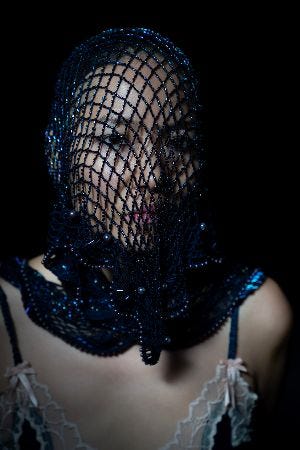
My mother didn’t have anyone to mirror her inherent value as a girl.
a woman. a human being.
She was only validated in relation to her looks
and her behavior towards others.
When my grandmother’s body was being buried in the ground,
my mother fell to her knees and cried,
“How can you leave me alone like this?
without even a sister?
It’s too lonely to bear.
I am so alone.”
My mother has also suffered from
a lack of maternal love her whole life.
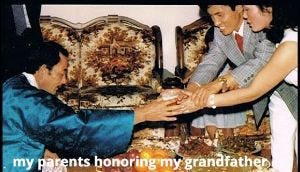
She always desired but struggled to experience
intimacy with other women.
With other people.
With herself.
I am also in this struggle.
I think we all are.
judgment.
separation.
sexism.
racism.
consumerism.
The idea that we are better or less than others
because of external forms.
Because of our sex, our race, our accomplishments, or financial status.
This sense of competition.
That life is a race, and we’ll get left behind if we don’t
look good enough,
make enough money,
get it “right.”
This feeling that we are not OK just as we are.
That we do not inherently belong and have value.
That we are not unconditionally loved.
That we are not held by the universal mother.
by Life.
The story “The Moon Comes Home”
is all about the journey from shame and not belonging
to coming home to unconditional love.
I started creating paintings to make this story into a picture book years ago.
I only did a few and then I got stuck.
I got stuck around the character of the condor.
I didn’t know how I wanted to draw him.
I judged myself for this.
I’m lazy.
Not focused enough.
I’m letting Life/ Mother Earth/ my higher self down
by not completing what I’m “supposed” to.
Ha. The story itself is all about trusting the cycles of life.
And being in total surrender and self-acceptance.
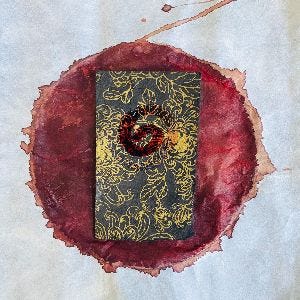
I have been delving more deeply into the blood mysteries-
sacred rites around menstruation.
All over the world, when a girl begins to bleed
it is said that she “becomes a woman.”
So how we view menstruation is intimately tied
to how we view women and the feminine.
How do you view menstruation?
Most of us feel it is something to hide,
a nuisance, uncomfortable, painful, perhaps even disgusting.
My periods used to be very painful and I also used to think of it as a nuisance.
But over the last several years,
I think as I became more connected to Mother Earth,
I found myself really enjoying my moon cycle.
I started to feel very empowered and feminine when I menstruated.
I loved bleeding into the Earth directly.
And I would give my plants water mixed with my blood.
But I never thought to add it to my art until recently.
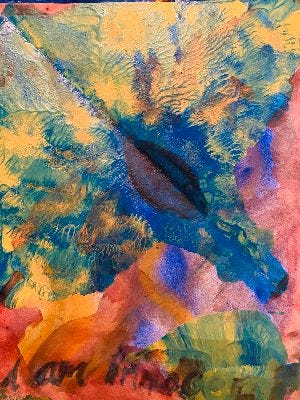
I was guided to paint a yoni with wings.
I painted it with my blood.
Later that night, I kept thinking about the moon story.
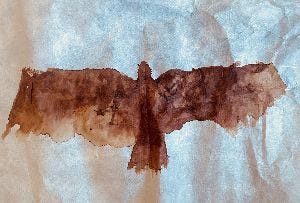
And suddenly, I realized the RED condor of my story,
who is an ally and guide for the MOON,
represents this sacred blood of life.
And then I immediately painted the condor with my blood.
And in that moment, I realized (again),
I’d always been perfectly aligned with life.
I wasn’t behind. I wasn’t lazy.
I wasn’t stuck or missing something.
I couldn’t have created the painting
for this story a moment sooner than I did.
We are connected to each other through love and blood.
Not only our biological family, but to all of life.
We are all born bathed in blood-it is our first annointing.
This separation from our physical mother begins our journey of individuation.
But it does not end our relationship
to the constant, loving embrace of
the Divine Mother.
As I open more deeply to the love of the Divine, that’s always been here, I am learning to become my own mother.
As my mother learns to become her own mother.
As my grandmother opens to the love of the Great Mother.
Now is the time for all of us to become our own mothers.
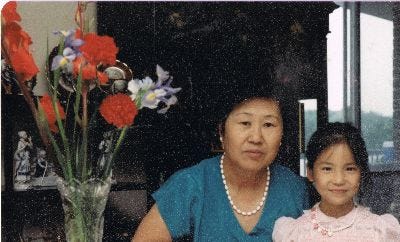
To treat ourselves with the patience kindness, and acceptance that is our birthright-
so that we may embrace one another- as mothers, as children, as brothers and sisters.
Go to next part of series. See Part 1 and Part 2 of this series.


