
You are not my mirror: I am your prism
An Art Journey to Alchemize the Lies of Racism — Part 4
I was born Jane Ida Lee.
My ancestry is Korean and my Korean name is 이재인.
The first character 이 is the family name (it means “plum tree” and symbolizes patience)
pronounced ee- without the “L” sound.
Jane is written as two characters 재 jae and 인 een.
Following family tradition, like all my female cousins,
the first syllable of my Korean name is Jae, after my maternal grandmother 우재순 (Ooh Jae-Soon).
My parents added “Ida” because they liked the sound of it.
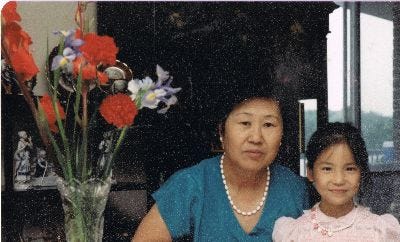
I hated my name when I was little.
Jane was too simple and plain.
Ida was weird and old-fashioned.
Lee was so stereotypically Asian and led to the inevitable
“You must be related to Bruce Lee! Do you know karate?”
People would always ask, “What’s your real name?”
I was secretly happy that I could say, Jane is my real name,
instead of something that sounded more “ethnic” and was difficult to pronounce.
I used to fantasize that I had a name like Veronica Montgomery or Cynthia Stone.
At the time, I thought it sounded more sophisticated.
But now I see, it just sounded undeniably White.
It breaks my heart to remember how I preferred these names.
I was in such deep self-denial that I wished I had
a name that represented absolutely nothing about who I was.
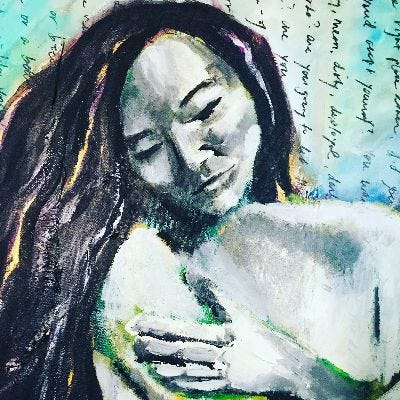
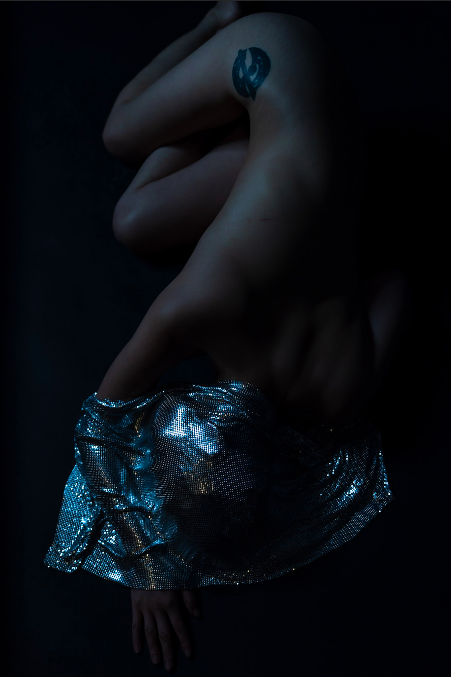
When I was 17, I got a tattoo that was a
stylized version of my last name in Korean.
I liked its simple, universal elements- the circle and the line
(that I saw as symbols of masculine and feminine energies.)
I had to hide this from my parents, especially my mother.
Tattoos are very common in Korea now,
but 20 years ago, it was still considered taboo.
In my mom’s mind, only gangsters had tattoos.
And she hated anything that breathed of counter-culture.
Being “respectable” in the eyes of others
was one of her most important values. (She’s opened up a lot since then :)
When I was 21, I finally gathered the courage to show my mom the tattoo.
She looked at it in disgust and said,
“This is the worst mistake of your life.
No man is going to marry you now.”
I laughed inside.
If this happened to be the worst mistake of my life,
I was going to have it incredibly easy.
And it was so obvious to me that any man
that did not accept something like a tattoo
was not fit to be my husband.
To my mom, I said,
“But, it’s an honoring of our family!
Our family name will be with me for life,
even if I get married and change my name.”
My mom groaned.
“Oh, so stupid.
In Korea, women don’t change their names when they get married.
And, if you had to get a tattoo,
why not be like other girls
and get something small and pretty, like a flower?
Why this big, dark thing?”
Well, because I’m not like other girls, Mom.
Her disappointment didn’t feel good, but I wasn’t surprised.
And I was thrilled to hear that Korean women didn’t change their names,
thinking it was a symbol of a more evolved society than I’d imagined.
Later I learned that historically women in Korea
weren’t included in the family registry.
It’s not that their original names
were considered valuable,
it’s that the women were seen as so insignificant
that their names didn’t matter at all.
— — — — — — — — — — — — — — — -
I learned to love my name when I moved to Korea
after graduating from college.
Koreans pronounced my name slightly differently-
as two syllables instead of one- making it sound
more subtle and lovely to my ears.
I spent my first few years in Korea teaching English
at one of the top institutes in Seoul.
I was told by my boss to pretend
like I didn’t speak any Korean.
They were worried that Koreans would not value
me as a native English speaker if I could also speak Korean.
I hated this rule.
Why should the fact that I spoke another language
devalue my status as a proficient speaker in the other?
But I understood the reality.
The fact that I was Asian already made me
less desirable to Korean students than a White American,
White South African or other “exotic” ethnicity.
In fact, to most Koreans
(and Mexicans and Italians and others in
most countries I’ve travelled in the world)
American = White.
At the end of each term, I would smugly
reveal to the students that I actually knew Korean
and had understood what they’d been saying all along.
This would always result in delight
(they found me much more approachable/
less intimidating when they heard my
juvenile expression of their native language),
a deeper sense of bonding, and a series of questions.
The first of these would be:
“What’s your Korean name?”
“Jane.”
“Ohhh. 재인 (jae- een). That’s a very pretty name.”
(They “heard” the name differently
once they knew it was a Korean name).
“What’s the 한자 (han-ja)?”
한자 are Chinese characters.
Traditionally in Korea, names were seen
as an important aspect of one’s destiny.
They were never random and
were often made up of Chinese characters
that conveyed a specific meaning.
(The Korean language is related to Chinese
the way English is related to Greek or Latin.
Totally different languages that share similar roots.
Written Korean uses an alphabet that was created long after the oral language already existed.
Before that, Chinese characters were used.
Because of their complexity
(Chinese doesn’t use an alphabet
but has distinct characters that make up each word),
only a privileged few in ancient Korea were literate.
After the Korean alphabet was invented,
the literacy rate became among the highest in the world.)
Some Korean words are “pure Korean,”
but many have their roots in Chinese.
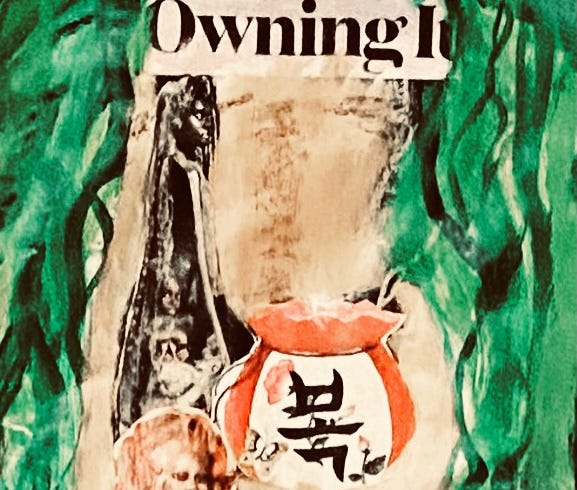
For the latter you have to know which
Chinese characters the Korean words are derived
from to understand their meaning,
because the same sound can have multiple meanings.
This is usually made clear through context but with something like a name, you would have no idea unless it was explicitly stated.
I’ve always been into meaning and symbols,
so I was very excited at the idea that “Jane”
was not just a sound that could be written in Korean,
but a name that carried a deeper truth.
So, one day, I excitedly called my parents
and asked them to assign Chinese characters
to my name, so it could have meaning.
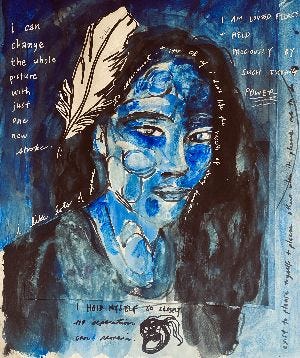
My dad laughed and said, “We already did.
I chose the most simple characters,
in case you ever learned to write 한자.”
(OK, so not the most poetic origin story,
but I was just happy I had a real Korean name.)
Here is the 한자 of my first name.
이 李 plum tree (obviously not unique to me)
재 在 to exist
인 仁 wise, virtuous person
When combined, the characters become like poems
and carry a new meaning.
Together, 재인 translates to “compassionate philosopher.”
I found this fascinating.
I had just graduated from college with
degrees in Philosophy and Psychology,
which seemed like a perfect mirror to this name
that I didn’t even know I had.
I was also born with my sun (and many other planets)
in Sagittarius, sign of the philosopher and truth-seeker
and my moon in Pisces- the sign of the compassionate artist.
I felt this deep sense of destiny and a new appreciation for my name.
I never thought I would change it.

But, a few years ago, Yeeve Rayne
came to me as my new name.
It came while I was channeling a trilogy of stories
from Mother Earth and the Body of the Child
(the unified body of all the incoming souls)
that honor the sacred union of the
Divine Masculine & the Divine Feminine.
They are simple creation stories.
They are also living maps and mirrors
that reflect and guide the journey of my life.
The second story is called the “Rebirth of the Golden Butterfly Queen.”
In the story, the Queen sings a song
that wakes people to the treasures within.
The first time I said my new name aloud
in the presence of another person,
was just before I performed this song.
I hadn’t yet been using the name because it
felt awkward. It didn’t yet feel real.
But, after saying aloud
“My name is Yeeve Rayne,”
I heard the lines of the song differently, as if for the first time.
Everything clicked into place,
and I knew this was indeed my new name.
“I am the Golden Queen
I am here to overthrow the reign of shame…
I sing my own legend to honor
the worlds’ history
that lives inside of me…
“I am spreading seeds to create new gardens of Eden…
I contain every color and every flower each of my parts fitting together without any dilution whatsoever…”
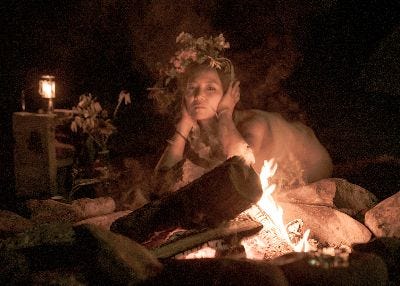
As Jane represents a sort of everywoman (Jane Doe, Plain Jane),
Eve, “mother of all life,” stands for all women.
But the way the biblical Eve has commonly been understood
does not embody the true Divine Feminine.
(Eve also means “serpent” which
may be closer to the truth.)
I was not brought up with any religion,
yet this ancient story of Adam and Eve
and the Fall still affects me.
It is imbedded in our Western collective unconscious.
And with it, an inherent sense of unworthiness,
the guilt and shame that accompanies pleasure,
and the demonization of the body and the feminine.
The odd spelling of Yeeve, seems to signify
an evolution of that feminine archetype.
Not the help-mate that brought shame
and expulsion from the Garden of Eden
and suffering for all future generations.
But the force of nature that is pure desire,
that knows Earth as Heaven
and the body as a holy vehicle of creation.
The one who embodies the divine union
of the masculine and feminine
and co-creates new gardens of Eden.
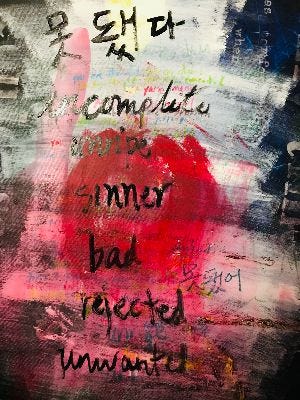
The third story is called “The Tree Beyond Good and Evil.”
It tells of a woman who possesses
the power of fire.
No one knows her name
or where she comes from.
She belongs to no one
yet is the most tethered of all.
For she keeps her world- the Land of Eternal Winter-
alive, one small flame at a time.
But her people never know warmth,
cannot let the heat penetrate their skin-
until she fully expresses her power
and sets the entire world aflame.
Until she accepts the totality of who she is,
dissolving her old limited identity,
the waters of life cannot pour through her
to quench the burning world.
I didn’t know how this story ended,
until I embraced my new name.
“And the fire woman, who was no longer
needed or feared, knew herself.
She knew herself as beloved.
And the whole world knew her name…
Yeeve 이재인 Rayne.”
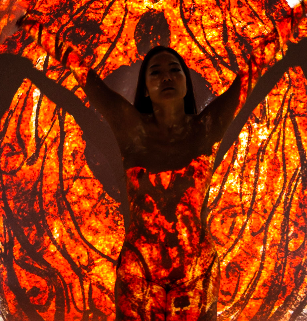
I performed this story a few months ago,
and someone commented on how much it
reflected our current experience- the global
pandemic, fires raging across the land.
(There’s a dragon in the story that
forces people to stay huddled indoors.
But it also brings the usually private people
of Winter closer together.
And teaches them to light their own fires.)
Like you, perhaps,
I have been using this time
To move a little slower.
To be more present.
To understand more.
To love better.
To be kinder to my body.
To hold precious that which is precious
and let go of that which is
ready to burn way.
To nourish the parts of me that
have been starving
And warm the parts of me
I’ve left out in the cold.
And now I reclaim all of me.
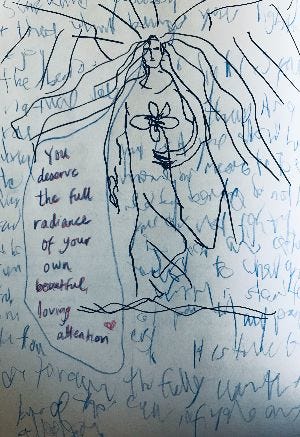
I honor where I’ve come from- my Korean ancestry,
and especially my mother and grandmothers.
I honor their struggles and their pain
and what they had to do to survive.
And I’m so grateful for their beauty, their tenacity,
their self-respect, their courage, their talents and
their passion for life.
I honor the Western culture and land
and people I was born and raised with.
I honor the grief and accept the ignorance
and self-denial that has led to- and continues to create- such destruction and violence.
And I’m so grateful for the abundance,
the freedom, the natural beauty, the creativity
and the diversity I’ve had the privilege to live within.
I let go of my attachment to suffering.
It is not a betrayal of my ancestors,
to all those suffering in the world,
or the younger me
to let go.
I let go of my identity as
one who doesn’t belong.
As one who is separate
because she is worse or special because she is best.
I let go of comparison.
I let go of my fear of being
left behind.
I let go of my race
against time.
I let go of my need to
be validated by others.
I see myself.
My name is Yeeve Jane Ida Lee Rayne.
I am not your mirror.
I am your prism.
Let us penetrate each other with our light.
That through us, new rainbow worlds of belonging, freedom and possibility be made manifest.
*you can read part 1 of the journey here…


