
Xebec
Sailing… takes me away to where this word does not exist
Today’s New York Times Spelling Bee letters:
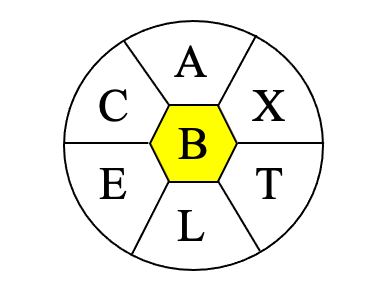
A, C, E, L, T, X, and center B (all words must include B).
Merriam-Webster says…
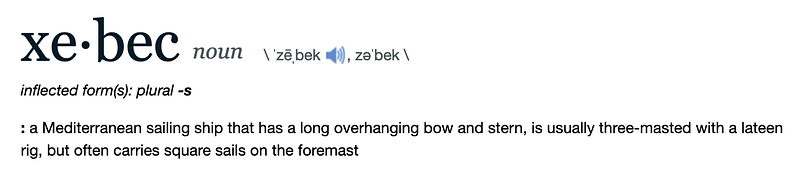
Silly little dictionary! Don’t you know that xebec can’t possibly be a word if the New York Times says it ain’t?
For further fascinating facts, check out the Spelling Bee Master.
What’s your favorite dord* from today’s puzzle?
My Two Cents
I was tempted to go with cabaletta as today’s dord. This musical word about the musical arts (opera) would have made a nice article, I think. But I couldn’t pass up xebec. How often does one see words that begin with “x”? And to top it off… rejected!
In Spelling Bee lingo, “bingo” is when a given game provides at least one word that begins with each of its seven letters. Spoiler alert to those who are still playing today’s puzzle: there is no bingo. And the only reason there is no bingo today is because the New York Times did not accept xebec.
It seems the editors of the Spelling Bee are not too keen on nautical terms. Barely three weeks ago they rejected carrack. But c’mon! Xebec is a much cooler-looking and sounding word. Oh, and speaking of sound… it’s pronounced ZEE-beck.
Coarse air
The dictionary explains that the word likely originated from the Arabic shabbāk. The French transliterated it as chebec, and along with the influence of either the Catalan or Spanish words xabec or xabeque, respectively, the word became known as xebec in English. Sometimes it’s also spelled as zebec.
Xebecs are believed to have been first constructed in Algeria in the 16th or 17th century, during the Ottoman reign. They were used by Barbary pirates, or corsairs, being easy and cheap to build.
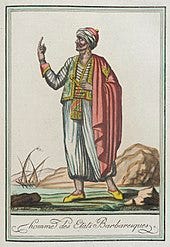
It seems that back then the index finger was the one used to express displeasure.
A description of the ship I found says this: “Xebecs had a long overhanging bowsprit and aft-set mizzen mast.” If you know as much about boating as I do (which is next to nothing), you may find this a lot more helpful:
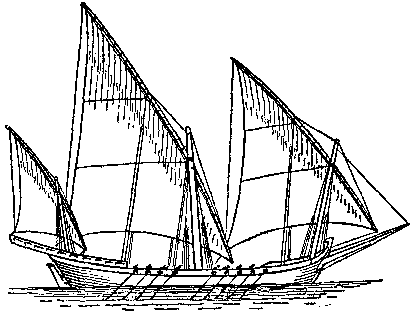
A long, overhanging bow, or front part (on the right) was one distinctive feature of the xebec. Corsairs would build them with a distinctive aerodynamic (for that era) hull that had a narrow floor, which allowed the ship to sail faster than the merchant vessel it was chasing.
Certainly a helpful trait if you were a pirate. Also helpful were the lateen rigs (the triangular sails mounted at an angle on the mast), which allowed the xebecs to sail “against the wind”, and the oars that let the ship sneak up to vessels that were motionless if there was no wind.
Xebecs were considered the fastest ships until the arrival of steam-powered boats. They carried anywhere between three to forty guns, although most usually had about twenty or twenty-five small, swiveling cannons. Crew count also varied greatly from several dozen to a few hundred men.
One famous xebec, the El Gamo, was involved in one of the most incredible mano a mano in naval history. Spoiler alert: the El Gamo was on the wrong side of that historical duel.
David and Goliath at sea
Redundant as it may seem, the HMS Speedy was a Speedy-class brig, or ship with two square-rigged masts. She was built in the port town of Dover, England, towards the end of the American Revolution, but first saw action in the French one. Then she ping-ponged from country to country, its popularity growing like a certain cryptocurrency named after a canine. Here is the list of countries it spent some time with, via capture, recapture, and re-recapture:
▹ Great Britain: 1781–1794
▹ France: 1794–1795
▹ Great Britain: 1795–1801
▹ France: 1801–1802
▹ Papal States: 1802–1806
What happened in 1806? Speedy was struck, or stranded.
During her second marriage to Britain, the nation had her portrait painted in 1800:
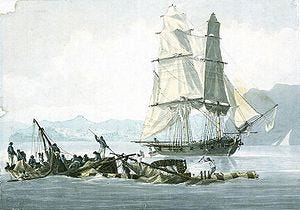
She’s the one not sinking, in case you were wondering.
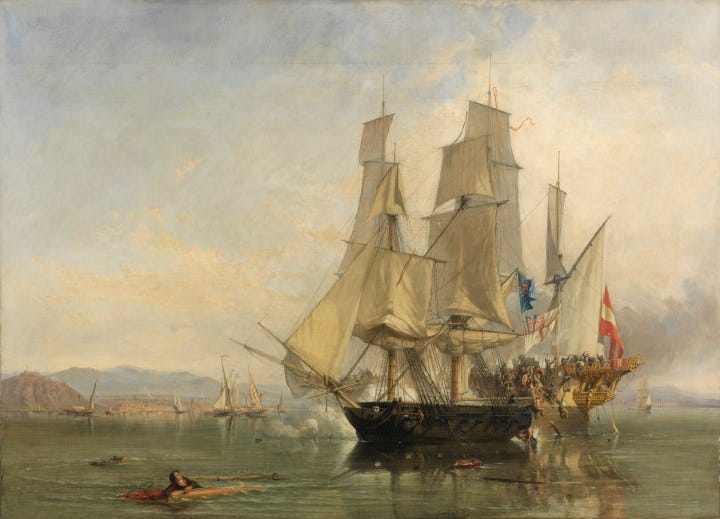
A year and change later she was cruising along Barcelona, Spain at dawn, when she ran into a xebec. and not just any xebec, the El Gamo. The latter had a crew of 319 men and 32 guns. Speedy had only 54 guys and 14 guns. Plus she was sort of hung over from partying in Barcelona. Cause that’s what people do in Barcelona. Trust me. I live in Spain, but in the less touristy Madrid.
The Speedy had been under the command of several captains, but the current one, Thomas Cochrane, 10th Earl of Dundonald, Marquess of Maranhão, had a much much longer name than all the previous ones. So that naturally made him ballsier, and he attacked.
El Gamo fired and hoisted its colors to show it was a Spanish xebec off Spanish waters. Cochrane decided to confuse the enemy by hoisting American colors. Why? I have no idea, but it made the El Gamo hesitate. And you know the old saying about hesitation. Well, it certainly worked this time.
Speedy managed to get close enough to jam its yards (the horizontal poles on which the sails hang) into Gamo’s rigging. As the ships were side by side, the Gamo’s guns, which were mounted too high, could no longer fire on Cochrane’s ship. This long-named, ballsy captain was also quite smart. The Speedy’s guns had been set in such a way that they could fire upward.
And fire away they did. The first shot killed the Spanish captain of El Gamo. At this point the guy who took over decided to board the Speedy. He tried three times with no success. Then Cochrane showed him how it’s done by rushing all his men onto the enemy ship. (I guess he was also a football defensive coordinator.)
All his men except one. The Speedy’s doctor remained aboard and served as a decoy when his captain yelled at him to serve more men. At the same time, Cochrane had the Spanish colors torn down. The Spaniards, thinking someone had given the order to surrender, and that a bunch more British were about to jump over and inflict further whoop-ass… surrendered.
The photo at the top of this article depicts that battle. Here it is so you can keep slowly scrolling down, and not up.
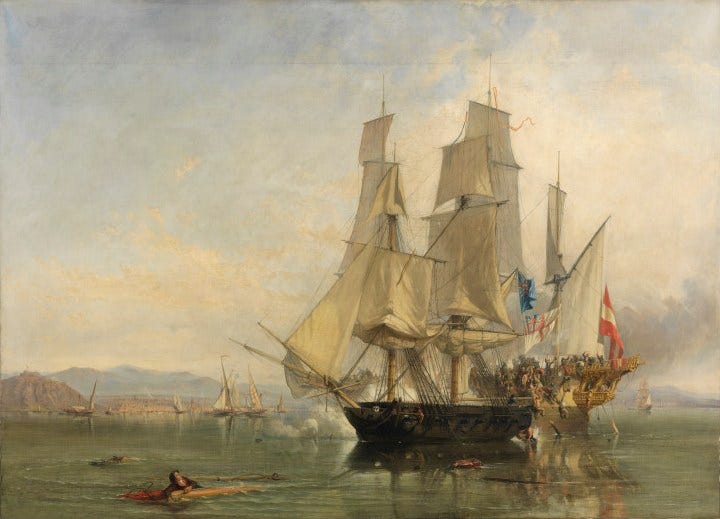
The aftermath of this naval upset was interesting. As Wikipedia explains (based on information from Roy and Lesley Adkins The War for all the Oceans: From Nelson at the Nile to Napoleon at Waterloo):
“Stung that he had been beaten by such an inferior foe, the Spanish second-in-command asked Cochrane for a certificate assuring him that he had done all he could to defend his ship. Cochrane obliged, with the equivocal wording that he had “conducted himself like a true Spaniard”. Cochrane was amused to learn that this certificate had later secured the Spanish officer further advancement.”
Now that was a pretty cool story. Aren’t you glad I decided to write about xebec and not cabaletta?
Well, the editors of the Spelling Bee don’t really care either way, as they decided that, despite that exciting boat story, xebec is still a dord.*
You can check out my previous entry on another dord* here:
*What the heck is a dord, you ask? Here’s the answer: