
Meed
One of the oldest words in the English language is rejected!
Today’s New York Times Spelling Bee letters:
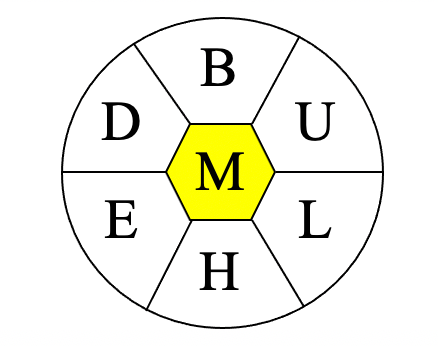
B, D, E, H, L, U, and center M (all words must include M).
Merriam-Webster says…
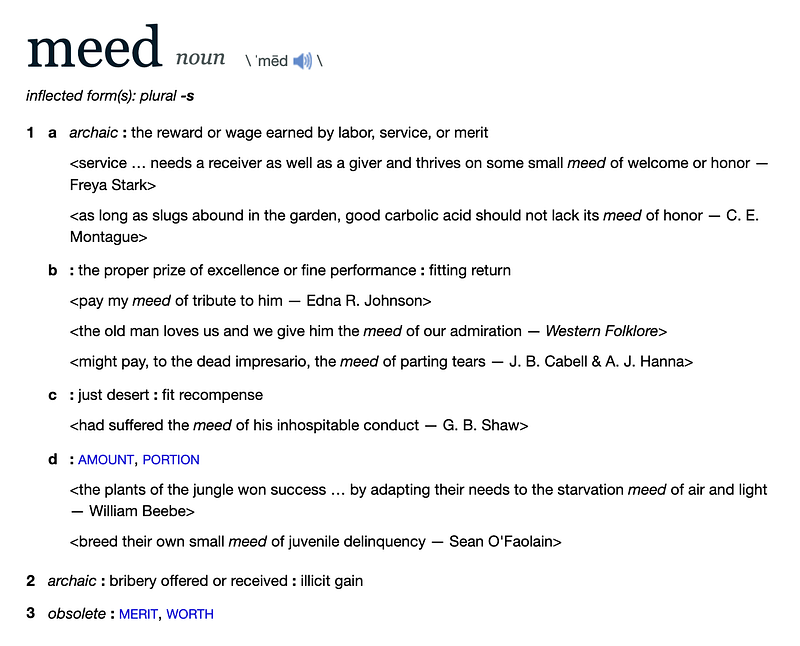
Silly little dictionary! Don’t you know that meed can’t possibly be a word if the New York Times says it ain’t?
For further fascinating facts, check out the Spelling Bee Master.
What’s your favorite dord* from today’s puzzle?
My Two Cents
I had a mini celebration this afternoon when I found the final word on the list of today’s Spelling Bee puzzle. That means I got to see this little beauty displayed on the screen of my phone:
I’ve intentionally not included the total point and word count, in case any reader is still working on today’s game.
So that, among other things, made my day.
How to be a wolf
Merriam-Webster explains the following:
“The word meed is one of the oldest terms in our language, having been part of English for about 1,000 years. An early form of the word appeared in the Old English classic Beowulf, and it can be found in works by literary luminaries including Geoffrey Chaucer, Edmund Spenser, John Milton, Alexander Pope, and Ben Jonson.”
Do not confuse Ben Jonson with Ben Johnson, with an “h”. The former made people in the 1600s laugh their hearts out with his humorous plays, while the latter broke people’s hearts when it was discovered he had used performance-enhancing drugs to win the gold medal in the 100-meter event at the 1988 Seoul Olympics.
Now, the dictionary has given us a bunch of meanings, not that helped meed be accepted as a word in today’s puzzle. It also lists examples by writers who have used the term more recently than the ones mentioned in the citation. There’s George Bernard Shaw (of course!), but also Freya Stark and Sean O’Faolain, both of whom died in the 1990s.
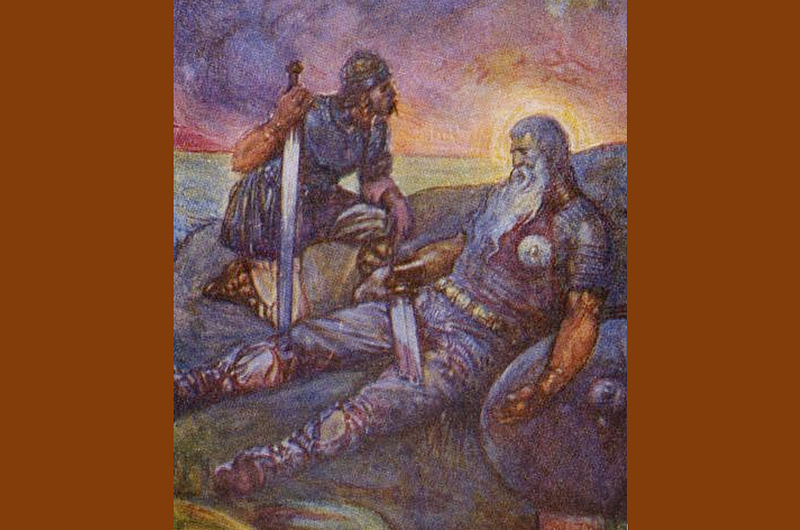
So, we’re not talking about a word that’s hasn’t been used since… well, Beowulf. Speaking of which, the image at the top of the article depicts Wiglaf returning to witness the eponymous hero of the story die. Emphasis on “witness”. Wiglaf basically just knelt there and did nothing as his king slowly bled to death, apparently from a sword stuck in his thigh. Well, it’s not like medicine in the 6th century (when the poem is set) would have helped Beowulf much.
There, I’ve given away the biggest spoiler of a yarn spun between 975 and 1025. Now that I’ve ruined the ending for you, I might as well summarize the rest of the plot. Now, I don’t have access to the Nowell Codex (the only known manuscript to contain the poem)… wait, scratch that. I just provided you with the link, which means I do have access.
Okay, then, my Old English is a bit fuzzy, having studied it never, and I don’t have a copy in Modern English handy. So I’ll just be a bit lazy today and quote Wikipedia’s synopsis.
“The protagonist Beowulf, a hero of the Geats, comes to the aid of Hrothgar, king of the Danes, whose great hall, Heorot, is plagued by the monster Grendel. Beowulf kills Grendel with his bare hands, then kills Grendel’s mother with a giant’s sword that he found in her lair. Later in his life, Beowulf becomes king of the Geats, and finds his realm terrorized by a dragon, some of whose treasure had been stolen from his hoard in a burial mound. He attacks the dragon with the help of his thegns or servants, but they do not succeed. Beowulf decides to follow the dragon to its lair at Earnanæs, but only his young Swedish relative Wiglaf, whose name means “remnant of valour”, dares to join him. Beowulf finally slays the dragon, but is mortally wounded in the struggle. He is cremated and a burial mound by the sea is erected in his honour.”
Here’s a photo of page one, where you can clearly see the word meed being used not once, but zero times. I’m told it appears later at some point.
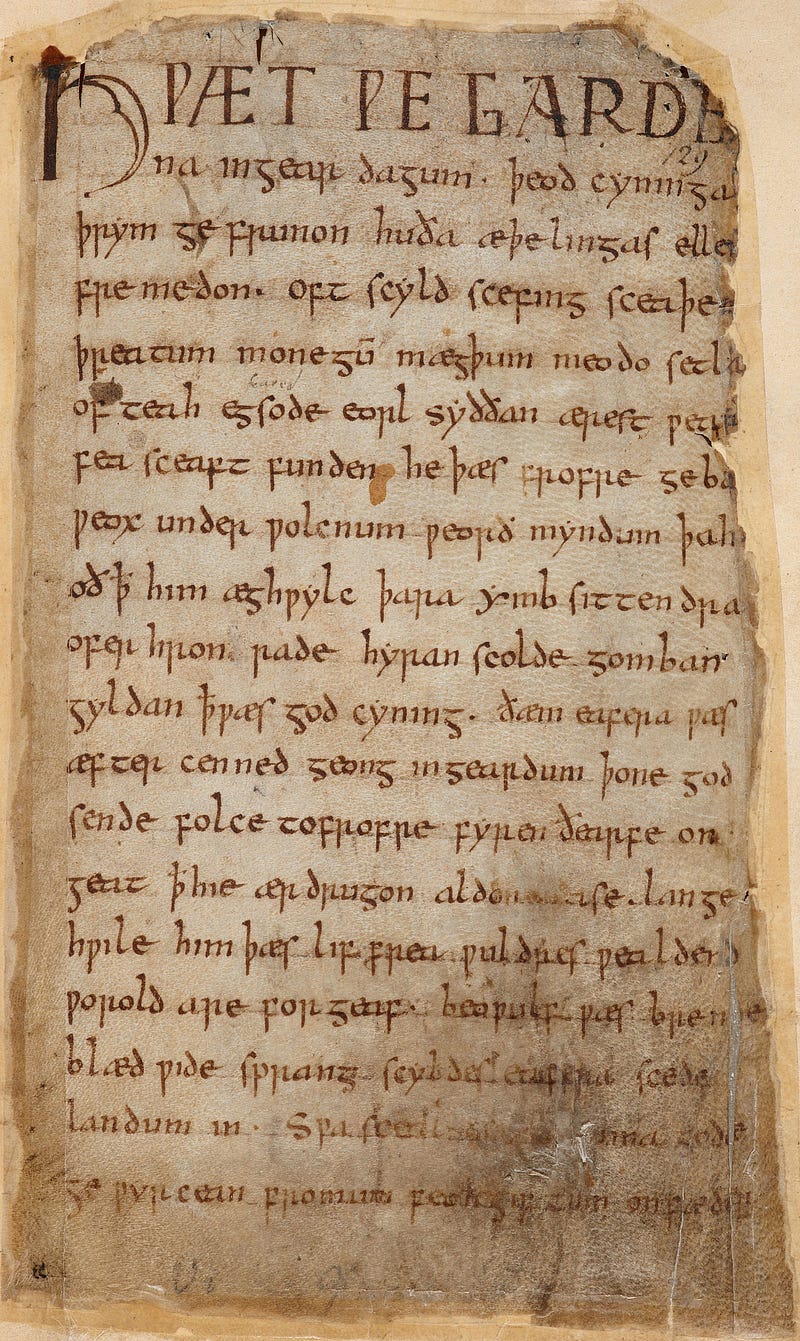
Zoom zoom
As usual, the helpful editors of Merriam-Webster also provide us with the etymology of meed.
Middle English, from Old English mēd; akin to Old High German miata reward, Greek misthos.
Anything in the above sentence sound familiar?
If you said misthos and you’re not Greek, I’m impressed. But I was actually referring to this:
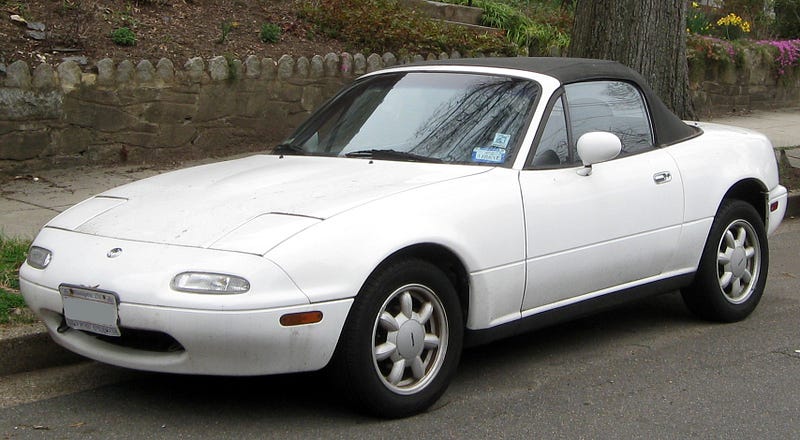
That’s an example of a first-generation Mazda MX-5, in production from 1989 to 1997. The roadster was marketed as the Miata in the Americas. It was designed under Japanese automaker Mazda’s philosophy of Jinba ittai (人馬一体), a term related to mounted archery that means “oneness of horse and rider”.
According to Mazda, the Miata is the best-selling two-seat convertible sports car in history. That’s quite the specific category, but it was good enough to help the company enter The Guinness Book of World Records. No word on which are the best-selling four-seat convertible sports car, the best-selling two-seat non-convertible sports car, or the best-selling three-seat semi-convertible SUV in history. If anyone knows, feel free to educate us via the comments section.
According to lore, the name Miata was picked early on by Rod Bymaster, Mazda’s head of product planning and marketing. And he based his decision on the origin of our daily dord, meed. But he didn’t pick that word, well, because Mazda Meed sounds silly. And might get people thinking of mead, the fermented drink made of water, honey, and malt.
So Bymaster instead chose miata, from the Old High German. This story has been confirmed by Bob Hall, former American motoring journalist and founding member of the team that developed the MX-5.
On April 22, 2016, Mazda broke its Guinness World Record by producing its one-millionth MX-5.
Despite appearing in Beowulf and inspiring the best-selling cute red two-seat convertible sports car in history, the editors of the Spelling Bee still decided that the word meed is a dord.*
You can check out my previous entry on another dord* here:
*What the heck is a dord, you ask? Here’s the answer: