
Globin
It’s in your blood… but not in the Spelling Bee game

Today’s New York Times Spelling Bee letters:
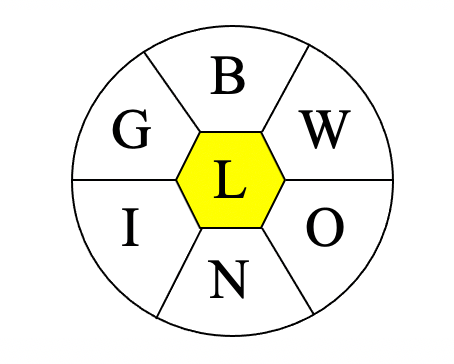
B, G, I, N, O, W, and center L (all words must include L).
Merriam-Webster says…
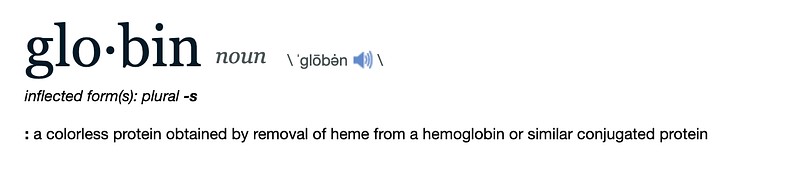
Silly little dictionary! Don’t you know that globin can’t possibly be a word if the New York Times says it ain’t?
For further fascinating facts, check out the Spelling Bee Master.
What’s your favorite dord* from today’s puzzle?
My Two Cents
Happy Mother’s Day to all moms who celebrate it today! Here in Spain the holiday falls on the first Sunday of May.
Skip the next few paragraphs if you’re still working on today’s Spelling Bee puzzle and you don’t want to see any spoilers. It’s one of those chunky ones with a lot of words, points, and pangrams. The maximum possible score is 360 points, which gives you the Queen Bee logo and tells you you’ve found all the words there are to find. Except for the ones that were rejected, of course. The second-highest score — Genius — sits at 252 points today. (Four-letter words get only one point; words that are five letters or longer get a point for each letter. The pangrams get a bonus of seven points in addition to the word score.)
My favorite range of Genius points is under 100. Typically that means there are fewer words, although some of those puzzles can be a real challenge. I don’t mind Genius levels of 100 to 150 points, but when things start to climb to 200 and above (like today), I get testy.
This morning, however, I was quickly able to get to 252 points. Not because I’m that good, but because the puzzle features three key letters: I, N, G. If you play the Spelling Bee, you learn to look out for certain letter combinations. Suffixes are very helpful because you can get a two-for-one combo: the basic word or root word, and the one with the suffix.
For example, in today’s game you can spell BOWL, and then add -ING and get BOWLING. Which happens to be a “perfect pangram”, as it contains exactly one instance of each letter in the puzzle. And you can create words that without the suffix would be too short. LOGGING will be accepted because it has seven letters, whereas LOG would be rejected because it has fewer than the minimum four letters the rules establish.
Sphere you are!
Merriam-Webster explains that globin may have originally been coined in German from glob- (a prefix meaning ball) and -in (a suffix referring to a chemical compound).
The definition given by the dictionary is a bit on the thin side, though. Globins are actually a superfamily of globular proteins whose main job is to bind with and transport oxygen. Two of the better-known examples are myoglobin and hemoglobin. (In the UK hemoglobin is spelled haemoglobin; the “a” gives you the cue to read it with a British accent.)
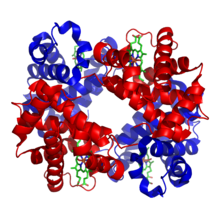
Hemoglobin is the protein that contains iron and carries oxygen in the red blood cells, or erythrocytes. This relatively big protein picks up the oxygen in your lungs and then travels through your bloodstream releasing it as needed in muscles and other tissues.
In humans, hemoglobin makes up most of the red blood cells’ dry weight and more than one-third of their total content. But when your hemoglobin levels go up or down too much, it can be a problem. Anemia, or a low count of hemoglobin, can occur due to iron deficiency, bone marrow disease, kidney failure, or loss of blood (duh!). Chemotherapy can also cause anemia.
Polycythemia, or elevated levels of hemoglobin, can happen because of heart or lung diseases, or a rare type of disease known as polycythemia vera, in which the bone marrow produces too many red blood cells.
Once hemoglobin drops off oxygen in the muscles, myoglobin springs into action, taking the oxygen to the mitochondria — or powerhouses — of the cells. While hefty Hemo has four globins, its cousin Myo has only one. But there are enough myoglobins in muscle to give red meat its color. (Well-done meat turns brown because the iron atoms turn to their oxidation state.)
High levels of myoglobin allow organisms to hold their breath longer. So now you know why whales, dolphins, and seals can stay underwater for so long. Also, I’ve given away the secret to the basic physiology of Aquaman and Namor.

That’s right: their superpowers consist of an excess of myoglobin. And don’t let any comic book nerd tell you otherwise!
Now, when muscle is damaged, it releases myoglobin into the bloodstream. So measuring levels of this globin in your blood can help doctors determine or confirm whether you’ve had a heart attack, for example. However, because myoglobin is not specific to heart tissue, it’s not as specific to myocardial infarction as other markers.
Darling, I don’t know why I go to extremes
Now, if you’ve been wondering all this time how the photo at the beginning of the article is related to the word globin, wonder no more.
The picture shows the giant tube worm, officially known as Riftia pachyptila. Yes, I agree: let’s stick to “giant tube worm”. Those elongated red tubes at the ends? They are branchial plumes, and they are bright red because they have up to 144 globin chains of hemoglobin.
This is what they look like when extroflexed:
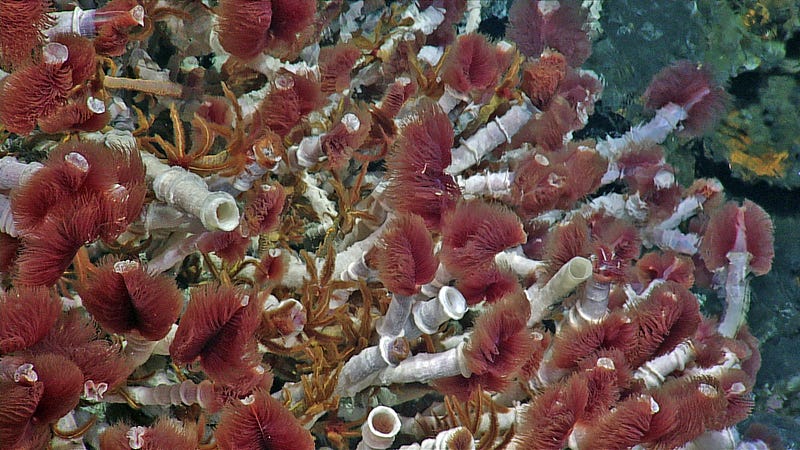
I don’t know what extroflexed means, but it sure looks pretty.
What’s impressive about the hemoglobin of these giant tube worms is that they are basically exposed to the elements and still work efficiently. Namely, the hemoglobin is able to carry oxygen in the presence of sulfide, which normally inhibits that globin molecule in other animals.
Then there’s the crocodile icefish, which hangs around Antarctica. This fish, of the Channichthyidae family, is the only known vertebrate whose adult form has no hemoglobin in its blood. So, in a sense, they are the anti-vampires of the world.
Perhaps that’s why it’s also called the “white-blooded fish”, as its blood appears colorless. Not coincidentally, myoglobin is also not found in this unique animal.
How do icefish manage to live without the essential globins that transport oxygen? Well, for one, they have larger blood vessels and hearts than other fish. Thanks to that, their blood volume is about four times that of regular fish.
The Soviets were so impressed by this creature that they dedicated a stamp to it in 1978.
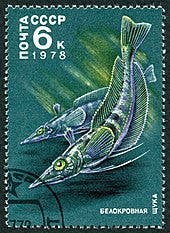
On the other hand, it looks like the editors of the Spelling Bee game wanted to pretend to be an icefish, as they decided that today’s puzzle would not have any globin in it. That means they’ve declared that word a dord.*
You can check out my previous entry on another dord* here:
*What the heck is a dord, you ask? Here’s the answer: