
Allonym
What’s my name? What’s my name?
Today’s New York Times Spelling Bee letters:
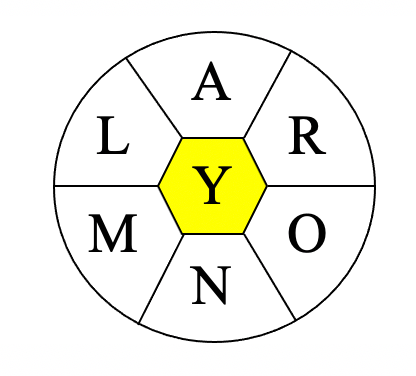
A, L, M, N, O, R, and center Y (all words must include Y).
Merriam-Webster says…
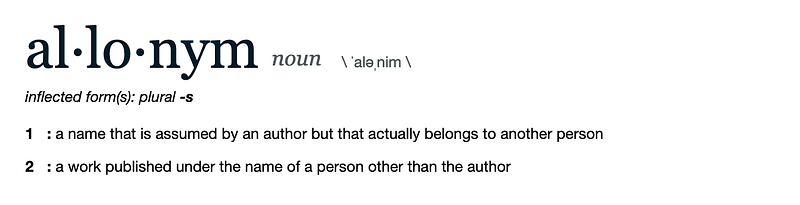
Silly little dictionary! Don’t you know that allonym can’t possibly be a word if the New York Times says it ain’t?
For further fascinating facts, check out the Spelling Bee Master.
What’s your favorite dord* from today’s puzzle?
My Two Cents
The repeated question at the top of the article (below the title) is a quote from Muhammad Ali during his fight against Ernie Terrell on February 2, 1967 at the Houston Astrodome. Ali has always fascinated me as both a sportsman and a civil rights activist, though I think he does not get enough credit for the latter, even today.
The dictionary tells us the word allonym comes from a similar word in French — allonyme — whose origin comes, in turn, from combining the Greek affixes all- (different) and -onym (name).
Term confusion
The terms pseudonym, pseudepigrapha, and allonym are distant cousins.
Pseudonym is commonly used as a synonym for “pen name”, although the former can be any type of fictitious name, while the latter is associated specifically with literary works. As Merriam-Webster explains:
“Pseudonym has its origins in the Greek word pseudōnymos, which means “bearing a false name.” Greek speakers formed their word by combining pseud-, meaning “false,” and onyma, meaning “name.” French speakers adopted the Greek word as pseudonyme, and English speakers later modified the French word into pseudonym. Many celebrated authors have used pseudonyms. Samuel Clemens wrote under the pseudonym “Mark Twain,” Charles Lutwidge Dodgson assumed the pseudonym “Lewis Carroll,” and Mary Ann Evans used “George Eliot” as her pseudonym.”
So if pseud- means “false” and (as you may know) epigraph means “an engraved inscription”, what does pseudepigrapha mean?
That term refers to writings of dubious authenticity or falsely attributed, typically used when discussing biblical works. Namely, Jewish religious literature written from about 300 BC to 300 AD. These include 3 & 4 Maccabees the Slavonic Second Book of Enoch, the Book of Jubilees the Psalms of Solomon, and the Testaments of the Twelve Patriarchs.
Some Christian denominations don’t recognize canonical works of other Christian groups. For example, Protestants consider Judith and 1 & 2 Maccabees as deuterocanonical, or “outside” the Protestant canon, although the Catholic and Eastern Orthodox Churches accept them as part of the Old Testament. So these are distinguished from pseudepigrapha because of that.
Also viewed as different from pseudepigrapha are apocrypha, Biblical texts that do not appear in the Hebrew Bible but were included in the Septuagint (the first known Greek translation) and the Latin Vulgate, a late 4th-century translation that centuries later became the official version of the Bible used by the Catholic Church.
Where does that leave allonym, our word of the day? The first definition is stated as “a name that is assumed by an author but that actually belongs to another person”. A typical case would be a ghostwriter. Say someone is writing an autobiography of a celebrity. Under the ghostwriting contract, the celebrity’s name will appear on the cover as the author. So, in a sense, the actual author —the ghostwriter — is assuming the name of the famous person who either can’t write lick or is too busy to write thousands of licks in a compelling or entertaining way.
Hey, I’m not judging. Ghostwriting can be a great, fun way to earn a living, and it usually pays quite well.
The second meaning of allonym is “a work published under the name of a person other than the author”. And that brings us to one of the more famous cases of this, at least in modern U.S. history.
The black list
If crappy human nature has taught us anything, it’s that people like to blame others for their problems. Owning up to the fact that you’re responsible for the majority of your ills and woes — and responsible for your attitude when facing those ills and woes that you’re not at fault for — is something that most human beings can’t handle.
Or, as military philosopher Nathan Jessup one famously said:
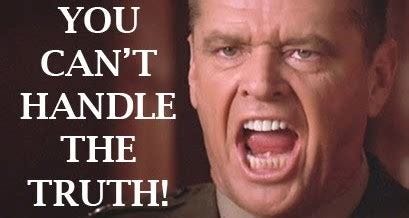
Blaming others is the original universal pastime, and this applies to humans individually and as a collective. So, for example, you might blame a person or a race or a gender for some misfortune you probably had a lot to do with. Or, as a society, we blame other nations, races, religions for bad things we’re largely responsible for.
While Native Americans, Jews, Blacks, Asians, Muslims, Hispanics, other minorities, and women have been the favorite scapegoats of American society at different points since the Mayflower reached Plymouth, during the mid-twentieth century the gravest threat was described as a color.
Red.
Yeah, Communism was infiltrating every crevice of the country and our national fabric was soaking up Marxism like it was the last drop of water in some weird mixed metaphor desert I just made up.
This was right after World War II and the Soviet Union, briefly an ally of the States during that conflict, had now become the country’s greatest enemy.
Now, there had been socialist and communist movements before the war, and in the late 1930s politicians really got itchy about the “Red Scare”. So the House of Representatives gathered around and created the House Un-American Activities Committee in 1938. The HUAC was tasked with investigating alleged subversive activities on the part of anyone or anything remotely suspected of having communist ties.
So, in trying to defeat fascism, the United States became… kinda fascist.
The whole mess extended all the way to Hollywood, of course. Another shocker! People in the film industry were summoned before Congress to name names. Some complied, notoriously Elia Kazan, of On the Waterfront fame. Others declined, and so were punished.
As Gary Baum and Daniel Miller explained in their 2012 Hollywood Reporter article, during the Hollywood Blacklist:
“studio chiefs and the head of the Motion Picture Association of America gathered at the Waldorf-Astoria hotel in New York and decreed an employment ban on the 10 members of the film industry who’d chosen not to cooperate with the House Committee on Un-American Activities, which had launched an investigation into the supposed communist infiltration of the business.”
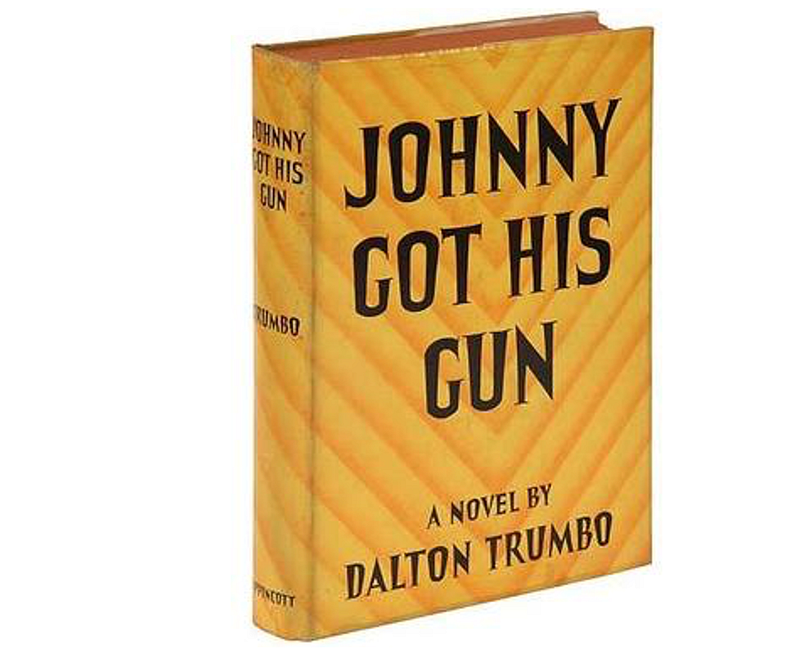
One of the people blacklisted is the author of the novel that appears at the top of this article.
Dalton Trumbo.
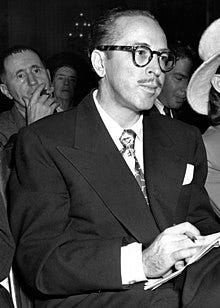
That photo was actually taken when Trumbo showed up before the HUAC. And heroically stood up for a bunch of amendments in the Constitution by refusing to testify.
Now, he wrote Johnny Got His Gun (which won the National Book Award) in 1938, before he was blacklisted. But after becoming one of the “Hollywood Ten”, he was not able to get public credit for his screenplay work, albeit the fact that he had good friends who found ways to help him earn money penning scripts using an allonym. Some of the well-known films he worked on during that time include Gun Crazy (1950), Roman Holiday (1953), The Brave One (1956), Cowboy (1958), and Spartacus (1960).
If you’ve seen Spartacus or at least the famous “I’m Spartacus” scene, you can clearly tell Trumbo was protesting what the American government had done, while calling out many in Hollywood for their cowardice.
By the time the movie Exodus came out (also 1960), the blacklisting had weakened enough that he was publicly credited by director Otto Preminger. Then Kirk Douglas, in a very Spartacus-like move, announced that Trumbo had written the screenplay for Stanley Kubrick’s film… Spartacus.
Before that, some of Trumbo’s writing— including his Oscar-winning story for Roman Holiday — was credited to an allonym. In the case of that movie, it was Ian McLellan Hunter who fronted for Trumbo, going as far as picking up the Oscar on awards night.
Dalton Trumbo’s story credit in that movie was reinstated when the film was released on DVD in 2003. On December 19, 2011, full credit for Trumbo’s work was restored by Hollywood.
So that’s about it for today. But before I finish, I want to recommend Trumbo’s novel Johnny Got His Gun. I read it in my late teens and was not prepared for the strong, shocking antiwar message the book delivers.
It’s still very much relevant today.
As for our word of the day… despite today’s abundant evidence to the contrary, the editors of the Spelling Bee puzzle decided that allonym is a dord.*
You can check out my previous entry on another dord* here:
*What the heck is a dord, you ask? Here’s the answer: