avatarAvi Kotzer

Free AI web copilot to create summaries, insights and extended knowledge, download it at here

4269

Abstract

while exploring the Atlantic coast of North American in 1524.</p><p id="0137">▹ Henry V’s flagship <i>Grace Dieu</i>, one of the largest <i>carracks</i> of its time (early 15th century).</p><p id="0b07">▹ The <i>Cinco Chagas</i> (literally, “five wounds”), a Portuguese <i>nau</i> believed to have contained treasures with the equivalent of $17–21 billion in 2021 dollars.</p><p id="63d3">In the mid-16th century, Portugal began trading directly with Japan, sending their <i>carracks</i> to the Asian island nation. The Japanese were apparently fascinated by these ships, dubbing them <i>kurofone</i> (black ships) because of the color of their hulls. There are many depictions of these ships on silk screens from that period.</p><p id="7dcc">There is a lengthy thesis written by Kotaru Yamafune about this subject:</p><div id="493a" class="link-block"> <a href="https://oaktrust.library.tamu.edu/handle/1969.1/ETD-TAMU-2012-08-11735"> <div> <div> <h2>Portuguese Ships on Japanese Namban Screens</h2> <div><h3>Namban screens are a well-known Japanese art form that was produced between the end of the 16th century and throughout…</h3></div> <div><p>oaktrust.library.tamu.edu</p></div> </div> <div> <div style="background-image: url(https://miro.readmedium.com/v2/resize:fit:320/)"></div> </div> </div> </a> </div><h2 id="9d0b">Story of a replica</h2><p id="853d">The images I found while researching today’s word made me feel nostalgic for the <i>carrack</i> in my life when I was a child.</p><p id="87b2">No, I didn’t grow up on a ship in the 16th century. I’m old, but not <i>that</i> old.</p><p id="24ef">In the neighborhood where I grew up in Caracas, Venezuela, there was a beautiful, lush park walking distance from my building. It was about 64 hectares in area, or about a fifth of New York’s Central Park and a bit less than half the size of London’s Hyde Park.</p><p id="146c">It had trails for running and biking, and basketball, and five-a-side football courts. It had a lot of animals spread around: otters, monkeys, birds, reptiles. It also had a small lake; you could rent pedal/paddle boats to futz around the water.</p><p id="448c">The park’s name changed over the course of the last 60 years. It was originally christened as Parque <a href="https://en.wikipedia.org/wiki/R%C3%B3mulo_Gallegos">Rómulo Gallegos</a>, then renamed Parque <a href="https://en.wikipedia.org/wiki/R%C3%B3mulo_Betancourt">Rómulo Betancourt</a> in 1983. In 2002 its name was changed once again, to Parque <a href="https://en.wikipedia.org/wiki/Francisco_de_Miranda">Francisco de Miranda</a>. But it was always informally called “Parque del Este” because it was located in the eastern part of the city.</p><p id="56f5">The lake I mentioned had a replica of Columbus’s <i>carrack</i>, the <i>Santa María</i>. Of the three ships that arrived in the Americas, this was the one that didn’t make it back, getting shipwrecked in the Dominican Republic. The replica was built in Barcelona, Spain, with the exact proportions and measurements of the original ship.</p><p id="e237">It was bought by the Venezuelan Development Corporation and shipped by sea to the port of La Guaira in 1967.</p><figure id="317f"><img src="https://cdn-images-1.readmedium.com/v2/resize:fit:800/0*Svp3mcWc6DVAktoz"><figcaption>The Santa María replica arriving in Venezuela</figcaption></figure><p id="4573">The <i>Santa María</i> ended up at Parque del Este and was opened as an exhibit in 1971. I remember going on board with my family and on school field trips. You could walk around the ship and even enter Columbus’s quarters. There were life-size figures of the explorer and his crew, as well as weapons, shields, clothing, navigational instruments, a stove and utensils, and dioramas depicting the journey from Spain to the “New World”.</p><figure id="7fe5"><img src="https://cdn-images-1.readmedium.com/v2/resize:fit:800/0*IIsuxh8SRruwQHgv.jpg"><figcaption>The Santa María replica during its glory days in Parque del Este</figcaption></figure><p id="3295">Even as a kid, I got a really good sense of just how small the ship was,

Options

and how rough the voyage across the Atlantic must have been.</p><p id="bb93">As many things in Venezuela did, the <i>Santa María</i> fell into disrepair over the years and closed for a while. Later it was restored and reopened. In the early 2000s, under Hugo Chavez’s regime, the ship again was left untended. In 2008 the government decided to dismantle the <i>Santa María</i> and replace it with the <i>Leander</i>, the ship used by Francisco de Miranda when he arrived in Venezuela in 1806.</p><p id="f782">Miranda was a Venezuelan military leader and revolutionary regarded as a forerunner of eventual liberator Simón Bolívar. During that ill-fated 1806 military expedition to liberate Venezuela from Spanish rule, he raised the first version of the Venezuelan flag, which he had designed himself.</p><p id="72a9">The <i>Leander</i> was named for Miranda’s son, and it was one of the three ships he packed with soldiers and weapons to fight the Spaniards. Things did not go well at all: the other two ships were captured and sixty men were imprisoned, ten of which were hanged and quartered.</p><p id="69ff">Miranda himself eventually ended up being arrested and imprisoned in Spain, where he died near Cádiz in 1816.</p><p id="9f55">So, in 2008, in order to honor Miranda’s efforts, Hugo Chávez decided the best course of action was to tear down the <i>Santa María</i> — which represented the colonialist past and the crimes committed by Columbus and the explorers who arrived after he did — and replace it with a replica of the <i>Leander</i>.</p><figure id="d446"><img src="https://cdn-images-1.readmedium.com/v2/resize:fit:800/0*RKgZt5CKwALc4H-q.jpg"><figcaption>The Leander with Miranda’s version of the Venezuelan flag</figcaption></figure><p id="e8b3">Now, it’s not like I’m a big fan of Columbus. But it doesn’t make sense to me to have erased history that way. It would have been interesting, for example, to have both ships displayed. The <i>Santa María</i> would represent the beginning of the Spanish conquest and all the horrible consequences that brought (especially for indigenous and African peoples). The <i>Leander</i> would stand for the beginning of the liberation process undertaken by Venezuelans more than 200 years ago.</p><p id="0c5b">That would be quite a stark, graphic contrast. It could be used to educate visitors and serve as a reminder that things can and do change. Instead, we have an Orwellian erasure of the past. To quote George Santayana, “Those who cannot remember the past are condemned to repeat it.”</p><p id="d808">And speaking of the past and forgetting, it seems the New York Times is set on doing just that. We shouldn’t be talking about <i>carracks</i> at all, you see, because the editors of the Spelling Bee puzzle have determined that the word <i>carrack </i>is a <a href="https://www.merriam-webster.com/words-at-play/dord-a-ghost-word"><b>dord</b></a><b>.</b></p><p id="044a">You can check out my previous entry on another <b>dord </b>here:</p><div id="859d" class="link-block"> <a href="https://readmedium.com/gayal-58c96bbddff0"> <div> <div> <h2>Gayal</h2> <div><h3>Who’s the bos(s)? G(h)ayal is!</h3></div> <div><p>medium.com</p></div> </div> <div> <div style="background-image: url(https://miro.readmedium.com/v2/resize:fit:320/1*eURncOZWruesWLashRurpQ.png)"></div> </div> </div> </a> </div><p id="ad42">*What the heck is a <b>dord, </b>you ask? Here’s the answer:</p><div id="d03b" class="link-block"> <a href="https://www.merriam-webster.com/words-at-play/dord-a-ghost-word"> <div> <div> <h2>'Dord': A Ghost Word</h2> <div><h3>One of the questions people like to ask lexicographers is this: Can you sneak something into the dictionary? Can you…</h3></div> <div><p>www.merriam-webster.com</p></div> </div> <div> <div style="background-image: url(https://miro.readmedium.com/v2/resize:fit:320/0*rN_NteeF_s30CZn2)"></div> </div> </div> </a> </div></article></body>

Carrack

Anchors aweigh, as we discuss some old ship
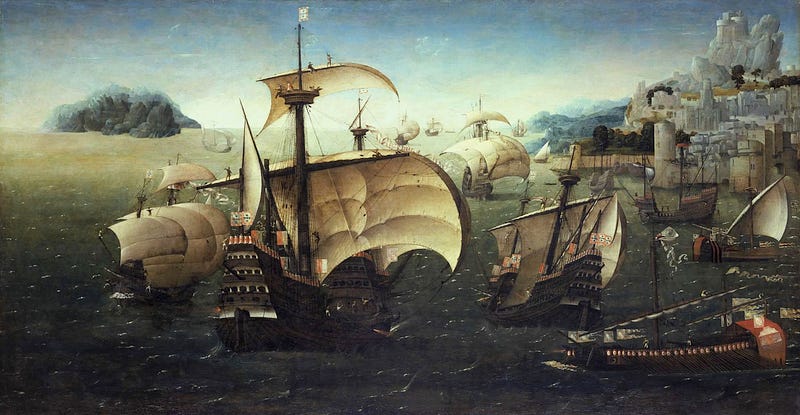
Credit: wikipedia

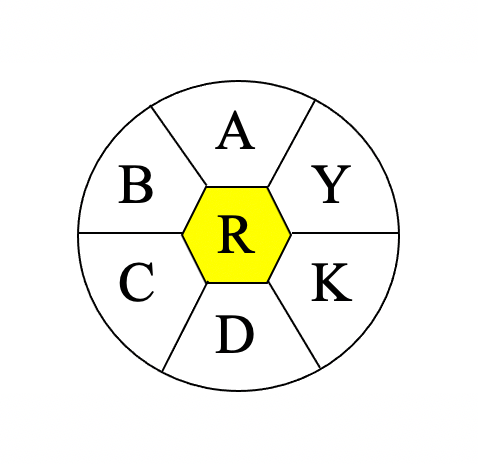
Today’s New York Times Spelling Bee letters:
Art: Iva Reztok

A, B, C, D, K, Y, and center R (all words must include R).

Merriam-Webster says…

Credit: merriam-webster.com

Silly little dictionary! Don’t you know carrack can’t possibly be a word if the New York Times says it ain’t?

For further fascinating facts, check out the Spelling Bee Master.

What’s your favorite dord* from today’s puzzle?

My Two Cents

A car rack, also known as a roof rack, is a bar or pair of bars you fix on top of your sedan or family van in order to carry large items like bulky luggage, bicycles, or kayaks. Also, perhaps a car rack is what a sexy vehicle shows off in the porno version of Cars.

I found one source indicating carrack comes from the Italian caracca, but Merriam-Webster insists its origins hark back to the Middle English carryk or carrake, themselves from Middle French caraque, from Old Spanish carraca, from Arabic qarāqīr, plural of qurqūr , meaning “merchant vessel”.

So there is some commonality between the Italian and Spanish words, although its likely they both

Now’s the time for naos

Carracks were sailing ships that trended in the 14th and 15th centuries, when Spanish and Portuguese were the two biggest world powers. These two countries, as well as other nations of Europe, used the carracks as transportation for trading between them and Western Asia, Africa, and the Americas.

Although the word carraca exists in both Spanish and Portuguese in reference to these ships, they are more commonly called nao/carabela and nau/caravela, respectively.

The three-to-four-masted carrack was developed from the single-masted cog, a much smaller ship that had been the previous standard for maritime transportation and trade. The carracks would later be replaced by the even-larger galleons, which stayed in use until the early 19th century.
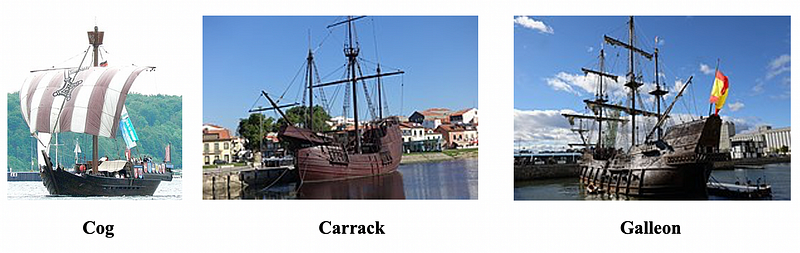
Screenshot collage: Iva Reztok

The above photos are of replicas, of course. But they give you an idea of comparative size.

One important improvement of the carrack over the cog was the planking construction used in the hull. Cogs were clinker-built, meaning the planks overlapped at the edges. This made the hull lighter and less rigid, which limited size and, therefore, cargo volume. Carvel-built sailboats were heavier, but they could eclipse clinker-built boats in size and accommodate more masts.
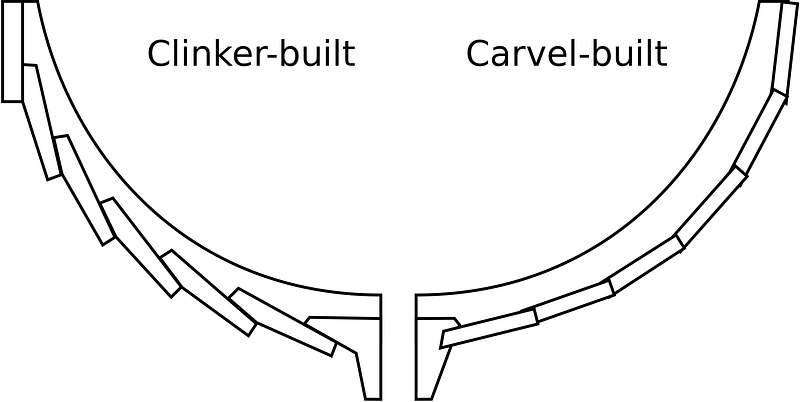
Credit: Willhig, wikipedia.com

Famous carracks include:

▹ Christopher Columbus’s Santa María, one of the three ships that he used for his first voyage to the Americas in 1492.

▹ Ferdinand Magellan’s Victoria, one of the five ships — and the only one to survive — of his historic circumnavigation of the world between 1519 and 1522.

▹ Giovanni da Verrazzano’s La Dauphine, the ship he used while exploring the Atlantic coast of North American in 1524.

▹ Henry V’s flagship Grace Dieu, one of the largest carracks of its time (early 15th century).

▹ The Cinco Chagas (literally, “five wounds”), a Portuguese nau believed to have contained treasures with the equivalent of $17–21 billion in 2021 dollars.

In the mid-16th century, Portugal began trading directly with Japan, sending their carracks to the Asian island nation. The Japanese were apparently fascinated by these ships, dubbing them kurofone (black ships) because of the color of their hulls. There are many depictions of these ships on silk screens from that period.

There is a lengthy thesis written by Kotaru Yamafune about this subject:

Story of a replica

The images I found while researching today’s word made me feel nostalgic for the carrack in my life when I was a child.

No, I didn’t grow up on a ship in the 16th century. I’m old, but not that old.

In the neighborhood where I grew up in Caracas, Venezuela, there was a beautiful, lush park walking distance from my building. It was about 64 hectares in area, or about a fifth of New York’s Central Park and a bit less than half the size of London’s Hyde Park.

It had trails for running and biking, and basketball, and five-a-side football courts. It had a lot of animals spread around: otters, monkeys, birds, reptiles. It also had a small lake; you could rent pedal/paddle boats to futz around the water.

The park’s name changed over the course of the last 60 years. It was originally christened as Parque Rómulo Gallegos, then renamed Parque Rómulo Betancourt in 1983. In 2002 its name was changed once again, to Parque Francisco de Miranda. But it was always informally called “Parque del Este” because it was located in the eastern part of the city.

The lake I mentioned had a replica of Columbus’s carrack, the Santa María. Of the three ships that arrived in the Americas, this was the one that didn’t make it back, getting shipwrecked in the Dominican Republic. The replica was built in Barcelona, Spain, with the exact proportions and measurements of the original ship.

It was bought by the Venezuelan Development Corporation and shipped by sea to the port of La Guaira in 1967.
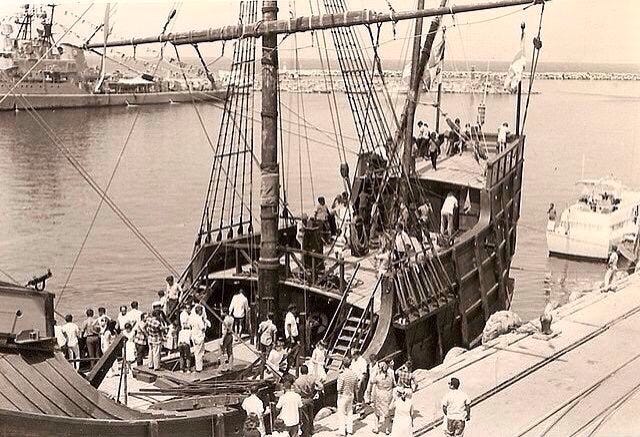
The Santa María replica arriving in Venezuela

The Santa María ended up at Parque del Este and was opened as an exhibit in 1971. I remember going on board with my family and on school field trips. You could walk around the ship and even enter Columbus’s quarters. There were life-size figures of the explorer and his crew, as well as weapons, shields, clothing, navigational instruments, a stove and utensils, and dioramas depicting the journey from Spain to the “New World”.
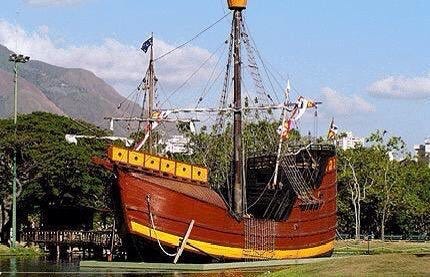
The Santa María replica during its glory days in Parque del Este

Even as a kid, I got a really good sense of just how small the ship was, and how rough the voyage across the Atlantic must have been.

As many things in Venezuela did, the Santa María fell into disrepair over the years and closed for a while. Later it was restored and reopened. In the early 2000s, under Hugo Chavez’s regime, the ship again was left untended. In 2008 the government decided to dismantle the Santa María and replace it with the Leander, the ship used by Francisco de Miranda when he arrived in Venezuela in 1806.

Miranda was a Venezuelan military leader and revolutionary regarded as a forerunner of eventual liberator Simón Bolívar. During that ill-fated 1806 military expedition to liberate Venezuela from Spanish rule, he raised the first version of the Venezuelan flag, which he had designed himself.

The Leander was named for Miranda’s son, and it was one of the three ships he packed with soldiers and weapons to fight the Spaniards. Things did not go well at all: the other two ships were captured and sixty men were imprisoned, ten of which were hanged and quartered.

Miranda himself eventually ended up being arrested and imprisoned in Spain, where he died near Cádiz in 1816.

So, in 2008, in order to honor Miranda’s efforts, Hugo Chávez decided the best course of action was to tear down the Santa María — which represented the colonialist past and the crimes committed by Columbus and the explorers who arrived after he did — and replace it with a replica of the Leander.
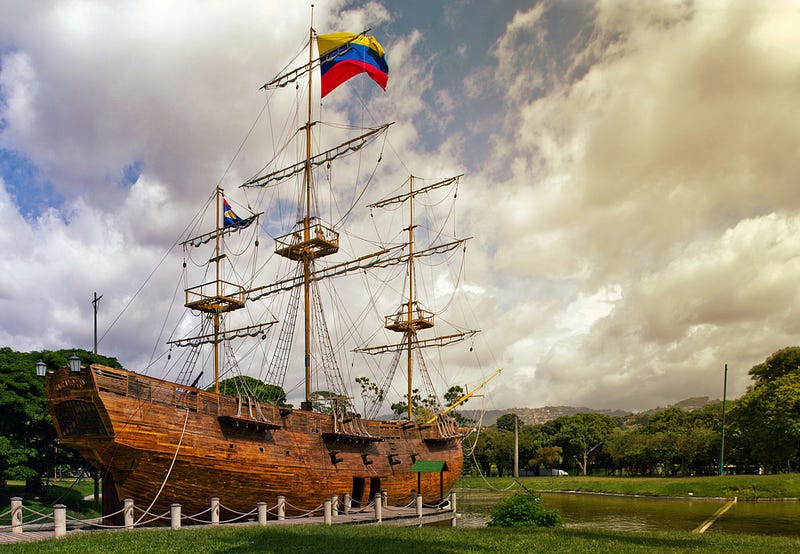
The Leander with Miranda’s version of the Venezuelan flag

Now, it’s not like I’m a big fan of Columbus. But it doesn’t make sense to me to have erased history that way. It would have been interesting, for example, to have both ships displayed. The Santa María would represent the beginning of the Spanish conquest and all the horrible consequences that brought (especially for indigenous and African peoples). The Leander would stand for the beginning of the liberation process undertaken by Venezuelans more than 200 years ago.

That would be quite a stark, graphic contrast. It could be used to educate visitors and serve as a reminder that things can and do change. Instead, we have an Orwellian erasure of the past. To quote George Santayana, “Those who cannot remember the past are condemned to repeat it.”

And speaking of the past and forgetting, it seems the New York Times is set on doing just that. We shouldn’t be talking about carracks at all, you see, because the editors of the Spelling Bee puzzle have determined that the word carrack is a dord.*

You can check out my previous entry on another dord* here:

*What the heck is a dord, you ask? Here’s the answer:

Spelling Bee
Language
History
New York Times
Culture
Recommended from ReadMedium