
WWII-The GI Bill -From Normandy Trenches To School Benches
The postwar US Army universities in Europe, created to “provide a transition between army life and education - and to help veterans regain mental flexibility”.
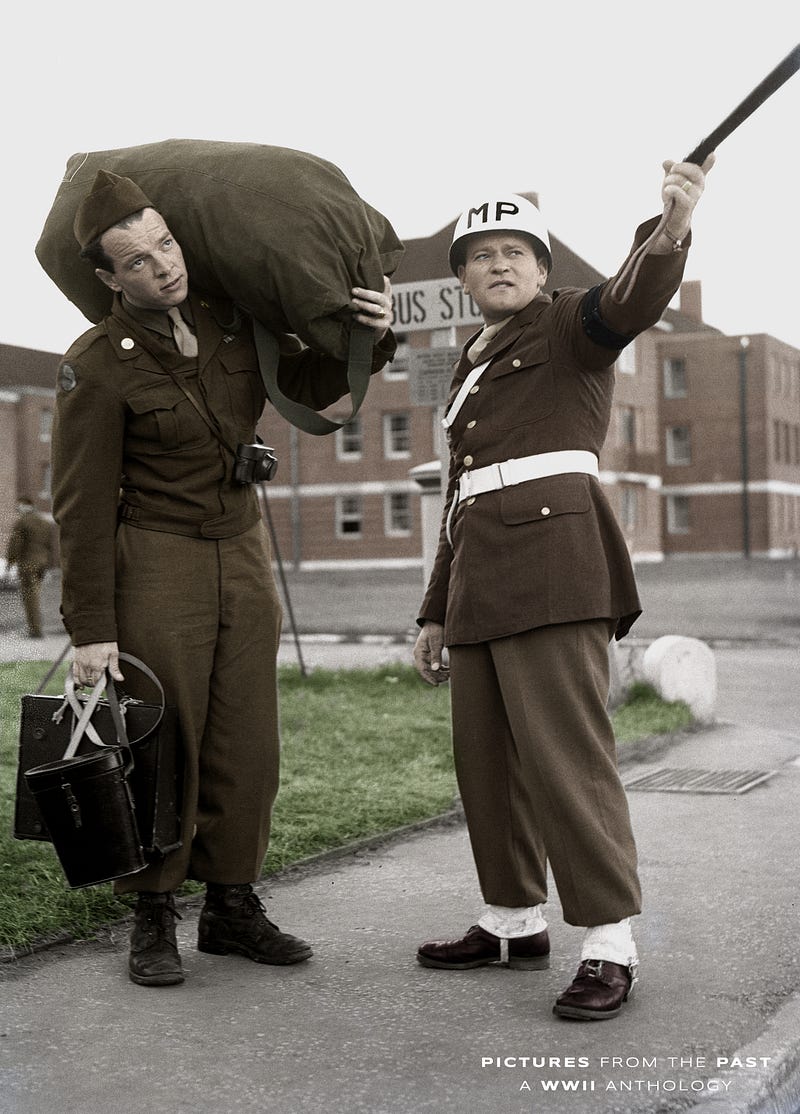
On VE-day, 8th of May 1945, Germany unconditionally surrendered to the Allied armed forces, officially ending WWII in the European Theatre.
More than 2.5 million US soldiers, whose sole purpose for years had been to win the war, had now in fact won the war. Standing at the finish line — many were wondering what to do next.
Introduction
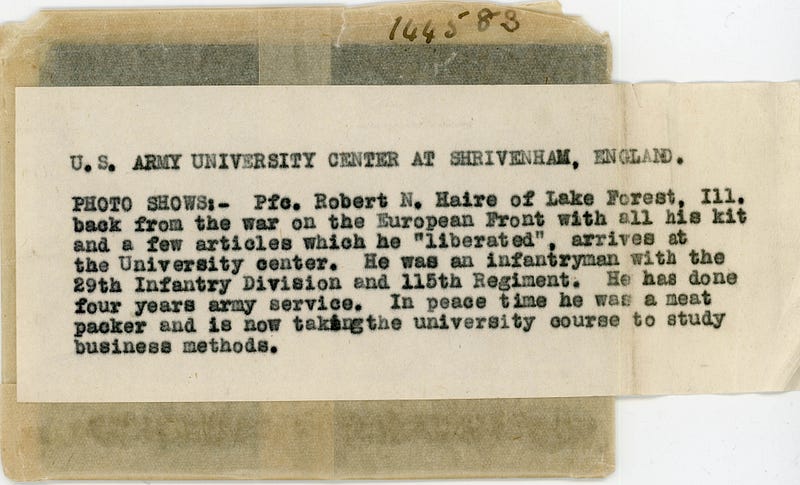
PFC Robert N. Haire (pictured above), would, like many others, have found himself waking up from a 4-year rite of passage in a foreign land. A new world, very unlike the one he had left behind 4 years earlier, and in many ways, a very different man than he was before the war…
Twelve weeks later, three American-style universities were opened in Europe. The army was bringing education to the G.I.s.
The first G.I. university was created in Florence, Italy, the second one in Biarritz, France, and the third one in Shrivenham, England. It became, what was really the precursor to, the G.I. Bill.
The Servicemen’s Act
On June 22nd, 1944 the Servicemen’s Readjustment Act was passed. While the American Legion was pushing to help veterans from all wars, President Roosevelt was trying to focus on a program that would help all poor and less fortunate, regardless of their military service. The outcome, despite his efforts, still became a bill that favored the men in service. It allowed benefits for any veteran who had served on active duty for a minimum of 90 days during the war.
The benefits provided that the soldier had been honorably discharged, included areas such as education, vocational training, and guaranteed low-cost mortgages. It covered living expenses and tuition associated with enrollment in high school, low-interest loans for business start-ups, and unemployment payment for up to a year.
PFC. Robert N. Haire
Robert N. Haire (pictured in the photo above) worked as a meat packer before the war started and had been with the 29th Infantry Division, 155th Regiment through D-Day, Battle for Brest, and Operation Cobra, until the very end of the campaign.
He now had the opportunity, through the G.I. Bill, to get an education, improve himself, and better his chances for the future. From having dodged bullets and dug trenches only weeks prior, he would exchange guns with school books and foxholes with comfy cushions along with three square meals a day.
The Army Universities
The purpose of these American-style campuses was to, “… provide a transition between army life and subsequent attendance at a university in the USA”. A kind of halfway house of rehabilitation, “to regain mental flexibility” and to reintroduce the soldiers into the ways of civil life.
This was an intermission for soldiers, either on their way back to the States or (if you did not have enough points in “The Adjusted Service Rating Score System”), a welcome break before redeployment to the Pacific Theatre. Students, therefore, attended for one term only. The only requirement was a High School Diploma and enlisted men were given preference (only 10% enrolled were officers).
In Shrivenham, England the previous army camp was made into a university. It was functional for 2 terms only, until December 1945. During that period an estimated 8000 students had attended, distributed out with roughly 4000 each term.
Structure and Discipline
While it was a school, it was still created on military grounds, and military discipline continued in many ways. Reveille was sounded every morning and while the G.I.s had nice warm beds, clean sheets, good food, a beer tavern, and American Football - you could still be court-martialed for skipping classes.
Three hundred different courses were available in 8 main fields, and 130 civilian professors along with 100 Army officers were hired and given leave to teach.
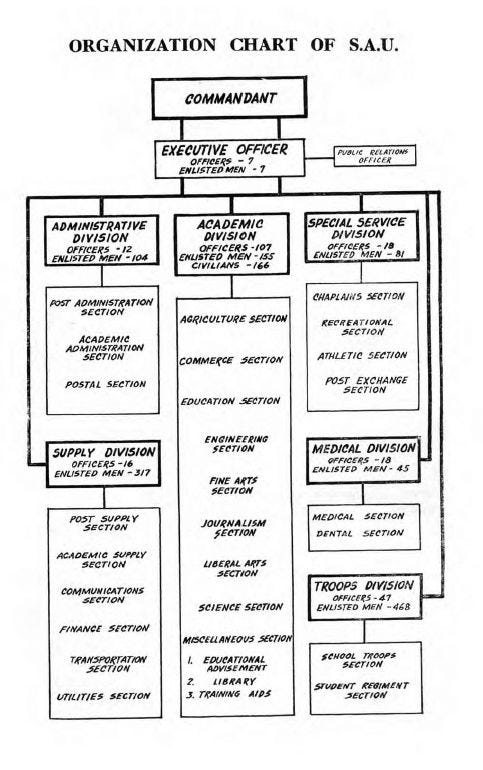
As is quite clear from the Organization Chart of S.A.U., it bears a distinct resemblance to the methodical and hierarchical ways of the military.
The Daily Life
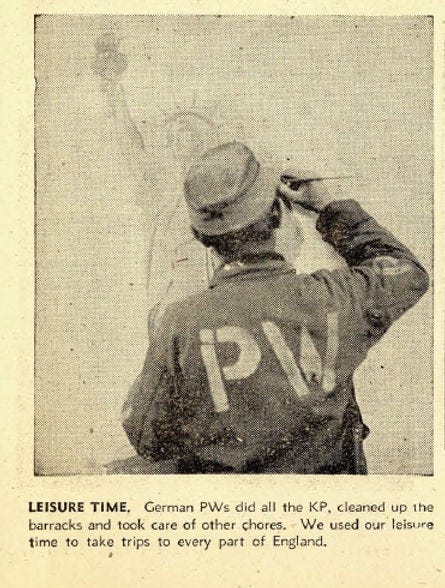
Most of the grunt work, associated with the daily running, cooking, and maintenance work on the premises was done by German POWs. The heroes studied while the defeated did the hard labor.
Oxford University also contributed with the allowed use of the Bodleian Library (by professors only though), and even a local postman generously donated 1000 volumes for the institution.
The open and informal teaching style created a lot of excitement and interest within the British, more formal and intellectual environment, and brought many visiting academics and dignitaries on-site to observe.
It’s, perhaps, worth mentioning a couple of initiatives: a journalism course, which was the only one on British soil, at the time, and the first student radio show in Britain. It was, actually, 15 years prior to “Hertfordshire’s Crush Radio”, which is normally regarded as the first student broadcaster in Britain.
Also, a ”state-of-the-art language laboratory” with phonographs and lots of records was made available on campus for nearly 15 hours every day. As a student, you were allowed to take 3 courses. Midterms and final exams were given and a no-pass got you booted back to your unit.
Shrivenham is located in the middle of the Shakespearean, pastoral heart country of Oxford. That gave the students immense opportunities to visit a multitude of historical and cultural sites and cities, never normally afforded to “Regular Joe’s”. Special trains and buses were there to ensure that they made good of all the offerings available.
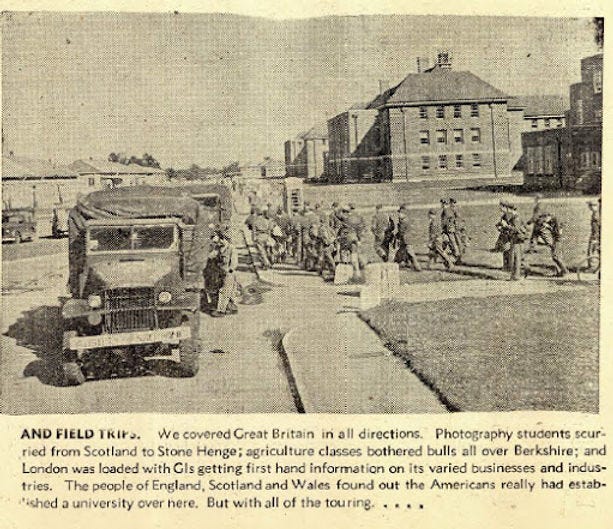
Many more offerings were made available at the university, some more popular than others. As the photo below states:
“Studies like these helped to keep a man’s mind off.. .a cold occupation winter in Germany”.
Or it could, also, be due to the fact that during the 2 terms at Shrivenham, a young girl by the name of Diana Fluck modeled for the art classes. She was later to be known as none other than, Diana Dors.
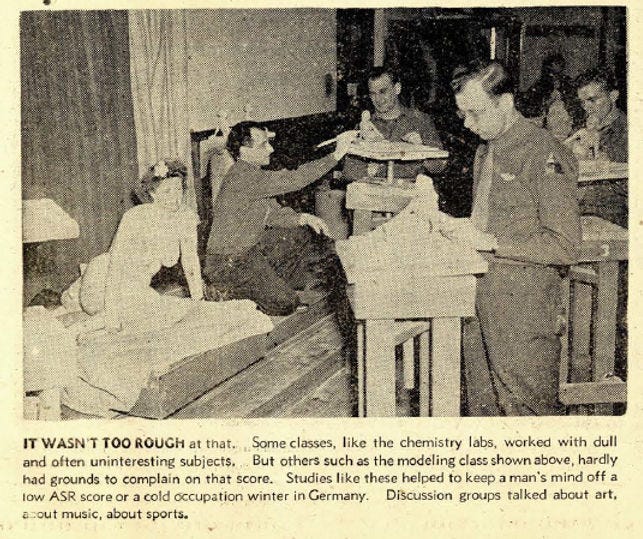
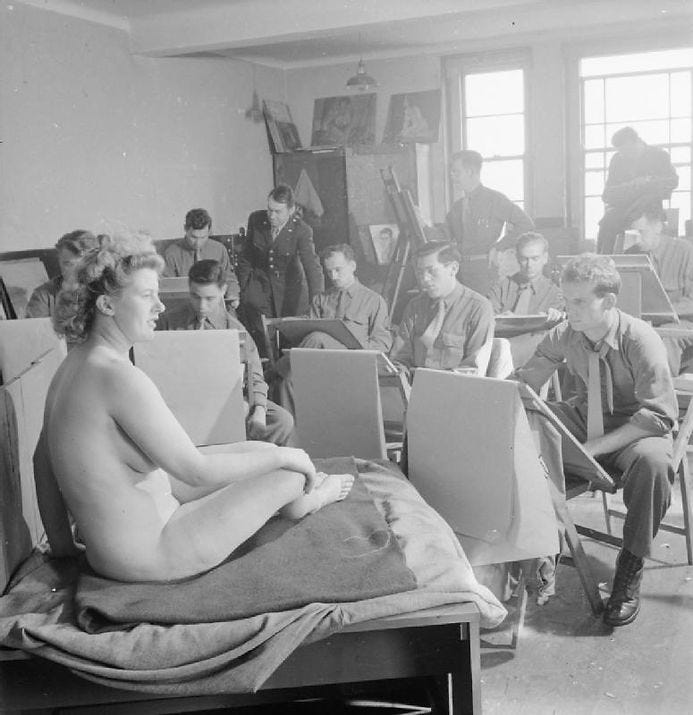
Many of the photos above are from the campus’ own “Shrivenham Post” Dec. 5th, 1945 edition and illustrate the high quality of competence in education and execution.
Success
Despite the initial less-than-optimistic forecast of this relatively short and unique educational experiment, most students, against popular belief, passed their courses with top marks. The British political magazine “New Statesman”, implored the S.A.U. to continue. They lobbied for the development of an equivalent British institution at the time. Although, sadly nothing ever came of this.
Twelve years later, nearly 8 million vets had benefited from the G.I. Bill, which was praised for its significant contribution to raising the “US stock of human capital and encouraging economic growth”.
Criticism
The G.I. Bill was however also criticized widely for its racial discrimination in its invariable accommodation of Jim Crow laws. As Pulitzer-Prize-winning author Colson Whitehead writes very poignantly in his 2019 novel, The Nickel Boys:
“He loved the Army, and even received a commendation for a letter he wrote to his captain about inequities in the treatment of colored soldiers...but then he came home to find that not even the G.I. Bill could override an intractable reality: …‘What was the point of a no-interest loan when a white bank won’t let you step inside?’… Bitter, angry and living in a town where ‘white boys’ were prone to ‘lynching black men in uniform’…”
While the G.I. Bill was a fantastic opportunity at its inception, at least for some, the historian Ira Katznelson described it as merely “an affirmative action for whites”. A bill that actually ended up increasing the already existing racial wealth and social imbalance. By comparison, 67,000 mortgages were insured by the bill, in the New York area alone, but less than 100 of these were given to non-whites.
At the time of writing, the “Black Lives Matter” movement (and the need for it), sadly, only shows too well that the struggle is ever there. The inequalities that have existed between races for centuries are still ingrained within the very roots of “modern” society. It was there long before, it was there then, and it is still here today. This is particularly and tragically ironic when we look at some of the fundamental reasons for what caused the outbreak of WWII in the first place.
War Booty
When mentioning the imbalance of wealth, it’s an interesting sidenote to mention the other obvious focal point of the initial photo of the article and the accompanying text. PFC Haire…“with all his kit and a few articles which he ‘liberated’…”
In whatever way our man PFC Haire came about his “liberated” possessions, it was technically legal for American soldiers to ‘take/acquire’ souvenirs. At the time, this was a grey zone, like many other areas during the war years.
The acquisition of “War Booty” by American G.I.s was a common occurrence during the campaign in European allied countries. However, once the Siegfried Line was broken and US soldiers stood on German ground, the unwritten code of conduct and behavior changed dramatically.
Anyone who has seen HBO’s award-winning show “Band of Brothers”, will recall the maniacal looting frenzy performed by the infamous Captain Ronald Speirs.
As Seth A. Givens writes in the introduction of his thesis, “Bringing Back Memories: GIs, Souvenir Hunting, and Looting in Germany, 1945”:
“Not only was there souvenir hunting on the battlefield — taking pistols, helmets, and flags from German soldiers — but also widespread looting of civilian homes. Servicemen justified their actions by claiming wartime necessity, opportunities for profit, keepsakes, and revenge for Nazi atrocities”.
Conclusion
In spite of the clear criticism, the program was a roaring success and provided a multitude of young, battle-torn soldiers a very welcome respite. A chance to acclimatize and re-enter society again through the introduction of higher education and cultural offers.
Since then Congress has approved a number of expansions to the benefits within the G.I. Bill, ensuring that proper help is given to assist American military veterans.
This article was originally published on my own website PICTURESFROMTHEPAST.NET. I was subsequently contacted by the US Mesothelioma Veterans, who have endorsed the article and I would like to give them a mention.
If you liked this article, take a minute to support the US Mesothelioma Veterans at https://www.mesotheliomaveterans.org/
About MVC:
The Mesothelioma Veterans Center team is made up of proud veterans, military family members, experienced VA-accredited attorneys, and caring patient advocates.
We founded the Mesothelioma Veterans Center in 2015 with one goal in mind: To serve veterans affected by mesothelioma and other asbestos-related diseases.
Asbestos exposure is the only known cause of mesothelioma, a deadly cancer that forms in the lining of the lungs, abdomen, or other organs.
Veterans ran a higher risk of exposure since the U.S. military relied on asbestos between the 1930s and early 1980s. The dangers of asbestos were hidden from the military by the makers of asbestos-based products during this time.
Our team has seen the devastating effects that mesothelioma and other asbestos-related diseases have on veterans and their loved ones. We are committed to arming veterans with the knowledge that will help them take back control of their health and life.
Members of our veterans support team are available 24/7 to answer any questions you have and help you get VA benefits, medical treatment, and financial compensation.


